Indian silverbill
Euodice malabarica
Avilumen editorial team ·

The Indian silverbill or white-throated munia is a small passerine bird found in the Indian subcontinent and adjoining regions that was formerly considered to include the closely related African silverbill. This estrildid finch is a common resident breeding bird in the drier regions of the Middle East and the Indian subcontinent.
The Indian silverbill or white-throated munia (Euodice malabarica) is a small passerine bird found in the Indian subcontinent and adjoining regions that was formerly considered to include the closely related African silverbill (Euodice cantans). This estrildid finch is a common resident breeding bird in the drier regions of the Middle East and the Indian subcontinent. It has also been introduced into many other parts of the world and has become established in some areas. They forage in small flocks in grassland and scrub habitats.
Taxonomy
The Indian silverbill was formally described by the Swedish naturalist Carl Linnaeus in 1758 in the tenth edition of his Systema Naturae. He placed the species with the crossbills in the genus Loxia and coined the binomial name Loxia malabarica.
The specific epithet is from the Malabar region on the southwestern coast of India. Linnaeus specified the locality as India but this was restricted to the Malabar region by E. C. Stuart Baker in 1926. The Indian silverbill is now placed with the African silverbill in the genus Euodice that was introduced by Ludwig Reichenbach in 1862. The species is monotypic: no subspecies are recognised.
The Indian and Africa silverbills were formerly placed in the genus Lonchura. A molecular phylogenetic study published in 2020 found that these two silverbills formed a clade that was basal to the members of Lonchura.
Description
The adult Indian silverbill is 11–11.5 cm long and has a conical silver-grey bill, buff-brown upperparts, white underparts, buffy flanks and dark wings. The tail is black and the wings are dark contrasting with a white rump. The sexes are similar, but immatures have buff underparts and a shorter tail. The tail appears pointed as the length of the feathers reduces from the centre outwards. It feeds mainly on seeds, but also takes insects and has been known to visit nectar bearing flowers, such as those of Erythrina trees.
Habitat and distribution
It frequents dry open scrub, fallow land and cultivation, sometimes near water. Although mainly found on the plains, they can be found up to about 1200 m in some sub-Himalayan regions. It occurs in Pakistan, Nepal, Bangladesh, India, Sri Lanka, Iran and Israel. It has been accidentally introduced into many other parts of the world and has established itself in Jordan, Israel, Kuwait, Oman, Puerto Rico, Qatar, Saudi Arabia, Egypt since 2019, United States, Virgin Islands (possibly extinct) and Nice (southern France).
Although largely sedentary, some populations make seasonal movements.
Behaviour and ecology
These birds are gregarious and are found in flocks of as many as 60 birds. They feed on the ground or on low shrubs and grass stalks. They constantly utter a low cheeping or chirping contact call as they forage. They visit water and drink with a rapid sip and swallow action. Their feed on a wide range of grass seeds and will also make use of crop species.
The breeding season is spread out and varies with region. They nest in winter in southern India and after summer in northern India. The nest, an untidy ball of grasses with an opening on the side, is placed in low shrubs, often on thorny Acacia. They are also known to make use of the old nests of baya weaver sometimes even visiting those that are occupied by the weaver birds. They will sometimes build their nest below the platform nests of vultures or storks. Old nests are used as dormitories through the year for roosting. Females are known to lay their eggs in the nests of other pairs. The clutch varies from 4 to 8 white eggs and these are incubated by both parents for about 11 days. Helpers may be involved in breeding as more than a pair are sometimes seen at a nest.
Several parasitic protozoans and coccidia (Sivatoshella lonchurae) have been described from the species.
Text adapted from Wikipedia · CC BY-SA 4.0
Distribution

Taxonomy
- Order
- Passeriformes
- Family
- Estrildidae
- Genus
- Euodice
- Conservation status
- Least concern
Listen to its call
No recording yet
Care guide
Canary and Finch Care Guide: Diet, Housing and Breeding
How to care for canaries, zebra finches, Gouldian finches and other finches: diet, flight cage setup, health, song and breeding. A guide for bird keepers.
Read the guide →Illustration gallery
6 illustrations of Euodice malabarica (Indian silverbill) in different styles, true to its real plumage. Shown watermarked; the art pack includes the high-resolution originals, ready to print.
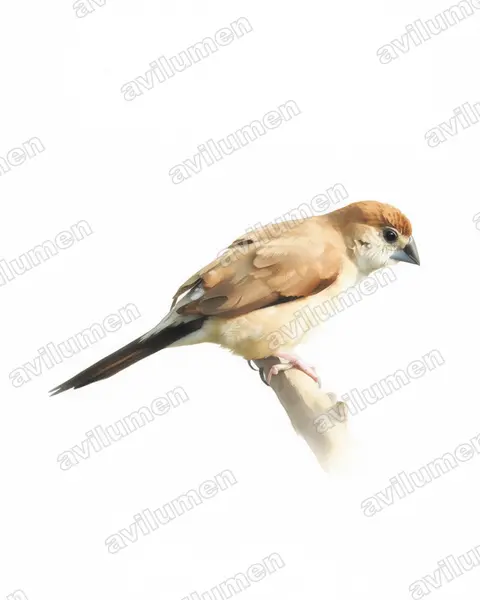
Watercolor 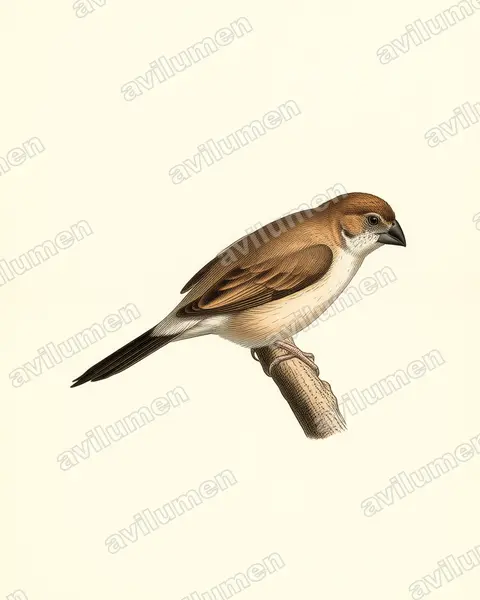
Vintage plate 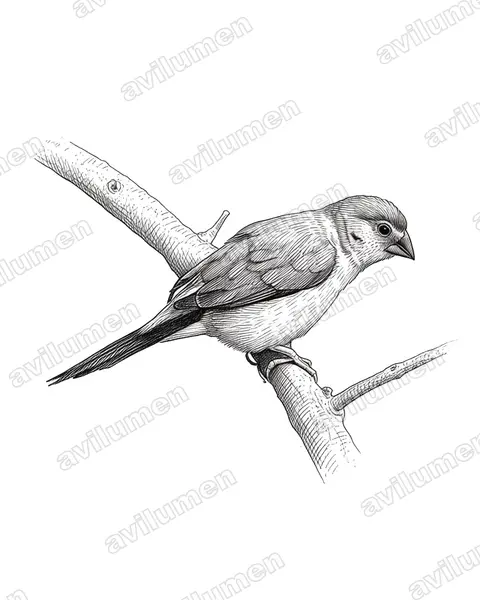
Ink 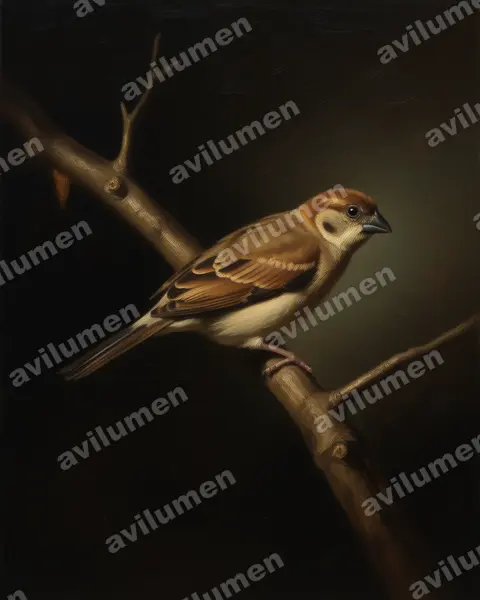
Oil 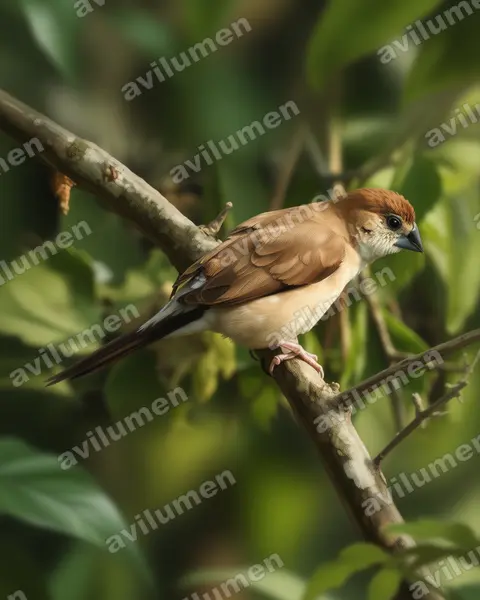
Realistic 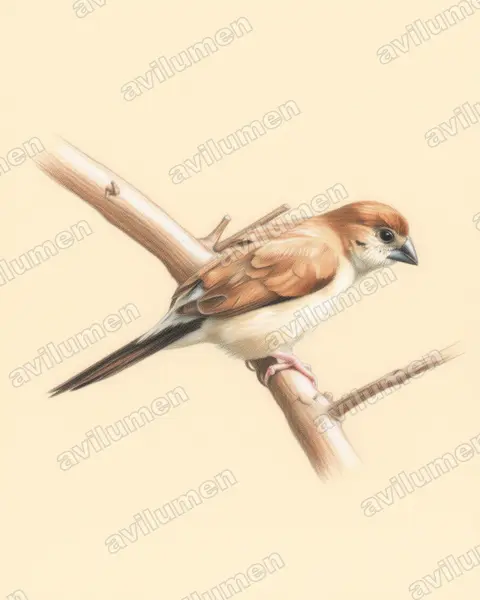
Colored pencil
Illustrations based on the photograph by Dr. Raju Kasambe (CC BY-SA 4.0), from Wikimedia Commons.
Digital editions
HD Digital Art Pack — Indian silverbill
Digital download: 6 high-resolution illustrations of the Indian silverbill (Euodice malabarica), print-ready. This is a digital file; no animal or physical item is included.
AI Avatar — Indian silverbill
Generate an avatar fusing your face with the Indian silverbill (Euodice malabarica). Delivered digitally in 8K, watermark-free. Digital product; no animals are sold or brokered.
Instant download. No live birds are sold.
Frequently asked questions
- Is Euodice malabarica (Indian silverbill) endangered?
- The IUCN Red List places Euodice malabarica, commonly known as the Indian silverbill, in the «Least concern» category. «Least concern» means it is not currently threatened.
- Where does Euodice malabarica (Indian silverbill) live?
- Euodice malabarica (Indian silverbill) is found in Africa.
- What family does Euodice malabarica (Indian silverbill) belong to?
- Euodice malabarica (Indian silverbill) belongs to the family Estrildidae, in the order Passeriformes.
- What colour is Euodice malabarica (Indian silverbill)?
- The plumage of Euodice malabarica (Indian silverbill) combines these colours: Grey and White.
More from the same family
 Least concern
Red-headed finch
Amadina erythrocephala
The red-headed finch is a common species of estrildid finch found in Africa. It has an estimated global extent of occurrence of 1,600,000 km2 (620,000 sq mi). It is found in Angola, Botswana, Lesotho, Namibia, South Africa and Zimbabwe.
from $1.99
 Least concern
Cut-throat finch
Amadina fasciata
The cut-throat finch is a common species of estrildid finch found throughout Africa; it is also known as the bearded finch, the ribbon finch, the cut throat, and the weaver finch.
from $1.99
 Least concern
Red avadavat
Amandava amandava
The red avadavat, red munia or strawberry finch, is a sparrow-sized bird of the family Estrildidae. It is found in the open fields and grasslands of tropical Asia and is popular as a cage bird due to the colourful plumage of the males in their breeding season. It breeds in the Indian subcontinent in the monsoon season.
from $1.99
 Vulnerable
Green avadavat
Amandava formosa
The green avadavat or green munia is a species of Estrildid finch with green and yellow on the body, a bright red bill and black "zebra stripes" on the flanks. They are endemic to the Indian subcontinent and were formerly popular as cagebirds. The name "avadavat" is a corruption of the name the city of Ahmedabad in Gujarat, India, which was a centre of bird trade.
from $1.99