Blue-winged Parrotlet
Forpus xanthopterygius
Avilumen editorial team ·

The cobalt-rumped parrotlet or blue-winged parrotlet is a species of parrot in the family Psittacidae.
The cobalt-rumped parrotlet (Forpus xanthopterygius) or blue-winged parrotlet is a species of parrot in the family Psittacidae.
There are two subspecies: Salvadori's cobalt-rumped parrotlet (F. x. flavescens) and Hellmayr's cobalt-rumped parrotlet (F. x. flavissimus).
Distribution and habitat
Cobalt-rumped parrotlets are found in much of central and northern South America. Their range is split by each subspecies, as described above. It is generally common and widespread, though more localized in the Amazon Basin.
Cobalt-rumped parrotlets are mainly found in lowlands. They occur in dry and riparian woodlands, cerrado, caatinga, palm groves, semi-arid scrubland, savanna, and pastures. Cobalt-rumped parrotlets tend to avoid densely forested areas. They are not found at altitudes above 1,200 metres (3,900 ft).
Cobalt-rumped parrotlets are generally non-migratory; however, populations in Argentina move locally according to the flowering seasons of various plant species in their diet. Populations in the Brazilian Atlantic Forest are altitudinal migrants.
Conservation
The number of cobalt-rumped parrotlets is unknown, but the population is stable. It is listed as Least Concern by the IUCN Red List. The number of wild individuals is unknown.
Threats
The cobalt-rumped parrotlet is not known to be affected by deforestation or the pet trade, unlike many of its close relatives in the genus Forpus. There are many areas across its range that are already protected.
Social
Flocks are usually around 20 birds but can grow to over 50 around fruiting trees or seeding grasses. They are highly social and gregarious. Cobalt-rumped parrotlets tend to feed in groups, usually between 2 and 12 individuals.
Cobalt-rumped parrotlets call while in flight and perched. Their calls are high-pitched "sheet" or "zeet" screeches or twittering. When feeding and socializing in large groups they make twittering and chattering noises.
Reproduction
Cobalt-rumped parrotlets' breeding season is May to August, but occupied nests have been observed in July, January, and March in different areas of the birds' range. Females lay 3-7 small, white, roughly spherical eggs. Some cobalt-rumped parrotlets have been observed to scrape rufous hornero nests (made of clay) with their beaks. Though the reason for this is not entirely clear, nests created by rufous horneros have been used by cobalt-rumped parrotlets to raise their broods, which has led to the suggestion that the parrotlets are "taste-testing" the nest material to determine whether it is suitable, according to unknown standards, for their needs. However, similar studies of other Forpus species have concluded that clay-licking provides important minerals to the birds that otherwise would not be accessible.
Diet
Cobalt-rumped parrotlets mostly feed on Cecropia sp. and Ficus sp. fruits, Mikania sp. and Trema micrantha seeds, and Ambrosia sp., Handroanthus serratifolius, and Marcgravia sp. flowers. However, they are known to occasionally feed on other plants such as grass. Cobalt-rumped parrotlets have been known to migrate locally based on the flowering and fruiting seasons of some of the main plants of their diet.
Taxonomy
For many years, the cobalt-rumped parrotlet was considered conspecific with the green-rumped parrotlet (Forpus passerinus), but today all authorities recognize the two as separate species. The turquoise-winged parrotlet (F. spengeli) and the riparian parrotlet (F. crassirostris) were also considered conspecific with the cobalt-rumped parrotlet until studies in 2015 pointed out the error in this classification based on morphological and geographical differences. However, some taxonomic authorities, including the American Ornithological Society, still consider them so.
The cobalt-rumped parrotlet, at least until 2021, is a rare case in which the common name has been more stable than the binomial. F. xanthopterygius initially referred to what are now considered two distinct species: the cobalt-rumped parrotlet (then referred to as the blue-winged parrotlet) and the white-winged parakeet (Brotogeris versicolurus). In 1945, the Brazilian ornithologist Olivério Pinto discarded the name F. xanthopterygius for the blue-winged parrotlet and renamed it F. crassirostris (which now applies to the closely related riparian parrotlet). During the same year, the blue-winged parrotlet was mistakenly recorded as F. xanthopterygius crassirostris and was again reverted to F. xanthopterygius. In 1978, Pinto mentioned the mistake in Novo Catálogo das Aves do Brazil and the name was changed to F. crassirostris. However, as was pointed out in 1999, the original name (F. xanthopterygius) remains valid per ICZN rules. Consequently, this name was re-applied to the blue-winged parrotlet. In 2021, the species was renamed from blue-winged parrotlet to cobalt-rumped parrotlet by the IOC, marking the first major change to the common name of the species. Additionally, the name of the nominate subspecies also changed: F. x. xanthopterygius is the subspecies formerly listed as F. crassirostris vividus.
Text adapted from Wikipedia · CC BY-SA 4.0
Where it lives
Distribution

Taxonomy
- Order
- Psittaciformes
- Family
- Psittacidae
- Genus
- Forpus
- Conservation status
- Least concern
Listen to its call
No recording yet
Care guide
Budgie, Conure and Parakeet Care Guide
How to care for budgies, conures, parrotlets, ringnecks and other parakeets: diet, cage setup, health, behavior, breeding and legal status for owners.
Read the guide →Illustration gallery
6 illustrations of Forpus xanthopterygius (Blue-winged Parrotlet) in different styles, true to its real plumage. Shown watermarked; the art pack includes the high-resolution originals, ready to print.
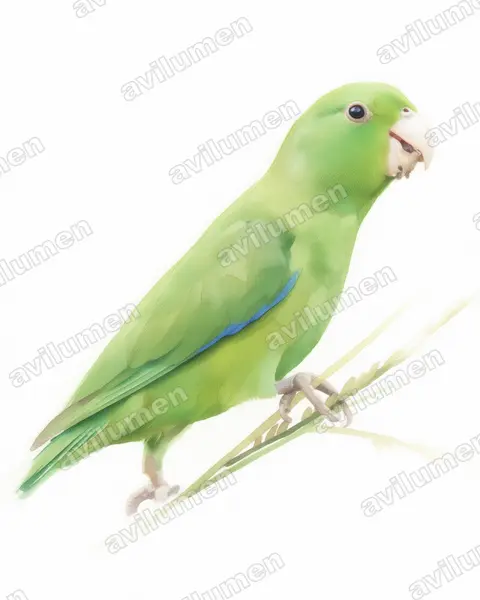
Watercolor 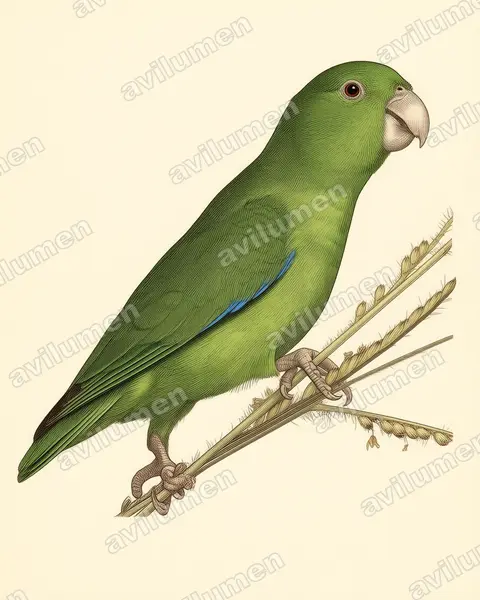
Vintage plate 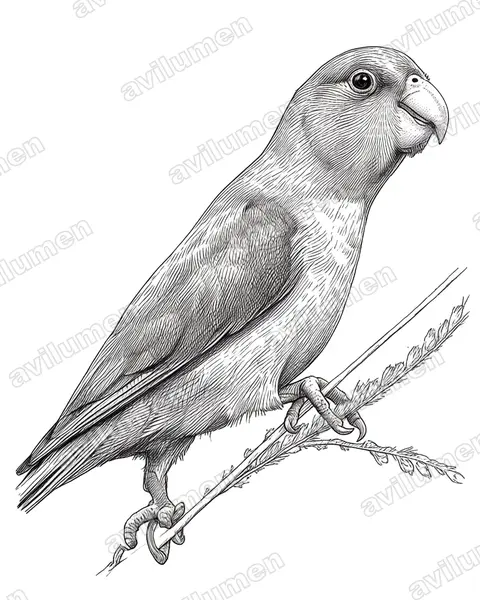
Ink 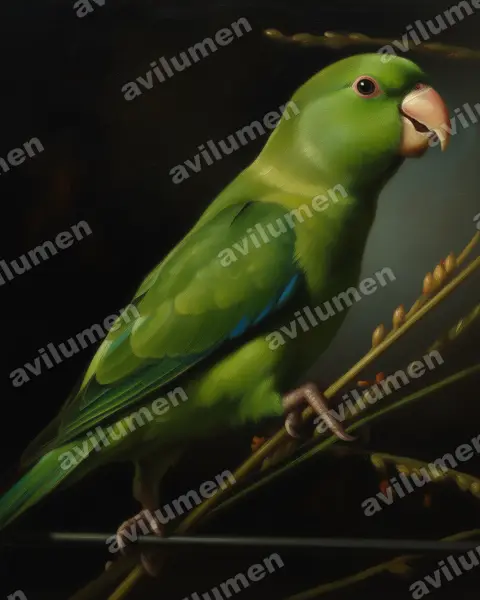
Oil 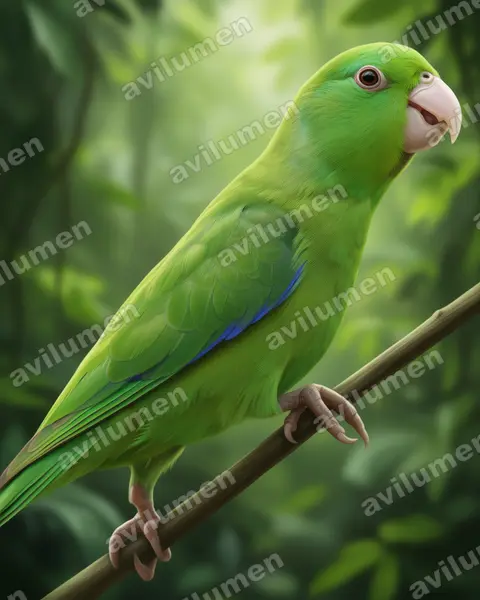
Realistic 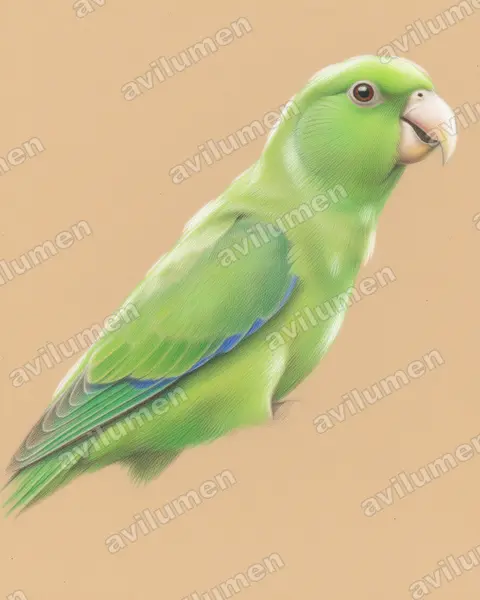
Colored pencil
Illustrations based on the photograph by Wagner Machado Carlos Lemes (CC BY 2.0), from Wikimedia Commons.
Digital editions
HD Digital Art Pack — Blue-winged Parrotlet
Digital download: 6 high-resolution illustrations of the Blue-winged Parrotlet (Forpus xanthopterygius), print-ready. This is a digital file; no animal or physical item is included.
AI Avatar — Blue-winged Parrotlet
Generate an avatar fusing your face with the Blue-winged Parrotlet (Forpus xanthopterygius). Delivered digitally in 8K, watermark-free. Digital product; no animals are sold or brokered.
Instant download. No live birds are sold.
Frequently asked questions
- Is Forpus xanthopterygius (Blue-winged Parrotlet) endangered?
- The IUCN Red List places Forpus xanthopterygius, commonly known as the Blue-winged Parrotlet, in the «Least concern» category. «Least concern» means it is not currently threatened.
- Where does Forpus xanthopterygius (Blue-winged Parrotlet) live?
- Forpus xanthopterygius (Blue-winged Parrotlet) is found in Brazil and South America.
- What family does Forpus xanthopterygius (Blue-winged Parrotlet) belong to?
- Forpus xanthopterygius (Blue-winged Parrotlet) belongs to the family Psittacidae, in the order Psittaciformes.
- What colour is Forpus xanthopterygius (Blue-winged Parrotlet)?
- The plumage of Forpus xanthopterygius (Blue-winged Parrotlet) combines these colours: Blue and Green.
More from the same family
 Near threatened
Yellow-faced Parrot
Alipiopsitta xanthops
The yellow-faced parrot, formerly also known as the yellow-faced amazon, is the only species of the genus Alipiopsitta. It is a Neotropical parrot, and was classified in the genus Amazona for many years. It is a predominantly green and yellow-plumaged bird with a yellow head. It is a semi-nomadic species found in the cerrado region of Brazil and adjacent Bolivia.
from $1.99
 Least concern
Moluccan King Parrot
Alisterus amboinensis
The Moluccan king parrot is a parrot endemic to Peleng Island, Maluku, and West Papua in Indonesia. It is sometimes referred to as the Ambon king parrot or Amboina king parrot, but this is potentially misleading, as it is found on numerous other islands than Ambon. The male and female are similar in appearance, with a predominantly red head and underparts, green wings, and blue back and tail.
from $1.99
 Least concern
Papuan King Parrot
Alisterus chloropterus
The Papuan king parrot, also known as the green-winged king parrot, is a species of parrot in the family Psittaculidae found in New Guinea. Its natural habitats are subtropical or tropical moist lowland forest and subtropical or tropical moist montane forest.
from $1.99
 Least concern
Australian King Parrot
Alisterus scapularis
The Australian king parrot is a species of parrot endemic to eastern Australia ranging from Cooktown in Queensland to Port Campbell in Victoria. Found in humid and heavily forested upland regions of the eastern portion of the continent, including eucalyptus wooded areas in and directly adjacent to subtropical and temperate rainforest. They feed on fruits and seeds gathered from trees or on the ground.
from $1.99