Purple-crowned Lorikeet
Glossopsitta porphyrocephala
Avilumen editorial team ·

The purple-crowned lorikeet, is a lorikeet found in scrub and mallee of southern Australia. It is a small lorikeet distinguished by a purple crown, an orange forehead and ear-coverts, and a light blue chin and chest.
The purple-crowned lorikeet (Psitteuteles porphyrocephalus), (also known as the porphyry-crowned lorikeet, zit parrot, blue-crowned lorikeet, purple-capped lorikeet, lory, cowara, lorikeet, and purple-capped parakeet) is a lorikeet found in scrub and mallee of southern Australia. It is a small lorikeet distinguished by a purple crown, an orange forehead and ear-coverts, and a light blue chin and chest.
Taxonomy
The purple-crowned lorikeet was described by Lionel Dietrichsen in 1837 as Trichoglossus porphyrocephalus. His first description in 1832 used the name Psittacus purpureus, a name preoccupied by a description of another species. The specific epithet derived from the Ancient Greek words porphuros "purple" and kephalē "head". Alternate common names include porphyry-crowned lorikeet, Dietrichsen's lory, and Zit parrot, from its shrill call.
Description
Measuring around 15 cm (6 in) long, the male purple-crowned lorikeet is a small lorikeet with a dark purple crown, a yellow-orange forehead and ear-coverts, deepening to orange lores, and green upperparts, tinted bronze on the mantle and nape. The chin, chest and belly are a conspicuous powder blue, while the thighs and under-tail coverts are yellowish-green. The green tail has some orange-red coloration at the bases of the lateral feathers. The large crimson patches under the wings are visible when the bird is in flight. The small beak is black, the iris brown and the feet grey. The female is similar but has a darker iris, paler ear coverts and lacks the crimson patches. Immature birds are duller and lack the purple crown.
Its call is a high-pitched loud tsit, as well as chattering while eating in treetops. Its call is lower pitched than the little lorikeet but higher than the musk lorikeet.
Distribution and habitat
The purple-crowned lorikeet is found in southwest Western Australia, and in southern South Australia, east from the southern Eyre Peninsula, through the Gawler Ranges and southern Flinders Ranges and across Victoria to East Gippsland. It is also found on Kangaroo Island, but is not found in Tasmania. It is the only native lorikeet found in Western Australia.
Locally nomadic, it is often found in dry sclerophyll forest and town parks and gardens, especially where Eucalyptus trees are flowering.
Behaviour
Generally found in small groups, the species may congregate in larger flocks, and may be in the company of Little- and musk lorikeets. It is a fast, straight flyer and dwells mainly in the forest canopy far above the ground.
Feeding
The lorikeet is a gregarious blossom nomad that often reappears in areas where it has not been seen for some time. Blossoms of various Eucalyptus and Melaleuca species, and the boobialla (Myoporum insulare) are among material consumed.
Breeding
Breeding season is from August to December with one brood laid. The nest is a small unlined hollow in eucalypt, often with a knot-hole entrance. Sometimes the species nests in colonies. A clutch of 2–4 matte white roundish eggs, measuring 20 x 17 mm, is laid. The incubation period is around 17 days.
Aviculture
Captive purple-crowned lorikeets have had a reputation for being short-lived. It is uncommonly seen in captivity outside Australia.
Text adapted from Wikipedia · CC BY-SA 4.0
Distribution

Taxonomy
- Order
- Psittaciformes
- Family
- Psittacidae
- Genus
- Glossopsitta
- Conservation status
- Least concern
Listen to its call
No recording yet
Care guide
Lory and Lorikeet Care Guide: Nectar Diet and Housing
How to care for lories and rainbow lorikeets: nectar and pollen diet, hygiene, cage setup, health, behavior and CITES legal status for lorikeet owners.
Read the guide →Illustration gallery
6 illustrations of Glossopsitta porphyrocephala (Purple-crowned Lorikeet) in different styles, true to its real plumage. Shown watermarked; the art pack includes the high-resolution originals, ready to print.
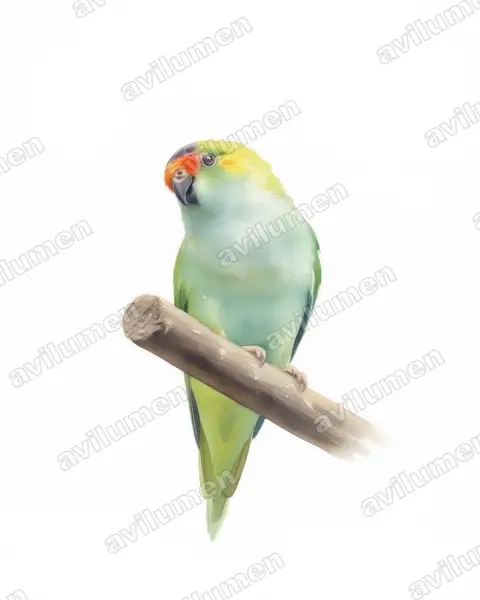
Watercolor 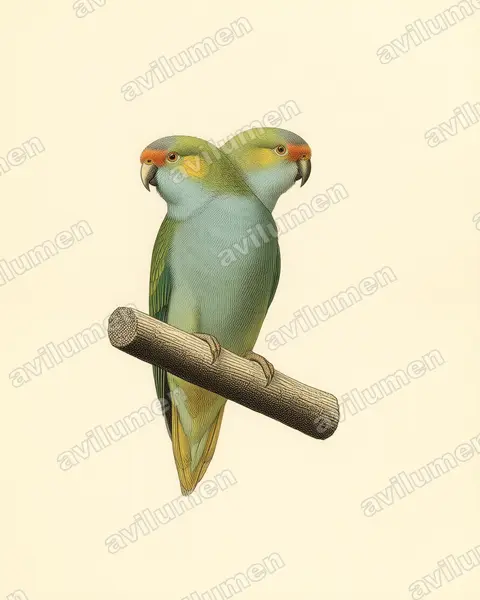
Vintage plate 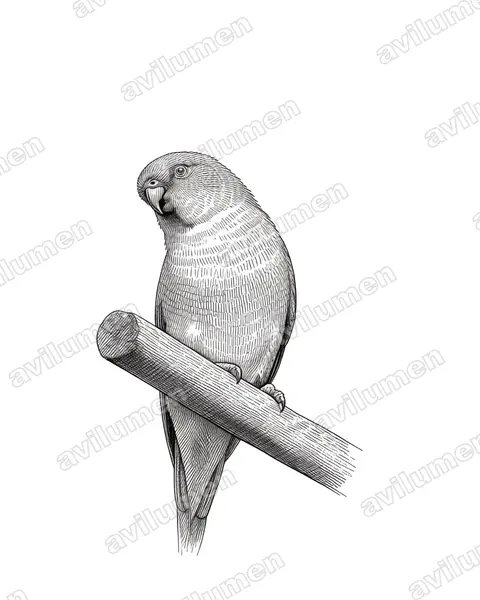
Ink 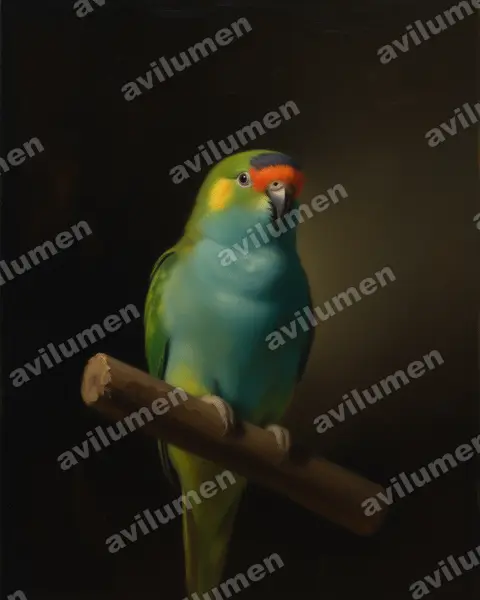
Oil 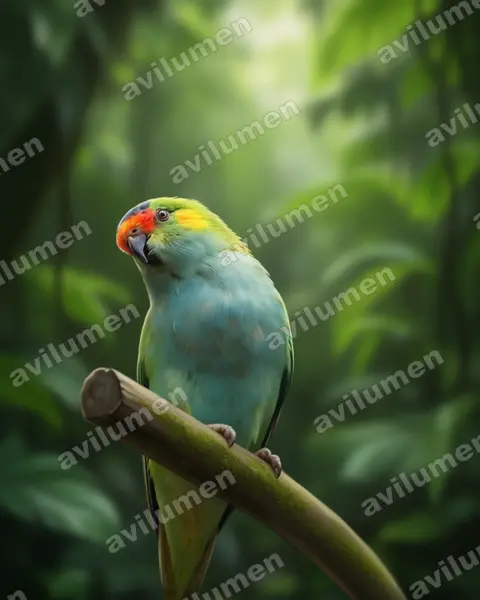
Realistic 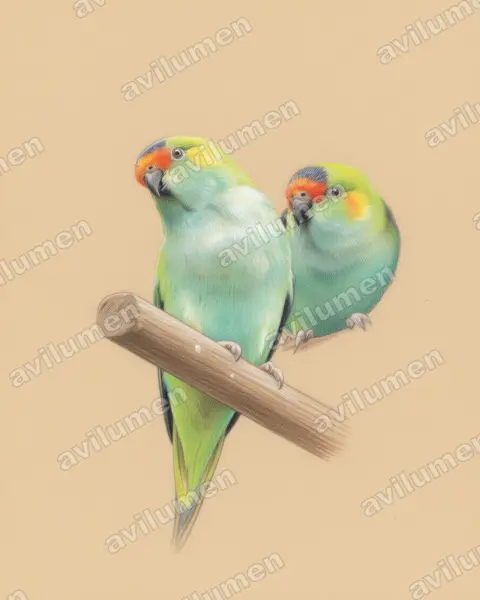
Colored pencil
Illustrations based on the photograph by derivative work: Snowmanradio (talk) Purple-crowned_Lorikeet_(Glossopsitta_porphyrocephala)_-pair_by_nesting_box.jpg: Ruth Ellison (CC BY 2.0), from Wikimedia Commons.
Digital editions
HD Digital Art Pack — Purple-crowned Lorikeet
Digital download: 6 high-resolution illustrations of the Purple-crowned Lorikeet (Glossopsitta porphyrocephala), print-ready. This is a digital file; no animal or physical item is included.
AI Avatar — Purple-crowned Lorikeet
Generate an avatar fusing your face with the Purple-crowned Lorikeet (Glossopsitta porphyrocephala). Delivered digitally in 8K, watermark-free. Digital product; no animals are sold or brokered.
Instant download. No live birds are sold.
Frequently asked questions
- Is Glossopsitta porphyrocephala (Purple-crowned Lorikeet) endangered?
- The IUCN Red List places Glossopsitta porphyrocephala, commonly known as the Purple-crowned Lorikeet, in the «Least concern» category. «Least concern» means it is not currently threatened.
- Where does Glossopsitta porphyrocephala (Purple-crowned Lorikeet) live?
- Glossopsitta porphyrocephala (Purple-crowned Lorikeet) is found in Australia.
- What family does Glossopsitta porphyrocephala (Purple-crowned Lorikeet) belong to?
- Glossopsitta porphyrocephala (Purple-crowned Lorikeet) belongs to the family Psittacidae, in the order Psittaciformes.
- What colour is Glossopsitta porphyrocephala (Purple-crowned Lorikeet)?
- The plumage of Glossopsitta porphyrocephala (Purple-crowned Lorikeet) combines these colours: Green and Pink.
More from the same family
 Near threatened
Yellow-faced Parrot
Alipiopsitta xanthops
The yellow-faced parrot, formerly also known as the yellow-faced amazon, is the only species of the genus Alipiopsitta. It is a Neotropical parrot, and was classified in the genus Amazona for many years. It is a predominantly green and yellow-plumaged bird with a yellow head. It is a semi-nomadic species found in the cerrado region of Brazil and adjacent Bolivia.
from $1.99
 Least concern
Moluccan King Parrot
Alisterus amboinensis
The Moluccan king parrot is a parrot endemic to Peleng Island, Maluku, and West Papua in Indonesia. It is sometimes referred to as the Ambon king parrot or Amboina king parrot, but this is potentially misleading, as it is found on numerous other islands than Ambon. The male and female are similar in appearance, with a predominantly red head and underparts, green wings, and blue back and tail.
from $1.99
 Least concern
Papuan King Parrot
Alisterus chloropterus
The Papuan king parrot, also known as the green-winged king parrot, is a species of parrot in the family Psittaculidae found in New Guinea. Its natural habitats are subtropical or tropical moist lowland forest and subtropical or tropical moist montane forest.
from $1.99
 Least concern
Australian King Parrot
Alisterus scapularis
The Australian king parrot is a species of parrot endemic to eastern Australia ranging from Cooktown in Queensland to Port Campbell in Victoria. Found in humid and heavily forested upland regions of the eastern portion of the continent, including eucalyptus wooded areas in and directly adjacent to subtropical and temperate rainforest. They feed on fruits and seeds gathered from trees or on the ground.
from $1.99