Crimson Fruitcrow
Haematoderus militaris
Avilumen editorial team ·

The crimson fruitcrow is a species of bird in the large family Cotingidae, not a crow. The only member of the genus Haematoderus, it is found in Brazil, French Guiana, Guyana, Suriname, and Venezuela. Its natural habitat is subtropical or tropical moist lowland forests. Because of its large range and population density this species is not classified as vulnerable.
The crimson fruitcrow (Haematoderus militaris) is a species of bird in the large family Cotingidae, not a crow. The only member of the genus Haematoderus, it is found in Brazil, French Guiana, Guyana, Suriname, and Venezuela.
Its natural habitat is subtropical or tropical moist lowland forests. Because of its large range and population density this species is not classified as vulnerable.
Description
The crimson fruitcrow is a large bird about 34 centimetres (13 in) long. The adult male has glossy crimson plumage on head, back and breast, the feathers being long and stiff. A bushy crimson crest is sometimes raised. The wings and tail are dark brown to black, the tail being partly concealed by the long tail-coverts. The female and the immature male have a paler crimson head, throat and underparts, the back, wings and tail being dark brown and the feathers being more flexible. Both sexes have thick, dark red beaks.
Distribution
This species is native to the tropical, lowland rainforests of Guyana, French Guiana and northeastern Brazil. There have been occasional sightings outside its normal range, in west Brazil and east Venezuela. It is an uncommon species and is present in the forest canopy and at the verges of woodland.
Behaviour
Despite its name, this fruitcrow feeds mainly on large insects such as cicadas, beetles and grasshoppers; it supplements this diet with fruit. Its flight is leisurely and looping, and a display flight, involving ascending in a corkscrew fashion followed by a long glide, has been documented. It perches high in the canopy, each bird seeming to have a favoured spot. Although usually silent, this bird can emit a low hoot reminiscent of an owl, and also has a sharp "bok" call.
Status
The crimson fruitcrow is generally rather uncommon and patchy in its distribution, and its population size may be declining slowly. However, it has a very extensive range, and the International Union for Conservation of Nature does not consider it threatened and has assessed its conservation status as being of "least concern".
Text adapted from Wikipedia · CC BY-SA 4.0
Where it lives
Distribution

Taxonomy
- Order
- Passeriformes
- Family
- Cotingidae
- Genus
- Haematoderus
- Conservation status
- Least concern
Listen to its call
No recording yet
Illustration gallery
6 illustrations of Haematoderus militaris (Crimson Fruitcrow) in different styles, true to its real plumage. Shown watermarked; the art pack includes the high-resolution originals, ready to print.
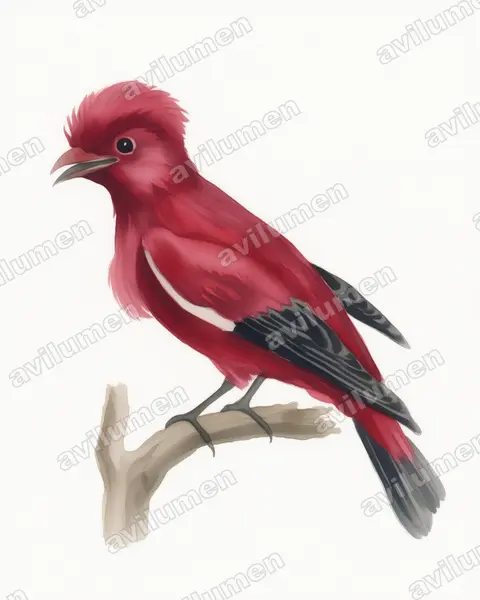
Watercolor 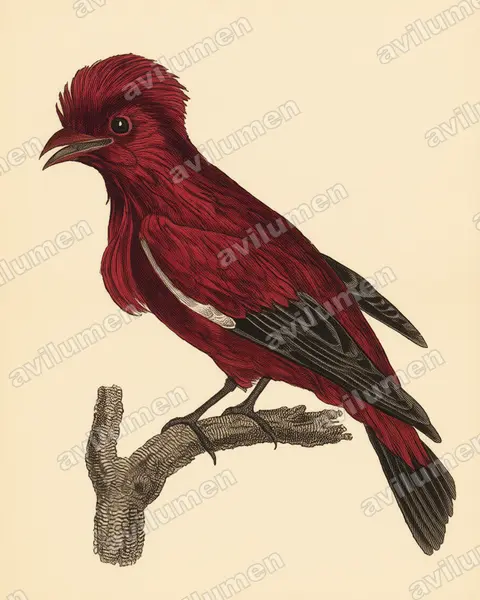
Vintage plate 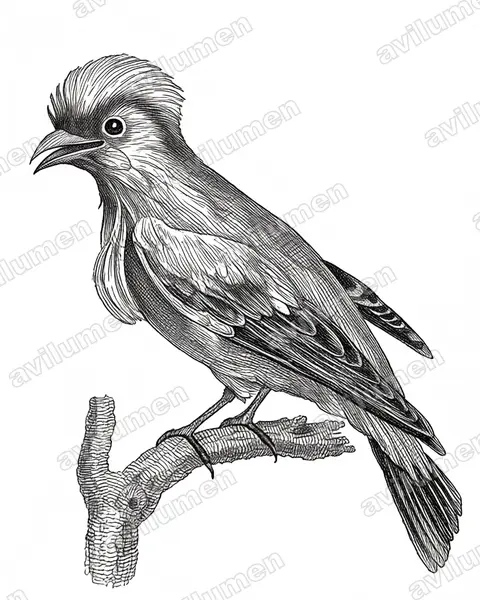
Ink 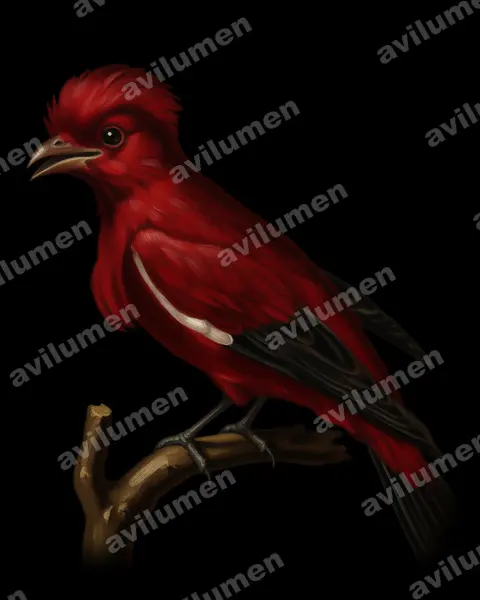
Oil 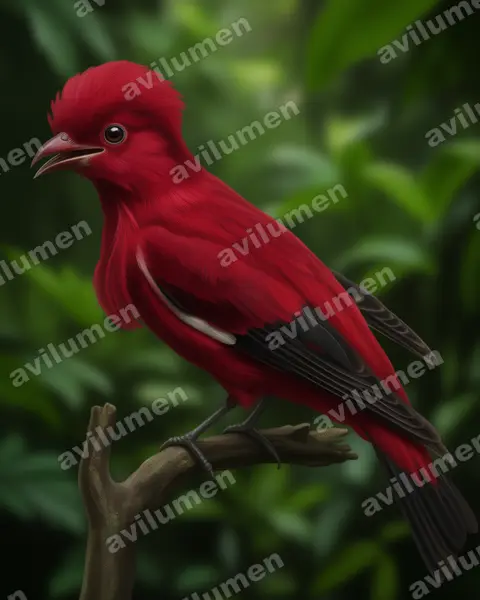
Realistic 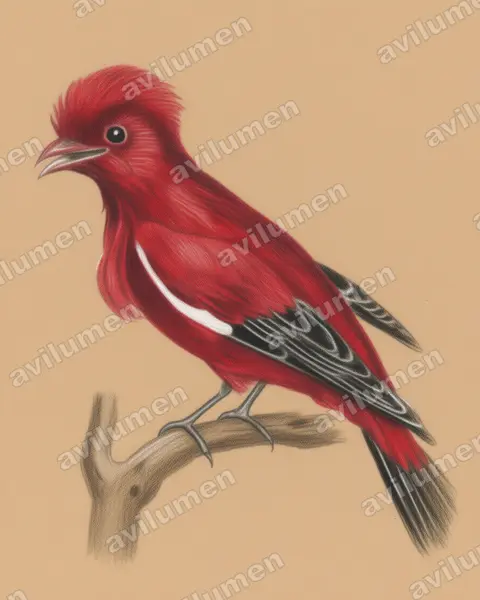
Colored pencil
Illustrations based on the photograph by Unknown authorUnknown author (Public domain), from Wikimedia Commons.
Digital editions
HD Digital Art Pack — Crimson Fruitcrow
Digital download: 6 high-resolution illustrations of the Crimson Fruitcrow (Haematoderus militaris), print-ready. This is a digital file; no animal or physical item is included.
AI Avatar — Crimson Fruitcrow
Generate an avatar fusing your face with the Crimson Fruitcrow (Haematoderus militaris). Delivered digitally in 8K, watermark-free. Digital product; no animals are sold or brokered.
Instant download. No live birds are sold.
Frequently asked questions
- Is Haematoderus militaris (Crimson Fruitcrow) endangered?
- The IUCN Red List places Haematoderus militaris, commonly known as the Crimson Fruitcrow, in the «Least concern» category. «Least concern» means it is not currently threatened.
- Where does Haematoderus militaris (Crimson Fruitcrow) live?
- Haematoderus militaris (Crimson Fruitcrow) is found in Brazil and South America.
- What family does Haematoderus militaris (Crimson Fruitcrow) belong to?
- Haematoderus militaris (Crimson Fruitcrow) belongs to the family Cotingidae, in the order Passeriformes.
- What colour is Haematoderus militaris (Crimson Fruitcrow)?
- The plumage of Haematoderus militaris (Crimson Fruitcrow) combines these colours: Red and Black.
More from the same family
 Least concern
Scaled Fruiteater
Ampelioides tschudii
The scaled fruiteater is a species of bird in the family Cotingidae. It is the only member of the genus Ampelioides. This bird is found in Bolivia, Colombia, Ecuador, Peru, and Venezuela, where its natural habitat is the high elevation tropical forests of the Andes mountains. The scaled fruiteater is a chunky, short-tailed, flat-headed bird measuring 19–20 cm (7.5–7.9 in) in length.
from $1.99
 Least concern
Red-crested Cotinga
Ampelion rubrocristatus
The red-crested cotinga is a species of bird in the family Cotingidae. It is found in Bolivia, Colombia, Ecuador, Peru, and Venezuela.
from $1.99
 Least concern
Chestnut-crested Cotinga
Ampelion rufaxilla
The chestnut-crested cotinga is a species of bird in the family Cotingidae. It is found in Bolivia, Colombia, Ecuador, and Peru.
from $1.99
 Critically endangered
Kinglet Calyptura
Calyptura cristata
The kinglet calyptura is a small Critically Endangered passerine bird in the family Tyrannidae, the tyrant flycatchers. It is endemic to southeastern Brazil.
from $1.99