Golden-plumed Parakeet
Leptosittaca branickii
Avilumen editorial team ·

The golden-plumed parakeet is a Neotropical parrot species within the family Psittacidae, belonging to the monotypic genus Leptosittaca. This somewhat Aratinga-like species is found in humid temperate highland forests, especially with Podocarpus, on the east Andean slope in Colombia, Ecuador, and Peru. It is generally local and uncommon. It is threatened by habitat loss.
The golden-plumed parakeet (Leptosittaca branickii) is a Neotropical parrot species within the family Psittacidae, belonging to the monotypic genus Leptosittaca. This somewhat Aratinga-like species is found in humid temperate highland forests, especially with Podocarpus, on the east Andean slope in Colombia, Ecuador, and Peru. It is generally local and uncommon. It is threatened by habitat loss. Clearing of high-altitude forests for agricultural reasons have greatly impacted the loss of habitat for this parakeet species. Further reduction of such habitats will continue to diminish the number of golden-plumed parakeets left in South America. It is the only known parakeet species that can detect ultraviolet radiation.
Description
The golden-plumed parakeet is a large and long tailed montane parakeet that resides in the Andean cloud forests of Colombia, Peru, and Ecuador. Adults are mostly bright green with orange-yellow lores and small golden yellow crests behind the eyes. Their bellies are a faded yellowish color with reddish orange feathers scattered about. Golden-plumed parakeets have yellowish flight feathers on their underside as well as strongly reddish color feathers on the underside of their tail. Juveniles strongly resemble the adults, but their bellies are a paler green, yellow, and orange color as well as having pale pink bills.
Behavior
Golden-plumed parakeets usually abide in groups of 5-15 and can be seen in groups as large as 35-40 birds. The golden-plumed parakeet likely has a nomadic movement pattern, leaving the nest when the chicks have fledged and returning next breeding season. Also, they are usually on exposed branches and outer crowns of Wax palms and are very active callers. Their call is a shrill sound that is present in flight and while they are perched, and it can be heard all year and more frequently during nesting areas during the breeding season. During copulation, the males and females share the same perch and gradually approach each other. The male slowly mounts the female and they both raise their long tails, rub together their cloacas, and shake their tails literally for 1–2 minutes.
Diet
They depend on wax palms for shelter and are heavily dependent on Podocarpus cones for food. They spend a lot of their time foraging in the Podocarpus trees.
Conservation
Habitat degradation and fragmentation are the two main threats causing a decline in the number of golden-plumed parakeets in Ecuador. There are only about 7,300-20,000 golden-plumed parakeets mature adults left today as a result of fragmentation and habitat loss. There are conversation sites scattered throughout their region to aid their struggle.
Predation
There is evidence of predation of eggs and chicks by Andean weasels from Ecuador. In the first case, the Andean weasel consumed both the one egg in the nest, as well as the adult parakeet; in the second, the weasel consumed two eggs, a two-week-old chick, and the brain of the adult parakeet. The adult's body and skull were left beneath the nest. The occupation of nesting cavities by western honeybees, both a form of competition and predation, has also been noted as a detrimental factor in the nesting success of golden-plumed parakeets in Ecuador. Bees have been known to occupy both empty nests, as well as active nests with golden-plumed parakeet chicks (Williamson 2011).
Text adapted from Wikipedia · CC BY-SA 4.0
Where it lives
Distribution

Taxonomy
- Order
- Psittaciformes
- Family
- Psittacidae
- Genus
- Leptosittaca
- Conservation status
- Least concern
Listen to its call
No recording yet
Care guide
Budgie, Conure and Parakeet Care Guide
How to care for budgies, conures, parrotlets, ringnecks and other parakeets: diet, cage setup, health, behavior, breeding and legal status for owners.
Read the guide →Illustration gallery
6 illustrations of Leptosittaca branickii (Golden-plumed Parakeet) in different styles, true to its real plumage. Shown watermarked; the art pack includes the high-resolution originals, ready to print.
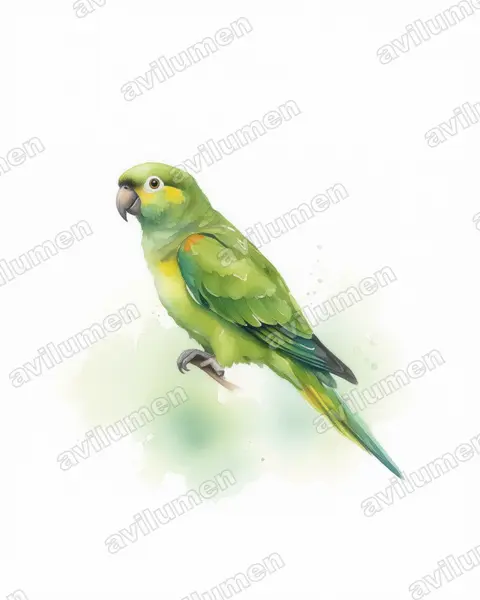
Watercolor 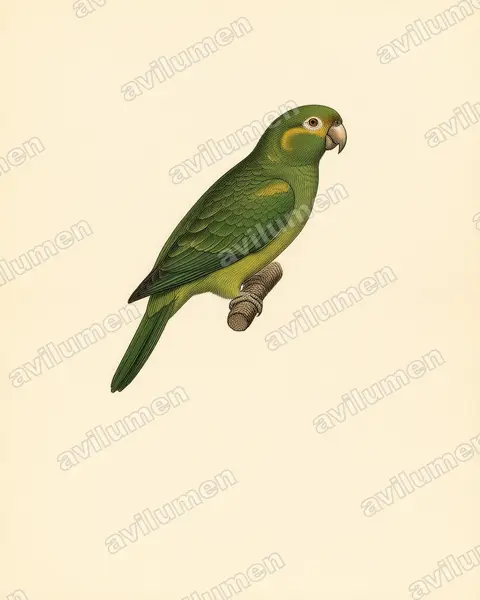
Vintage plate 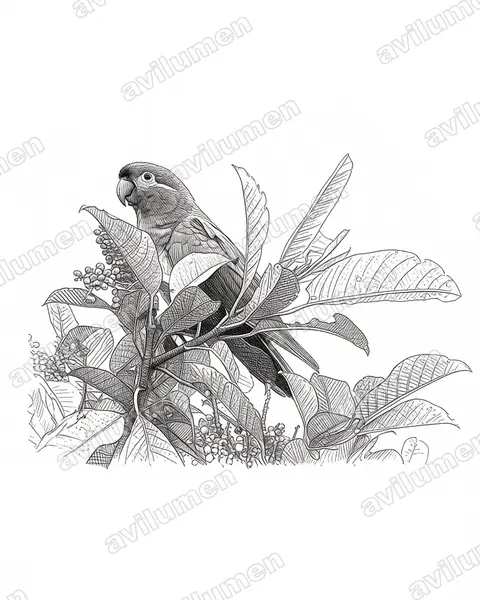
Ink 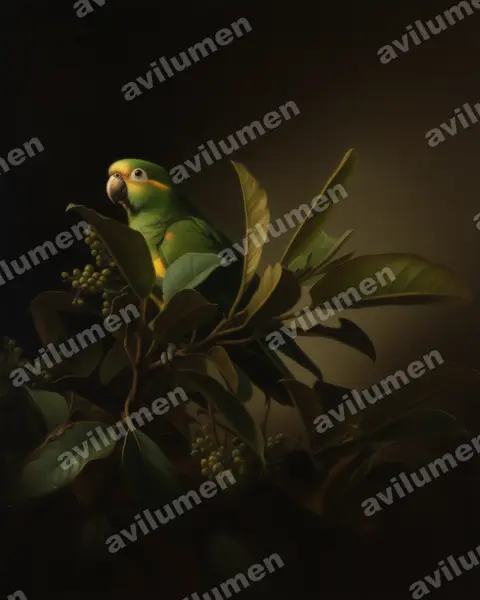
Oil 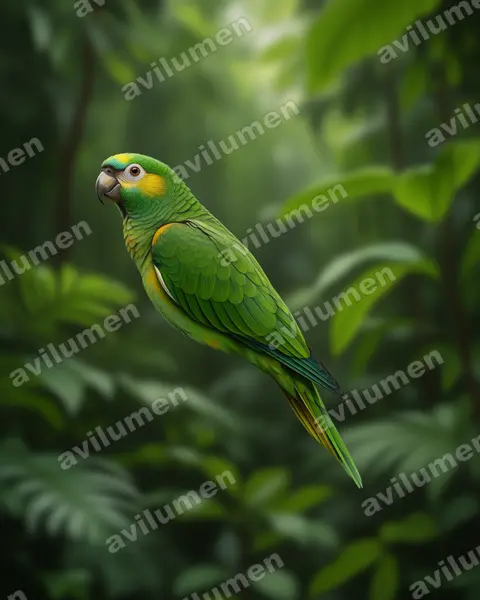
Realistic 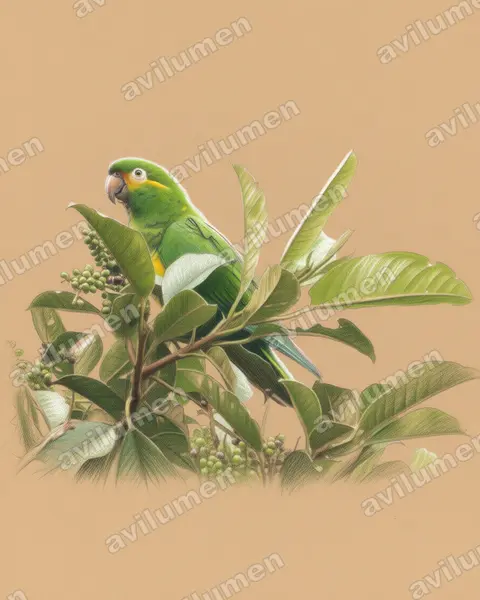
Colored pencil
Illustrations based on the photograph by markaharper1 (CC BY-SA 2.0), from Wikimedia Commons.
Digital editions
HD Digital Art Pack — Golden-plumed Parakeet
Digital download: 6 high-resolution illustrations of the Golden-plumed Parakeet (Leptosittaca branickii), print-ready. This is a digital file; no animal or physical item is included.
AI Avatar — Golden-plumed Parakeet
Generate an avatar fusing your face with the Golden-plumed Parakeet (Leptosittaca branickii). Delivered digitally in 8K, watermark-free. Digital product; no animals are sold or brokered.
Instant download. No live birds are sold.
Frequently asked questions
- Is Leptosittaca branickii (Golden-plumed Parakeet) endangered?
- The IUCN Red List places Leptosittaca branickii, commonly known as the Golden-plumed Parakeet, in the «Least concern» category. «Least concern» means it is not currently threatened.
- Where does Leptosittaca branickii (Golden-plumed Parakeet) live?
- Leptosittaca branickii (Golden-plumed Parakeet) is found in South America.
- What family does Leptosittaca branickii (Golden-plumed Parakeet) belong to?
- Leptosittaca branickii (Golden-plumed Parakeet) belongs to the family Psittacidae, in the order Psittaciformes.
- What colour is Leptosittaca branickii (Golden-plumed Parakeet)?
- The plumage of Leptosittaca branickii (Golden-plumed Parakeet) combines these colours: Yellow and Green.
More from the same family
 Near threatened
Yellow-faced Parrot
Alipiopsitta xanthops
The yellow-faced parrot, formerly also known as the yellow-faced amazon, is the only species of the genus Alipiopsitta. It is a Neotropical parrot, and was classified in the genus Amazona for many years. It is a predominantly green and yellow-plumaged bird with a yellow head. It is a semi-nomadic species found in the cerrado region of Brazil and adjacent Bolivia.
from $1.99
 Least concern
Moluccan King Parrot
Alisterus amboinensis
The Moluccan king parrot is a parrot endemic to Peleng Island, Maluku, and West Papua in Indonesia. It is sometimes referred to as the Ambon king parrot or Amboina king parrot, but this is potentially misleading, as it is found on numerous other islands than Ambon. The male and female are similar in appearance, with a predominantly red head and underparts, green wings, and blue back and tail.
from $1.99
 Least concern
Papuan King Parrot
Alisterus chloropterus
The Papuan king parrot, also known as the green-winged king parrot, is a species of parrot in the family Psittaculidae found in New Guinea. Its natural habitats are subtropical or tropical moist lowland forest and subtropical or tropical moist montane forest.
from $1.99
 Least concern
Australian King Parrot
Alisterus scapularis
The Australian king parrot is a species of parrot endemic to eastern Australia ranging from Cooktown in Queensland to Port Campbell in Victoria. Found in humid and heavily forested upland regions of the eastern portion of the continent, including eucalyptus wooded areas in and directly adjacent to subtropical and temperate rainforest. They feed on fruits and seeds gathered from trees or on the ground.
from $1.99