Chestnut-breasted mannikin
Lonchura castaneothorax
Avilumen editorial team ·

The chestnut-breasted mannikin, also known as the chestnut-breasted munia or bully bird, is a small brown-backed munia with a black face and greyish crown and nape. It has a broad ferruginous breast bar above a white belly. The species' natural range includes Australia, Indonesia, and Papua New Guinea. It has also been introduced to French Polynesia and New Caledonia.
The chestnut-breasted mannikin (Lonchura castaneothorax), also known as the chestnut-breasted munia or bully bird (in Australia), is a small brown-backed munia with a black face and greyish crown and nape. It has a broad ferruginous breast bar above a white belly. The species' natural range includes Australia, Indonesia, and Papua New Guinea. It has also been introduced to French Polynesia and New Caledonia.
Subspecies and location
The chestnut-breasted mannikin has a total of six subspecies and seven forms. The subspecies are as follows:
L. c. castaneothorax – (Gould, 1837): nominate, occurs in eastern Australia.
L. c. assimilis – Mathews, 1910: occurs in northern Australia. Not recognized as a valid subspecies by some authorities. Identification: Richer breast and cream ground color to belly and flanks.
L. c. ramsayi – Delacour, 1943: occurs in southeastern Papua New Guinea. Identification: Distinctive black head with faint scalloping. Female is more noticeable than the male.
L. c. boschmai – Junge, 1952: occurs in Lake Wissel area in Irian Jaya. Identification: Brown scallops on the flanks and paler to straw on the upper tail-coverts.
L. c. sharpii – (Madarász, 1894): occurs in Hollandia, Irian Jaya and Papua New Guinea. Identification: Pale grey on the head, and dull upper tail-coverts.
L. c. uropygialis – Stresemann & Paludan, 1934: occurs in Geelvink Bay in western Irian Jaya. Identification: Grey on the head not so pale, and note orange on the long upper tail-coverts.
L. castaneothorax occurs in Tahiti. Apparently, it is descended from L. c. castaneothorax. They are distinguished today by having paler underparts and by the scalloping of the nape extended onto the mantle.
Habitat
In Australia, the chestnut-breasted mannikin is known as a bird of reed beds and rank grasses bordering rivers, in swamp, in grassy country, and mangroves. It is commonly found in cane fields and cereal crops. In dry seasons, it is seen in arid country but always near water. It is also found in grassy woodland.
John Gould wrote of it (quoted in Cayley, 1932):
I had not the good fourtune to meet with this bird in a state of nature, but I have been informed that it frequents reed beds bordering the banks of rivers and lagoons on the eastern coast, and that it much resembles the Bearded Tit Panurus biarmicus, of Europe in the alertness with which it passes up and down the upright stems of reeds, from the lower part to the very top, a habit for which the lengthened and curved form of its claws seem well adapted.
In New Guinea, the chestnut-breasted mannikin is a bird of drier areas and does not usually seen in jungle roads and clearings where other munias such as grey-headed mannikin are found.
In French Polynesia, it is well established as an introduced species, and its habits have developed somewhat differently, indicating the adaptability of the species. It is widespread on the bracken-covered hill slopes, in pastures and gardens (it is not a garden bird in Australia), on cultivated land and wasteland, in forest ecotones and coconut plantations (Lever 1989).
Habits and food
In Australia, during the breeding season chestnut-breasted mannikins are mostly seen in pairs, but in late autumn and winter months it congregates in large flocks, at times eating seeds of cereal crops.
Chestnut-breasted mannikin is a highly sociable species, flocking in large number outside the breeding season. Breeding birds will join groups or flocks when foraging.
It has a distinct liking for barley seed and thus the local people give it a name "barley bird". The species is also fond of paspalum grass Paspalum longifolium, bullrush millet Pennisetum typhoides and Sorghum species. It has also been recorded that it feeds on feral millet Pannicum maximum and wild sugar cane Saccharum robustum in Papua New Guinea (Bapista 1990).
Text adapted from Wikipedia · CC BY-SA 4.0
Distribution

Taxonomy
- Order
- Passeriformes
- Family
- Estrildidae
- Genus
- Lonchura
- Conservation status
- Least concern
Listen to its call
No recording yet
Care guide
Canary and Finch Care Guide: Diet, Housing and Breeding
How to care for canaries, zebra finches, Gouldian finches and other finches: diet, flight cage setup, health, song and breeding. A guide for bird keepers.
Read the guide →Illustration gallery
6 illustrations of Lonchura castaneothorax (Chestnut-breasted mannikin) in different styles, true to its real plumage. Shown watermarked; the art pack includes the high-resolution originals, ready to print.
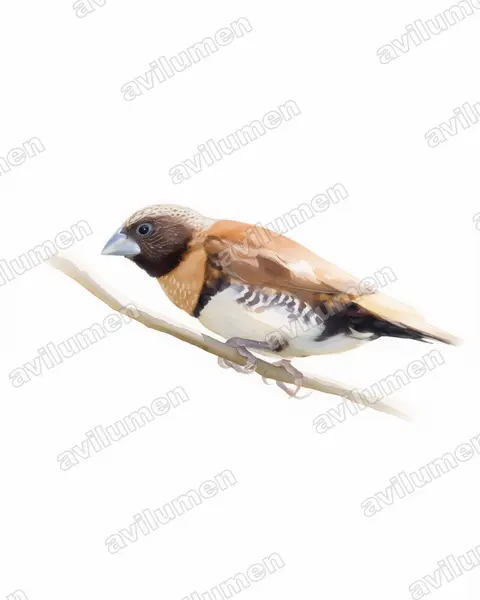
Watercolor 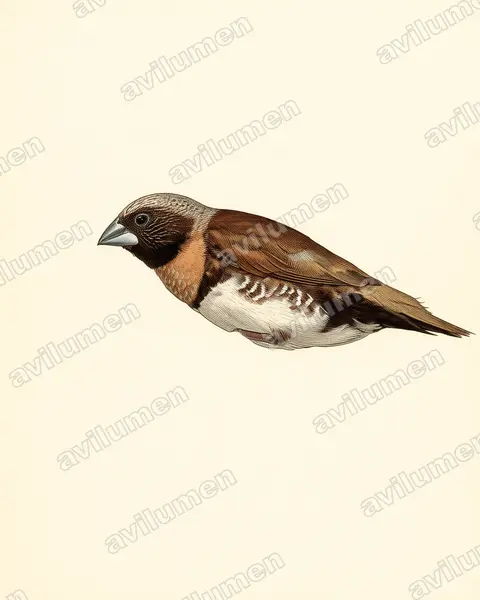
Vintage plate 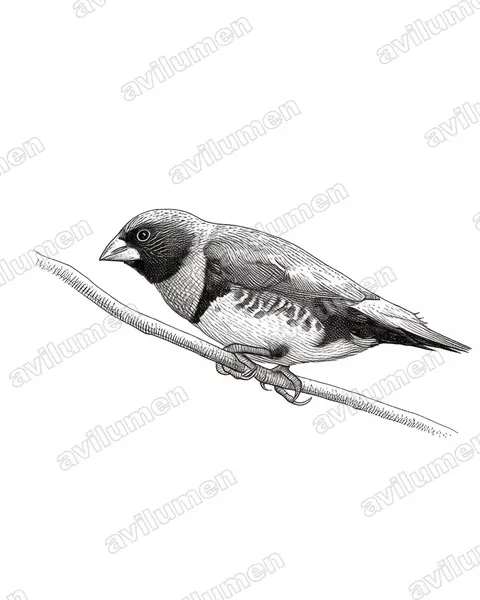
Ink 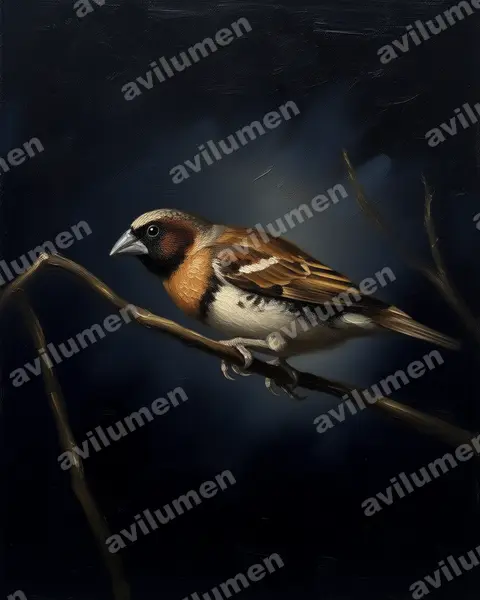
Oil 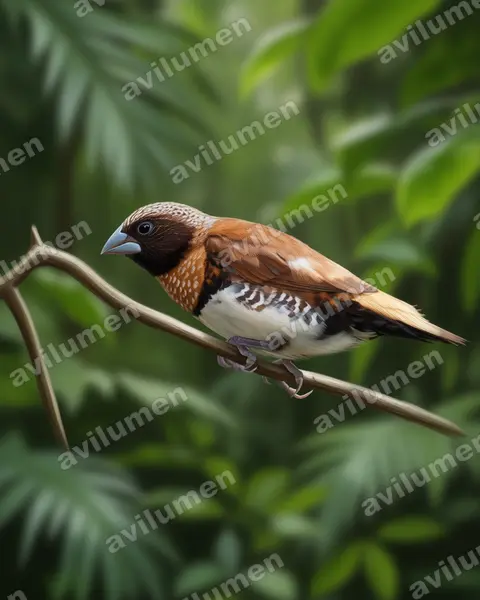
Realistic 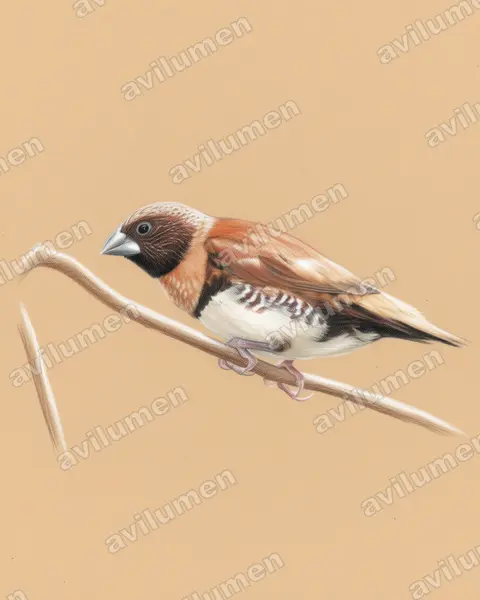
Colored pencil
Illustrations based on the photograph by fir0002 flagstaffotos [at] gmail.com Canon 20D + Canon 400mm f/5.6 L (GFDL 1.2), from Wikimedia Commons.
Digital editions
HD Digital Art Pack — Chestnut-breasted mannikin
Digital download: 6 high-resolution illustrations of the Chestnut-breasted mannikin (Lonchura castaneothorax), print-ready. This is a digital file; no animal or physical item is included.
AI Avatar — Chestnut-breasted mannikin
Generate an avatar fusing your face with the Chestnut-breasted mannikin (Lonchura castaneothorax). Delivered digitally in 8K, watermark-free. Digital product; no animals are sold or brokered.
Instant download. No live birds are sold.
Frequently asked questions
- Is Lonchura castaneothorax (Chestnut-breasted mannikin) endangered?
- The IUCN Red List places Lonchura castaneothorax, commonly known as the Chestnut-breasted mannikin, in the «Least concern» category. «Least concern» means it is not currently threatened.
- Where does Lonchura castaneothorax (Chestnut-breasted mannikin) live?
- Lonchura castaneothorax (Chestnut-breasted mannikin) is found in Australia and Indonesia.
- What family does Lonchura castaneothorax (Chestnut-breasted mannikin) belong to?
- Lonchura castaneothorax (Chestnut-breasted mannikin) belongs to the family Estrildidae, in the order Passeriformes.
- What colour is Lonchura castaneothorax (Chestnut-breasted mannikin)?
- The plumage of Lonchura castaneothorax (Chestnut-breasted mannikin) combines these colours: Brown and Black.
More from the same family
 Least concern
Red-headed finch
Amadina erythrocephala
The red-headed finch is a common species of estrildid finch found in Africa. It has an estimated global extent of occurrence of 1,600,000 km2 (620,000 sq mi). It is found in Angola, Botswana, Lesotho, Namibia, South Africa and Zimbabwe.
from $1.99
 Least concern
Cut-throat finch
Amadina fasciata
The cut-throat finch is a common species of estrildid finch found throughout Africa; it is also known as the bearded finch, the ribbon finch, the cut throat, and the weaver finch.
from $1.99
 Least concern
Red avadavat
Amandava amandava
The red avadavat, red munia or strawberry finch, is a sparrow-sized bird of the family Estrildidae. It is found in the open fields and grasslands of tropical Asia and is popular as a cage bird due to the colourful plumage of the males in their breeding season. It breeds in the Indian subcontinent in the monsoon season.
from $1.99
 Vulnerable
Green avadavat
Amandava formosa
The green avadavat or green munia is a species of Estrildid finch with green and yellow on the body, a bright red bill and black "zebra stripes" on the flanks. They are endemic to the Indian subcontinent and were formerly popular as cagebirds. The name "avadavat" is a corruption of the name the city of Ahmedabad in Gujarat, India, which was a centre of bird trade.
from $1.99