Mascarene parrot
Mascarinus mascarin
Avilumen editorial team ·

The Mascarene parrot or mascarin is an extinct species of parrot that was endemic to the Mascarene island of Réunion in the western Indian Ocean. The taxonomic relationships of this species have been subject to debate; it has historically been grouped with either the Psittaculini parrots or the vasa parrots, with the latest genetic study favouring the former group.
The Mascarene parrot or mascarin (Mascarinus mascarinus) is an extinct species of parrot that was endemic to the Mascarene island of Réunion in the western Indian Ocean. The taxonomic relationships of this species have been subject to debate; it has historically been grouped with either the Psittaculini parrots or the vasa parrots, with the latest genetic study favouring the former group.
The Mascarene parrot was 35 cm (14 in) in length with a large red bill and long, rounded tail feathers. Its legs were red, and it had naked red skin around the eyes and nostrils. It had a black facial mask and partially white tail feathers, but the colouration of the body, wings and head in the living bird is unclear. Descriptions from life indicate the body and head were ash grey, and the white part of the tail had two dark central feathers. In contrast, stuffed specimens and old descriptions based on them indicate that the body was brown and the head bluish. This may be due to the specimens having changed colour as a result of ageing and exposure to light. Very little is known about the bird in life.
The Mascarene parrot was first mentioned in 1674, and live specimens were later brought to Europe, where they lived in captivity. The species was scientifically described in 1771. Only two stuffed specimens exist today, in Paris and Vienna. The date and cause of extinction for the Mascarene parrot is unclear. The latest account, from 1834, is considered dubious, so it is probable that the species became extinct prior to 1800, and may have become extinct even earlier.
Taxonomy
The Mascarene parrot was first mentioned by the French traveller Sieur Dubois in his 1674 travelogue from the Mascarene Island of Réunion, and was only described a few times from life afterwards. At least three live specimens were brought to France in the late 18th century and kept in captivity, two of which were described while alive. Today, two stuffed specimens exist; the holotype, specimen MNHN 211, which is in the Muséum National d'Histoire Naturelle in Paris, while the other, specimen NMW 50.688, is in the Naturhistorisches Museum in Vienna. The latter specimen was bought from the Leverian Museum during a sale in London in 1806. A third stuffed specimen existed around the turn of the 18th century. The Mascarene parrot was scientifically described as Psittacus mascarinus (abbreviated as "mascarin") by the Swedish zoologist Carl Linnaeus in 1771. This name was first used by the French zoologist Mathurin Jacques Brisson in 1760 but was not intended as a scientific name. The name is a reference to the Mascarene Islands, which were themselves named after their Portuguese discoverer, Pedro Mascarenhas.
Early writers claimed the Mascarene parrot was found on Madagascar, an idea that led the French naturalist René Primevère Lesson to coin the junior synonym Mascarinus madagascariensis in 1831. His new genus name prevailed and, when the Italian zoologist Tommaso Salvadori combined it with the earlier specific name in 1891, it became a tautonym (a scientific name in which the two parts are identical). Lesson also included species of the Tanygnathus and Psittacula genera in Mascarinus, but this was not accepted by other writers. The following year, the German herpetologist Johann Georg Wagler erected the genus Coracopsis for the Mascarene parrot (which became Coracopsis mascarina under this system) and the lesser vasa parrot (Coracopsis nigra). The English zoologist William Alexander Forbes, believing that mascarinus was invalid as a specific name, since it was identical to the genus name, coined the new name Mascarinus duboisi in 1879, in honour of Dubois.
An unidentified dark parrot seen alive by the Swedish naturalist Fredrik Hasselqvist in Africa was given the name Psittacus obscurus by Linnaeus in 1758, who again synonymised it with the Mascarene parrot in 1766. Because of this association, some authors believed it was from the Mascarene Islands as well, but this dark parrot's description differs from that of the Mascarene parrot. This disagreement led some authors to use now-invalid combinations of the scientific names, such as Mascarinus obscurus and Coracopsis obscura. The unidentified parrot may have been a grey parrot (Psittacus erithacus) instead. Another unidentified parrot specimen, this one brown and housed in Cabinet du Roi, was described by the French naturalist Comte de Buffon in 1779 under his entry for the Mascarene parrot, in which he pointed out similarities and differences between the two. In 2007, the English palaeontologist Julian Hume suggested the possibility that this might have been a lesser vasa parrot, if not a discoloured old Mascarene grey parakeet (Psittacula bensoni). The specimen is now lost. English zoologist George Robert Gray assigned some eclectus parrot (Eclectus roratus) subspecies from the Moluccas to Mascarinus in the 1840s, but this idea was soon dismissed by other writers.
Subfossil parrot remains were later excavated from grottos on Réunion and reported in 1996. X-rays of the two existing stuffed Mascarene parrots made it possible to compare the remaining bones with the subfossils and showed these were intermediate in measurements in comparison to the modern specimens. The lesser vasa parrot was introduced to Réunion as early as 1780 but, though the subfossil parrot bones were similar to that species in some aspects, they were more similar to those of the Mascarene parrot and considered to belong to it.
The binomial name was emended from M. mascarinus to M. mascarin by the IOC World Bird List in 2016, to conform with how other species epithets by Linnaeus have been treated. In 2020, the International Commission on Zoological Nomenclature conserved the name M. mascarinus as a justified emendation of the original spelling.
Evolution
The affinities of the Mascarene parrot are unclear, and two hypotheses have competed since the mid-19th century. Some authors grouped it with the Coracopsinae (of African origin) due to its dark plumage, and others with the Psittaculinae parrots (of Asian origin) based on the large red beak, a feature which is diagnostic for that group. Its plumage pattern was mostly atypical for a psittaculine, though other members have black facial patterns. Although little is known about most extinct parrot species of the Mascarenes, subfossil remains show that they shared common features, such as enlarged heads and jaws, reduced pectoral bones, and robust leg bones. Hume supported their common origin in the radiation of the Psittaculini tribe based on morphological features and the fact that Psittacula parrots have managed to colonise many isolated islands in the Indian Ocean.
Sea levels were lower during the Pleistocene, so it was possible for species to colonise the Mascarene Islands from other areas. As suggested by the British ecologist Anthony S. Cheke and Hume in 2008, the Psittaculini could have invaded the area several times, as many of the species were so specialised that they may have evolved significantly on hotspot islands before the Mascarenes emerged from the sea. In 1999, the French palaeontologist Cécile Mourer-Chauviré and colleagues pointed out that Réunion is 3 million years old, which is enough time for new genera to evolve, but many endemics would have been wiped out by eruptions of the volcano Piton des Neiges between 300,000 and 180,000 years ago. Most recent and extant species would therefore probably be descendants of birds which had recolonised the island from Africa or Madagascar after this event. If the Mascarene parrot had in fact evolved into a distinct genus on Réunion prior to the volcanic eruption, it would have been one of the few survivors of this extinction event.
A 2011 genetic study by the British geneticist Samit Kundu and colleagues (which sampled the Paris specimen) found that the Mascarene parrot was grouped among the subspecies of the lesser vasa parrot from Madagascar and nearby islands and therefore not related to the Psittacula parrots. It also found that the Mascarene parrot line diverged 4.6 to 9 million years ago, prior to the formation of Réunion, indicating this must have happened elsewhere. In 2012, Leo Joseph and colleagues acknowledged the finding but pointed out that the sample might have been damaged and that further testing was needed before the issue could be fully resolved. They also noted that if Mascarinus was confirmed to be embedded within the genus Coracopsis, the latter would become a junior synonym, since the former name is older. In 2012, Hume expressed surprise at these findings due to the anatomical similarities between the Mascarene parrot and other parrots from the Mascarene islands that are believed to be psittaculines. He also pointed out that there is no fossil evidence found on other islands to support the hypothesis that the species evolved elsewhere before reaching Réunion.
In 2017, the German biologist Lars Podsiadlowski and colleagues sampled the Vienna specimen for a new genetic study and found that the Mascarene parrot was indeed part of the Psittacula group as suggested by Hume, clustering with the extinct Seychelles parakeet (P. wardi) and Asian subspecies of the Alexandrine parakeet (P. eupatria). The Mascarene parrot was therefore interpreted as having descended from an ancestral lineage of Alexandrine parakeets that had dispersed from Asia towards the Mascarene islands across the Indian Ocean. The researchers suggested that the 2011 genetic study had probably used a composite of sequences from two other parrot species sampled for the study (including a lesser vasa parrot), a result of contamination during laboratory procedures. The 2017 study also found that the parrots of the genus Tanygnathus were grouped among Psittacula parrots, and proposed that Tanygnathus and Mascarinus should therefore be merged into the genus Psittacula.
The cladograms below shows the placement of the Mascarene parrot according to the 2011 and 2017 DNA studies:
In 2018, the American ornithologist Kaiya L. Provost and colleagues also found the Mascarene parrot (using the sequence of Podsiadlowski and colleagues) and Tanygnathus species to group within Psittacula, and stated this argued for breaking up the latter genus. To solve the issue that the genera Mascarinus, Tanygnathus, as well as Psittinus fell within the genus Psittacula according to genetic studies, making that genus paraphyletic (an unnatural grouping), the German ornithologist Michael P. Braun and colleagues proposed in 2019 that Psittacula should be split into multiple genera, thereby retaining Mascarinus.
A 2022 genetic study by the Brazilian ornithologist Alexandre P. Selvatti and colleagues confirmed the earlier studies in regard to the relationship between Psittacula, the Mascarene parrot, and Tanygnathus. They suggested that Psittaculinae originated in the Australo–Pacific region (then part of the supercontinent Gondwana), and that the ancestral population of the Psittacula–Mascarinus lineage were the first psittaculines in Africa by the late Miocene (8–5 million years ago), and colonised the Mascarenes from there. In 2024, the American ornithologist Brian Tilston Smith and colleagues noted that if the phylogenetic findings of Podsiadlowski and colleagues were confirmed, the Mascarene parrot would also have to be placed in the genus Palaeornis (which was named before Mascarinus) that was revived by Braun and colleagues in 2019 for the Alexandrine parakeet and related species.
Description
The Mascarene parrot was 35 cm (14 in) in length. The wing was 211 mm (8.3 in), the tail 144–152 mm (5.7–6.0 in), the culmen 32–36 mm (1.3–1.4 in), and the tarsus 22–24 mm (0.87–0.94 in). It had a large red bill and moderately long, rounded tail feathers. It had a black velvet-like facial mask on the front part of the head. There are several discrepancies in how the colour of the body, wings, tail feathers and the head have historically been described and depicted. In 1674, Dubois described live specimens as being "petit-gris" which is the colour of the dark phase of the red squirrel. According to Hume, this colour is a dark blackish grey or brown.
In 1760, Brisson published the following description based on a captive bird (which may have been the specimen now preserved in Paris):
Upperparts of head and neck clear (ash) grey. Back, rump, underparts of neck, breast, belly, sides, legs, scapular feathers, upper coverts of tail very-dark (ash) grey. Wing feathers of the same colour. The tail is composed of 12 feathers: the two median ones are also very-dark (ash) grey. All the lateral ones are of the same colour, except that they have a little white at their base. The eyes are surrounded by a naked skin, bright red. Pupil black, iris red. The base of the superior half of the beak is also surrounded by a red naked skin in which the nostrils are placed. Beak similarly red. Legs pale flesh. Claws grey-brown. I am unaware from which country it is found. I have seen it living in Paris.
Text adapted from Wikipedia · CC BY-SA 4.0
Plumage colours
Distribution

Taxonomy
- Order
- Psittaciformes
- Family
- Psittacidae
- Genus
- Mascarinus
- Conservation status
- Extinct
Listen to its call
No recording yet
Illustration gallery
6 illustrations of Mascarinus mascarin (Mascarene parrot) in different styles, true to its real plumage. Shown watermarked; the art pack includes the high-resolution originals, ready to print.
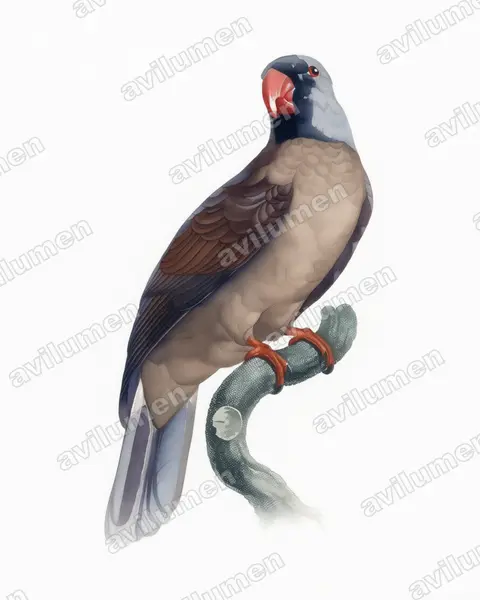
Watercolor 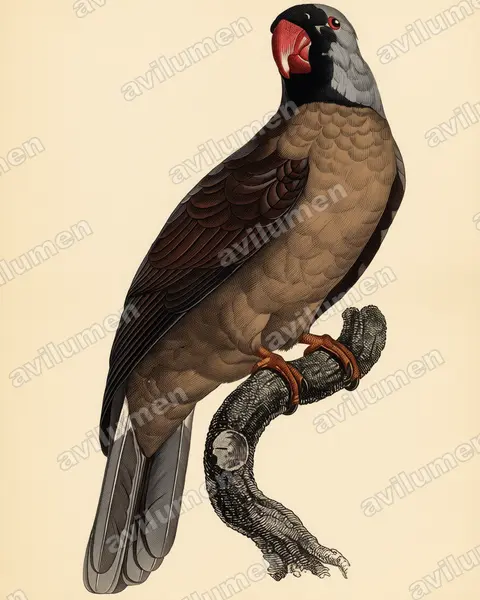
Vintage plate 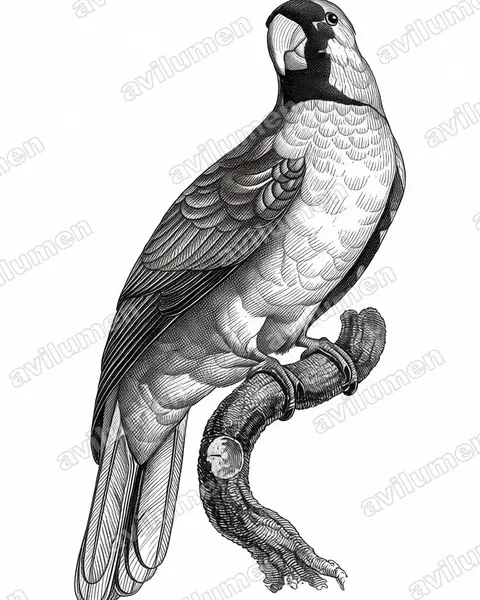
Ink 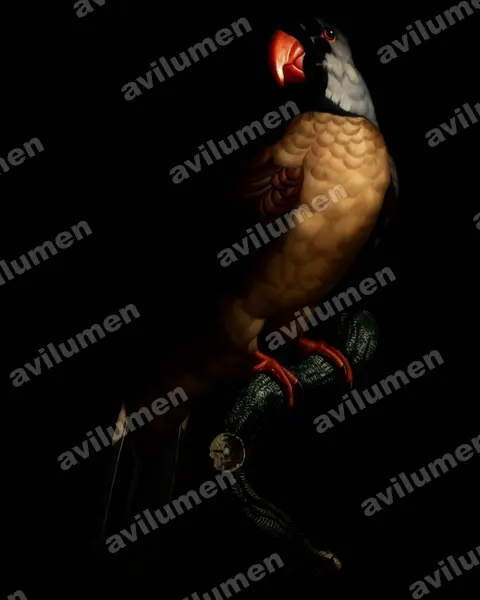
Oil 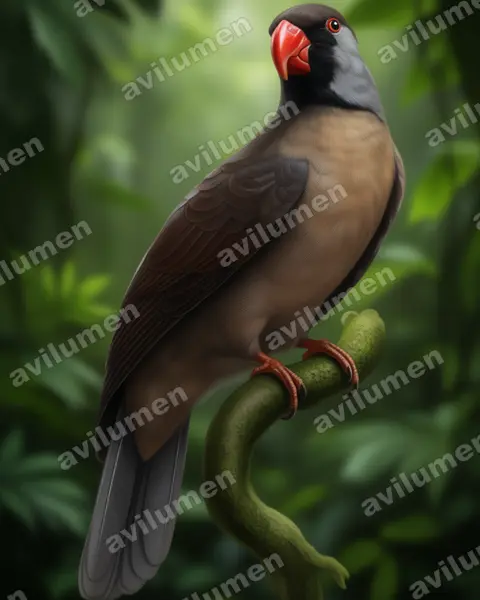
Realistic 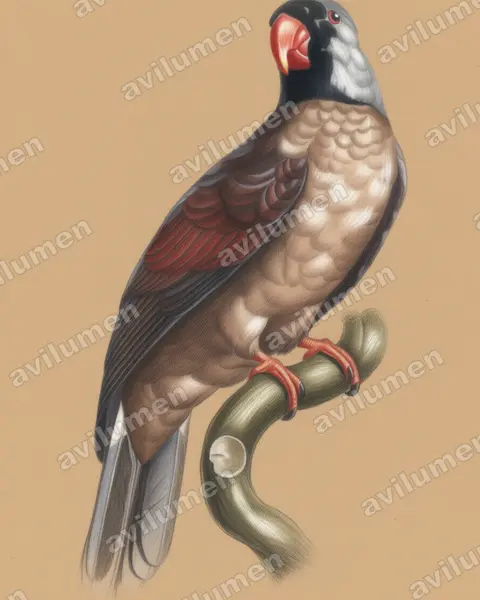
Colored pencil
Illustrations based on the photograph by Jacques Barraband (Public domain), from Wikimedia Commons.
Digital editions
HD Digital Art Pack — Mascarene parrot
Digital download: 6 high-resolution illustrations of the Mascarene parrot (Mascarinus mascarin), print-ready. This is a digital file; no animal or physical item is included.
AI Avatar — Mascarene parrot
Generate an avatar fusing your face with the Mascarene parrot (Mascarinus mascarin). Delivered digitally in 8K, watermark-free. Digital product; no animals are sold or brokered.
Instant download. No live birds are sold.
Frequently asked questions
- Is Mascarinus mascarin (Mascarene parrot) endangered?
- The IUCN Red List places Mascarinus mascarin, commonly known as the Mascarene parrot, in the «Extinct» category. «Extinct» means no individual is known to remain alive.
- What family does Mascarinus mascarin (Mascarene parrot) belong to?
- Mascarinus mascarin (Mascarene parrot) belongs to the family Psittacidae, in the order Psittaciformes.
- What colour is Mascarinus mascarin (Mascarene parrot)?
- The plumage of Mascarinus mascarin (Mascarene parrot) combines these colours: Brown.
More from the same family
 Near threatened
Yellow-faced Parrot
Alipiopsitta xanthops
The yellow-faced parrot, formerly also known as the yellow-faced amazon, is the only species of the genus Alipiopsitta. It is a Neotropical parrot, and was classified in the genus Amazona for many years. It is a predominantly green and yellow-plumaged bird with a yellow head. It is a semi-nomadic species found in the cerrado region of Brazil and adjacent Bolivia.
from $1.99
 Least concern
Moluccan King Parrot
Alisterus amboinensis
The Moluccan king parrot is a parrot endemic to Peleng Island, Maluku, and West Papua in Indonesia. It is sometimes referred to as the Ambon king parrot or Amboina king parrot, but this is potentially misleading, as it is found on numerous other islands than Ambon. The male and female are similar in appearance, with a predominantly red head and underparts, green wings, and blue back and tail.
from $1.99
 Least concern
Papuan King Parrot
Alisterus chloropterus
The Papuan king parrot, also known as the green-winged king parrot, is a species of parrot in the family Psittaculidae found in New Guinea. Its natural habitats are subtropical or tropical moist lowland forest and subtropical or tropical moist montane forest.
from $1.99
 Least concern
Australian King Parrot
Alisterus scapularis
The Australian king parrot is a species of parrot endemic to eastern Australia ranging from Cooktown in Queensland to Port Campbell in Victoria. Found in humid and heavily forested upland regions of the eastern portion of the continent, including eucalyptus wooded areas in and directly adjacent to subtropical and temperate rainforest. They feed on fruits and seeds gathered from trees or on the ground.
from $1.99