Razor-billed Curassow
Mitu tuberosum
Avilumen editorial team ·

The razor-billed curassow is a species of bird in the family Cracidae, the chachalacas, guans, and curassows. It is found in Bolivia, Brazil, Colombia, and Peru.
The razor-billed curassow (Mitu tuberosum) is a species of bird in the family Cracidae, the chachalacas, guans, and curassows. It is found in Bolivia, Brazil, Colombia, and Peru.
Taxonomy and systematics
The razor-billed curassow was originally placed in genus Crax but genetic data confirm that Mitu is a valid genus. It was for a time treated as a subspecies of Alagoas curassow (Mitu mitu) and they are now treated as sister species. The razor-billed curassow is monotypic.
Description
The razor-billed curassow is 83 to 89 cm (2.7 to 2.9 ft) long and males weigh about 3,860 g (8.5 lb). Their plumage is mostly black with a strong purplish blue gloss. The lower belly and undertail coverts are chestnut and the tips of the tail feathers white. It has a tall ragged crest. Its large bright red bill is laterally compressed, which gives the species its common name.
Distribution and habitat
The razor-billed curassow is found in much of Amazonia, mostly south of the Amazon River in eastern Peru, northern Bolivia, and northern Brazil all the way to the Atlantic coast. It is found north of the Amazon in southeastern Colombia, extreme northeastern Peru, and Brazil as far east as the Rio Negro. It inhabits lowland evergreen forest, primarily terra firme but also gallery and várzea forests and along the margins of lakes and streams. In elevation it ranges from sea level to 1,350 m (4,400 ft) though it may only locally exceed 1,000 m (3,300 ft).
Feeding
The razor-billed curassow typically forages alone or in pairs on the forest floor. Its diet is mostly fallen fruits and also includes leaves, insects, fungi, and small vertebrates.
Breeding
The razor-billed curassow is occasionally polygynous and might be regularly so. In northern Peru at least, its nesting season spans from November to February. One nest was described as "a perfect round cup" of branches, lianas, and leaves. The clutch size is two or three eggs.
Vocalization
The razor-billed curassow's song is " "a series of deep booming notes, the first 3 rising, the last 2 even at a slightly higher pitch: BMMM mmMMM... mmMMM'BMMM-BMMM, sometimes followed after pause by sharp BMM!." It is sung from a perch at any time of day but most frequently before and at dawn and during the breeding season. Its calls include "rising whistles and popping notes" and "soft pweet calls".
Status
The IUCN has assessed the razor-billed curassow as being of Least Concern. It has a very large range. However, its population has not been quantified and is believed to be declining, primarily because of heavy hunting pressure.
Text adapted from Wikipedia · CC BY-SA 4.0
Where it lives
Plumage colours
Distribution

Taxonomy
- Order
- Galliformes
- Family
- Cracidae
- Genus
- Mitu
- Conservation status
- Near threatened
Listen to its call
No recording yet
Illustration gallery
6 illustrations of Mitu tuberosum (Razor-billed Curassow) in different styles, true to its real plumage. Shown watermarked; the art pack includes the high-resolution originals, ready to print.
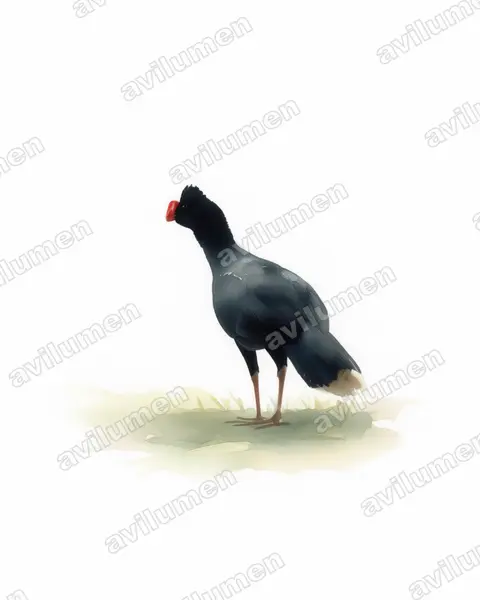
Watercolor 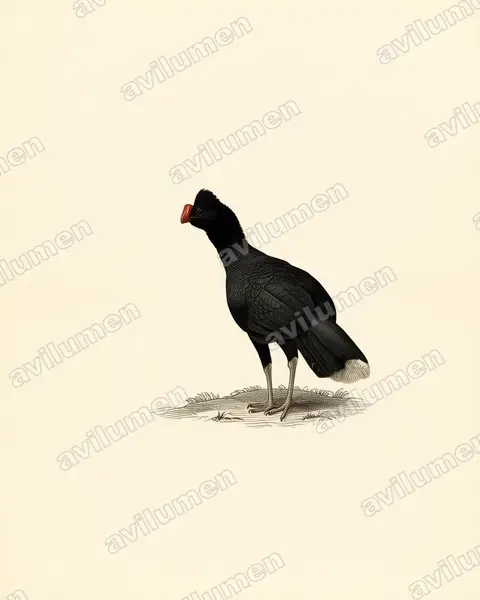
Vintage plate 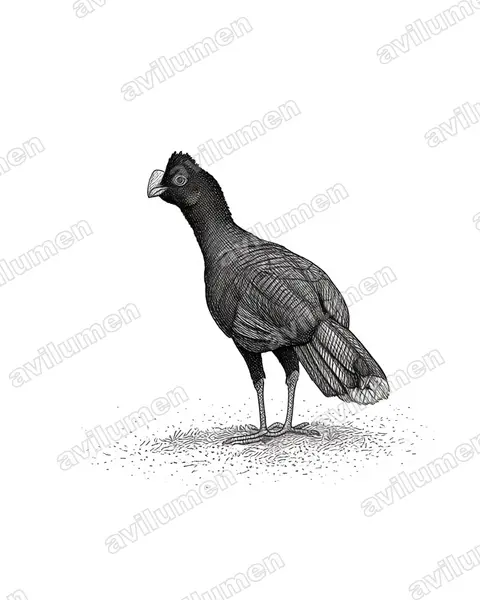
Ink 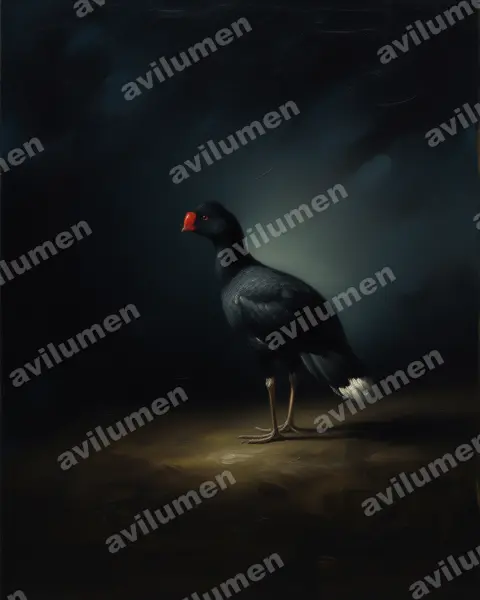
Oil 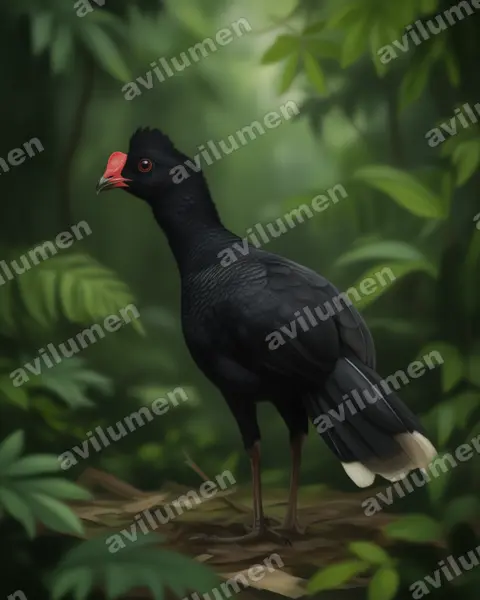
Realistic 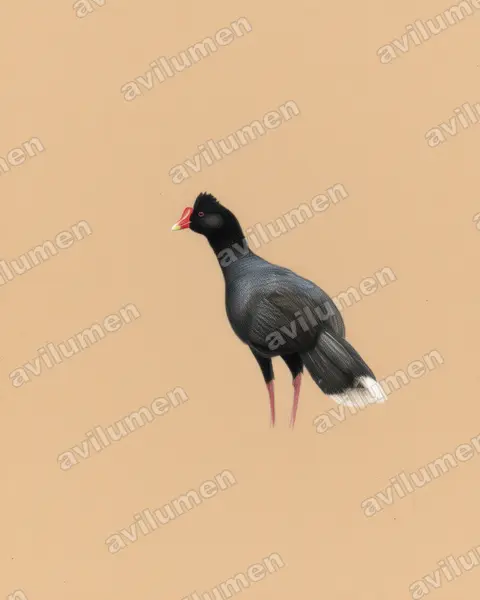
Colored pencil
Illustrations based on the photograph by Whaldener Endo (CC BY-SA 4.0), from Wikimedia Commons.
Digital editions
HD Digital Art Pack — Razor-billed Curassow
Digital download: 6 high-resolution illustrations of the Razor-billed Curassow (Mitu tuberosum), print-ready. This is a digital file; no animal or physical item is included.
AI Avatar — Razor-billed Curassow
Generate an avatar fusing your face with the Razor-billed Curassow (Mitu tuberosum). Delivered digitally in 8K, watermark-free. Digital product; no animals are sold or brokered.
Instant download. No live birds are sold.
Frequently asked questions
- Is Mitu tuberosum (Razor-billed Curassow) endangered?
- The IUCN Red List places Mitu tuberosum, commonly known as the Razor-billed Curassow, in the «Near threatened» category. «Near threatened» means it is not threatened yet, but is close to becoming so.
- Where does Mitu tuberosum (Razor-billed Curassow) live?
- Mitu tuberosum (Razor-billed Curassow) is found in Brazil and South America.
- What family does Mitu tuberosum (Razor-billed Curassow) belong to?
- Mitu tuberosum (Razor-billed Curassow) belongs to the family Cracidae, in the order Galliformes.
- What colour is Mitu tuberosum (Razor-billed Curassow)?
- The plumage of Mitu tuberosum (Razor-billed Curassow) combines these colours: Black.
More from the same family
 Least concern
Wattled Guan
Aburria aburri
The wattled guan is a species of bird in the family Cracidae. It is a fairly large black cracid with blue-based, black-tipped beak and a long, red-and-yellow wattle.
from $1.99
 Least concern
Sickle-winged Guan
Chamaepetes goudotii
The sickle-winged guan is a species of bird in the chachalaca, guan, and curassow family Cracidae. It is found in Bolivia, Colombia, Ecuador, and Peru.
from $1.99
 Least concern
Black Guan
Chamaepetes unicolor
The black guan is a species of bird in the chachalaca, guan, and curassow family Cracidae. It is found in Costa Rica and Panama.
from $1.99
 Critically endangered
Blue-billed Curassow
Crax alberti
The blue-billed curassow is a species of bird in the family Cracidae, the chachalacas, guans, and curassows. It is endemic to Colombia.
from $1.99