Manu Parrotlet
Nannopsittaca dachilleae
Avilumen editorial team ·

The Manu parrotlet or Amazonian parrotlet is a species of parrotlet native to the western Amazon basin, from southern Peru to northwest Bolivia. It is found in lowland forests near bamboo and rivers.
The Manu parrotlet (Nannopsittaca dachilleae) or Amazonian parrotlet is a species of parrotlet native to the western Amazon basin, from southern Peru to northwest Bolivia. It is found in lowland forests near bamboo and rivers.
It is classified as Least Concern by the IUCN.
Taxonomy and naming
The Manu parrotlet was discovered in 1985 by John P. O'Neill, Charles A. Munn, and Irma Franke while exploring the Manú River in the Manú National Park in eastern Peru. The new species was named after the scientists' colleague, conservationist and journalist Barbara D'Achille.
The generic name is from Latin nānus dwarf, from Greek nanos dwarf + Latin psittaca feminine of psittacus parrot, from Greek psittakos parrot; dachilleae a Latinized form of the surname d'Achille, hence the "dwarf parrot of d'Achille".
Description
The upper parts, nape, auriculars, dorsum, tertials, wing covers, rump, upper-tail, and rectrices are bright green. The forehead, anterior crown, and ores are a pale blue. The malar area, breast, belly, and under-tail are a paler more yellowish green. No sexual dimorphism has been described as yet.
Behavior
The bird was consistently measured to be in flocks of anywhere from 5 to 12 birds by the researchers who described it. Flocks make sounds similar to squawking or peeping. One possible nest was observed, a burrow among a cluster of bromeliads.
Feeding
It generally tends to forage on the ground for seeds or in mineral deposits left by rivers, especially on the seeds left behind by bamboo in the genus Guadua.
Another important source of nutrients for the Manu parrotlet is the clay licks, narrow horizons exposed to a vertical bank on a riverbed to consume sodium and other minerals that are depositeted there. The Manu parrotlet appeared every two or three days about midday with groups of dusky-billed parrotlet (Forpus sclateri), tui parakeet (Brotogeris sanctithomae), and cobalt-winged parakeet (B. cyanoptera), with the Manu parrotlet eating clay for about 30 minutes.
Distribution and habitat
The bird has a patchy distribution throughout Brazil, Bolivia, and Peru, with the latter containing the majority of its population. It largely occupies riparian forests, especially those that consist of Calocophyllum spruceanum and Cecropia membranacea.
Conservation
The Manu parrotlet faces primarily habitat fragmentation and degradation from industry, especially mining, and associated roads.
Text adapted from Wikipedia · CC BY-SA 4.0
Where it lives
Plumage colours
Distribution

Taxonomy
- Order
- Psittaciformes
- Family
- Psittacidae
- Genus
- Nannopsittaca
- Conservation status
- Least concern
Listen to its call
No recording yet
Illustration gallery
6 illustrations of Nannopsittaca dachilleae (Manu Parrotlet) in different styles, true to its real plumage. Shown watermarked; the art pack includes the high-resolution originals, ready to print.
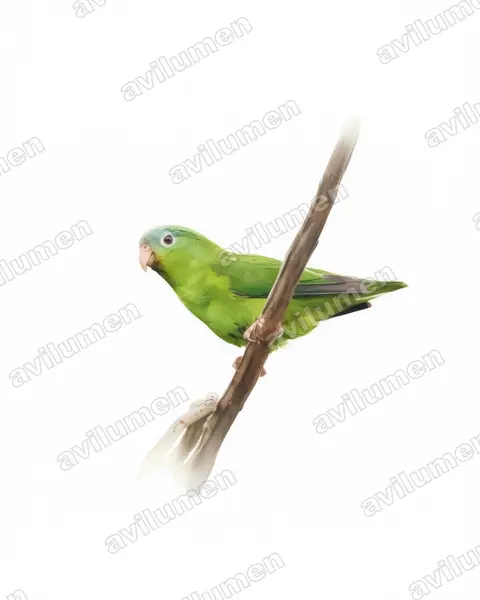
Watercolor 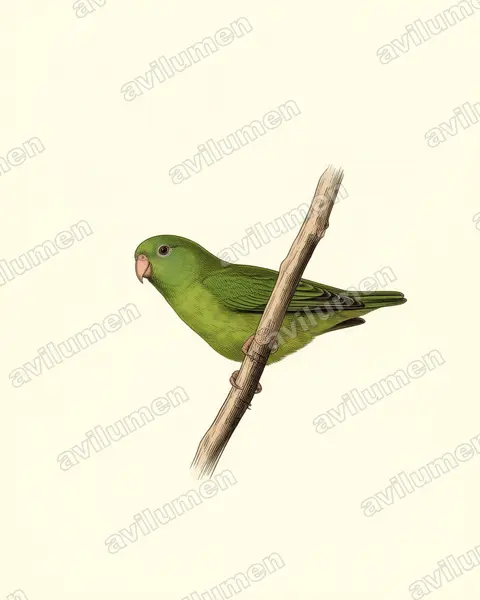
Vintage plate 
Ink 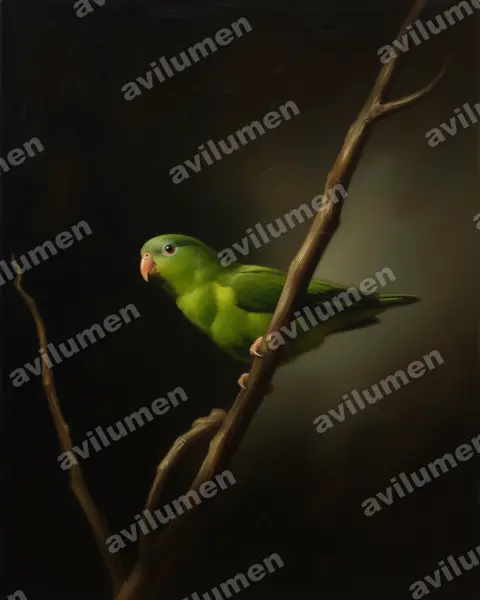
Oil 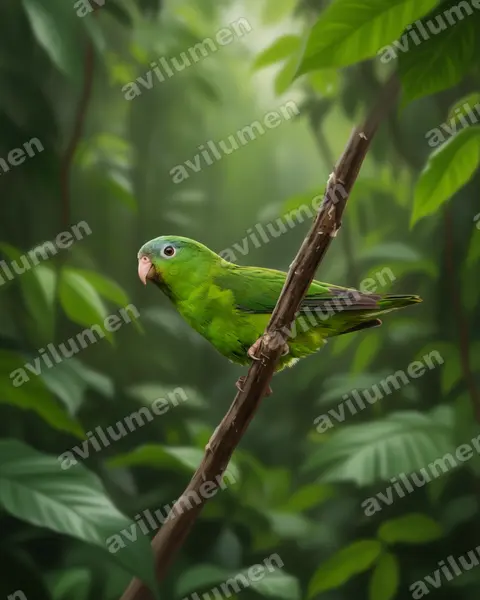
Realistic 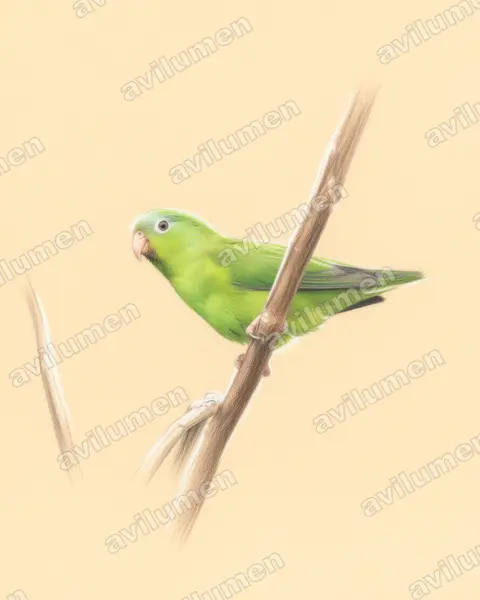
Colored pencil
Illustrations based on the photograph by Hector Bottai (CC BY-SA 4.0), from Wikimedia Commons.
Digital editions
HD Digital Art Pack — Manu Parrotlet
Digital download: 6 high-resolution illustrations of the Manu Parrotlet (Nannopsittaca dachilleae), print-ready. This is a digital file; no animal or physical item is included.
AI Avatar — Manu Parrotlet
Generate an avatar fusing your face with the Manu Parrotlet (Nannopsittaca dachilleae). Delivered digitally in 8K, watermark-free. Digital product; no animals are sold or brokered.
Instant download. No live birds are sold.
Frequently asked questions
- Is Nannopsittaca dachilleae (Manu Parrotlet) endangered?
- The IUCN Red List places Nannopsittaca dachilleae, commonly known as the Manu Parrotlet, in the «Least concern» category. «Least concern» means it is not currently threatened.
- Where does Nannopsittaca dachilleae (Manu Parrotlet) live?
- Nannopsittaca dachilleae (Manu Parrotlet) is found in Brazil and South America.
- What family does Nannopsittaca dachilleae (Manu Parrotlet) belong to?
- Nannopsittaca dachilleae (Manu Parrotlet) belongs to the family Psittacidae, in the order Psittaciformes.
- What colour is Nannopsittaca dachilleae (Manu Parrotlet)?
- The plumage of Nannopsittaca dachilleae (Manu Parrotlet) combines these colours: Green.
More from the same family
 Near threatened
Yellow-faced Parrot
Alipiopsitta xanthops
The yellow-faced parrot, formerly also known as the yellow-faced amazon, is the only species of the genus Alipiopsitta. It is a Neotropical parrot, and was classified in the genus Amazona for many years. It is a predominantly green and yellow-plumaged bird with a yellow head. It is a semi-nomadic species found in the cerrado region of Brazil and adjacent Bolivia.
from $1.99
 Least concern
Moluccan King Parrot
Alisterus amboinensis
The Moluccan king parrot is a parrot endemic to Peleng Island, Maluku, and West Papua in Indonesia. It is sometimes referred to as the Ambon king parrot or Amboina king parrot, but this is potentially misleading, as it is found on numerous other islands than Ambon. The male and female are similar in appearance, with a predominantly red head and underparts, green wings, and blue back and tail.
from $1.99
 Least concern
Papuan King Parrot
Alisterus chloropterus
The Papuan king parrot, also known as the green-winged king parrot, is a species of parrot in the family Psittaculidae found in New Guinea. Its natural habitats are subtropical or tropical moist lowland forest and subtropical or tropical moist montane forest.
from $1.99
 Least concern
Australian King Parrot
Alisterus scapularis
The Australian king parrot is a species of parrot endemic to eastern Australia ranging from Cooktown in Queensland to Port Campbell in Victoria. Found in humid and heavily forested upland regions of the eastern portion of the continent, including eucalyptus wooded areas in and directly adjacent to subtropical and temperate rainforest. They feed on fruits and seeds gathered from trees or on the ground.
from $1.99