Java sparrow
Padda oryzivora
Avilumen editorial team ·

The Java sparrow, also known as the Java finch, Java rice sparrow or Java rice bird, is a small passerine bird. This species in the family Estrildidae is a resident breeding bird in Java, Bali, and Bawean in Indonesia. It is a popular cage bird, and has been introduced into many other countries.
The Java sparrow (Padda oryzivora; syn. Lonchura oryzivora), also known as the Java finch, Java rice sparrow or Java rice bird, is a small passerine bird. This species in the family Estrildidae is a resident breeding bird in Java, Bali, and Bawean in Indonesia. It is a popular cage bird, and has been introduced into many other countries.
Taxonomy
The Java sparrow was formally described by the Swedish naturalist Carl Linnaeus in 1758 in the tenth edition of his Systema Naturae under the binomial name Loxia oryzivora. The specific epithet combines Latin oryza meaning "rice" with -vorus meaning "eating". Linnaeus based his description on the "Padda or Rice-bird" that had been described and illustrated in 1743 by the English naturalist George Edwards in his A Natural History of Uncommon Birds. Edwards believed that his specimens had come from China but mentions the common name "Java sparrow".
The species was long classified in the genus Padda, but on the basis of preliminary genetic studies Padda was merged into the genus Lonchura in 2009, before being returned to its older generic status in 2020 following more detailed genetic analysis.
Description
The Java sparrow is about 15 to 17 cm (5.9 to 6.7 in) in length from the beak to its tip of tail feathers. Although only about the size of a house sparrow, it may be the largest species in the estrildid family. The mean body weight is 24.5 g (0.86 oz), making it slightly heavier than its nearest known rival, the black-bellied seedcracker. The adult is unmistakable, with its grey upperparts and breast, pink belly, white-cheeked black head, red eye-ring, pink feet and thick red bill.
Both sexes are similar. Immature birds have brown upperparts and pale brown underparts, and a plain head. Very young birds have a black beak with a pink base.
The call is a chip, and the song is a rapid series of call notes chipchipchipchipchipchip.
Java sparrows produce distinct trill-calls in different behavioural contexts, according to a study by Furutani et al. (2018). These trill-calls, though acoustically similar, vary based on their repetition rate, which changes depending on the situation. In aggressive interactions, the sparrows emit faster trill-calls with higher sound pressure levels and entropy. In contrast, during affiliative behaviour, the trill-calls are slower and softer. This variation in trill-calls plays a crucial role in the birds' social communication, helping them convey different intentions based on the context.
Habitat
The Java sparrow is a very gregarious bird which feeds mainly on grain and other seeds. It frequents open grassland and cultivation, and was formerly a pest in rice fields, hence its scientific name. The nest is constructed in a tree or building, and up to eight eggs are laid.
Aviculture
The Java sparrow has been a popular cage bird in Asia for centuries, first in China's Ming Dynasty and then in Japan from the 17th century, frequently appearing in Japanese paintings and prints. Meiji-era writer Natsume Sōseki wrote an essay about his pet Java sparrow.
In the late 1960s and early 1970s the Java sparrow was one of the most popular cage birds in the United States until its import was banned. Today it remains illegal to possess in California because of a perceived threat to agriculture, although rice-dependent Asian countries like China, Taiwan and Japan have not regulated the bird.
In Asia the Java sparrow is most often raised almost from birth by human breeders and owners, and they become very tame and attached to humans. As such, they can be normally kept in relatively small cages, but let out for indoor exercise without their attempting to escape. In captivity, a variety of colours have been bred, including white, silver/opal, fawn/isabel, pastel, cream and agate (which currently is rare within European captive specimens) along with the pied Java sparrow called the sakura buncho in Japan.
Introductions
The Java sparrow was introduced in the Indian subcontinent, but it failed to become a successful resident on the Indian mainland. In the United States there are breeding populations on several of the Hawaiian Islands, especially Oahu.
In the Caribbean, the Java sparrow was introduced to Puerto Rico where it is fairly common near San Juan. It has also been sighted in Jamaica, but is not known to occur on any of the other islands. It was also introduced to Christmas Island, off the coast of Western Australia.
Conservation
The Java sparrow is considered by some countries to be an agricultural pest with respect to rice cultivation. An ongoing loss of natural habitat, hunting in some areas and trapping (as a pest) in others has led to much smaller numbers in the wild and sightings in its natural range have become increasingly uncommon. The Java sparrow is now evaluated as endangered on the IUCN Red List of Threatened Species with less than 10,000 individuals remaining. It is also listed on Appendix II of CITES. The species is also severely threatened by the illegal exotic pet trade as they are sought after for their distinctive song, according to TRAFFIC.
Text adapted from Wikipedia · CC BY-SA 4.0
Distribution

Taxonomy
- Order
- Passeriformes
- Family
- Estrildidae
- Genus
- Padda
- Conservation status
- Endangered
Listen to its call
No recording yet
Care guide
Canary and Finch Care Guide: Diet, Housing and Breeding
How to care for canaries, zebra finches, Gouldian finches and other finches: diet, flight cage setup, health, song and breeding. A guide for bird keepers.
Read the guide →Illustration gallery
6 illustrations of Padda oryzivora (Java sparrow) in different styles, true to its real plumage. Shown watermarked; the art pack includes the high-resolution originals, ready to print.
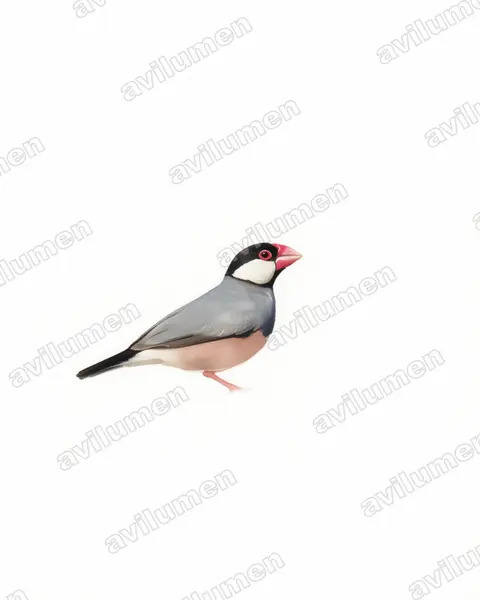
Watercolor 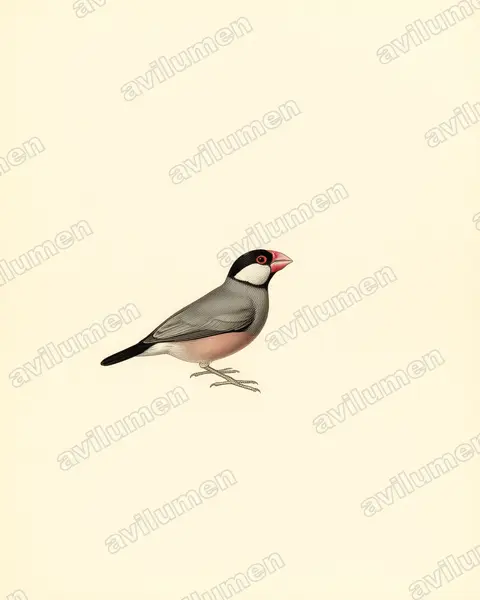
Vintage plate 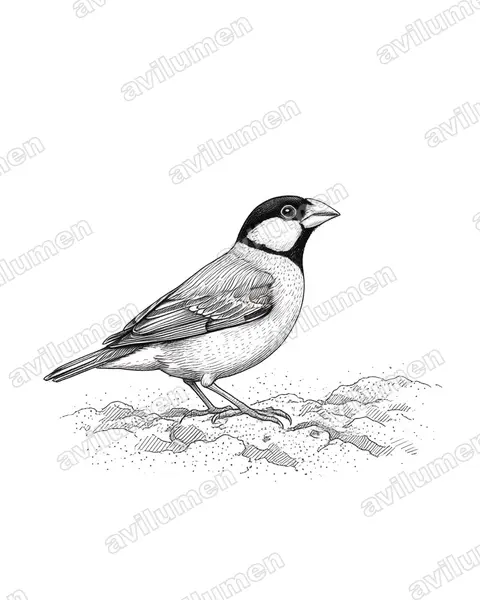
Ink 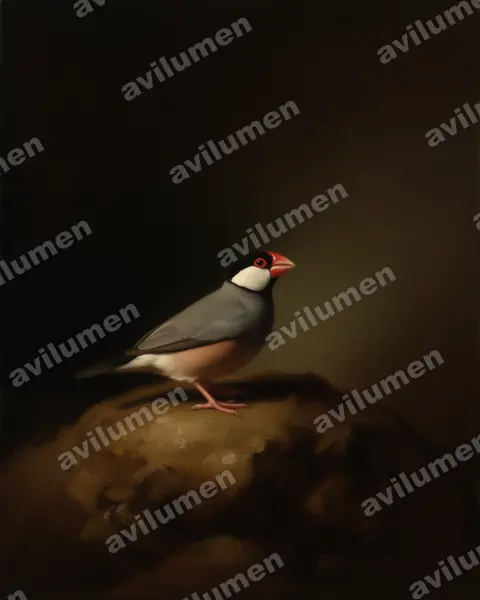
Oil 
Realistic 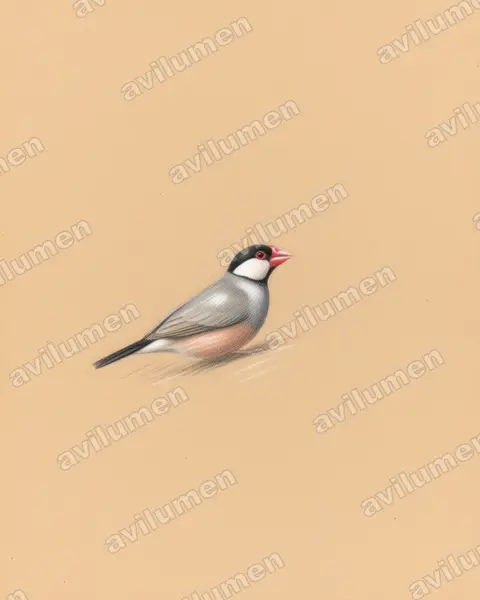
Colored pencil
Illustrations based on the photograph by Francesco Veronesi from Italy (CC BY-SA 2.0), from Wikimedia Commons.
Digital editions
HD Digital Art Pack — Java sparrow
Digital download: 6 high-resolution illustrations of the Java sparrow (Padda oryzivora), print-ready. This is a digital file; no animal or physical item is included.
AI Avatar — Java sparrow
Generate an avatar fusing your face with the Java sparrow (Padda oryzivora). Delivered digitally in 8K, watermark-free. Digital product; no animals are sold or brokered.
Instant download. No live birds are sold.
Frequently asked questions
- Is Padda oryzivora (Java sparrow) endangered?
- The IUCN Red List places Padda oryzivora, commonly known as the Java sparrow, in the «Endangered» category. «Endangered» means it faces a very high risk of disappearing in the wild.
- Where does Padda oryzivora (Java sparrow) live?
- Padda oryzivora (Java sparrow) is found in India, Philippines, and Venezuela.
- What family does Padda oryzivora (Java sparrow) belong to?
- Padda oryzivora (Java sparrow) belongs to the family Estrildidae, in the order Passeriformes.
- What colour is Padda oryzivora (Java sparrow)?
- The plumage of Padda oryzivora (Java sparrow) combines these colours: Grey, Black, and White.
More from the same family
 Least concern
Red-headed finch
Amadina erythrocephala
The red-headed finch is a common species of estrildid finch found in Africa. It has an estimated global extent of occurrence of 1,600,000 km2 (620,000 sq mi). It is found in Angola, Botswana, Lesotho, Namibia, South Africa and Zimbabwe.
from $1.99
 Least concern
Cut-throat finch
Amadina fasciata
The cut-throat finch is a common species of estrildid finch found throughout Africa; it is also known as the bearded finch, the ribbon finch, the cut throat, and the weaver finch.
from $1.99
 Least concern
Red avadavat
Amandava amandava
The red avadavat, red munia or strawberry finch, is a sparrow-sized bird of the family Estrildidae. It is found in the open fields and grasslands of tropical Asia and is popular as a cage bird due to the colourful plumage of the males in their breeding season. It breeds in the Indian subcontinent in the monsoon season.
from $1.99
 Vulnerable
Green avadavat
Amandava formosa
The green avadavat or green munia is a species of Estrildid finch with green and yellow on the body, a bright red bill and black "zebra stripes" on the flanks. They are endemic to the Indian subcontinent and were formerly popular as cagebirds. The name "avadavat" is a corruption of the name the city of Ahmedabad in Gujarat, India, which was a centre of bird trade.
from $1.99