Helmeted Curassow
Pauxi pauxi
Avilumen editorial team ·

The helmeted curassow or northern helmeted curassow, is a large terrestrial bird in the family Cracidae found in the subtropical cloud-forest in steep, mountainous regions of western Venezuela and northern Colombia. There are two subspecies found in different mountain ranges. It is a mostly black bird with a white tip to its tail, a red bill and a distinctive grey casque on its forehead.
The helmeted curassow (Pauxi pauxi) or northern helmeted curassow, is a large terrestrial bird in the family Cracidae found in the subtropical cloud-forest in steep, mountainous regions of western Venezuela and northern Colombia. There are two subspecies found in different mountain ranges. It is a mostly black bird with a white tip to its tail, a red bill and a distinctive grey casque on its forehead. The population of this bird is in decline and the International Union for Conservation of Nature has rated its conservation status as "endangered".
Description
It is a large terrestrial black curassow with a small head, large bluish grey casque on forehead, red bill, white-tipped tail feathers, greenish glossed mantle and breast feathers, and white below. Both sexes are similar. Length in adult birds can vary from 80 to 100 cm (31 to 39 in). The male, at 3.6 kg (8 lbs), is larger than the female, at 2.6 kg (5.8 lbs). Among standard measurements, the wing chord is 36.3 to 42.7 cm (14.3 to 16.8 in), the tail is 30.4 to 36.2 cm (12.0 to 14.3 in) and the tarsus is 8.9 to 11.2 cm (3.5 to 4.4 in). Some rare rufous morph female has a black barred and reddish brown plumage. For some time, it also contained the horned curassow taxa as subspecies. Nowadays its southern congener is considered a distinct species P. unicornis.
Distribution
One of the largest birds in its habitat, the helmeted curassow is distributed in the eastern Andes of Venezuela and Colombia. In a recent study done in Tamá National Natural Park of Colombia, it suggested that the park contains a significant population of helmeted curassow with a population density of 4.8 individuals per square kilometer. Furthermore, it was noted that most of the observed helmeted curassow occupied the lower strata, forest floor and subcanopy, of the forest, where they are vulnerable to poachers during the dry season. The diet consists mainly of seeds, fruits, insects and small animals. The female lays two cream-colored eggs and incubates them for about 30 days.
Status
The helmeted curassow is listed on Appendix II of CITES. Formerly classified as a Vulnerable species by the IUCN, recent research shows that its numbers are decreasing more and more rapidly. It is consequently uplisted to Endangered status in 2008.
Taxonomy
There are two subspecies:
Mérida helmeted curassow, Pauxi pauxi pauxi
Cordillera de Mérida into Cordillera Oriental, Colombia
Casque larger, egg-shaped
Perijá helmeted curassow, Pauxi pauxi gilliardi
Serranía del Perijá
Casque smaller, less bulbous, rather cylindrical in shape.
Their evolutionary history is not well researched compared to other curassows. The helmeted curassows probably are a lineage of Late Miocene (Tortonian–Messinian, about 8–7 million years ago) origin. This species' present-day distribution suggests that it became isolated some 6 million years ago as its mountain range uplifted. It is not known when gene flow between the subspecies ceased.
Text adapted from Wikipedia · CC BY-SA 4.0
Where it lives
Distribution

Taxonomy
- Order
- Galliformes
- Family
- Cracidae
- Genus
- Pauxi
- Conservation status
- Vulnerable
Listen to its call
No recording yet
Illustration gallery
6 illustrations of Pauxi pauxi (Helmeted Curassow) in different styles, true to its real plumage. Shown watermarked; the art pack includes the high-resolution originals, ready to print.
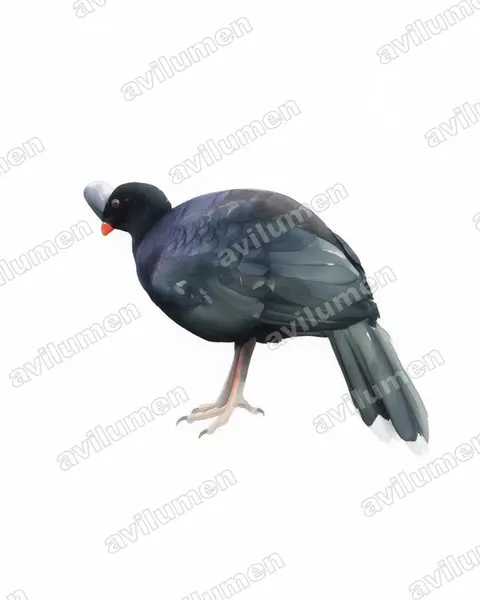
Watercolor 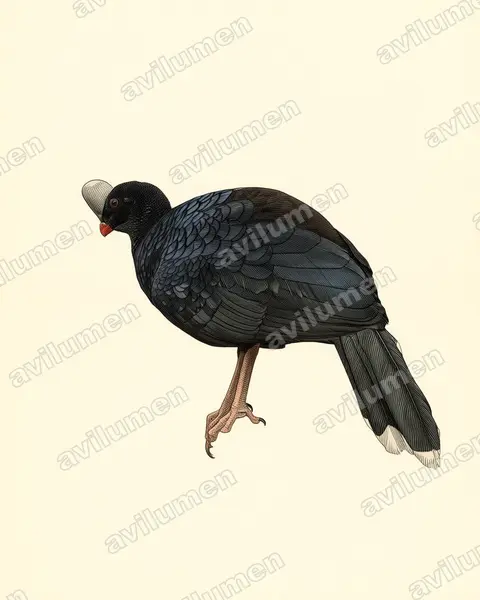
Vintage plate 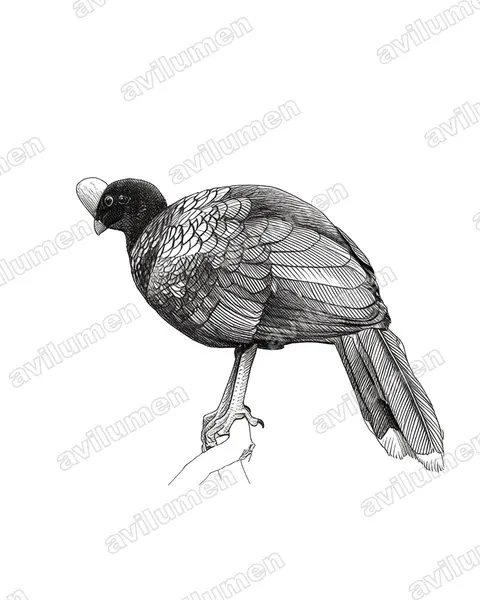
Ink 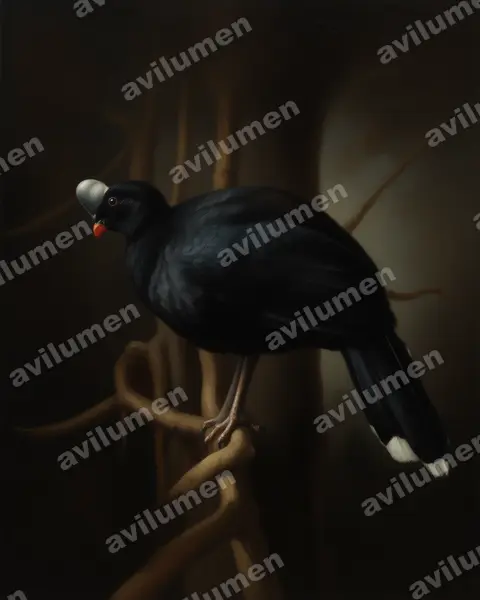
Oil 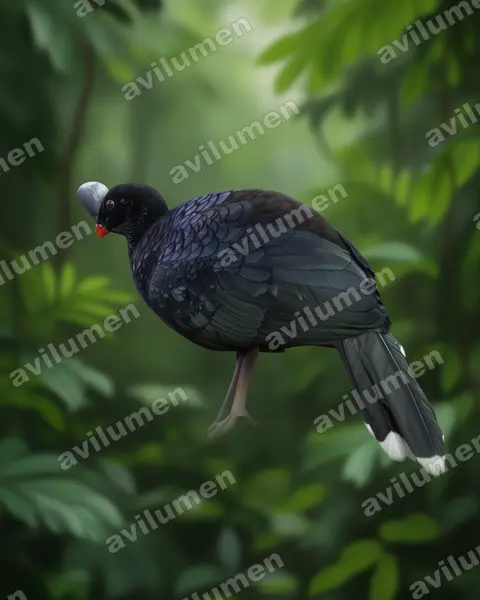
Realistic 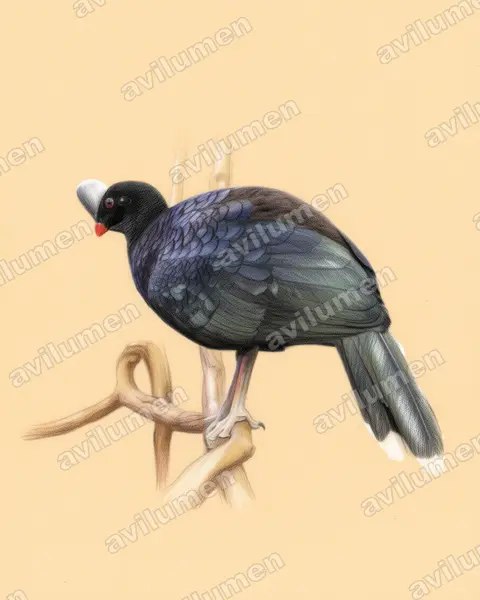
Colored pencil
Illustrations based on the photograph by Greg Hume (CC BY-SA 3.0), from Wikimedia Commons.
Digital editions
HD Digital Art Pack — Helmeted Curassow
Digital download: 6 high-resolution illustrations of the Helmeted Curassow (Pauxi pauxi), print-ready. This is a digital file; no animal or physical item is included.
AI Avatar — Helmeted Curassow
Generate an avatar fusing your face with the Helmeted Curassow (Pauxi pauxi). Delivered digitally in 8K, watermark-free. Digital product; no animals are sold or brokered.
Instant download. No live birds are sold.
Frequently asked questions
- Is Pauxi pauxi (Helmeted Curassow) endangered?
- The IUCN Red List places Pauxi pauxi, commonly known as the Helmeted Curassow, in the «Vulnerable» category. «Vulnerable» means it faces a high risk of extinction in the medium term.
- Where does Pauxi pauxi (Helmeted Curassow) live?
- Pauxi pauxi (Helmeted Curassow) is found in South America.
- What family does Pauxi pauxi (Helmeted Curassow) belong to?
- Pauxi pauxi (Helmeted Curassow) belongs to the family Cracidae, in the order Galliformes.
- What colour is Pauxi pauxi (Helmeted Curassow)?
- The plumage of Pauxi pauxi (Helmeted Curassow) combines these colours: Black and White.
More from the same family
 Least concern
Wattled Guan
Aburria aburri
The wattled guan is a species of bird in the family Cracidae. It is a fairly large black cracid with blue-based, black-tipped beak and a long, red-and-yellow wattle.
from $1.99
 Least concern
Sickle-winged Guan
Chamaepetes goudotii
The sickle-winged guan is a species of bird in the chachalaca, guan, and curassow family Cracidae. It is found in Bolivia, Colombia, Ecuador, and Peru.
from $1.99
 Least concern
Black Guan
Chamaepetes unicolor
The black guan is a species of bird in the chachalaca, guan, and curassow family Cracidae. It is found in Costa Rica and Panama.
from $1.99
 Critically endangered
Blue-billed Curassow
Crax alberti
The blue-billed curassow is a species of bird in the family Cracidae, the chachalacas, guans, and curassows. It is endemic to Colombia.
from $1.99