Rusty-margined Guan
Penelope superciliaris
Avilumen editorial team ·

The rusty-margined guan is a species of bird in the family Cracidae, which includes the chachalacas, guans, and curassows. It is found in Argentina, Bolivia, Brazil, and Paraguay.
The rusty-margined guan (Penelope superciliaris) is a species of bird in the family Cracidae, which includes the chachalacas, guans, and curassows. It is found in Argentina, Bolivia, Brazil, and Paraguay.
Taxonomy and systematics
The International Ornithological Committee (IOC) and the Handbook of the Birds of the World taxonomies recognize the four rusty-margined guan subspecies listed in the box to the right. The Clements taxonomy does not recognize P. s. pseudonyma as separate but includes its population in the nominate subspecies. Birds in Brazil's Alagoas state are distinctive and might be a separate subspecies. The rusty-margined guan and the Marail guan (P. marail) form a superspecies.
Description
The rusty-margined guan is 55 to 73 cm (1.8 to 2.4 ft) long. The nominate subspecies weighs 950 to 1,150 g (2.1 to 2.5 lb) and P. s. jacupemba 750 to 880 g (1.7 to 1.9 lb). The species' upperparts are dark olive to brownish with the eponymous reddish margins on the wing coverts and scapulars. The belly is also rusty. The face is pale with a supercilium whose color ranges from white to buff or ochre in the different subspecies. P. s. jacupemba paler overall than the nominate and P. s. major is darker.
Distribution and habitat
The nominate subspecies of rusty-margined guan is found in Amazonian Brazil south of the Amazon River. P. s. pseudonyma when treated separately is more westerly than the nominate sensu stricto. P. s. jacupemba is found from central and southern Brazil into eastern Bolivia. P. s. major is found in extreme southeastern Brazil, eastern Paraguay, and extreme northeastern Argentina.
The rusty-margined guan inhabits a wide variety of landscapes across its large range. Examples include the interior and edges of heavy forest, gallery forest, restinga, woodlands in cerrado grasslands, caatinga, mangroves, and Eucalyptus plantations. It is generally a bird of the lowlands but can be found as high as 1,300 m (4,300 ft) in parts of Brazil.
Movement
The rusty-margined guan is essentially sedentary, though in some areas birds roost in higher areas and move down to feed with an elevation change of up to 400 m (1,300 ft). It seldom flies more than about 20 m (66 ft) and usually much less.
Feeding
The rusty-margined guan forages alone, in pairs, or in groups of up to 10 birds. It mainly feeds between about 5 and 10 m (16 and 33 ft) above the ground, but often feeds on the ground as well. Its diet is almost entirely fruit; one study identified the fruit of 117 plant species. It also eats small amounts of flowers, leaves, and insects.
Breeding
The rusty-margined guan's breeding season spans October to February in Argentina and August to February in southeastern Brazil; it has not been well defined elsewhere. Its nest is a platform made of sticks lined with live and dead leaves, usually built in a tree. The clutch size is three eggs.
Vocal and non-vocal sounds
The rusty-margined guan gives a wing-whirring display that has not well defined. It gives a "gruff barking" call, probably in alarm but possibly in other contexts as well.
Status
The IUCN has assessed the rusty-margined guan as being Near Threatened. It is reasonably common only in protected areas though even there poaching is a concern.
Text adapted from Wikipedia · CC BY-SA 4.0
Where it lives
Plumage colours
Distribution

Taxonomy
- Order
- Galliformes
- Family
- Cracidae
- Genus
- Penelope
- Conservation status
- Near threatened
Listen to its call
No recording yet
Illustration gallery
6 illustrations of Penelope superciliaris (Rusty-margined Guan) in different styles, true to its real plumage. Shown watermarked; the art pack includes the high-resolution originals, ready to print.
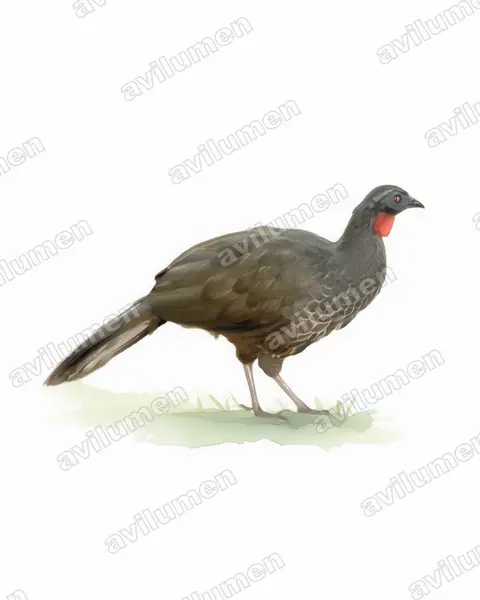
Watercolor 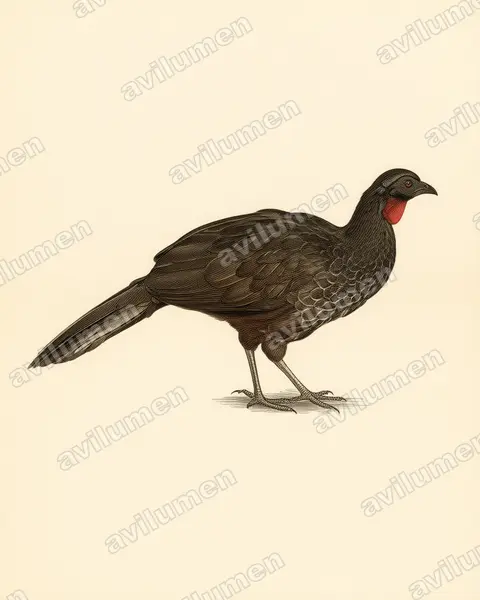
Vintage plate 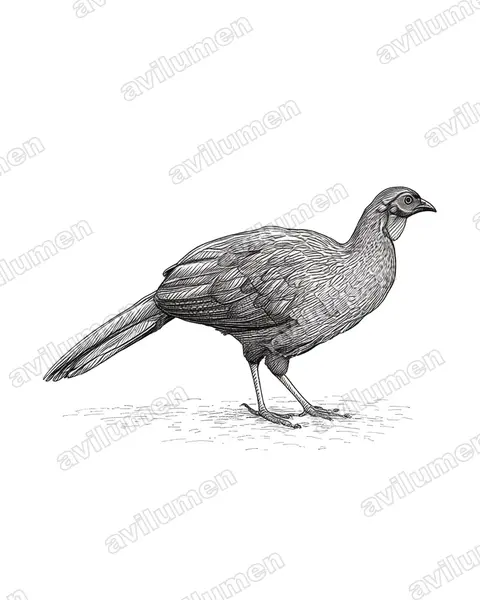
Ink 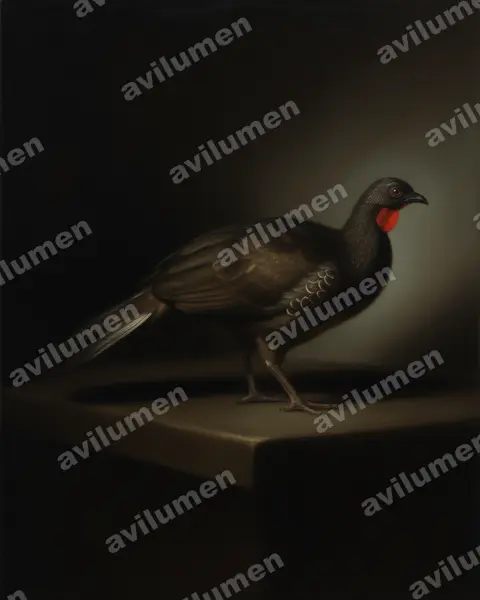
Oil 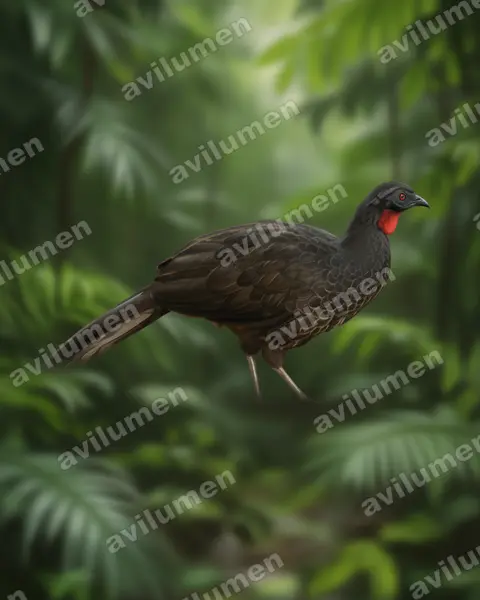
Realistic 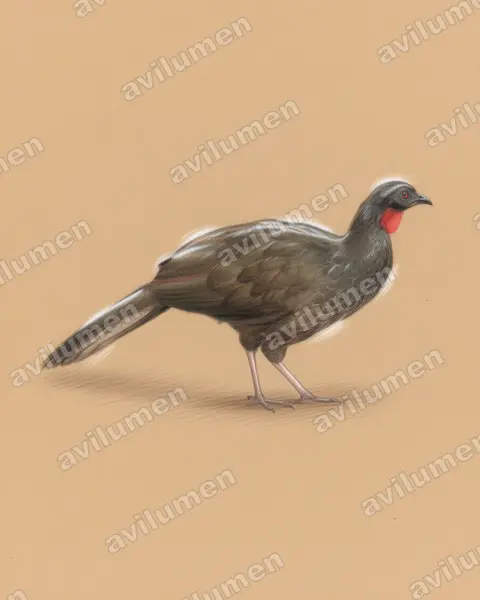
Colored pencil
Illustrations based on the photograph by Zimbres (CC BY-SA 2.5), from Wikimedia Commons.
Digital editions
HD Digital Art Pack — Rusty-margined Guan
Digital download: 6 high-resolution illustrations of the Rusty-margined Guan (Penelope superciliaris), print-ready. This is a digital file; no animal or physical item is included.
AI Avatar — Rusty-margined Guan
Generate an avatar fusing your face with the Rusty-margined Guan (Penelope superciliaris). Delivered digitally in 8K, watermark-free. Digital product; no animals are sold or brokered.
Instant download. No live birds are sold.
Frequently asked questions
- Is Penelope superciliaris (Rusty-margined Guan) endangered?
- The IUCN Red List places Penelope superciliaris, commonly known as the Rusty-margined Guan, in the «Near threatened» category. «Near threatened» means it is not threatened yet, but is close to becoming so.
- Where does Penelope superciliaris (Rusty-margined Guan) live?
- Penelope superciliaris (Rusty-margined Guan) is found in Brazil and South America.
- What family does Penelope superciliaris (Rusty-margined Guan) belong to?
- Penelope superciliaris (Rusty-margined Guan) belongs to the family Cracidae, in the order Galliformes.
- What colour is Penelope superciliaris (Rusty-margined Guan)?
- The plumage of Penelope superciliaris (Rusty-margined Guan) combines these colours: Brown.
More from the same family
 Least concern
Wattled Guan
Aburria aburri
The wattled guan is a species of bird in the family Cracidae. It is a fairly large black cracid with blue-based, black-tipped beak and a long, red-and-yellow wattle.
from $1.99
 Least concern
Sickle-winged Guan
Chamaepetes goudotii
The sickle-winged guan is a species of bird in the chachalaca, guan, and curassow family Cracidae. It is found in Bolivia, Colombia, Ecuador, and Peru.
from $1.99
 Least concern
Black Guan
Chamaepetes unicolor
The black guan is a species of bird in the chachalaca, guan, and curassow family Cracidae. It is found in Costa Rica and Panama.
from $1.99
 Critically endangered
Blue-billed Curassow
Crax alberti
The blue-billed curassow is a species of bird in the family Cracidae, the chachalacas, guans, and curassows. It is endemic to Colombia.
from $1.99