Capuchinbird
Perissocephalus tricolor
Avilumen editorial team ·

The capuchinbird or calfbird is a large passerine bird of the family Cotingidae. It is monotypic within the genus Perissocephalus. It is found in humid forests in north-eastern South America, almost entirely north of the Amazon River and east of Rio Negro.
The capuchinbird or calfbird (Perissocephalus tricolor) is a large passerine bird of the family Cotingidae. It is monotypic within the genus Perissocephalus. It is found in humid forests (up to 1,400 metres (4,600 ft) but mostly below 600 m) in north-eastern South America, almost entirely north of the Amazon River and east of Rio Negro (Colombia, Venezuela, Brazil and The Guianas).
Description
The capuchinbird is a large thick-set suboscine passerine with a relatively heavy bill. Adults weigh between 340 and 420 grams (12 and 15 oz) and are typically around 40 centimetres (16 in) long, making it the largest suboscine passerine, apart from the Amazonian and long-wattled umbrellabirds – indeed, females average larger than any female umbrellabird. Its plumage is overall rich brown, approaching orange on the belly and undertail coverts, and the remiges and short tail are black. The most distinctive feature is its bare, almost vulture-like head covered in dull blue skin. Juveniles resemble adults, with the exception of some downy feathers on the head.
Ecology
They gather in leks where they "sing". The "song" is very odd and difficult to describe accurately, although some have compared it to the distant sound of a chainsaw or (as indicated by its alternative name "calfbird") a young cow mooing. The nest is small and rather scanty and is normally found in close proximity to the lek. Capuchinbirds eat mainly fruits and insects.
Status
The capuchinbird has a very wide distribution and although it is an uncommon bird, its total population is estimated to be large. The population may be in slight decline because of deforestation, but not at a fast enough rate for it to be considered threatened, so the International Union for Conservation of Nature has rated its conservation status as being of "least concern".
Text adapted from Wikipedia · CC BY-SA 4.0
Where it lives
Distribution

Taxonomy
- Order
- Passeriformes
- Family
- Cotingidae
- Genus
- Perissocephalus
- Conservation status
- Least concern
Listen to its call
No recording yet
Illustration gallery
6 illustrations of Perissocephalus tricolor (Capuchinbird) in different styles, true to its real plumage. Shown watermarked; the art pack includes the high-resolution originals, ready to print.
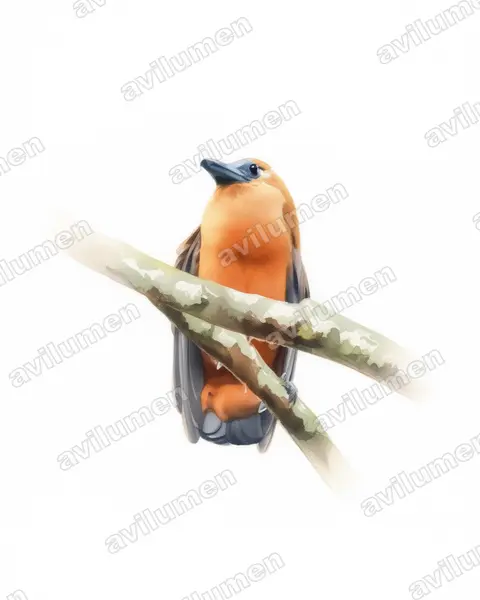
Watercolor 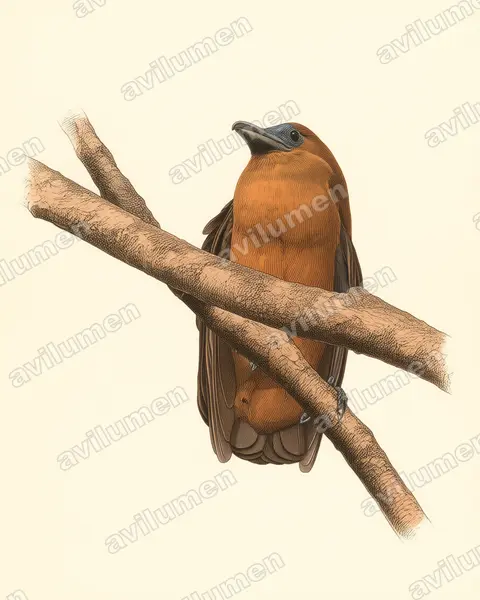
Vintage plate 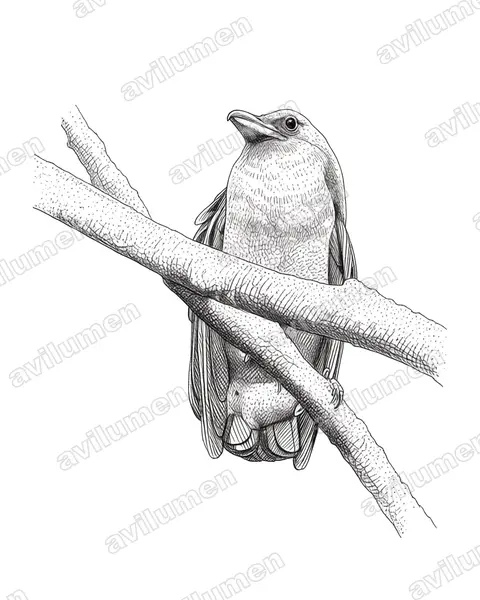
Ink 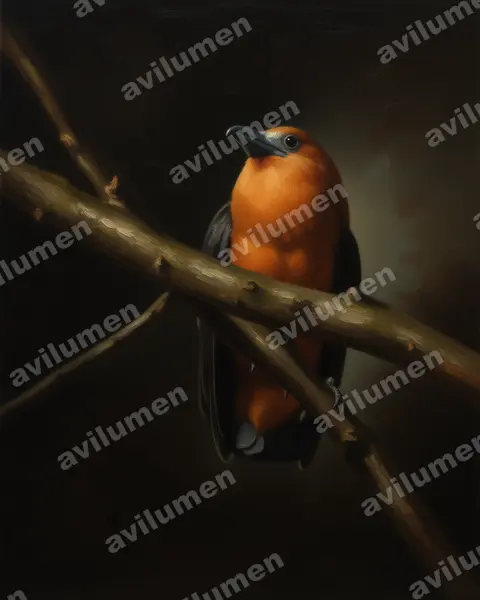
Oil 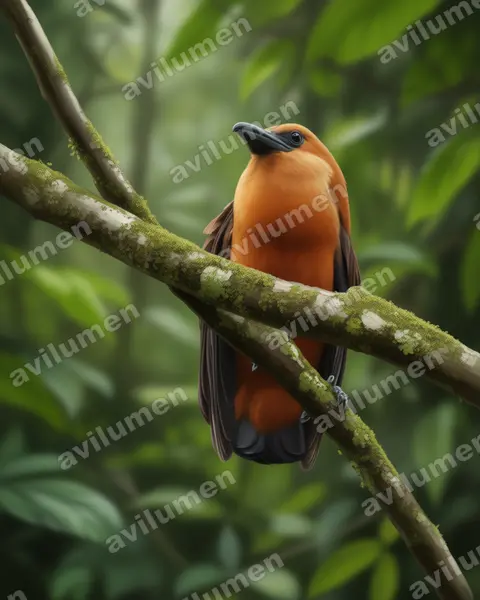
Realistic 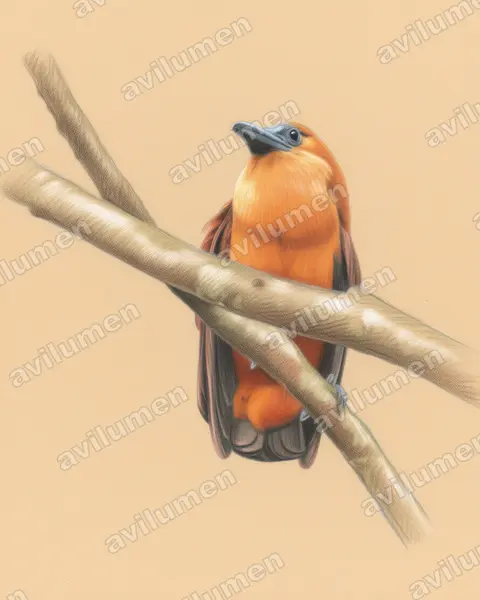
Colored pencil
Illustrations based on the photograph by Hector Bottai (CC BY-SA 4.0), from Wikimedia Commons.
Digital editions
HD Digital Art Pack — Capuchinbird
Digital download: 6 high-resolution illustrations of the Capuchinbird (Perissocephalus tricolor), print-ready. This is a digital file; no animal or physical item is included.
AI Avatar — Capuchinbird
Generate an avatar fusing your face with the Capuchinbird (Perissocephalus tricolor). Delivered digitally in 8K, watermark-free. Digital product; no animals are sold or brokered.
Instant download. No live birds are sold.
Frequently asked questions
- Is Perissocephalus tricolor (Capuchinbird) endangered?
- The IUCN Red List places Perissocephalus tricolor, commonly known as the Capuchinbird, in the «Least concern» category. «Least concern» means it is not currently threatened.
- Where does Perissocephalus tricolor (Capuchinbird) live?
- Perissocephalus tricolor (Capuchinbird) is found in Brazil and South America.
- What family does Perissocephalus tricolor (Capuchinbird) belong to?
- Perissocephalus tricolor (Capuchinbird) belongs to the family Cotingidae, in the order Passeriformes.
- What colour is Perissocephalus tricolor (Capuchinbird)?
- The plumage of Perissocephalus tricolor (Capuchinbird) combines these colours: Brown and Black.
More from the same family
 Least concern
Scaled Fruiteater
Ampelioides tschudii
The scaled fruiteater is a species of bird in the family Cotingidae. It is the only member of the genus Ampelioides. This bird is found in Bolivia, Colombia, Ecuador, Peru, and Venezuela, where its natural habitat is the high elevation tropical forests of the Andes mountains. The scaled fruiteater is a chunky, short-tailed, flat-headed bird measuring 19–20 cm (7.5–7.9 in) in length.
from $1.99
 Least concern
Red-crested Cotinga
Ampelion rubrocristatus
The red-crested cotinga is a species of bird in the family Cotingidae. It is found in Bolivia, Colombia, Ecuador, Peru, and Venezuela.
from $1.99
 Least concern
Chestnut-crested Cotinga
Ampelion rufaxilla
The chestnut-crested cotinga is a species of bird in the family Cotingidae. It is found in Bolivia, Colombia, Ecuador, and Peru.
from $1.99
 Critically endangered
Kinglet Calyptura
Calyptura cristata
The kinglet calyptura is a small Critically Endangered passerine bird in the family Tyrannidae, the tyrant flycatchers. It is endemic to southeastern Brazil.
from $1.99