Reddish hermit
Phaethornis ruber
Avilumen editorial team ·

The reddish hermit is a species of bird in the family Trochilidae, the hummingbirds. It is found in Bolivia, Brazil, Colombia, Ecuador, Peru, Venezuela, and the Guianas.
The reddish hermit (Phaethornis ruber) is a species of bird in the family Trochilidae, the hummingbirds. It is found in Bolivia, Brazil, Colombia, Ecuador, Peru, Venezuela, and the Guianas.
Taxonomy and systematics
In 1743 the English naturalist George Edwards included a picture and a description of the reddish hermit in his A Natural History of Uncommon Birds. He used the English name "The little brown huming-bird". Edwards based his etching on a specimen owned by the Duke of Richmond that had been collected in Suriname. When in 1758 the Swedish naturalist Carl Linnaeus updated his Systema Naturae for the tenth edition, he placed the reddish hermit with the hummingbirds in the genus Trochilus. Linnaeus included a brief description, coined the binomial name Trochilus ruber, and cited Edwards' work. The specific epithet ruber is a Latin word meaning "red". The type locality is Suriname. The reddish hermit is now placed in the genus Phaethornis that was introduced in 1827 by William Swainson. The reddish hermit has sometimes been considered conspecific with the white-browed hermit (P. stuarti).
Four subspecies are recognised:
P. r. episcopus Gould, 1857
P. r. ruber (Linnaeus, 1758)
P. r. nigricinctus Lawrence, 1858
P. r. longipennis Berlepsch & Stolzmann, 1902
Some introgression has been noted between the nominate P. r. ruber and P. r. longipennis. P. r. episcopus and P. r. nigricinctus might actually be separate species but data to confirm the hypothesis are lacking. The population of P. r. ruber in southeastern Brazil has been proposed as a separate subspecies P. r. pygmaeus but its apparent differences are within the range of variation in the rest of ruber.
Description
The reddish hermit is 8 to 9 cm (3.1 to 3.5 in) long and weighs 1.8 to 3 g (0.06 to 0.11 oz). All subspecies are generally dark green and rufous on the upperparts and cinnamon rufous on the underparts. Males have a black band on the chest and the tail feather have narrow white or reddish tips. Females have lighter underparts than the males. P. r. episcopus is about the same size as the nominate but has orange-rufous rather than cinnamon-rufous underparts and white tips to the tail. P. r. nigricinctus is the smallest subspecies; it has the richest rufous underparts. P. r. longipennis is the largest subspecies. It has a whitish chin and its central tail feathers have rufous tips.
Distribution and habitat
The subspecies of reddish hermit are distributed thus:
P. r. episcopus, central and eastern Venezuela, Guyana, and northwestern Brazil's Roraima state
P. r. ruber, Suriname and French Guiana through Brazil as far south as northern Paraná state and in the west to southeastern Peru and northern Bolivia.
P. r. nigricinctus, eastern and southern Colombia and extreme southwestern Venezuela south through eastern Ecuador into northeastern Peru and northwestern Brazil.
P. r. longipennis, southeastern Peru from the department of Pasco to northern Cuzco.
Movement
The reddish hermit is assumed to be sedentary.
Feeding
The reddish hermit is a "trap-line" feeder like other hermit hummingbirds, visiting a circuit of many species of flowering plants for nectar. It also consumes small arthropods. Nectar robbing by piercing the base of a flower has been regularly observed in southeastern Brazil.
Breeding
The reddish hermit's breeding seasons vary throughout its large range; in general in the north it is within May to October and in the south within October to February. The nest is a cone-shaped cup made of plant fibers, mosses, lichens, other plant material, and spider web. It is attached under a drooping leaf. The clutch size is two eggs and the female alone incubates them.
Vocalization
The reddish hermit's song is "a high-pitched phrase repeated incessantly with clear pauses between phrases...evenly-spaced, slightly descending, single notes followed by a number of accelerating descending notes, e.g. 'tsee....tsee...tsee...tsee.tse.tsitsi'." It frequently sings for long periods at leks. It has "long whining calls" made while hovering and a "stip!" flight call.
Status
The IUCN has assessed the reddish hermit as being of Least Concern, though its population size is unknown and is believed to be decreasing. It has a very large range, is considered "locally common to abundant", and occurs in several protected areas.
Text adapted from Wikipedia · CC BY-SA 4.0
Where it lives
Distribution

Taxonomy
- Order
- Apodiformes
- Family
- Trochilidae
- Genus
- Phaethornis
- Conservation status
- Least concern
Listen to its call
No recording yet
Illustration gallery
6 illustrations of Phaethornis ruber (Reddish hermit) in different styles, true to its real plumage. Shown watermarked; the art pack includes the high-resolution originals, ready to print.
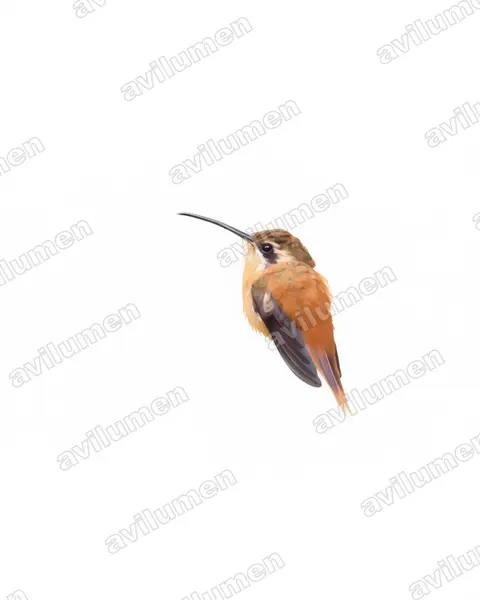
Watercolor 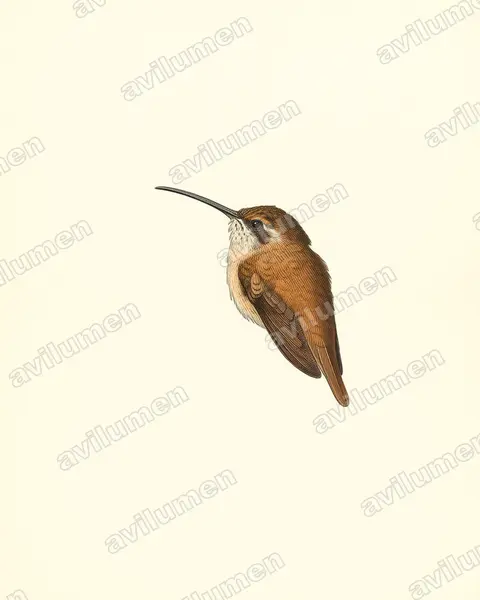
Vintage plate 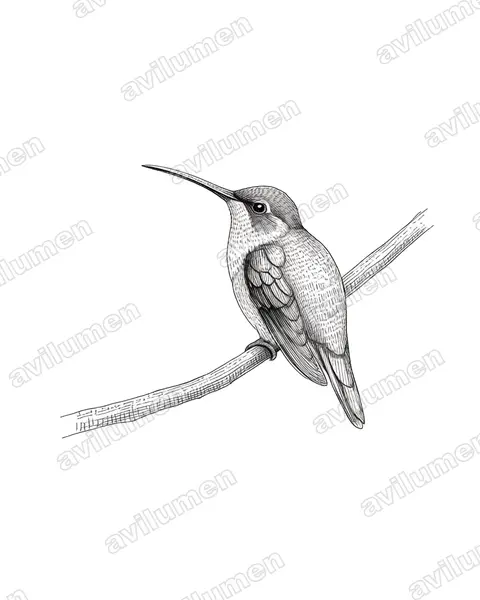
Ink 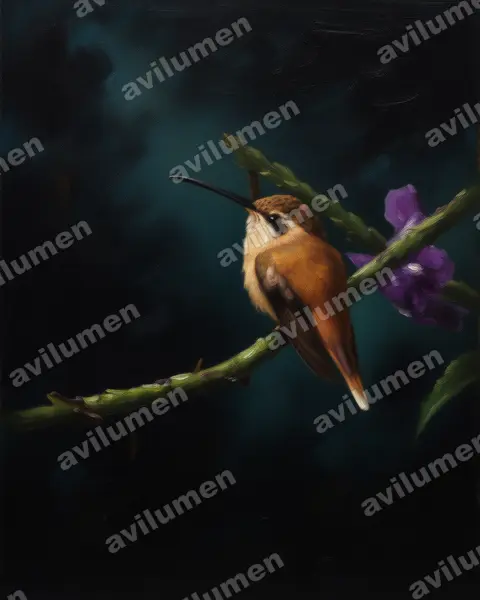
Oil 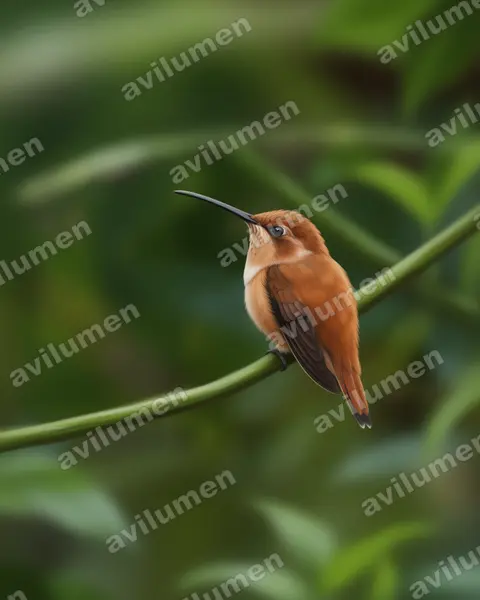
Realistic 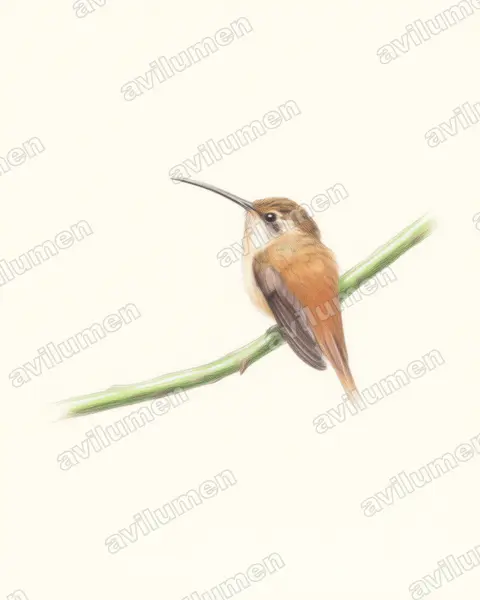
Colored pencil
Illustrations based on the photograph by https://www.flickr.com/photos/jquental (CC BY 2.0), from Wikimedia Commons.
Digital editions
HD Digital Art Pack — Reddish hermit
Digital download: 6 high-resolution illustrations of the Reddish hermit (Phaethornis ruber), print-ready. This is a digital file; no animal or physical item is included.
AI Avatar — Reddish hermit
Generate an avatar fusing your face with the Reddish hermit (Phaethornis ruber). Delivered digitally in 8K, watermark-free. Digital product; no animals are sold or brokered.
Instant download. No live birds are sold.
Frequently asked questions
- Is Phaethornis ruber (Reddish hermit) endangered?
- The IUCN Red List places Phaethornis ruber, commonly known as the Reddish hermit, in the «Least concern» category. «Least concern» means it is not currently threatened.
- Where does Phaethornis ruber (Reddish hermit) live?
- Phaethornis ruber (Reddish hermit) is found in Brazil and South America.
- What family does Phaethornis ruber (Reddish hermit) belong to?
- Phaethornis ruber (Reddish hermit) belongs to the family Trochilidae, in the order Apodiformes.
- What colour is Phaethornis ruber (Reddish hermit)?
- The plumage of Phaethornis ruber (Reddish hermit) combines these colours: Red and Brown.
More from the same family
 Least concern
Emerald-chinned Hummingbird
Abeillia abeillei
The emerald-chinned hummingbird is a species of hummingbird in the "emeralds", tribe Trochilini of subfamily Trochilinae.
from $1.99
 Least concern
Speckled hummingbird
Adelomyia melanogenys
The speckled hummingbird is a species of hummingbird. It is the only member of the genus Adelomyia. It inhabits Neotropical montane cloud forests at elevations of 1,000–2,500 meters and is confined to the Andes of Argentina, Bolivia, Peru, Ecuador, Colombia and Venezuela; as well as to some isolated montane forests in western Ecuador and Venezuela.
from $1.99
 Vulnerable
Purple-backed sunbeam
Aglaeactis aliciae
The purple-backed sunbeam is a bird species in the family Trochilidae. It is found only in Peru.
from $1.99
 Near threatened
White-tufted sunbeam
Aglaeactis castelnaudii
The white-tufted sunbeam is a species of hummingbird in the family Trochilidae. It is found only in Peru. Its natural habitats are subtropical or tropical moist montane forest and subtropical or tropical high-altitude shrubland.
from $1.99