Speckle-faced Parrot
Pionus tumultuosus
Avilumen editorial team ·

The plum-crowned parrot or plum-crowned pionus is a species of bird in subfamily Arinae of the family Psittacidae, the African and New World parrots. It is found in Bolivia and Peru.
The plum-crowned parrot (Pionus tumultuosus) or plum-crowned pionus is a species of bird in subfamily Arinae of the family Psittacidae, the African and New World parrots. It is found in Bolivia and Peru.
Taxonomy and systematics
The plum-crowned parrot's taxonomy has not been settled. The International Ornithological Committee and BirdLife International's Handbook of the Birds of the World consider it to be a full species. The South American Classification Committee of the American Ornithological Society (SACC) and the Clements taxonomy treat it and the white-capped parrot (P. seniloides) as subspecies of the speckle-faced parrot under the binomial P. tumultuosus. The SACC declined to split the speckle-faced in 2005 but recognizes that a 2007 study suggests that the split is valid.
Description
The plum-crowned parrot is 29 to 30 cm (11 to 12 in) long and weighs about 229 g (8.1 oz). Adults' forehead and crown are plum and the rest of their face, their throat, and their breast are dull purple with plum pink flecks. Their back, wings, and belly are green. Their undertail coverts and the base of their tail are red; the rest of their tail is green with some blue on the outer feathers. Their bill is pale yellowish horn-colored, their iris dark with grayish skin around it, and their legs and feet gray. Immature birds have a brownish green crown and breast, white speckles on their ear coverts, and yellowish green undertail coverts.
Distribution and habitat
The plum-crowned parrot is found on the east side of the Andes from the Department of Huánuco in central Peru east through Bolivia into Santa Cruz Department. It inhabits humid subtropical forest and cloudforest, especially areas with bamboo, and visits nearby agricultural areas as well. In elevation it mostly occurs between 2,000 and 3,300 m (6,600 and 10,800 ft).
Movement
The plum-crowned parrot is somewhat nomadic.
Feeding
Little is known about the plum-crowned parrot's foraging behavior or diet. It is known to feed on fruits; those of Turpinia paniculata and members of family Clusiaceae have been identified. It also feeds in maize fields.
Breeding
The plum-crowned parrot is thought to breed in November and December. Its breeding biology in the wild is not known; in captivity its clutch size is four eggs and the incubation period is about 26 days. In the wild it is assumed to nest in tree cavities like others of its genus.
Vocalization
The plum-crowned parrot's flight call is "a low, harsh crrah." It makes a variety of "conversational" calls, some of them nasal, when perched.
Status
The IUCN has assessed the plum-crowned parrot as being of Least Concern. It has a fairly large range but its population size is not known and is believed to be decreasing. No immediate threats have been identified. It is considered "[g]enerally uncommon and local".
Text adapted from Wikipedia · CC BY-SA 4.0
Where it lives
Taxonomy
- Order
- Psittaciformes
- Family
- Psittacidae
- Genus
- Pionus
- Conservation status
- Least concern
Listen to its call
No recording yet
Care guide
Amazon, African Grey and Eclectus Parrot Care Guide
How to care for Amazon parrots, African greys, eclectus and pionus: diet, cage setup, health, behavior and CITES requirements for medium and large parrots.
Read the guide →Illustration gallery
6 illustrations of Pionus tumultuosus (Speckle-faced Parrot) in different styles, true to its real plumage. Shown watermarked; the art pack includes the high-resolution originals, ready to print.
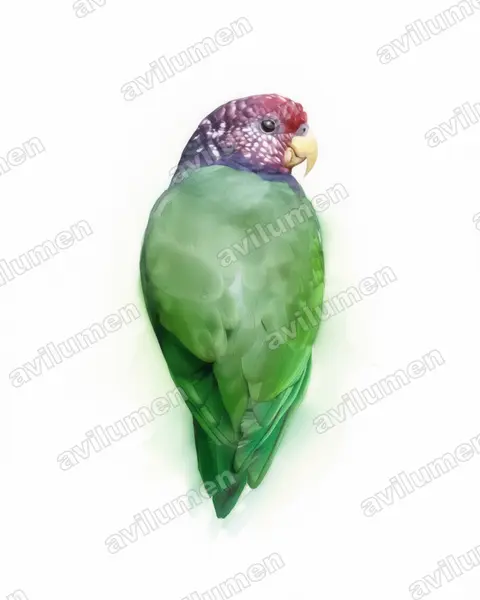
Watercolor 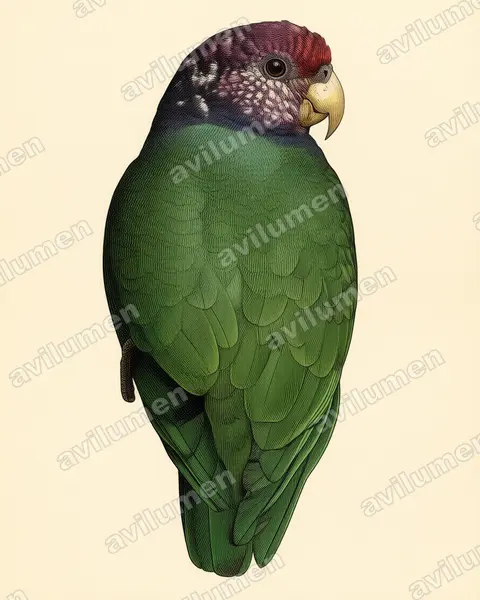
Vintage plate 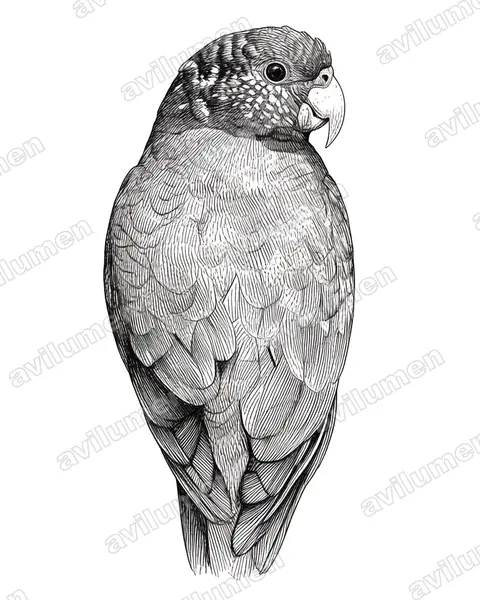
Ink 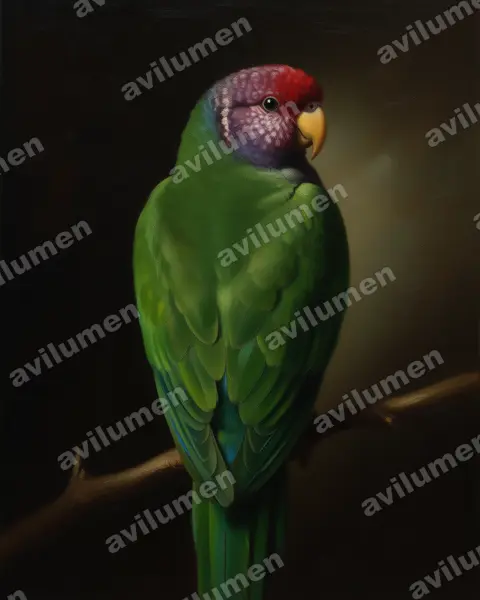
Oil 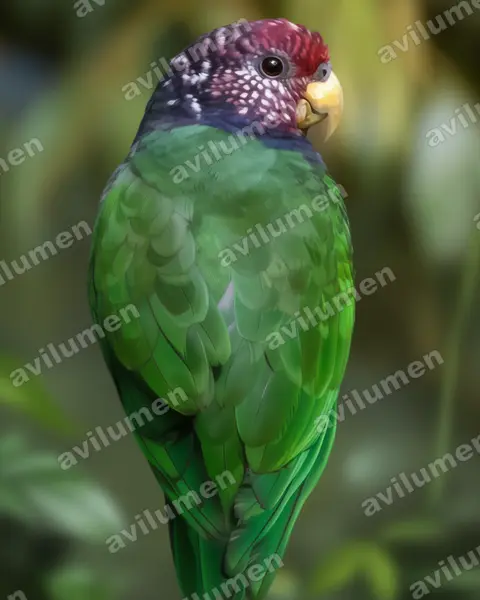
Realistic 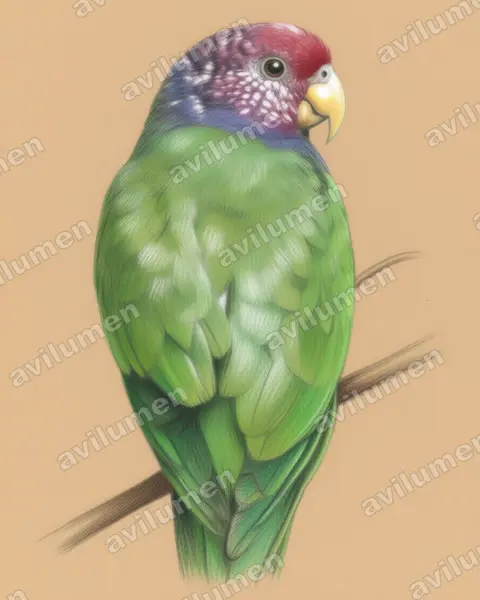
Colored pencil
Illustrations based on the photograph by thibaudaronson (CC BY-SA 4.0), from Wikimedia Commons.
Digital editions
HD Digital Art Pack — Speckle-faced Parrot
Digital download: 6 high-resolution illustrations of the Speckle-faced Parrot (Pionus tumultuosus), print-ready. This is a digital file; no animal or physical item is included.
AI Avatar — Speckle-faced Parrot
Generate an avatar fusing your face with the Speckle-faced Parrot (Pionus tumultuosus). Delivered digitally in 8K, watermark-free. Digital product; no animals are sold or brokered.
Instant download. No live birds are sold.
Frequently asked questions
- Is Pionus tumultuosus (Speckle-faced Parrot) endangered?
- The IUCN Red List places Pionus tumultuosus, commonly known as the Speckle-faced Parrot, in the «Least concern» category. «Least concern» means it is not currently threatened.
- Where does Pionus tumultuosus (Speckle-faced Parrot) live?
- Pionus tumultuosus (Speckle-faced Parrot) is found in South America.
- What family does Pionus tumultuosus (Speckle-faced Parrot) belong to?
- Pionus tumultuosus (Speckle-faced Parrot) belongs to the family Psittacidae, in the order Psittaciformes.
- What colour is Pionus tumultuosus (Speckle-faced Parrot)?
- The plumage of Pionus tumultuosus (Speckle-faced Parrot) combines these colours: Green and Brown.
More from the same family
 Near threatened
Yellow-faced Parrot
Alipiopsitta xanthops
The yellow-faced parrot, formerly also known as the yellow-faced amazon, is the only species of the genus Alipiopsitta. It is a Neotropical parrot, and was classified in the genus Amazona for many years. It is a predominantly green and yellow-plumaged bird with a yellow head. It is a semi-nomadic species found in the cerrado region of Brazil and adjacent Bolivia.
from $1.99
 Least concern
Moluccan King Parrot
Alisterus amboinensis
The Moluccan king parrot is a parrot endemic to Peleng Island, Maluku, and West Papua in Indonesia. It is sometimes referred to as the Ambon king parrot or Amboina king parrot, but this is potentially misleading, as it is found on numerous other islands than Ambon. The male and female are similar in appearance, with a predominantly red head and underparts, green wings, and blue back and tail.
from $1.99
 Least concern
Papuan King Parrot
Alisterus chloropterus
The Papuan king parrot, also known as the green-winged king parrot, is a species of parrot in the family Psittaculidae found in New Guinea. Its natural habitats are subtropical or tropical moist lowland forest and subtropical or tropical moist montane forest.
from $1.99
 Least concern
Australian King Parrot
Alisterus scapularis
The Australian king parrot is a species of parrot endemic to eastern Australia ranging from Cooktown in Queensland to Port Campbell in Victoria. Found in humid and heavily forested upland regions of the eastern portion of the continent, including eucalyptus wooded areas in and directly adjacent to subtropical and temperate rainforest. They feed on fruits and seeds gathered from trees or on the ground.
from $1.99