Trinidad Piping Guan
Pipile pipile
Avilumen editorial team ·

The Trinidad piping guan locally known as the pawi, is a bird in the chachalaca, guan and curassow family Cracidae, endemic to the island of Trinidad. It is a large bird, somewhat resembling a turkey in appearance, and research has shown that its nearest living relative is the blue-throated piping guan from South America. It is a mainly arboreal species feeding mostly on fruit, but also on flowers and leaves.
The Trinidad piping guan (Pipile pipile) locally known as the pawi, is a bird in the chachalaca, guan and curassow family Cracidae, endemic to the island of Trinidad. It is a large bird, somewhat resembling a turkey in appearance, and research has shown that its nearest living relative is the blue-throated piping guan from South America. It is a mainly arboreal species feeding mostly on fruit, but also on flowers and leaves. At one time abundant, it has declined in numbers and been extirpated from much of its natural range and the International Union for Conservation of Nature has rated the bird as "critically endangered".
Description
This is a medium-sized cracid, 60 cm in length, and similar in general appearance to a turkey, with a thin neck and small head. It is mainly black with a purple gloss. The large crest is blackish, edged with white, and there are large white wing patches. The bare face and wattle are blue, and the legs are red.
The Trinidad piping guan's call is a thin piping. The wings whirr in flight.
Ecology
They are forest birds, and the nest is built in a tree. Three large white eggs are laid, the female alone incubating. This arboreal species feeds on fruit and berries (such as those from the fragrant nutmeg and baboonwood), as well as flowers and leaves. The confirmation of small insects being a part of their diet has not been made yet.
Taxonomy
Data confirms that the other blue-wattled species, the blue-throated piping guan, is the Trinidad species' closest living relative. The same data suggests that these diverged some 400,000 years ago at latest, perhaps as early as 1.6 mya, whereas Trinidad has been an island only since the end of the last ice age. This indicates that the Trinidad piping guan evolved in mainland South America, being driven to its relict island range in more recent times. The holotype of this species was supposedly collected in the "Orinoco River [region] near Cumaná" (del Hoyo 1994a,b). This locality has usually been considered erroneous. However, as it indicates an area on the mainland roughly opposite Trinidad, it might actually be correct and indicate that the Trinidad piping guan was not extirpated from Venezuela until around 1800. In South America, the form cumanensis has a greenish gloss to the plumage, a white face and crest, and a blue wattle, cujubi has a blue face and a red wattle, and jacutinga has a black face and a red wattle."
Status
This species is found only in Trinidad where it was once abundant throughout the Northern Range and the southern Trinity Hills, and also occurred in lowland areas such as the Nariva Swamp and Aripo Savannas. It is threatened by illegal hunting and to a lesser extent by habitat destruction. It is now absent from the lowlands, and almost certainly extinct in the Trinity Hills where surveys have failed to find it since 1994. There is a credible report of a sighting in 2000 in the Northern Range and there are 200 to 350 km2 (77 to 135 mi2) of suitable habitat there so the International Union for Conservation of Nature has rated the bird as "critically endangered".
Text adapted from Wikipedia · CC BY-SA 4.0
Where it lives
Distribution

Taxonomy
- Order
- Galliformes
- Family
- Cracidae
- Genus
- Pipile
- Conservation status
- Critically endangered
Listen to its call
No recording yet
Illustration gallery
6 illustrations of Pipile pipile (Trinidad Piping Guan) in different styles, true to its real plumage. Shown watermarked; the art pack includes the high-resolution originals, ready to print.
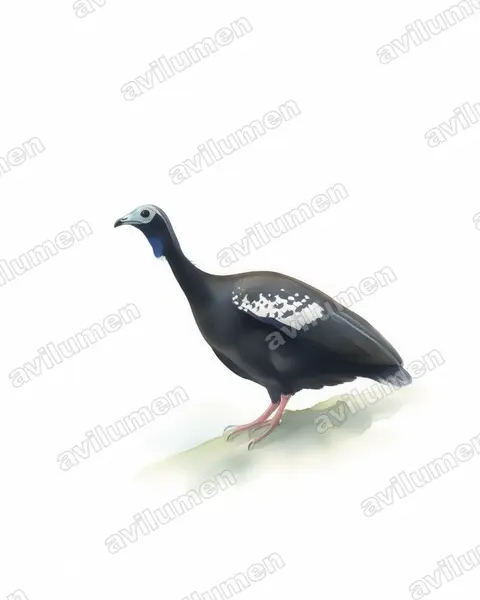
Watercolor 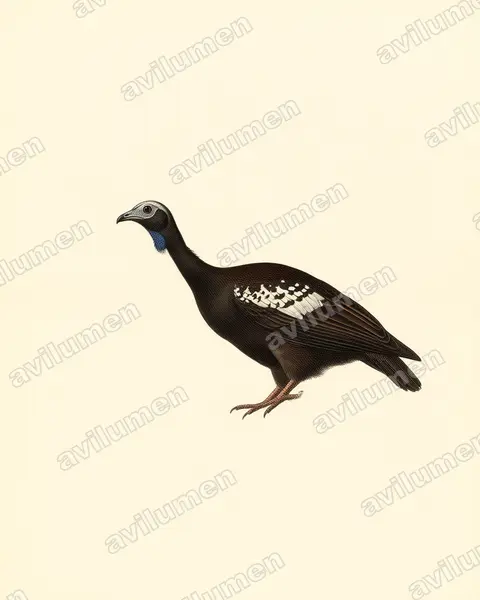
Vintage plate 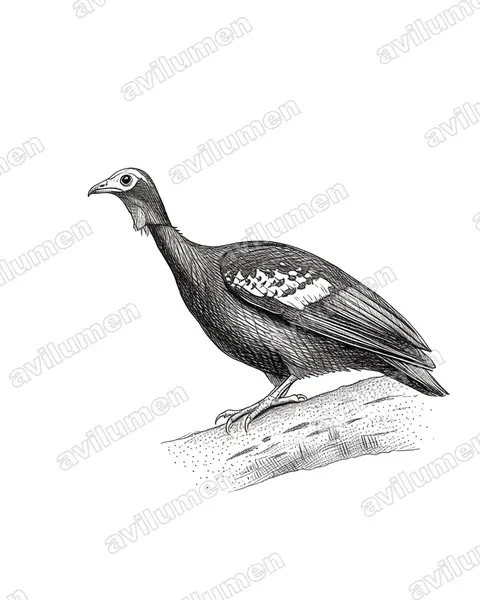
Ink 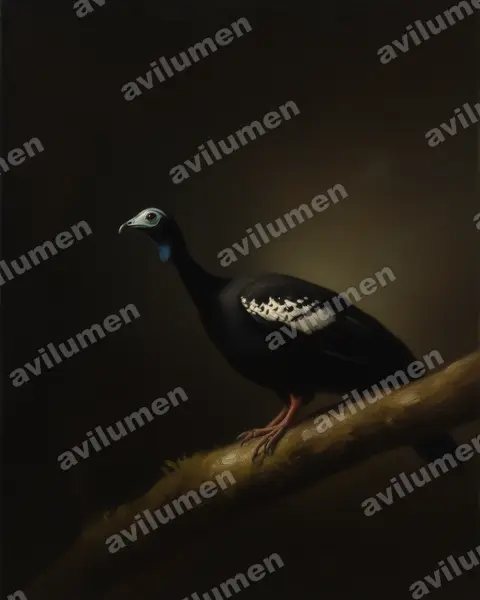
Oil 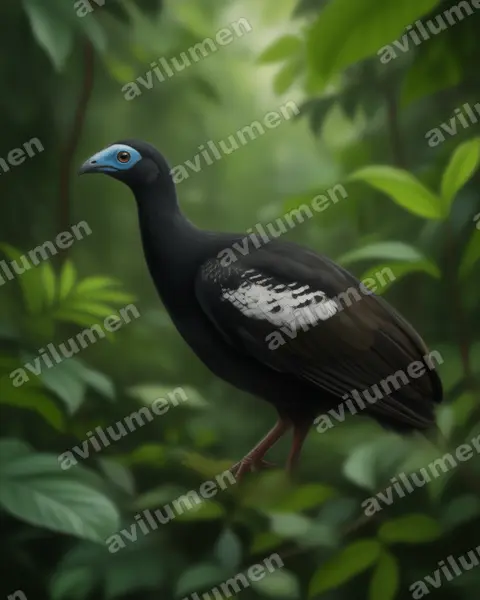
Realistic 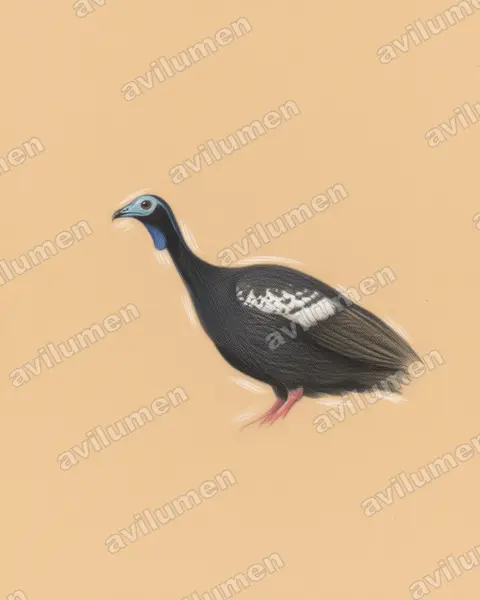
Colored pencil
Illustrations based on the photograph by Alastair Rae (CC BY-SA 2.0), from Wikimedia Commons.
Digital editions
HD Digital Art Pack — Trinidad Piping Guan
Digital download: 6 high-resolution illustrations of the Trinidad Piping Guan (Pipile pipile), print-ready. This is a digital file; no animal or physical item is included.
AI Avatar — Trinidad Piping Guan
Generate an avatar fusing your face with the Trinidad Piping Guan (Pipile pipile). Delivered digitally in 8K, watermark-free. Digital product; no animals are sold or brokered.
Instant download. No live birds are sold.
Frequently asked questions
- Is Pipile pipile (Trinidad Piping Guan) endangered?
- The IUCN Red List places Pipile pipile, commonly known as the Trinidad Piping Guan, in the «Critically endangered» category. «Critically endangered» is the highest threat level before extinction.
- Where does Pipile pipile (Trinidad Piping Guan) live?
- Pipile pipile (Trinidad Piping Guan) is found in South America.
- What family does Pipile pipile (Trinidad Piping Guan) belong to?
- Pipile pipile (Trinidad Piping Guan) belongs to the family Cracidae, in the order Galliformes.
- What colour is Pipile pipile (Trinidad Piping Guan)?
- The plumage of Pipile pipile (Trinidad Piping Guan) combines these colours: Brown and Black.
More from the same family
 Least concern
Wattled Guan
Aburria aburri
The wattled guan is a species of bird in the family Cracidae. It is a fairly large black cracid with blue-based, black-tipped beak and a long, red-and-yellow wattle.
from $1.99
 Least concern
Sickle-winged Guan
Chamaepetes goudotii
The sickle-winged guan is a species of bird in the chachalaca, guan, and curassow family Cracidae. It is found in Bolivia, Colombia, Ecuador, and Peru.
from $1.99
 Least concern
Black Guan
Chamaepetes unicolor
The black guan is a species of bird in the chachalaca, guan, and curassow family Cracidae. It is found in Costa Rica and Panama.
from $1.99
 Critically endangered
Blue-billed Curassow
Crax alberti
The blue-billed curassow is a species of bird in the family Cracidae, the chachalacas, guans, and curassows. It is endemic to Colombia.
from $1.99