Brown-necked Parrot
Poicephalus fuscicollis
Avilumen editorial team ·

The brown-necked parrot, sometimes known in aviculture as the uncape parrot, is a large Poicephalus parrot species endemic to Africa.
The brown-necked parrot (Poicephalus fuscicollis), sometimes known in aviculture as the uncape parrot, is a large Poicephalus parrot species endemic to Africa.
It consists of two subspecies: the savanna-dwelling brown-necked parrot (P. fuscicollis fuscicollis) and grey-headed parrot (P. f. suahelicus) subspecies. It formerly included the Cape parrot (now Poicephalus robustus) as a subspecies before the Cape parrot was re-classified as a distinct species.
Taxonomy
German naturalist Heinrich Kuhl described the brown-necked parrot in his 1819 work Conspectus Psittacorum. Although unsure of its country of origin, he felt it was definitely a distinct species and related to the Cape parrot. The species name is from the Latin words fuscus "dark" and collum "neck".
South Africa-based ornithologist Phillip Clancey proposed the Cape and brown-necked parrots were separate species in 1997 based on the shape and size of the bill, head coloration and preferred habitat. Mike Perrin observed that species status would facilitate protection of the endangered Cape parrot. Genetic analysis of the three taxa published in 2015 supported the distinctness of brown-necked and cape parrots, showing that ancestors of the two had diverged between 2.13 and 2.67 million years ago—in the late Pliocene to early Pleistocene epoch. This period was a period of changes in climate, where grassland and forest were expanding and contracting, which led to isolation and eventually speciation of separate populations.
The old name for the three taxa was Cape parrot, with virtually all the individuals in captivity belonging to what became P. fuscicollis. Jean Pattison called them Uncape parrots because of this.
Description
The largest member of its genus, the brown-necked parrot has a relatively large head and bill, and stocky build. It has a light grey head. The nominate subspecies fuscicollis has a bluer sheen to its plumage than suahelicus. The upperparts are yellow-green and underparts greenish.
Distribution
Subspecies fuscicollis is found in west Africa from Gambia and southern Senegal to Ghana and Togo. Locally common in places, it appears to have declined in Senegal and Gambia. Subspecies suahelicus is found in southern Africa from southern Congo and Tanzania to northern Namibia and south to northern South Africa.
Aviculture
The species adapts readily to captivity and is seen in the pet trade. They are highly intelligent and are known for mimicking sounds as well as human speech.
Text adapted from Wikipedia · CC BY-SA 4.0
Distribution

Taxonomy
- Order
- Psittaciformes
- Family
- Psittacidae
- Genus
- Poicephalus
- Conservation status
- Least concern
Listen to its call
No recording yet
Care guide
Amazon, African Grey and Eclectus Parrot Care Guide
How to care for Amazon parrots, African greys, eclectus and pionus: diet, cage setup, health, behavior and CITES requirements for medium and large parrots.
Read the guide →Illustration gallery
6 illustrations of Poicephalus fuscicollis (Brown-necked Parrot) in different styles, true to its real plumage. Shown watermarked; the art pack includes the high-resolution originals, ready to print.
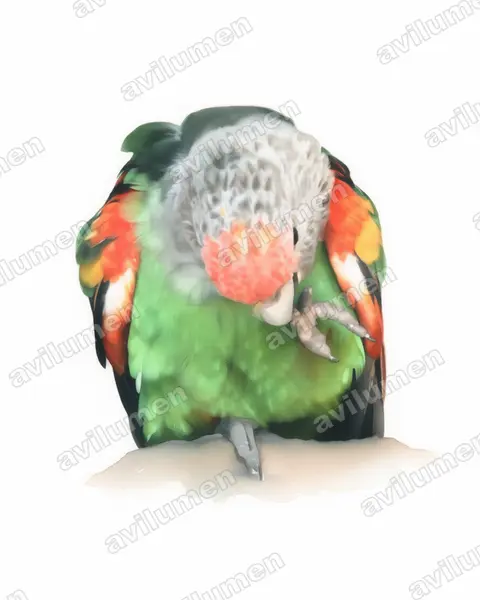
Watercolor 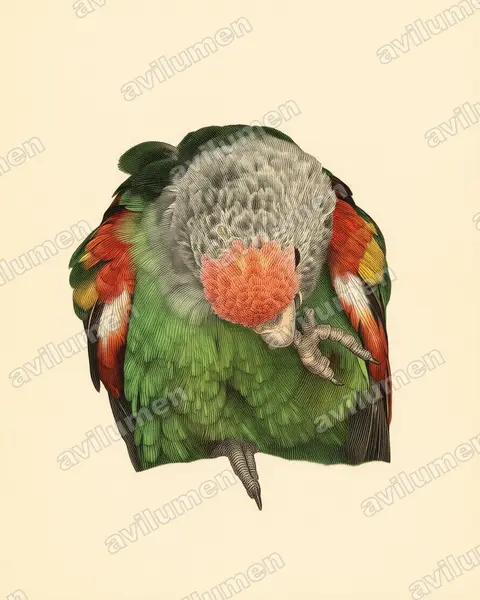
Vintage plate 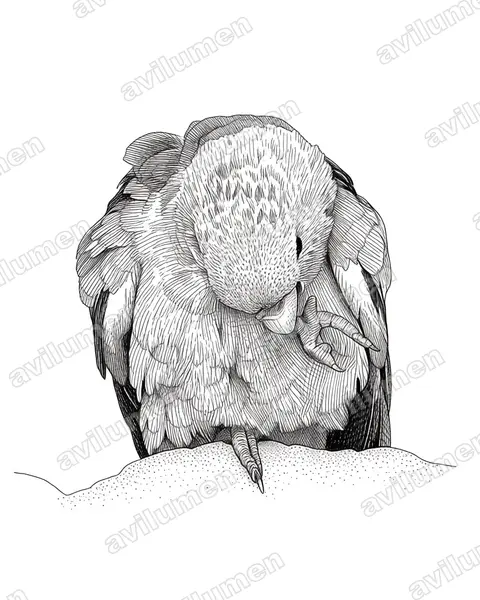
Ink 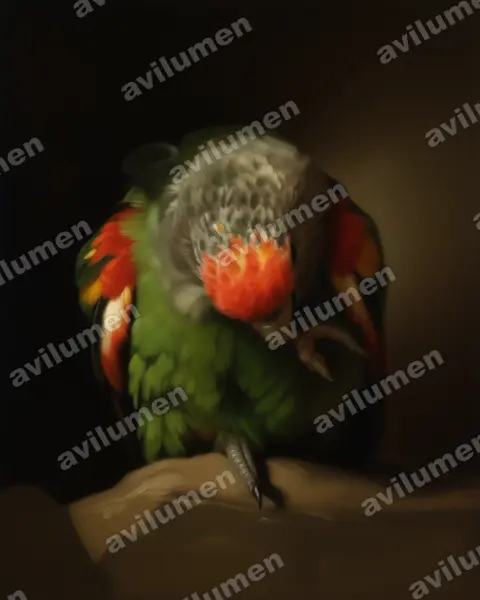
Oil 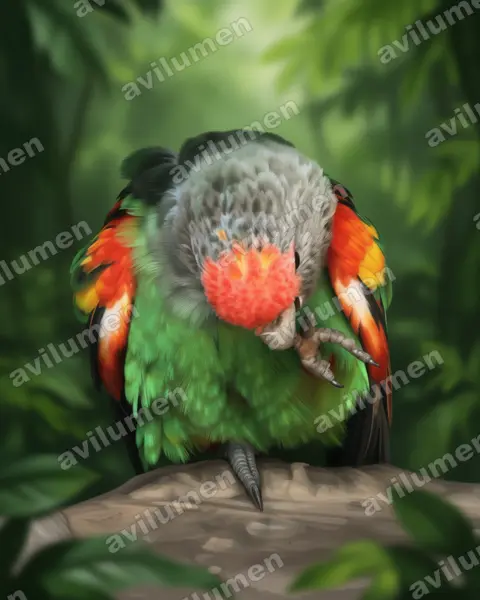
Realistic 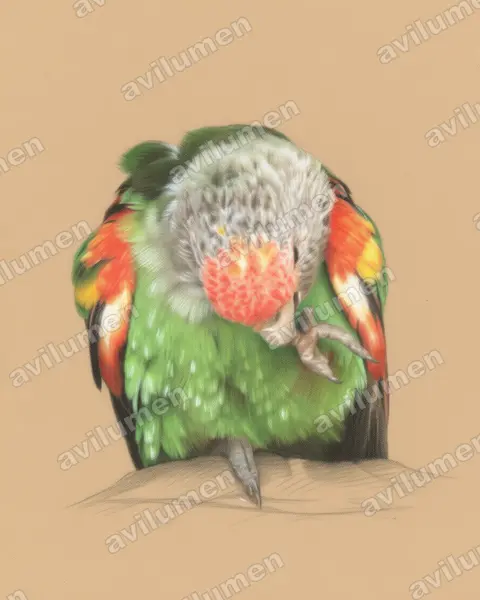
Colored pencil
Illustrations based on the photograph by JMK (CC BY-SA 4.0), from Wikimedia Commons.
Digital editions
HD Digital Art Pack — Brown-necked Parrot
Digital download: 6 high-resolution illustrations of the Brown-necked Parrot (Poicephalus fuscicollis), print-ready. This is a digital file; no animal or physical item is included.
AI Avatar — Brown-necked Parrot
Generate an avatar fusing your face with the Brown-necked Parrot (Poicephalus fuscicollis). Delivered digitally in 8K, watermark-free. Digital product; no animals are sold or brokered.
Instant download. No live birds are sold.
Frequently asked questions
- Is Poicephalus fuscicollis (Brown-necked Parrot) endangered?
- The IUCN Red List places Poicephalus fuscicollis, commonly known as the Brown-necked Parrot, in the «Least concern» category. «Least concern» means it is not currently threatened.
- What family does Poicephalus fuscicollis (Brown-necked Parrot) belong to?
- Poicephalus fuscicollis (Brown-necked Parrot) belongs to the family Psittacidae, in the order Psittaciformes.
- What colour is Poicephalus fuscicollis (Brown-necked Parrot)?
- The plumage of Poicephalus fuscicollis (Brown-necked Parrot) combines these colours: Green and Yellow.
More from the same family
 Near threatened
Yellow-faced Parrot
Alipiopsitta xanthops
The yellow-faced parrot, formerly also known as the yellow-faced amazon, is the only species of the genus Alipiopsitta. It is a Neotropical parrot, and was classified in the genus Amazona for many years. It is a predominantly green and yellow-plumaged bird with a yellow head. It is a semi-nomadic species found in the cerrado region of Brazil and adjacent Bolivia.
from $1.99
 Least concern
Moluccan King Parrot
Alisterus amboinensis
The Moluccan king parrot is a parrot endemic to Peleng Island, Maluku, and West Papua in Indonesia. It is sometimes referred to as the Ambon king parrot or Amboina king parrot, but this is potentially misleading, as it is found on numerous other islands than Ambon. The male and female are similar in appearance, with a predominantly red head and underparts, green wings, and blue back and tail.
from $1.99
 Least concern
Papuan King Parrot
Alisterus chloropterus
The Papuan king parrot, also known as the green-winged king parrot, is a species of parrot in the family Psittaculidae found in New Guinea. Its natural habitats are subtropical or tropical moist lowland forest and subtropical or tropical moist montane forest.
from $1.99
 Least concern
Australian King Parrot
Alisterus scapularis
The Australian king parrot is a species of parrot endemic to eastern Australia ranging from Cooktown in Queensland to Port Campbell in Victoria. Found in humid and heavily forested upland regions of the eastern portion of the continent, including eucalyptus wooded areas in and directly adjacent to subtropical and temperate rainforest. They feed on fruits and seeds gathered from trees or on the ground.
from $1.99