Blue-winged Racket-tail
Prioniturus verticalis
Avilumen editorial team ·

The blue-winged racket-tail or Sulu racquet-tail is a species of parrot in the family Psittaculidae. It is endemic to Tawi-Tawi island in the Philippines and is one of the most endangered parrots in the world. It is threatened by habitat loss and the poaching for the cage-bird trade.
The blue-winged racket-tail or Sulu racquet-tail (Prioniturus verticalis) is a species of parrot in the family Psittaculidae.
It is endemic to Tawi-Tawi island in the Philippines and is one of the most endangered parrots in the world. It is threatened by habitat loss and the poaching for the cage-bird trade.
Description and taxonomy
It has mainly dark green plumage on back, an olive/green on its breast and belly. Male birds have a pale blue with small red patch on its forehead and forecrown. Females look identical to the male except, they do not have a red spot on their forecrown. The primary feathers blue on outer webs while the middle tail feathers green. Racquet feathers black tinged with blue. Their side tail feathers are green tipped black. Their bill has a blue-grey hue.
Most similar to the Montane racket-tail but forehead, sides of head and nape are green. Females also have less blue on their face compared to the Montane racket-tail.
Ecology and behavior
The security situation in the Sulu archipelago has prevented researchers from studying this bird. It is presumed to have a similar diet as all other racquet-tails, feeding on fruit, particularly bananas, flowers and seeds of growing corn, and rice.
Its breeding season is believed to be from September to January. Like all other parrots, it is a cavity nester. A single nest was recorded in a large broken off palm tree in a grove of palms beside a forest.
Habitat and conservation status
Its natural habitats are tropical moist lowland forests and subtropical or tropical mangrove forests.
It is now assessed as Critically Endangered by the IUCN Red List with population estimates being just 50 - 249 mature individuals. Its main threat is habitat loss and trapping. Once prevalent throughout all the islands of the Sulu Archipelago, the blue-winged racket-tail is now only found on isolated places on Tawi-Tawi due to rapid habitat destruction during the past 200 years.
One of this bird's threats is its own tame behavior. This tame behavior is taken advantage of by trappers and has made it an easy target to capture for the illegal exotic pet trade. Deforestation of the blue-winged racket-tail's natural habitat to make way for both legal and illegal logging agriculture, mining, and the uncontrolled settlement by humans has destroyed most of this bird's original habitat.
Text adapted from Wikipedia · CC BY-SA 4.0
Plumage colours
Taxonomy
- Order
- Psittaciformes
- Family
- Psittacidae
- Genus
- Prioniturus
- Conservation status
- Critically endangered
Listen to its call
No recording yet
Illustration gallery
6 illustrations of Prioniturus verticalis (Blue-winged Racket-tail) in different styles, true to its real plumage. Shown watermarked; the art pack includes the high-resolution originals, ready to print.
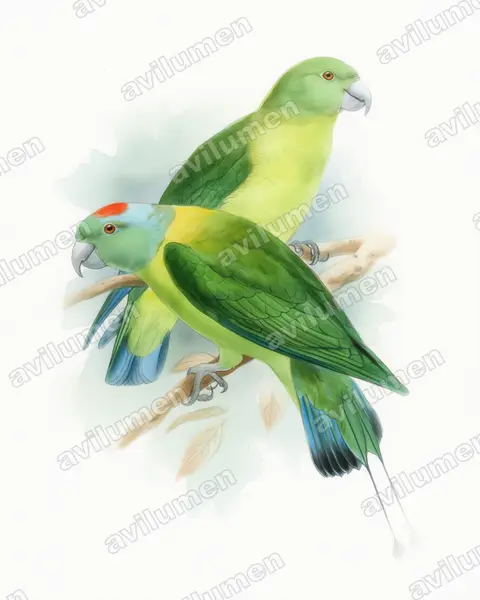
Watercolor 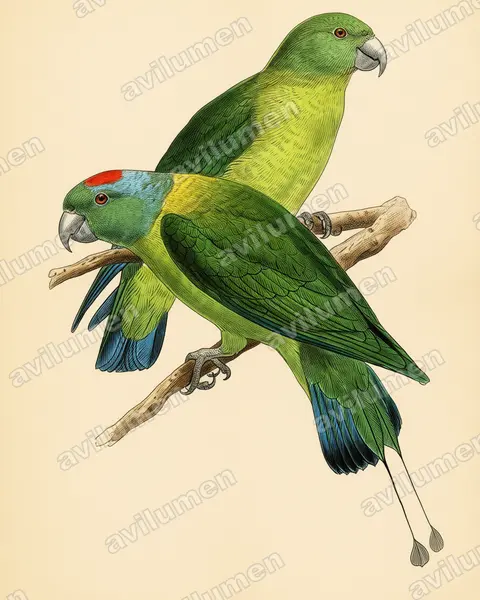
Vintage plate 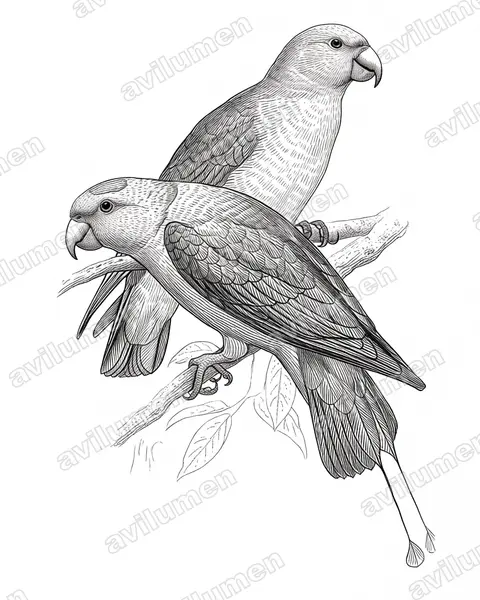
Ink 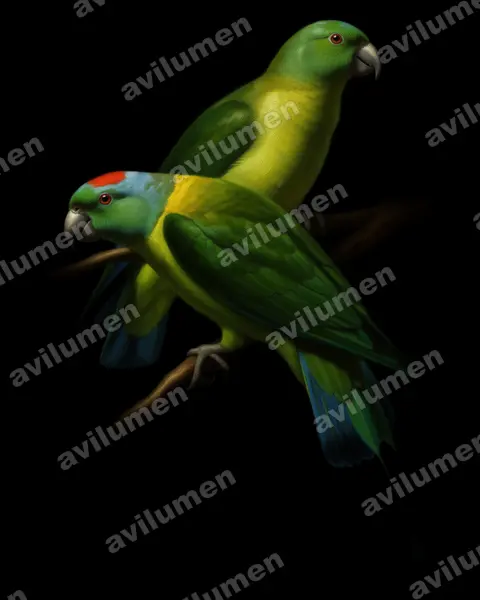
Oil 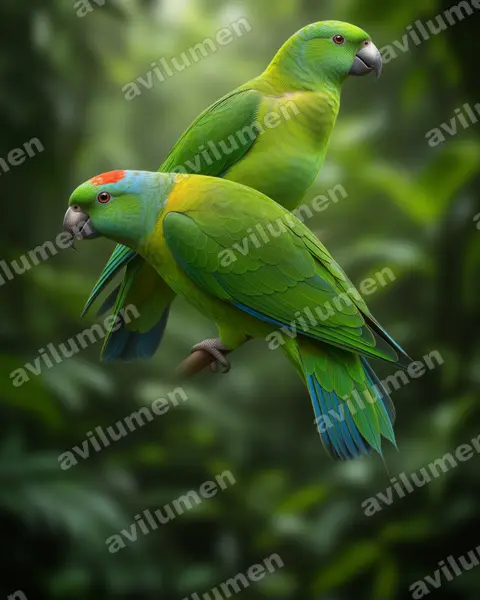
Realistic 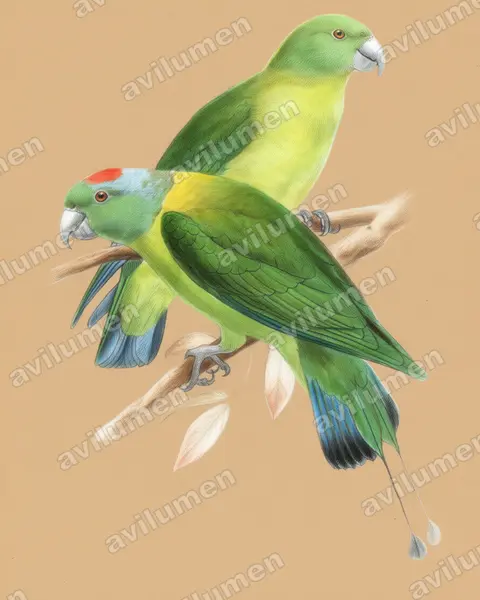
Colored pencil
Illustrations based on the photograph by John Gerrard Keulemans (Public domain), from Wikimedia Commons.
Digital editions
HD Digital Art Pack — Blue-winged Racket-tail
Digital download: 6 high-resolution illustrations of the Blue-winged Racket-tail (Prioniturus verticalis), print-ready. This is a digital file; no animal or physical item is included.
AI Avatar — Blue-winged Racket-tail
Generate an avatar fusing your face with the Blue-winged Racket-tail (Prioniturus verticalis). Delivered digitally in 8K, watermark-free. Digital product; no animals are sold or brokered.
Instant download. No live birds are sold.
Frequently asked questions
- Is Prioniturus verticalis (Blue-winged Racket-tail) endangered?
- The IUCN Red List places Prioniturus verticalis, commonly known as the Blue-winged Racket-tail, in the «Critically endangered» category. «Critically endangered» is the highest threat level before extinction.
- What family does Prioniturus verticalis (Blue-winged Racket-tail) belong to?
- Prioniturus verticalis (Blue-winged Racket-tail) belongs to the family Psittacidae, in the order Psittaciformes.
- What colour is Prioniturus verticalis (Blue-winged Racket-tail)?
- The plumage of Prioniturus verticalis (Blue-winged Racket-tail) combines these colours: Green.
More from the same family
 Near threatened
Yellow-faced Parrot
Alipiopsitta xanthops
The yellow-faced parrot, formerly also known as the yellow-faced amazon, is the only species of the genus Alipiopsitta. It is a Neotropical parrot, and was classified in the genus Amazona for many years. It is a predominantly green and yellow-plumaged bird with a yellow head. It is a semi-nomadic species found in the cerrado region of Brazil and adjacent Bolivia.
from $1.99
 Least concern
Moluccan King Parrot
Alisterus amboinensis
The Moluccan king parrot is a parrot endemic to Peleng Island, Maluku, and West Papua in Indonesia. It is sometimes referred to as the Ambon king parrot or Amboina king parrot, but this is potentially misleading, as it is found on numerous other islands than Ambon. The male and female are similar in appearance, with a predominantly red head and underparts, green wings, and blue back and tail.
from $1.99
 Least concern
Papuan King Parrot
Alisterus chloropterus
The Papuan king parrot, also known as the green-winged king parrot, is a species of parrot in the family Psittaculidae found in New Guinea. Its natural habitats are subtropical or tropical moist lowland forest and subtropical or tropical moist montane forest.
from $1.99
 Least concern
Australian King Parrot
Alisterus scapularis
The Australian king parrot is a species of parrot endemic to eastern Australia ranging from Cooktown in Queensland to Port Campbell in Victoria. Found in humid and heavily forested upland regions of the eastern portion of the continent, including eucalyptus wooded areas in and directly adjacent to subtropical and temperate rainforest. They feed on fruits and seeds gathered from trees or on the ground.
from $1.99