Rose-crowned Parakeet
Pyrrhura rhodocephala
Avilumen editorial team ·

The rose-crowned parakeet, also known as the rose-headed parakeet, rose-crowned conure or rose-headed conure, is a species of parrot in the family Psittacidae and genus Pyrrhura. It is endemic to Venezuela.
The rose-crowned parakeet (Pyrrhura rhodocephala), also known as the rose-headed parakeet, rose-crowned conure or rose-headed conure (perico cabeza roja or cotorra coronirroja in Spanish and conure tête-de-feu in French), is a species of parrot in the family Psittacidae and genus Pyrrhura. It is endemic to Venezuela.
Taxonomy
The rose-crowned parakeet was first described by Philip Sclater and Osbert Salvin in 1871.
Description
The rose-crowned parakeet is a small parrot, measuring 24 cm long with a wing length of 13 to 14.2 cm, tail 9.7 to 11.5 cm, and bill 1.6 to 1.8 cm long, with a tarsus length of 1.4 to 1.6 cm. As an adult it is mainly green; its bright red cap and white primary coverts (blue in juveniles) help to distinguish it from all other long-tailed, small parrot species in South America. It has blue primaries and a red tail and the sexes are alike. No other members of the genus Pyrrhura occur in its range. The painted parakeet also has red on its head but has bold, scaly patterns on its breast and throat. The bare skin around the eye is white.
Distribution and habitat
It is endemic to Venezuela, found only in the Andes of the north-west in the Cordillera de Mérida, from Táchira to Trujillo. Its natural habitats are subtropical or tropical moist montane forests and heavily degraded former forest, at elevations of 800 m to 3,100 m asl, but mostly at 1,500–2,500 m. It can also be found in farmland with scattered trees and at the forest edge.
Its estimated extent of occurrence is 17,000 km2. In 1988 it was assessed for the IUCN Red List as Near Threatened, updated to Lower Risk in 2000 and Least Concern since 2004; in 2002 it was described as "fairly common." A reported population decline caused by deforestation had not become problematic as of 2010, but Parr and Juniper considered that in a species with such a small range this must present a long-term threat. The current population trend is "stable" although the number of mature individuals is unknown. The rose-crowned parakeet is on the CITES Appendix II which "includes species not necessarily threatened with extinction, but in which trade must be controlled in order to avoid utilization incompatible with their survival."
Behavior
The rose-crowned parakeet is gregarious, forming noisy flocks of 10–30 birds when not breeding, and gathers in larger numbers to roost. It makes movements each day, but the species is probably resident. The voice is described as "harsh [and] reedy", though "apparently quieter than other Pyrrhura conures." The flight is "swift and direct." Nothing is known of the species' diet, though it is suspected to eat berries, seeds, fruits and flowers. It is thought to breed in April, May and June, probably laying 4–6 eggs.
Aviculture
The World Parrot Trust describes the rose-crowned parakeet as "uncommon" in captivity, with a probable lifespan of 10–15 years. It is suggested that a suitable diet should include 30% fruit, along with vegetables, pellets and mixed small seeds. Captive birds lay 4–6 eggs which hatch after 23–24 days, with the chicks fledging at "probably 7–8 weeks."
Text adapted from Wikipedia · CC BY-SA 4.0
Where it lives
Distribution

Taxonomy
- Order
- Psittaciformes
- Family
- Psittacidae
- Genus
- Pyrrhura
- Conservation status
- Least concern
Listen to its call
No recording yet
Care guide
Budgie, Conure and Parakeet Care Guide
How to care for budgies, conures, parrotlets, ringnecks and other parakeets: diet, cage setup, health, behavior, breeding and legal status for owners.
Read the guide →Illustration gallery
6 illustrations of Pyrrhura rhodocephala (Rose-crowned Parakeet) in different styles, true to its real plumage. Shown watermarked; the art pack includes the high-resolution originals, ready to print.
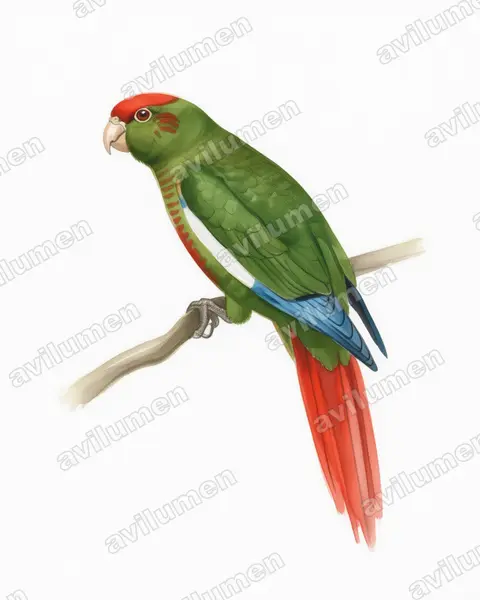
Watercolor 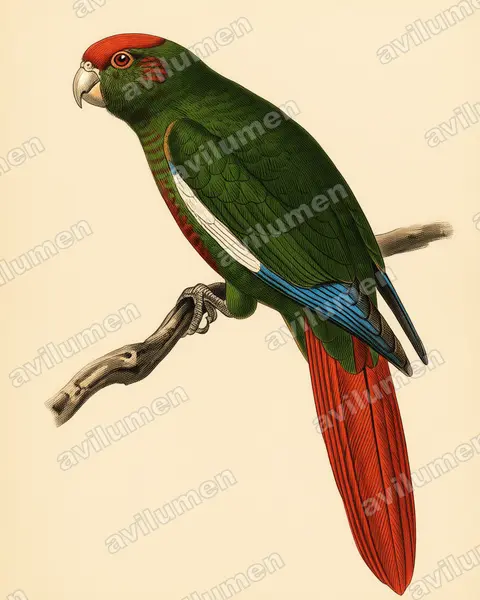
Vintage plate 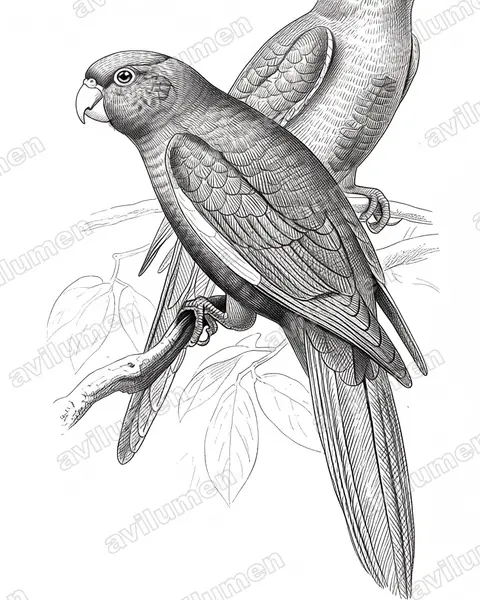
Ink 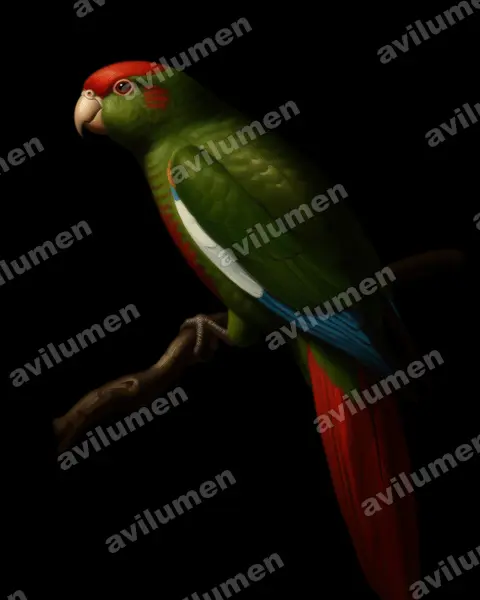
Oil 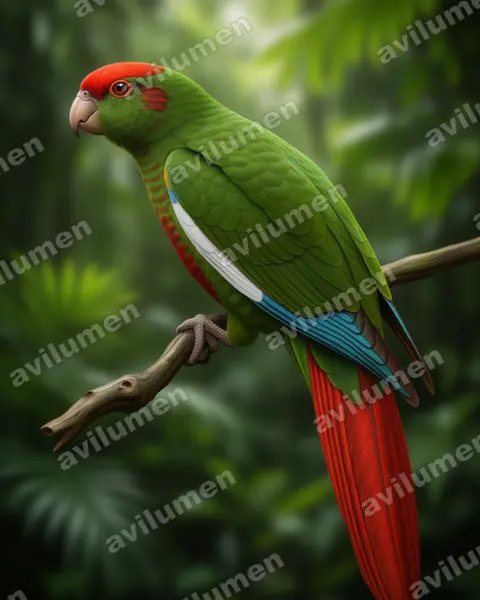
Realistic 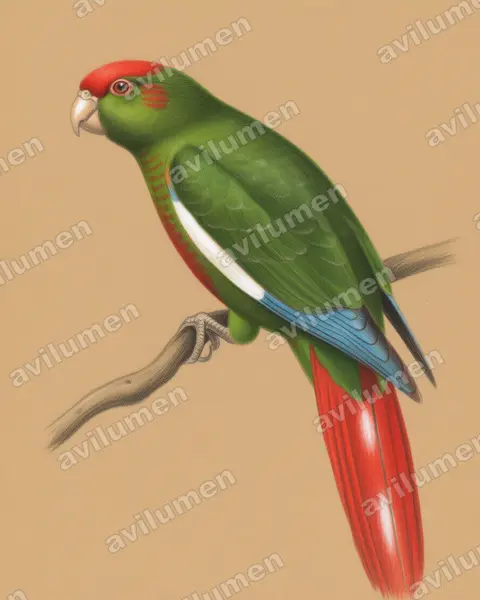
Colored pencil
Illustrations based on the photograph by John Gerrard Keulemans (Public domain), from Wikimedia Commons.
Digital editions
HD Digital Art Pack — Rose-crowned Parakeet
Digital download: 6 high-resolution illustrations of the Rose-crowned Parakeet (Pyrrhura rhodocephala), print-ready. This is a digital file; no animal or physical item is included.
AI Avatar — Rose-crowned Parakeet
Generate an avatar fusing your face with the Rose-crowned Parakeet (Pyrrhura rhodocephala). Delivered digitally in 8K, watermark-free. Digital product; no animals are sold or brokered.
Instant download. No live birds are sold.
Frequently asked questions
- Is Pyrrhura rhodocephala (Rose-crowned Parakeet) endangered?
- The IUCN Red List places Pyrrhura rhodocephala, commonly known as the Rose-crowned Parakeet, in the «Least concern» category. «Least concern» means it is not currently threatened.
- Where does Pyrrhura rhodocephala (Rose-crowned Parakeet) live?
- Pyrrhura rhodocephala (Rose-crowned Parakeet) is found in South America.
- What family does Pyrrhura rhodocephala (Rose-crowned Parakeet) belong to?
- Pyrrhura rhodocephala (Rose-crowned Parakeet) belongs to the family Psittacidae, in the order Psittaciformes.
- What colour is Pyrrhura rhodocephala (Rose-crowned Parakeet)?
- The plumage of Pyrrhura rhodocephala (Rose-crowned Parakeet) combines these colours: Green and Pink.
More from the same family
 Near threatened
Yellow-faced Parrot
Alipiopsitta xanthops
The yellow-faced parrot, formerly also known as the yellow-faced amazon, is the only species of the genus Alipiopsitta. It is a Neotropical parrot, and was classified in the genus Amazona for many years. It is a predominantly green and yellow-plumaged bird with a yellow head. It is a semi-nomadic species found in the cerrado region of Brazil and adjacent Bolivia.
from $1.99
 Least concern
Moluccan King Parrot
Alisterus amboinensis
The Moluccan king parrot is a parrot endemic to Peleng Island, Maluku, and West Papua in Indonesia. It is sometimes referred to as the Ambon king parrot or Amboina king parrot, but this is potentially misleading, as it is found on numerous other islands than Ambon. The male and female are similar in appearance, with a predominantly red head and underparts, green wings, and blue back and tail.
from $1.99
 Least concern
Papuan King Parrot
Alisterus chloropterus
The Papuan king parrot, also known as the green-winged king parrot, is a species of parrot in the family Psittaculidae found in New Guinea. Its natural habitats are subtropical or tropical moist lowland forest and subtropical or tropical moist montane forest.
from $1.99
 Least concern
Australian King Parrot
Alisterus scapularis
The Australian king parrot is a species of parrot endemic to eastern Australia ranging from Cooktown in Queensland to Port Campbell in Victoria. Found in humid and heavily forested upland regions of the eastern portion of the continent, including eucalyptus wooded areas in and directly adjacent to subtropical and temperate rainforest. They feed on fruits and seeds gathered from trees or on the ground.
from $1.99