Blue-naped Parrot
Tanygnathus lucionensis
Avilumen editorial team ·

The blue-naped parrot, also known as the blue-crowned green parrot, Luzon parrot, the Philippine green parrot, and locally known as pikoy, is a parrot native throughout the Philippines and the Talaud Islands of Indonesia. It is threatened by habitat loss and trapping for the pet trade. It is illegal to hunt, capture or possess Blue-naped parrots under Philippine Law RA 9147.
The blue-naped parrot (Tanygnathus lucionensis), also known as the blue-crowned green parrot, Luzon parrot, the Philippine green parrot, and locally known as pikoy, is a parrot native throughout the Philippines and the Talaud Islands of Indonesia. It is threatened by habitat loss and trapping for the pet trade.
It is illegal to hunt, capture or possess Blue-naped parrots under Philippine Law RA 9147.
Description
This is a medium size parrot, around 31 cm (12 in) in length, primarily green except for a light blue rear crown and nape, pale blue lower back and rump, scalloped shoulders with orange-brown on black coverts, and blackish underwings with green underwing coverts.
Taxonomy
In 1760 the French zoologist Mathurin Jacques Brisson included a description of the blue-naped parrot in his Ornithologie based on a specimen collected on the island of Luzon in the Philippines. He used the French name Le perroquet de l'Isle de Luçon and the Latin name Psittacus lucionensis. Although Brisson coined Latin names, these do not conform to the binomial system and are not recognised by the International Commission on Zoological Nomenclature. When in 1766 the Swedish naturalist Carl Linnaeus updated his Systema Naturae for the twelfth edition he added 240 species that had been previously described by Brisson. One of these was the blue-naped parrot. Linnaeus included a terse description, used the binomial name Psittacus lucionensis and cited Brisson's work. The specific name lucionensis is from Luzon in the Philippines. This species is now placed in the genus Tanygnathus which was introduced by the German naturalist Johann Wagler in 1832.
There are four subspecies:
T. l. lucionensis: Luzon and Mindoro, Philippines
T. l. hybridus: Polillo Islands, Philippines. Blue on crown less extensive, tinged with violet. More green on wing coverts.
T. l. salvadorii: Visayas, Palawan, Mindanao, Sulu Archipelago and the norhernmost islands near Borneo; all green back
T. l. talautensis: Talaud Islands (Indonesia); all green back but blue on head extends into the cheeks
Distribution and ecology
The species is widespread throughout the Philippines. Three subspecies are endemic to the Philippines: T. l. lucionensis (Luzon and Mindoro), T. l. hybridus (Polillo Islands), and T. l. salvadorii (southern Philippines, including the Sulu Archipelago). The last subspecies, T. l . talautensis, is native to the Visayas and Mindanao island groups of the Philippines, with a range extending to the Talaud Islands of Indonesia.
T. l. salvadorii and T. l . talautensis have also been introduced to the Sangihe Islands, the islands off northern Sabah in Malaysia, and within the mainland of Borneo itself (e.g. Kota Kinabalu).
It is found in secondary forest, at forest edges and in plantations at elevations of up to 1000 m. Flock size is usually under a dozen. The blue-naped parrot feeds on mangoes, berries, seeds, nuts and grains. It nests in tree holes.
Conservation
The International Union for Conservation of Nature has assessed this bird as near threatened with the population continuing to decrease. It estimates that there are 1,500 to 7,000 mature individuals left. It has been extripated across most of its range in Negros and Siquijor. Habitat loss and trapping have made this species scarce on most islands except Mindoro and Palawan. The Katala Foundation has raised concerns over the increasing illegal trade of this bird on Palawan.
Starting 2010, this species is depicted in the Philippine five hundred-peso note although it is incorrectly drawn with a peach colored beak.
It occurs in a few protected areas like Bataan National Park, Quezon Protected Landscape and Puerto Princesa Subterranean River National Park but while protected on paper, protection is lax and deforestation and trapping continue within these areas.
Text adapted from Wikipedia · CC BY-SA 4.0
Taxonomy
- Order
- Psittaciformes
- Family
- Psittacidae
- Genus
- Tanygnathus
- Conservation status
- Near threatened
Listen to its call
No recording yet
Care guide
Amazon, African Grey and Eclectus Parrot Care Guide
How to care for Amazon parrots, African greys, eclectus and pionus: diet, cage setup, health, behavior and CITES requirements for medium and large parrots.
Read the guide →Illustration gallery
6 illustrations of Tanygnathus lucionensis (Blue-naped Parrot) in different styles, true to its real plumage. Shown watermarked; the art pack includes the high-resolution originals, ready to print.
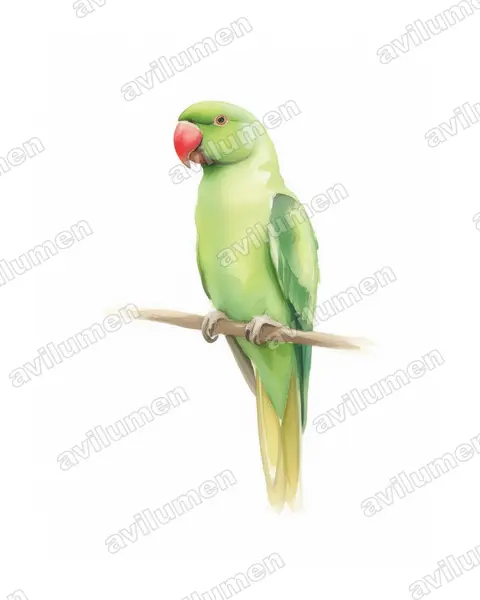
Watercolor 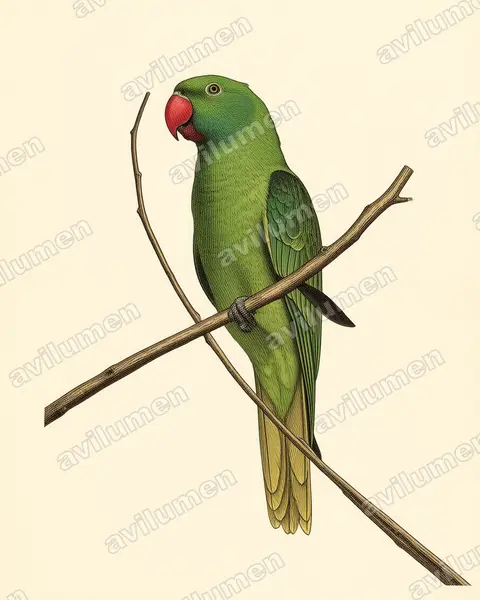
Vintage plate 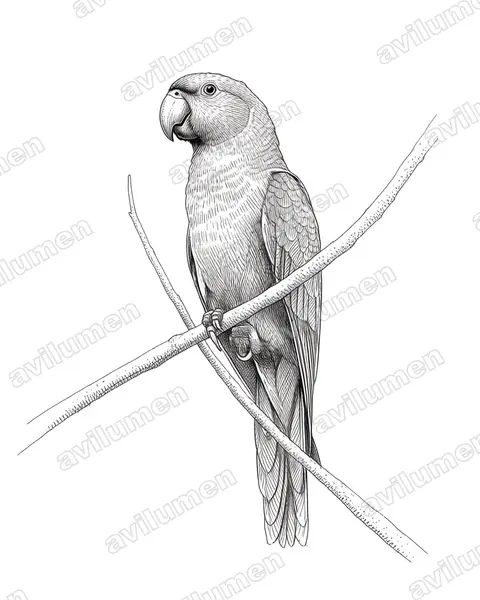
Ink 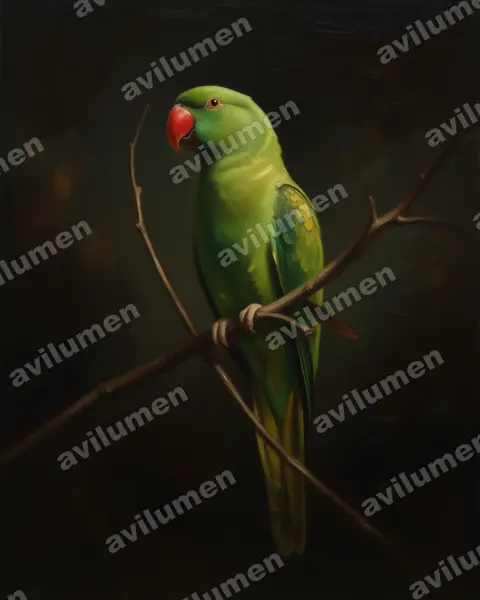
Oil 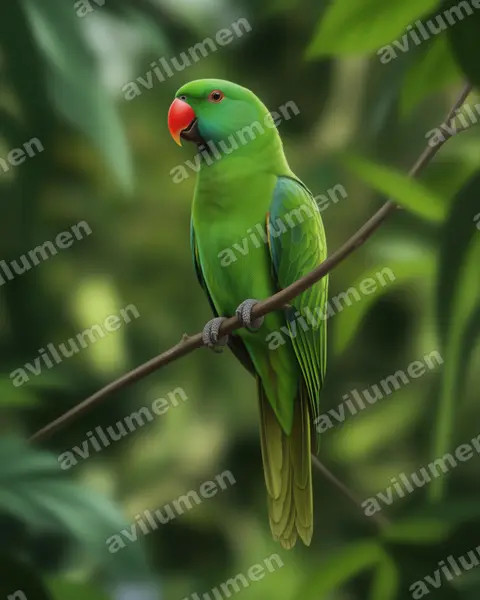
Realistic 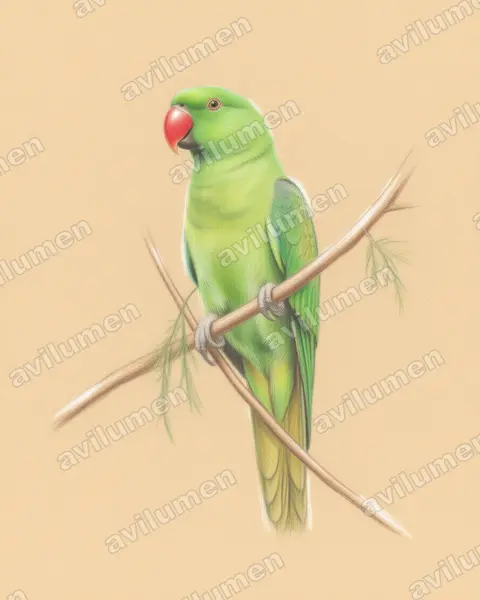
Colored pencil
Illustrations based on the photograph by Len Worthington (CC BY-SA 2.0), from Wikimedia Commons.
Digital editions
HD Digital Art Pack — Blue-naped Parrot
Digital download: 6 high-resolution illustrations of the Blue-naped Parrot (Tanygnathus lucionensis), print-ready. This is a digital file; no animal or physical item is included.
AI Avatar — Blue-naped Parrot
Generate an avatar fusing your face with the Blue-naped Parrot (Tanygnathus lucionensis). Delivered digitally in 8K, watermark-free. Digital product; no animals are sold or brokered.
Instant download. No live birds are sold.
Frequently asked questions
- Is Tanygnathus lucionensis (Blue-naped Parrot) endangered?
- The IUCN Red List places Tanygnathus lucionensis, commonly known as the Blue-naped Parrot, in the «Near threatened» category. «Near threatened» means it is not threatened yet, but is close to becoming so.
- What family does Tanygnathus lucionensis (Blue-naped Parrot) belong to?
- Tanygnathus lucionensis (Blue-naped Parrot) belongs to the family Psittacidae, in the order Psittaciformes.
- What colour is Tanygnathus lucionensis (Blue-naped Parrot)?
- The plumage of Tanygnathus lucionensis (Blue-naped Parrot) combines these colours: Green and Blue.
More from the same family
 Near threatened
Yellow-faced Parrot
Alipiopsitta xanthops
The yellow-faced parrot, formerly also known as the yellow-faced amazon, is the only species of the genus Alipiopsitta. It is a Neotropical parrot, and was classified in the genus Amazona for many years. It is a predominantly green and yellow-plumaged bird with a yellow head. It is a semi-nomadic species found in the cerrado region of Brazil and adjacent Bolivia.
from $1.99
 Least concern
Moluccan King Parrot
Alisterus amboinensis
The Moluccan king parrot is a parrot endemic to Peleng Island, Maluku, and West Papua in Indonesia. It is sometimes referred to as the Ambon king parrot or Amboina king parrot, but this is potentially misleading, as it is found on numerous other islands than Ambon. The male and female are similar in appearance, with a predominantly red head and underparts, green wings, and blue back and tail.
from $1.99
 Least concern
Papuan King Parrot
Alisterus chloropterus
The Papuan king parrot, also known as the green-winged king parrot, is a species of parrot in the family Psittaculidae found in New Guinea. Its natural habitats are subtropical or tropical moist lowland forest and subtropical or tropical moist montane forest.
from $1.99
 Least concern
Australian King Parrot
Alisterus scapularis
The Australian king parrot is a species of parrot endemic to eastern Australia ranging from Cooktown in Queensland to Port Campbell in Victoria. Found in humid and heavily forested upland regions of the eastern portion of the continent, including eucalyptus wooded areas in and directly adjacent to subtropical and temperate rainforest. They feed on fruits and seeds gathered from trees or on the ground.
from $1.99