Guinea Turaco
Tauraco persa
Avilumen editorial team ·

The Guinea turaco, also known as the green turaco or green lourie, is a species of turaco, a group of African otidimorph birds. It formerly included the Livingstone's, Schalow's, Knysna, black-billed and Fischer's turacos as subspecies.
The Guinea turaco (Tauraco persa), also known as the green turaco or green lourie, is a species of turaco, a group of African otidimorph birds. It formerly included the Livingstone's, Schalow's, Knysna, black-billed and Fischer's turacos as subspecies.
Taxonomy
The Guinea turaco was formally described by the Swedish naturalist Carl Linnaeus in 1758 in the tenth edition of his Systema Naturae. He placed it together with the cuckoos in the genus Cuculus and coined the binomial name Cuculus persa. The specific epithet is Latin meaning "Persian". Linnaeus based his description on the "Touraco" that had been described and illustrated in 1743 by the English naturalist George Edwards in his A Natural History of Uncommon Birds. Edwards's specimen had been brought to London from Guinea in West Africa. The Guinea turaco is now placed in the genus Tauraco that was introduced in 1779 by the Polish naturalist Jan Krzysztof Kluk.
Three subspecies are recognised:
T. p. buffoni (Vieillot, 1819) – Senegambia to Liberia
T. p. persa (Linnaeus, 1758) – Ivory Coast and Ghana to west Cameroon
T. p. zenkeri Reichenow, 1896 – south Cameroon, west Central African Republic, Equatorial Guinea, Gabon, north Angola, Congo and northwest DRCongo
Description
The Guinea turaco, often inconspicuous in the treetops, is approximately 40–43 cm (16–17 in) long, including a long tail. The weight can reach 225–290 g (7.9–10.2 oz). The plumage is largely brilliant green and blue, with the green color coming from the pigment turacoverdin; the tail and wings are dark purplish, except for the crimson primary feathers that are very distinct in flight. On the head is present an erectile semi-circular green crest. On the eyes there are red and white patches. The bill is thick and red. In the westernmost subspecies Tauraco persa buffoni, which sometimes is known as the Buffon's turaco, there is a white line above and in front of the eye and a black line below the eye. In the nominate subspecies (Tauraco persa persa) of the central part of its range and zenkeri of the southeastern part there also is a second white line below the black line. Unlike similar turacos with red bills, even adult Guinea turacos lack a white rear edge to the crest.
The Guinea turaco has a loud cawr-cawr call, consisting of 10–16 raucous cawing notes.
Distribution and habitat
Guinea turaco has an extremely large range and a stable population. It can be found in forests of West and Central Africa, ranging from Senegal east to DR Congo and south to northern Angola. It is present in the Republic of the Congo, Angola, Benin, Cameroon, Central African Republic, Democratic Republic of the Congo, Equatorial Guinea, Gabon, Gambia, Ghana, Guinea, Guinea-Bissau, Ivory Coast, Liberia, Mali, Nigeria, Senegal, Sierra Leone and Togo.
This species inhabits subtropical and tropical moist lowland, gallery forests and tropical rain forests edge, often near cultivated areas. It is common in climax forest with plentiful tall trees, from sea level to about 1,100 m (3,600 ft).
Behaviour and ecology
Tauraco persa is normally sedentary and strongly territorial. These birds feed on wide variety of wild and cultivated tropical fruits (for instance on Musanga, Macaranga, Rauvolfia, Cissus and Ficus species, etc.), but also on blossoms. They do not fly very well, preferring to climb from branch to branch.
They breed in May–June and August in Cameroon, from December to February and from June to September in Gabon, while in Sierra Leone they breed in June and in October. Females lay two eggs in a tree platform nest.
Text adapted from Wikipedia · CC BY-SA 4.0
Where it lives
Plumage colours
Distribution

Taxonomy
- Order
- Musophagiformes
- Family
- Musophagidae
- Genus
- Tauraco
- Conservation status
- Least concern
Listen to its call
No recording yet
Illustration gallery
6 illustrations of Tauraco persa (Guinea Turaco) in different styles, true to its real plumage. Shown watermarked; the art pack includes the high-resolution originals, ready to print.
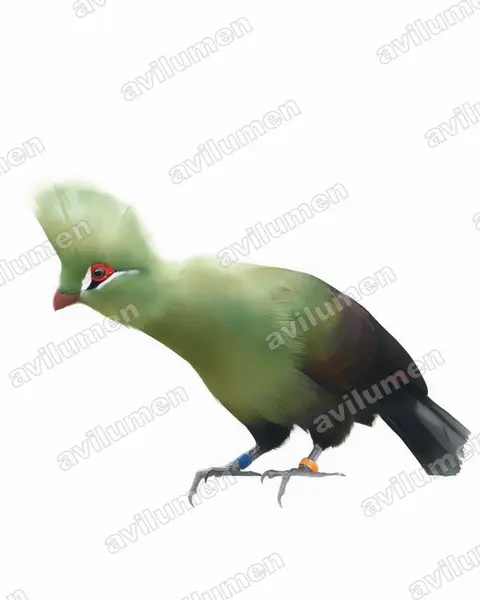
Watercolor 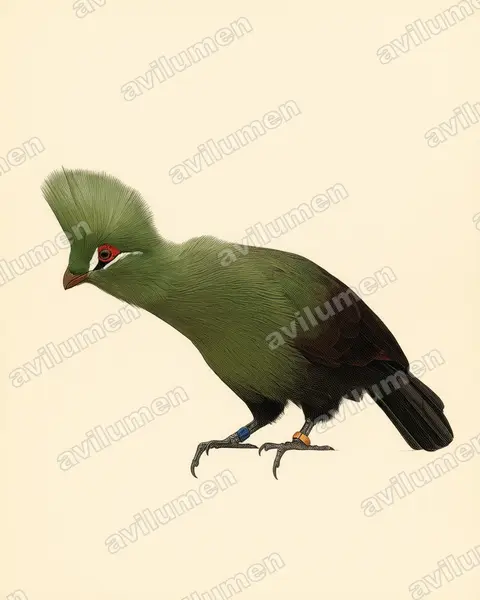
Vintage plate 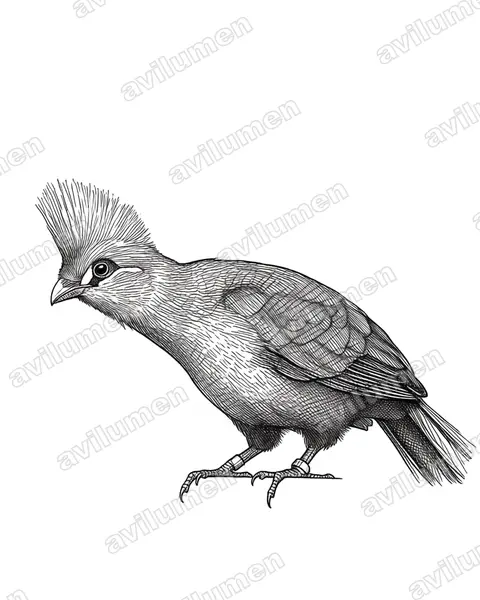
Ink 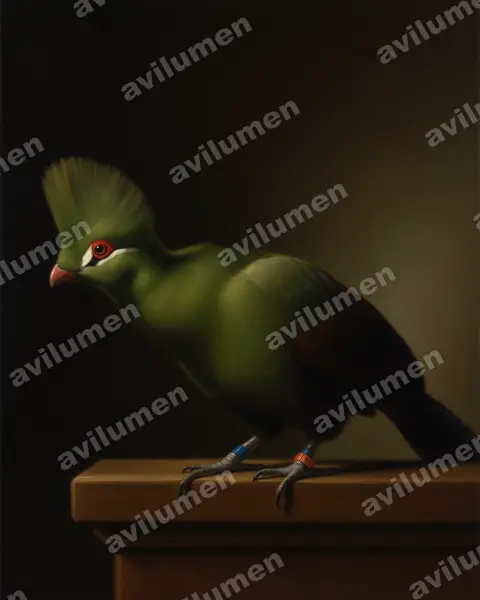
Oil 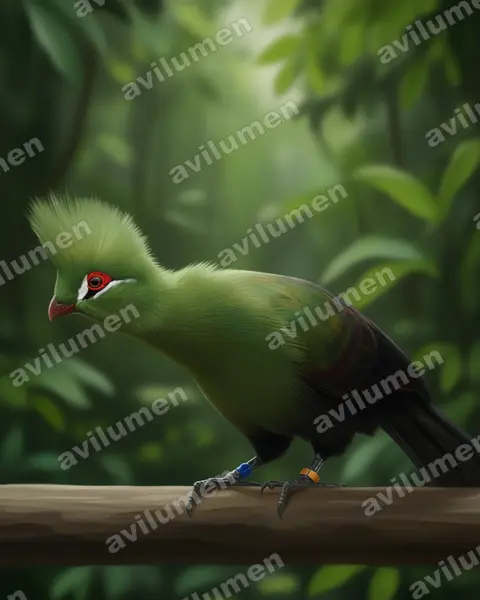
Realistic 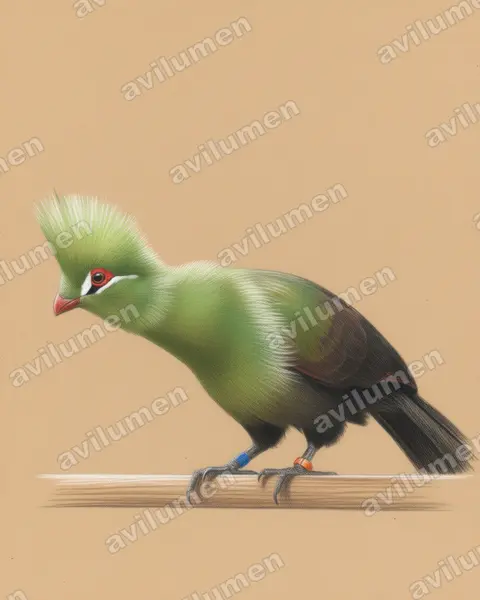
Colored pencil
Illustrations based on the photograph by www.opencage photographer (CC BY-SA 2.5), from Wikimedia Commons.
Digital editions
HD Digital Art Pack — Guinea Turaco
Digital download: 6 high-resolution illustrations of the Guinea Turaco (Tauraco persa), print-ready. This is a digital file; no animal or physical item is included.
AI Avatar — Guinea Turaco
Generate an avatar fusing your face with the Guinea Turaco (Tauraco persa). Delivered digitally in 8K, watermark-free. Digital product; no animals are sold or brokered.
Instant download. No live birds are sold.
Frequently asked questions
- Is Tauraco persa (Guinea Turaco) endangered?
- The IUCN Red List places Tauraco persa, commonly known as the Guinea Turaco, in the «Least concern» category. «Least concern» means it is not currently threatened.
- Where does Tauraco persa (Guinea Turaco) live?
- Tauraco persa (Guinea Turaco) is found in Africa and Burkina Faso.
- What family does Tauraco persa (Guinea Turaco) belong to?
- Tauraco persa (Guinea Turaco) belongs to the family Musophagidae, in the order Musophagiformes.
- What colour is Tauraco persa (Guinea Turaco)?
- The plumage of Tauraco persa (Guinea Turaco) combines these colours: Green.
More from the same family
 Least concern
Great Blue Turaco
Corythaeola cristata
The great blue turaco is a bird species of the family Musophagidae. At 70–76 cm (28–30 in) in length, it is the largest species of turaco. It has predominantly grey-blue plumage with an upright blue-black crest around 10 cm (3.9 in) high. The male and female have similar plumage. It is widespread throughout the African tropical rainforest.
from $1.99
 Least concern
Grey Go-away-bird
Corythaixoides concolor
The grey go-away-bird, also known as grey lourie, grey loerie, or kwêvoël, is a bold and common turaco of the southern Afrotropics. They are present in arid to moist, open woodlands and thorn savanna, especially near surface water. They regularly form groups and parties that forage in tree tops, or dust bathe on the ground.
from $1.99
 Not evaluated
White-bellied go-away-bird
Corythaixoides leucogaster
The white-bellied go-away-bird is a bird of eastern Africa in the family Musophagidae, commonly known as turacos.
from $1.99
 Least concern
Bare-faced Go-away-bird
Corythaixoides personatus
The bare-faced go-away-bird is a species of bird in the family Musophagidae which is native to the eastern Afrotropics. It is named for its distinctive and uniquely bare, black face.
from $1.99