Yellow-naped Amazon
Amazona auropalliata
Avilumen editorial team ·

The yellow-naped amazon or yellow-naped parrot is a widespread amazon parrot sometimes considered to be a subspecies of the yellow-crowned amazon. It inhabits the Pacific coast of southern Mexico and Central America. It has recently been reclassified as Critically Endangered by the IUCN Red List due to a dramatic decline across the extent of its range.
The yellow-naped amazon or yellow-naped parrot (Amazona auropalliata) is a widespread amazon parrot sometimes considered to be a subspecies of the yellow-crowned amazon (Amazona ochrocephala). It inhabits the Pacific coast of southern Mexico and Central America. It has recently been reclassified as Critically Endangered by the IUCN Red List due to a dramatic decline across the extent of its range. Yellow-naped amazons have lost more than 92% of their population over the last three generations.
The primary cause for their population decline are deforestation and illegal removal of young for the parrot trade. This parrot readily mimics sounds, and in captivity, this includes human speech, which is probably the reason it is popular in aviculture. Like all parrots, however, mimicking abilities vary greatly between individuals. Recent surveys of the Costa Rican population across an 11-year time span found a significant decline in their population. Despite this decline, the Costa Rican population is considered to be the stronghold for the species.
Description
The yellow-naped amazon is distinguished by its green forehead and crown and a yellow band across the lower nape (back part of neck) and hindneck. The eyes are orange, beak is dark gray and is paler towards the base of the upper mandible. The feet are also dark gray.
Yellow-naped amazons inhabit dry forest and mangrove habitat of the tropics, and nest in naturally occurring cavities Although yellow-naped amazons will not excavate cavities, they will chew the entrance. The parrots will nest in a wide variety of trees, although dead Coyols (palm trees) are one preferred species. During the breeding season, pairs are monogamous, and pairs defend small breeding territories around the nest by duetting with their partners. Breeding success is low (89%), and the majority of nests fail due to poaching
The vocal behavior of yellow-naped amazons has been more extensively studied than in any other wild parrot. Yellow-naped amazons, like all parrots, exhibit vocal learning behavior in the wild. This behavior manifests in the form of vocal dialects, in which the repertoire of calls that parrots vocalize change at discrete geographic boundaries, similar to how humans have different languages or dialects. These dialects also are meaningful to the parrots; they are less responsive to calls that are not their own dialect. Dialects are also stable over long periods of time.
Mated pairs of yellow-naped amazons also duet together on their territories in highly complex ways; they produce precisely coordinated and synchronized sequences of calls. These duets are organized by syntactic rules, in which the order and structure of notes changes in predetermined but flexible ways. Neighboring pairs of birds will counter-duet, in which pairs will rapidly exchange duets. This behavior appears similar to the counter-singing observed in male songbirds. These displays will at times become so heated that physical fights will occur at territory boundaries, although these are rare.
Taxonomy
Three subspecies are recognized:
A. a. auropalliata: Southern Mexico to northwestern Costa Rica.
A. a. parvipes: The Mosquito Coast in eastern Honduras and northeastern Nicaragua.
A. a. caribaea: Bay Islands, Honduras.
Range and habitat
It is found along the Pacific Coast from southern Mexico south to northern Costa Rica. Recent census efforts have indicated declining populations throughout much of the range, with reduced populations in Costa Rica and Nicaragua and vanishingly small populations in Honduras, Mexico and Guatemala (Dupin et al. 2020, Wright et al. 2018). The Mesoamerican Parrot Census Network, with support of the World Parrot Trust, has been engaging volunteers to assess the status of yellow-naped amazons across their range to assist with conservation.
In common with many parrot species, it feeds on nuts, berries, seeds, and fruit.
In captivity
Yellow-naped amazons are highly sought after for their talking ability and playful personalities. They are also known for nest-protective behaviors that often lead them to bite. This is particularly common in males during the breeding season. While they do not always handle emotions well, they will signal when stressed or over excited by spreading (fanning) their tail and eye pinning (contracting and expanding the pupils of their eyes). If they are allowed to calm down before they are handled, bites are not common. Yellow-naped amazons, as with many other parrots, tend to bond with one member of a household and may be jealous of others.
Yellow-naped amazons do enjoy the stimulation of interacting with people, however. The more they are socialized, the more comfortable they will be around humans and animals.
Yellow-naped amazons are cavity-nesting birds in their wild habitat, therefore they enjoy chewing. Because of this, they should be supplied with bird-safe and non-toxic toys to chew. They also enjoy manipulating objects and interacting with them.
A rare blue mutation of the yellow-naped amazon is known to exist in which the entire body is turquoise in color.
Text adapted from Wikipedia · CC BY-SA 4.0
Taxonomy
- Order
- Psittaciformes
- Family
- Psittacidae
- Genus
- Amazona
- Conservation status
- Critically endangered
Listen to its call
No recording yet
Care guide
Amazon, African Grey and Eclectus Parrot Care Guide
How to care for Amazon parrots, African greys, eclectus and pionus: diet, cage setup, health, behavior and CITES requirements for medium and large parrots.
Read the guide →Illustration gallery
6 illustrations of Amazona auropalliata (Yellow-naped Amazon) in different styles, true to its real plumage. Shown watermarked; the art pack includes the high-resolution originals, ready to print.
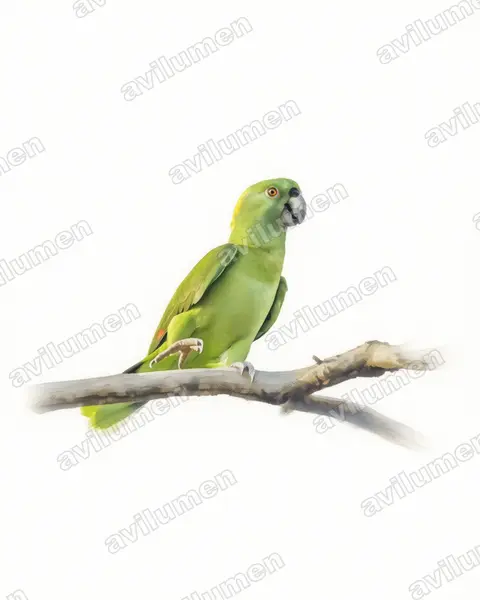
Watercolor 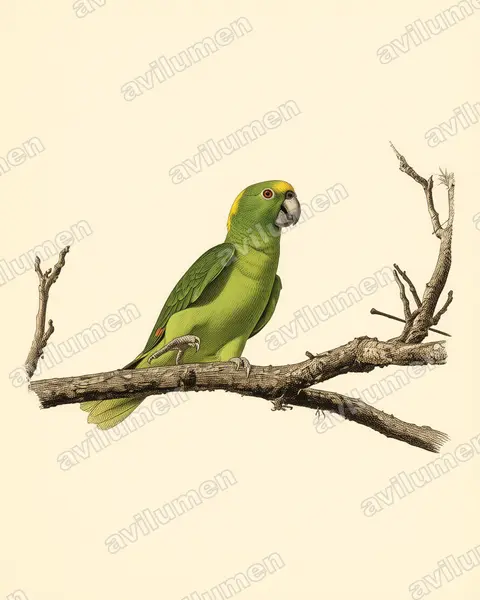
Vintage plate 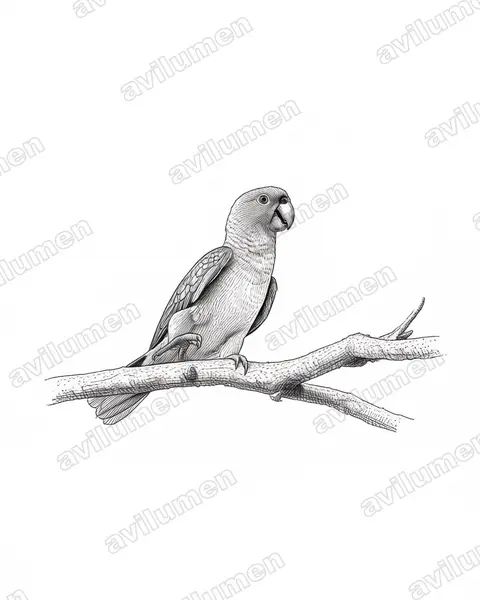
Ink 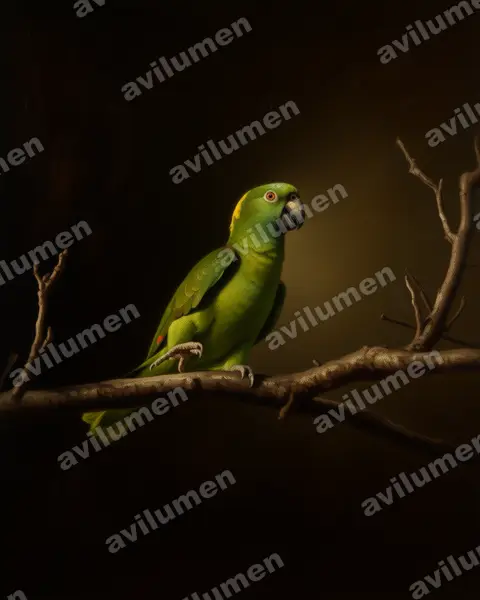
Oil 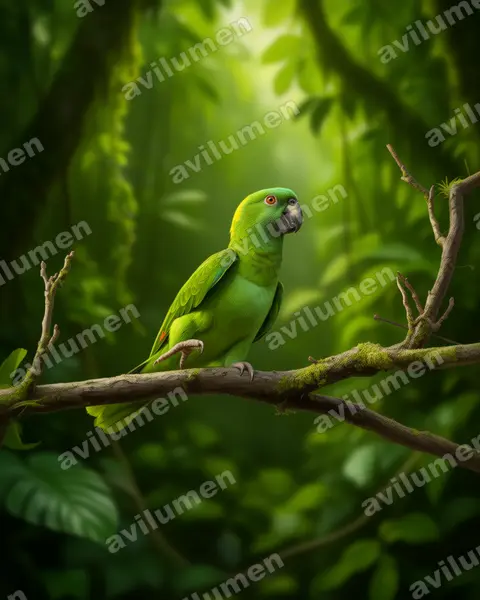
Realistic 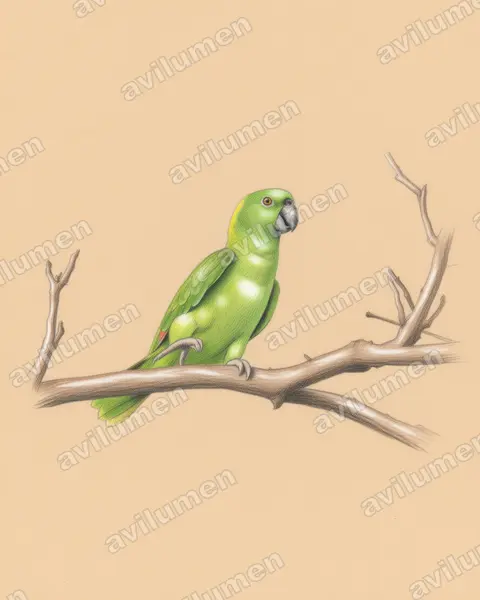
Colored pencil
Illustrations based on the photograph by Charles J. Sharp (CC BY-SA 4.0), from Wikimedia Commons.
Digital editions
HD Digital Art Pack — Yellow-naped Amazon
Digital download: 6 high-resolution illustrations of the Yellow-naped Amazon (Amazona auropalliata), print-ready. This is a digital file; no animal or physical item is included.
AI Avatar — Yellow-naped Amazon
Generate an avatar fusing your face with the Yellow-naped Amazon (Amazona auropalliata). Delivered digitally in 8K, watermark-free. Digital product; no animals are sold or brokered.
Instant download. No live birds are sold.
Frequently asked questions
- Is Amazona auropalliata (Yellow-naped Amazon) endangered?
- The IUCN Red List places Amazona auropalliata, commonly known as the Yellow-naped Amazon, in the «Critically endangered» category. «Critically endangered» is the highest threat level before extinction.
- What family does Amazona auropalliata (Yellow-naped Amazon) belong to?
- Amazona auropalliata (Yellow-naped Amazon) belongs to the family Psittacidae, in the order Psittaciformes.
- What colour is Amazona auropalliata (Yellow-naped Amazon)?
- The plumage of Amazona auropalliata (Yellow-naped Amazon) combines these colours: Green and Yellow.
More from the same family
 Near threatened
Yellow-faced Parrot
Alipiopsitta xanthops
The yellow-faced parrot, formerly also known as the yellow-faced amazon, is the only species of the genus Alipiopsitta. It is a Neotropical parrot, and was classified in the genus Amazona for many years. It is a predominantly green and yellow-plumaged bird with a yellow head. It is a semi-nomadic species found in the cerrado region of Brazil and adjacent Bolivia.
from $1.99
 Least concern
Moluccan King Parrot
Alisterus amboinensis
The Moluccan king parrot is a parrot endemic to Peleng Island, Maluku, and West Papua in Indonesia. It is sometimes referred to as the Ambon king parrot or Amboina king parrot, but this is potentially misleading, as it is found on numerous other islands than Ambon. The male and female are similar in appearance, with a predominantly red head and underparts, green wings, and blue back and tail.
from $1.99
 Least concern
Papuan King Parrot
Alisterus chloropterus
The Papuan king parrot, also known as the green-winged king parrot, is a species of parrot in the family Psittaculidae found in New Guinea. Its natural habitats are subtropical or tropical moist lowland forest and subtropical or tropical moist montane forest.
from $1.99
 Least concern
Australian King Parrot
Alisterus scapularis
The Australian king parrot is a species of parrot endemic to eastern Australia ranging from Cooktown in Queensland to Port Campbell in Victoria. Found in humid and heavily forested upland regions of the eastern portion of the continent, including eucalyptus wooded areas in and directly adjacent to subtropical and temperate rainforest. They feed on fruits and seeds gathered from trees or on the ground.
from $1.99