Red-lored Amazon
Amazona autumnalis
Avilumen editorial team ·

The red-lored amazon or red-lored parrot is a species of amazon parrot, native to tropical regions of the Americas, from eastern Mexico south to Ecuador where it occurs in humid evergreen to semi-deciduous forests up to 1,100 m altitude. It is absent from the Pacific side of Central America north of Costa Rica.
The red-lored amazon or red-lored parrot (Amazona autumnalis) is a species of amazon parrot, native to tropical regions of the Americas, from eastern Mexico south to Ecuador where it occurs in humid evergreen to semi-deciduous forests up to 1,100 m altitude. It is absent from the Pacific side of Central America north of Costa Rica. Not originally known from El Salvador, a pair - perhaps escaped from captivity - nested successfully in 1995 and 1996 in the outskirts of San Salvador and the species might expand its range permanently into that country in the future. This species has also established feral populations in several California cities.
Taxonomy
The red-lored amazon was formally described in 1758 by the Swedish naturalist Carl Linnaeus in the tenth edition of his Systema Naturae. He placed it with all the other parrots in the genus Psittacus and coined the binomial name Psittacus autumnalis. Linnaeus based his description on the "lesser green parrot" that had been described and illustrated in 1751 by the English naturalist George Edwards in the fourth volume of his A Natural History of Uncommon Birds. Edwards mistakenly believed his specimen had come from the West Indies. The type locality was later designated as southern Mexico. The red-lored amazon is now one of around thirty species placed in the genus Amazona that was introduced by the French naturalist René Lesson in 1830. The genus name is a Latinized version of the name Amazone used in the 18th century by the Comte de Buffon. The specific epithet autumnalis is Latin for "autumnal".
Two subspecies are recognised:
A. a. autumnalis (Linnaeus, C, 1758) – Caribbean slope of eastern Mexico to northern Nicaragua and Bay Islands
A. a. salvini (Salvadori, AT, 1891) – northern Nicaragua southward to northwestern Ecuador (south to northern Manabí) and far northwestern Venezuela (Zulia)
The lilacine amazon (Amazona lilacina) and the diademed amazon (Amazona diadema) were previously considered to be conspecific with the red-lored amazon.
Description
The red-lored amazon is 32–35 centimetres (13–14 in) in length, with a weight of 310–480 g. The plumage is primarily green, with a red forehead and, in some subspecies, yellow cheeks (sometimes with red spots). The crown is blue. Adult males and females do not differ in plumage. Juveniles have less yellow on the cheeks, less red on the forehead, and dark irises.
Food and feeding
Their food includes fruits, nuts and seeds. Like all parrots, red-lored amazons need a varied diet consisting of high quality pellets, a quality seed mix, and daily servings of fresh, bird-safe fruits and vegetables.
Breeding
The red-lored amazon nests in tree cavities. The eggs are white and there are usually three or four in a clutch. The female incubates the eggs for about 26 days and the chicks leave the nest about 60 days after hatching.
Status
In some areas, notably parts of Mexico and Venezuela, the red-lored amazon has become rare through trapping for the cagebird trade. On the other hand, it seems to be able to adapt to human-altered habitat to a considerable degree.
Aviculture
Red-lored amazons are fairly common pet parrots in the Americas. They can be devoted pets and some make fairly good talkers. Like most amazon parrots they often have a tendency to vocalize loudly, and sometimes to bite. Their behavior ranges from being quiet and curious to being aggressive, this can all be changed by basic training when the bird is of a young age. Red-lored amazons can grow up to 13 inches in length. While they largely feast on seeds, fruits and nuts, avocados and eggplants are poisonous to them and can kill them. Their average life span is up to 80 years.
Text adapted from Wikipedia · CC BY-SA 4.0
Where it lives
Distribution

Taxonomy
- Order
- Psittaciformes
- Family
- Psittacidae
- Genus
- Amazona
- Conservation status
- Least concern
Listen to its call
No recording yet
Care guide
Amazon, African Grey and Eclectus Parrot Care Guide
How to care for Amazon parrots, African greys, eclectus and pionus: diet, cage setup, health, behavior and CITES requirements for medium and large parrots.
Read the guide →Illustration gallery
6 illustrations of Amazona autumnalis (Red-lored Amazon) in different styles, true to its real plumage. Shown watermarked; the art pack includes the high-resolution originals, ready to print.
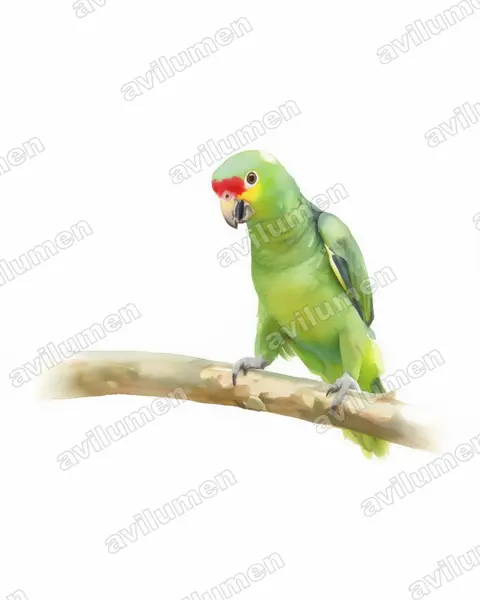
Watercolor 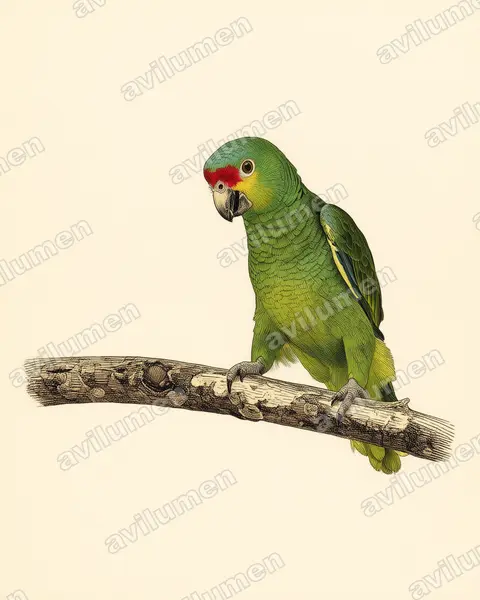
Vintage plate 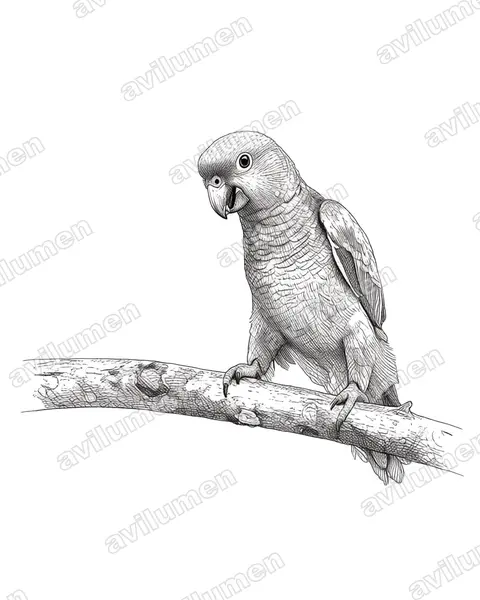
Ink 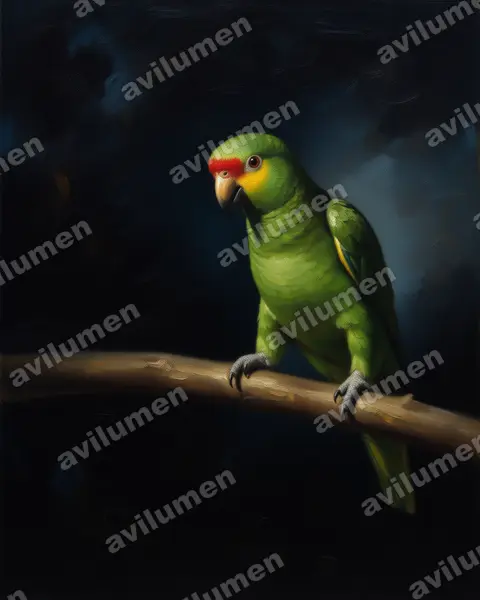
Oil 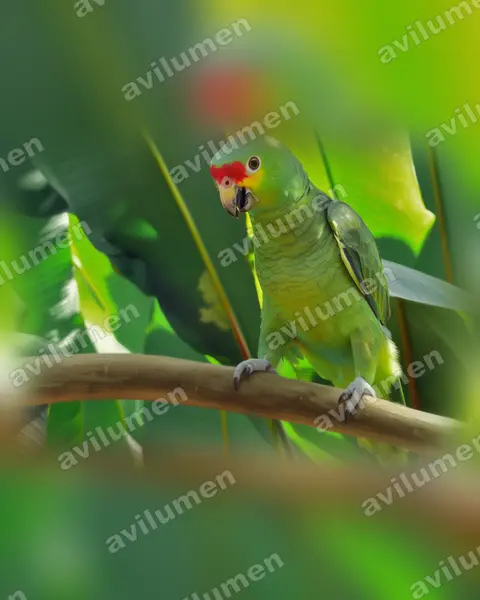
Realistic 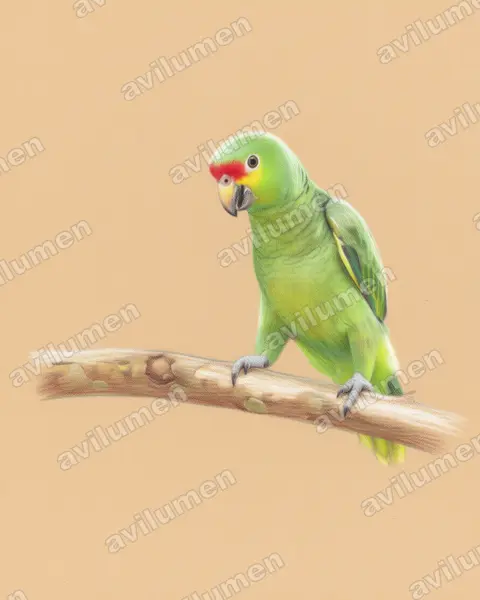
Colored pencil
Illustrations based on the photograph by Bernard DUPONT from FRANCE (CC BY-SA 2.0), from Wikimedia Commons.
Digital editions
HD Digital Art Pack — Red-lored Amazon
Digital download: 6 high-resolution illustrations of the Red-lored Amazon (Amazona autumnalis), print-ready. This is a digital file; no animal or physical item is included.
AI Avatar — Red-lored Amazon
Generate an avatar fusing your face with the Red-lored Amazon (Amazona autumnalis). Delivered digitally in 8K, watermark-free. Digital product; no animals are sold or brokered.
Instant download. No live birds are sold.
Frequently asked questions
- Is Amazona autumnalis (Red-lored Amazon) endangered?
- The IUCN Red List places Amazona autumnalis, commonly known as the Red-lored Amazon, in the «Least concern» category. «Least concern» means it is not currently threatened.
- Where does Amazona autumnalis (Red-lored Amazon) live?
- Amazona autumnalis (Red-lored Amazon) is found in Brazil and South America.
- What family does Amazona autumnalis (Red-lored Amazon) belong to?
- Amazona autumnalis (Red-lored Amazon) belongs to the family Psittacidae, in the order Psittaciformes.
- What colour is Amazona autumnalis (Red-lored Amazon)?
- The plumage of Amazona autumnalis (Red-lored Amazon) combines these colours: Green and Red.
More from the same family
 Near threatened
Yellow-faced Parrot
Alipiopsitta xanthops
The yellow-faced parrot, formerly also known as the yellow-faced amazon, is the only species of the genus Alipiopsitta. It is a Neotropical parrot, and was classified in the genus Amazona for many years. It is a predominantly green and yellow-plumaged bird with a yellow head. It is a semi-nomadic species found in the cerrado region of Brazil and adjacent Bolivia.
from $1.99
 Least concern
Moluccan King Parrot
Alisterus amboinensis
The Moluccan king parrot is a parrot endemic to Peleng Island, Maluku, and West Papua in Indonesia. It is sometimes referred to as the Ambon king parrot or Amboina king parrot, but this is potentially misleading, as it is found on numerous other islands than Ambon. The male and female are similar in appearance, with a predominantly red head and underparts, green wings, and blue back and tail.
from $1.99
 Least concern
Papuan King Parrot
Alisterus chloropterus
The Papuan king parrot, also known as the green-winged king parrot, is a species of parrot in the family Psittaculidae found in New Guinea. Its natural habitats are subtropical or tropical moist lowland forest and subtropical or tropical moist montane forest.
from $1.99
 Least concern
Australian King Parrot
Alisterus scapularis
The Australian king parrot is a species of parrot endemic to eastern Australia ranging from Cooktown in Queensland to Port Campbell in Victoria. Found in humid and heavily forested upland regions of the eastern portion of the continent, including eucalyptus wooded areas in and directly adjacent to subtropical and temperate rainforest. They feed on fruits and seeds gathered from trees or on the ground.
from $1.99