Kawall's Amazon
Amazona kawalli
Avilumen editorial team ·

Kawall's amazon, also known as the white-faced amazon, white-cheeked amazon or Kawall's parrot, is a relatively large species of parrot in the family Psittacidae. It is endemic to the south-central Amazon. After not having been recorded in the wild for around 70 years, the species was rediscovered in the 1980s.
Kawall's amazon (Amazona kawalli), also known as the white-faced amazon, white-cheeked amazon or Kawall's parrot, is a relatively large species of parrot in the family Psittacidae. It is endemic to the south-central Amazon. After not having been recorded in the wild for around 70 years, the species was rediscovered in the 1980s.
Taxonomy
Considerable taxonomic confusion has surrounded this species. "Aberrant mealy amazons", which actually were Kawall's amazon, were first noted in 1904. It was only in 1989 that the Kawall's amazon was recognised as a species after Brazilian bird keeper Nelson Kawall (after whom the species is named) received a few unusual amazons.
Description
The species is medium-sized for a parrot, reaching a length of 35–36 cm (13.8–14.2 in). The plumage is mostly green, with a narrow white strip at the base of the bill, narrow white eye-ring, and some blue and red present on the outermost flight feathers. Although it resembles the mealy amazon, Kawall's amazon can easily be recognised by its white patch of skin at the base of the bill, relatively small gray ocular ring (may fade to white in captivity), red near the base of the tail, overall brighter green hue and voice.
Distribution and habitat
Kawall's amazon has been reported from the Amazon basin of Brazil in Amazonas and Pará. A possible wider distribution, or the existence of isolated populations, is suggested by the existence of a previously misidentified specimen labelled 'Colombia', and a captive bird found on the edge of Amazonas National Park.
The species inhabits lowland rainforest and shows a preference for permanently flooded woodlands and riverine forest edges.
Ecology
Kawall's amazon has been observed feeding on tree seeds, palm fruits, flowers, and young leaves. It nests in tree cavities, and while it may search out suitable nesting cavities in the dry season, appears to restrict the actual nesting to periods when the forest is flooded.
Status
Although Kawall's amazon was only rediscovered in the wild relatively recently, it appears to be locally fairly common; however populations are declining due to habitat loss from deforestation. A certain amount of capture for the parrot trade also seems present. The species is currently classified as least concern by the IUCN.
Text adapted from Wikipedia · CC BY-SA 4.0
Where it lives
Distribution

Taxonomy
- Order
- Psittaciformes
- Family
- Psittacidae
- Genus
- Amazona
- Conservation status
- Least concern
Listen to its call
No recording yet
Care guide
Amazon, African Grey and Eclectus Parrot Care Guide
How to care for Amazon parrots, African greys, eclectus and pionus: diet, cage setup, health, behavior and CITES requirements for medium and large parrots.
Read the guide →Illustration gallery
6 illustrations of Amazona kawalli (Kawall's Amazon) in different styles, true to its real plumage. Shown watermarked; the art pack includes the high-resolution originals, ready to print.
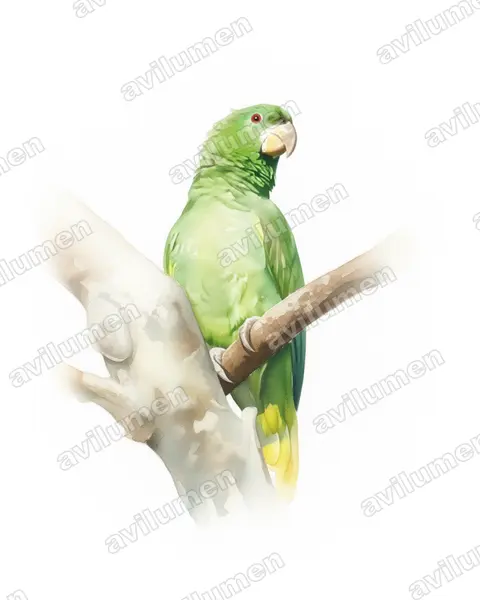
Watercolor 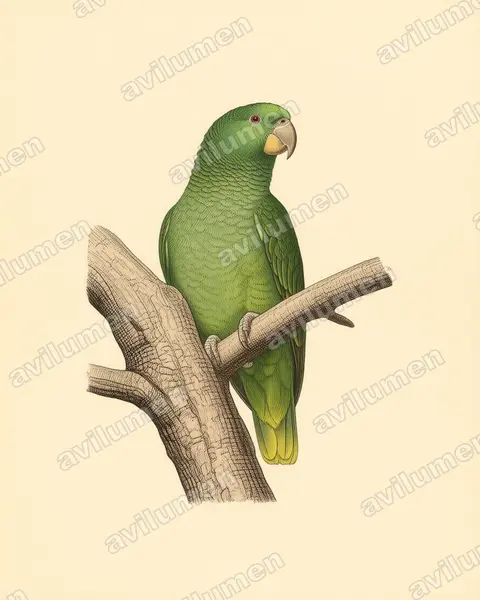
Vintage plate 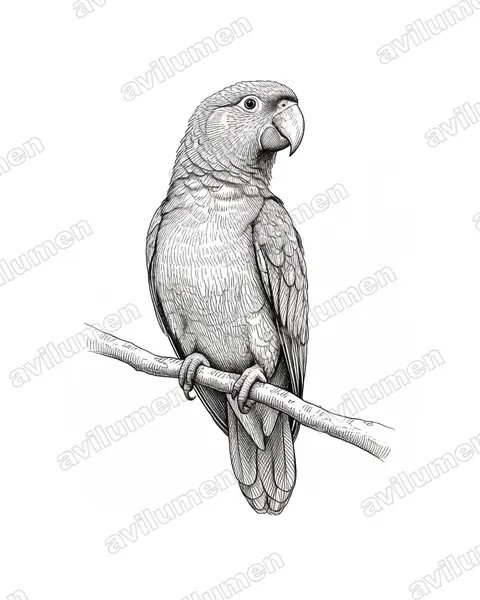
Ink 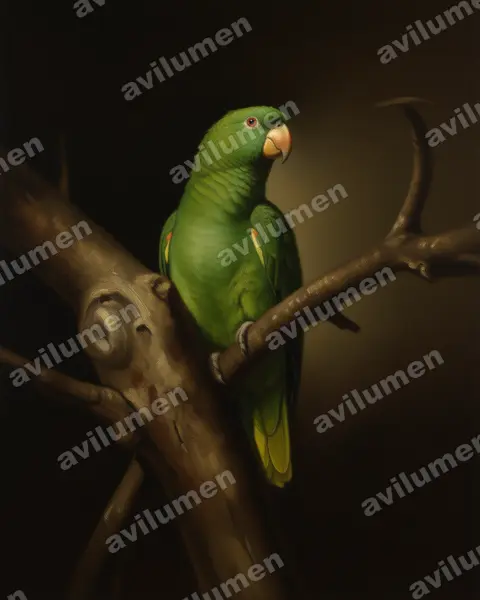
Oil 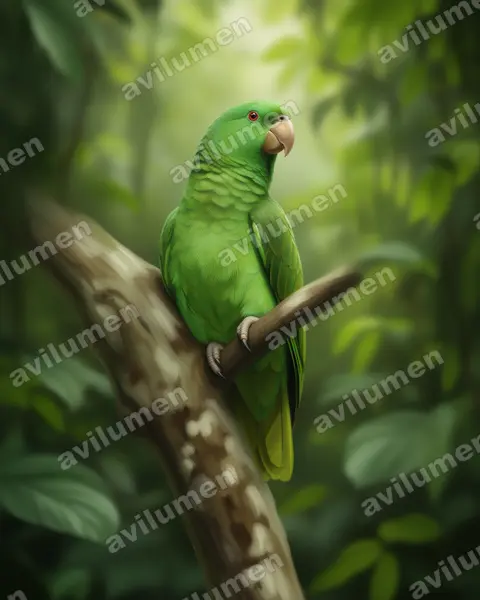
Realistic 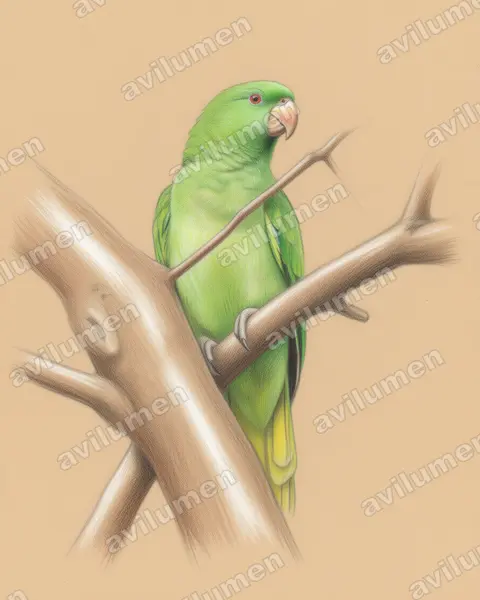
Colored pencil
Illustrations based on the photograph by Jacek Kisielewski (CC BY-SA 3.0), from Wikimedia Commons.
Digital editions
HD Digital Art Pack — Kawall's Amazon
Digital download: 6 high-resolution illustrations of the Kawall's Amazon (Amazona kawalli), print-ready. This is a digital file; no animal or physical item is included.
AI Avatar — Kawall's Amazon
Generate an avatar fusing your face with the Kawall's Amazon (Amazona kawalli). Delivered digitally in 8K, watermark-free. Digital product; no animals are sold or brokered.
Instant download. No live birds are sold.
Frequently asked questions
- Is Amazona kawalli (Kawall's Amazon) endangered?
- The IUCN Red List places Amazona kawalli, commonly known as the Kawall's Amazon, in the «Least concern» category. «Least concern» means it is not currently threatened.
- Where does Amazona kawalli (Kawall's Amazon) live?
- Amazona kawalli (Kawall's Amazon) is found in Brazil and South America.
- What family does Amazona kawalli (Kawall's Amazon) belong to?
- Amazona kawalli (Kawall's Amazon) belongs to the family Psittacidae, in the order Psittaciformes.
- What colour is Amazona kawalli (Kawall's Amazon)?
- The plumage of Amazona kawalli (Kawall's Amazon) combines these colours: Green and White.
More from the same family
 Near threatened
Yellow-faced Parrot
Alipiopsitta xanthops
The yellow-faced parrot, formerly also known as the yellow-faced amazon, is the only species of the genus Alipiopsitta. It is a Neotropical parrot, and was classified in the genus Amazona for many years. It is a predominantly green and yellow-plumaged bird with a yellow head. It is a semi-nomadic species found in the cerrado region of Brazil and adjacent Bolivia.
from $1.99
 Least concern
Moluccan King Parrot
Alisterus amboinensis
The Moluccan king parrot is a parrot endemic to Peleng Island, Maluku, and West Papua in Indonesia. It is sometimes referred to as the Ambon king parrot or Amboina king parrot, but this is potentially misleading, as it is found on numerous other islands than Ambon. The male and female are similar in appearance, with a predominantly red head and underparts, green wings, and blue back and tail.
from $1.99
 Least concern
Papuan King Parrot
Alisterus chloropterus
The Papuan king parrot, also known as the green-winged king parrot, is a species of parrot in the family Psittaculidae found in New Guinea. Its natural habitats are subtropical or tropical moist lowland forest and subtropical or tropical moist montane forest.
from $1.99
 Least concern
Australian King Parrot
Alisterus scapularis
The Australian king parrot is a species of parrot endemic to eastern Australia ranging from Cooktown in Queensland to Port Campbell in Victoria. Found in humid and heavily forested upland regions of the eastern portion of the continent, including eucalyptus wooded areas in and directly adjacent to subtropical and temperate rainforest. They feed on fruits and seeds gathered from trees or on the ground.
from $1.99