Yellow-crowned Amazon
Amazona ochrocephala
Avilumen editorial team ·

The yellow-crowned amazon or yellow-crowned parrot is a species of parrot native to tropical South America, Panama and Trinidad and Tobago in the Caribbean. The taxonomy is highly complex and the yellow-headed and yellow-naped amazon are sometimes considered subspecies of the yellow-crowned amazon. Except in the taxonomic section, the following deals only with the nominate group .They are found in the Amazon basin.
The yellow-crowned amazon or yellow-crowned parrot (Amazona ochrocephala) is a species of parrot native to tropical South America, Panama and Trinidad and Tobago in the Caribbean. The taxonomy is highly complex and the yellow-headed (A. oratrix) and yellow-naped amazon (A. auropalliata) are sometimes considered subspecies of the yellow-crowned amazon. Except in the taxonomic section, the following deals only with the nominate group (including subspecies xantholaema, nattereri and panamensis).They are found in the Amazon basin.
Taxonomy
The yellow-crowned amazon was formally described in 1788 by the German naturalist Johann Friedrich Gmelin in his revised and expanded edition of Carl Linnaeus's Systema Naturae. He placed it with all the other parrots in the genus Psittacus and coined the binomial name Psittacus ochrocephalus. Gmelin specified the type locality as "America", but this was restricted to Venezuela in 1902. The yellow-crowned amazon is now one of around thirty species of parrot placed in the genus Amazona that was introduced by the French naturalist René Lesson in 1830. The genus name is a Latinized version of the name Amazone given to these parrot in the 18th century by the Comte de Buffon, who believed they were native to Amazonian jungles. The specific ochrocephala combines the Ancient Greek ōkhros meaning "pale yellow" with -kephalos meaning "-headed".
Four subspecies are recognised:
A. o. panamensis (Cabanis, 1874) – west Panama and northwest Colombia
A. o. ochrocephala (Gmelin, JF, 1788) – east Colombia and Venezuela through the Guianas and north Brazil
A. o. xantholaema Berlepsch, 1913 – island of Marajó (off north Brazil in the Amazon delta)
A. o. nattereri (Finsch, 1865) – south Colombia to east Peru, north Bolivia and west Brazil
The Amazona ochrocephala complex, which has been described as "a taxonomic headache", is considered a single species by some authorities and split into three species, A. ochrocephala (yellow-crowned amazon), A. auropalliata (yellow-naped amazon) and A. oratrix (yellow-headed amazon), by others. The split is mainly based on the amount of yellow in the plumage, the color of the legs and bill, the close proximity of the oratrix group and auropalliata group in Oaxaca, Mexico, without apparent interbreeding and the presence of members of both the nominate group and the auropalliata group in northern Honduras. This evaluation has, however, been confused by misunderstandings regarding the plumage variations in the populations in northern Honduras, where birds vary greatly in amount of yellow on the head, crown and nape, but have pale bills and a juvenile plumage matching the oratrix group, but neither the nominate nor the auropalliata group. The taxon caribaea from the Bay Islands is a member of the auropalliata group, and occurs in relatively close proximity to the members of the oratrix group. As caribaea may have a relatively pale lower mandible, this could indicating a level of gene flow between this and the nearby taxa of the oratrix group. If confirmed, this could suggest that the two are better considered conspecific. Alternatively, it has been suggested that caribaea and parvipes, both typically placed in the auropalliata group, may be closer to the oratrix than they are to the auropalliata sensu stricto. Both are relatively small and have red to the shoulder as in the members of the oratrix group, but unlike auropalliata sensu stricto.
The members of this complex are known to hybridize in captivity and recent phylogenetic analysis of DNA did not support the split into the three "traditional" biological species, but did reveal three clades, which potentially could be split into three phylogenetic species: a Mexican and Central American species (incl. panamensis, which extends slightly into South America), a species of northern South America (northern nominate), and a species from the southern Amazon basin (nattereri, xantholaema and southern nominate). The Central American clade can potentially be split further, with panamensis and tresmariae recognized as two monotypic species. The members of the clade from the southern Amazon basin should arguably be included as subspecies of the blue-fronted amazon, as they are closer to each other than to the northern clades. Disregarding these problems, the following taxa are part of the Amazona ochrocephala complex as traditionally delimited:
nominate group ("true" yellow-crowned amazon):
Amazona o. ochrocephala: East-central and southeastern Colombia, Venezuela, Trinidad, Guyana, Suriname, French Guiana and the northern and eastern Amazon basin in Brazil.
Amazona o. xantholaema: Marajó Island, in the Amazon River delta of northeastern Brazil.
Amazona o. nattereri: Far southeastern Colombia, eastern Ecuador, eastern Peru, northern Bolivia and the southwestern Amazon basin of Brazil (east to around Mato Grosso); often included in A. o. ochrocephala.
Amazona o. panamensis: Western Panama to northwestern Colombia; sometimes called the Panama amazon
auropalliata group (yellow-naped amazon):
Amazona a./o. auropalliata: Southern Mexico to northwestern Costa Rica.
Amazona a./o. parvipes: The Mosquito Coast in eastern Honduras and northeastern Nicaragua.
Amazona a./o. caribaea: The Bay Islands, Honduras.
oratrix group (yellow-headed amazon):
Amazona o./o. oratrix: The Pacific and Gulf slopes of Mexico; also, a population in Stuttgart exists.
Amazona o./o. tresmariae: The Tres Marías Islands, off west-central Mexico.
Amazona o./o. belizensis: Belize.
Amazona o./o. hondurensis: The Sula Valley in northern Honduras.
Of these, hondurensis was only recently described, while the population in northwestern Honduras and adjacent eastern Guatemala (near Puerto Barrios) resembles belizensis and is commonly included in that subspecies, but may actually represent an undescribed subspecies. It has sometimes been referred to as guatemalensis, but until it is officially described, the name remains provisional. An additional subspecies, magna, has sometimes been recognized for the population on the Gulf slope of Mexico, but today most authorities consider it invalid, instead including this population in oratrix.
Description
Subspecies in the nominate group (including subspecies xantholaema, nattereri and panamensis) have a total length of 33–38 cm (14–15 in). As most other amazon parrots, it has a short squarish tail and primarily green plumage. It has dark blue tips to the secondaries and primaries and a red wing speculum, carpal edge (leading edge of the wing at the "shoulder") and base of the outer tail feathers. The red and dark blue sections are often difficult to see when the bird is perched, while the red base of the outer tail feathers only infrequently can be seen under normal viewing conditions in the wild. The amount of yellow to the head varies, with the nominate, nattereri and panamensis having yellow restricted to the crown-region (occasionally with a few random feathers around the eyes), while the subspecies xantholaema has most of the head yellow. All have a white eye-ring. They have a dark bill with a large horn (gray) or reddish spot on the upper mandible, except panamensis, which has a horn-colored beak. Males and females do not differ in plumage. Except for the wing speculum, juveniles have little yellow and red to the plumage.
Distribution and habitat
The yellow-crowned amazon is found in the Amazon basin and Guianas, with additional populations in northwestern South America and Panama. It has been introduced to Grand Cayman.
It is a bird of tropical forests (both humid and dry), woodlands, mangroves, and savannas and may also be found on cultivated land and suburban areas. In the southern part of its range, it is rarely found far from the Amazon rainforest. It is mainly a lowland bird, but has locally been recorded up to 800 m (2600 ft) along on the eastern slopes of the Andes. Introduced–and apparently breeding–populations have been reported in Puerto Rico.
A wild colony of around 60 animals has been living in Stuttgart, Germany, since the mid-1980s.
Food and feeding
They are normally found in pairs or small flocks up to 30, but larger groups may gather at clay licks. Their food includes fruits, nuts, seeds, berries, blossoms and leaf buds. Yellow-crowned amazons are fond of maize and cultivated fruits. Foods with sugar and a large amount of salt can be dangerous for them.
Breeding
The nest is in a hollow in a tree, palm or termitarium, where they lay two to three eggs. The incubation time is about 26 days and the chicks leave the nest about 60 days from hatching.
Conservation
The yellow-crowned amazon is considered to be of least concern by BirdLife International, and consequently, also by IUCN. Although populations are believed to be in decline, they do not yet approach the threshold specified by BirdLife International to rate the species as near threatened. As is the case with most parrots, it is listed on appendix II of CITES. It occurs in numerous protected areas and remains fairly common throughout a large part of its range.
Text adapted from Wikipedia · CC BY-SA 4.0
Where it lives
Distribution

Taxonomy
- Order
- Psittaciformes
- Family
- Psittacidae
- Genus
- Amazona
- Conservation status
- Least concern
Listen to its call
No recording yet
Care guide
Amazon, African Grey and Eclectus Parrot Care Guide
How to care for Amazon parrots, African greys, eclectus and pionus: diet, cage setup, health, behavior and CITES requirements for medium and large parrots.
Read the guide →Illustration gallery
6 illustrations of Amazona ochrocephala (Yellow-crowned Amazon) in different styles, true to its real plumage. Shown watermarked; the art pack includes the high-resolution originals, ready to print.
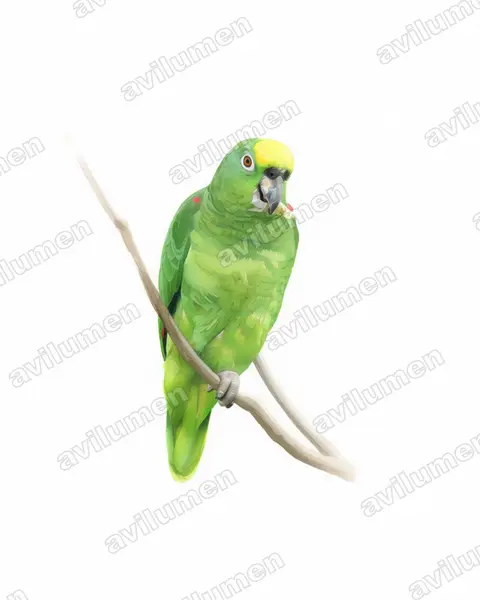
Watercolor 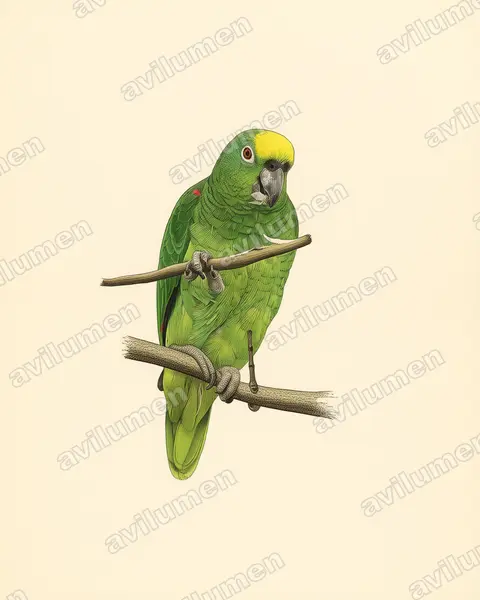
Vintage plate 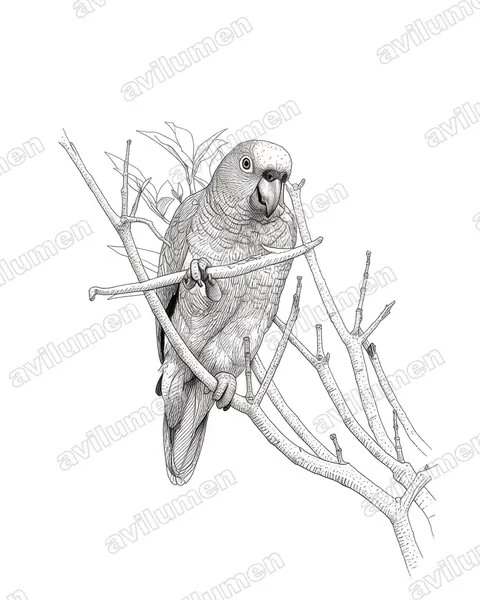
Ink 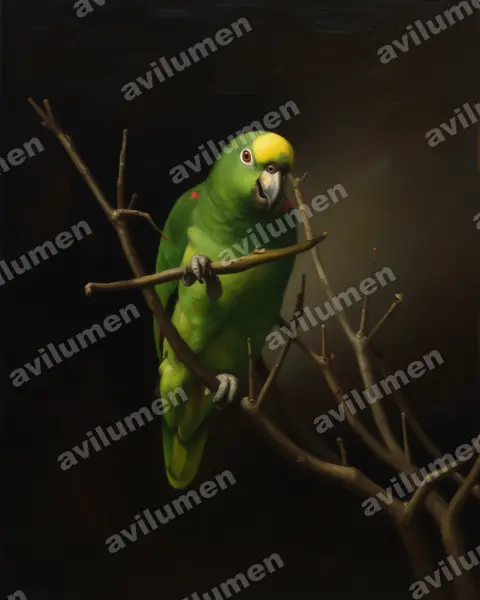
Oil 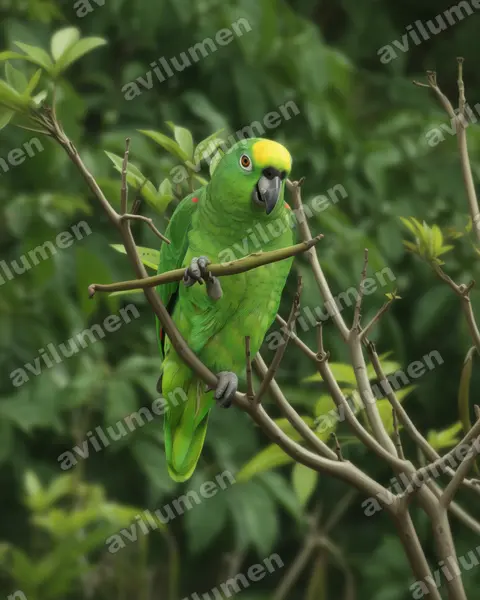
Realistic 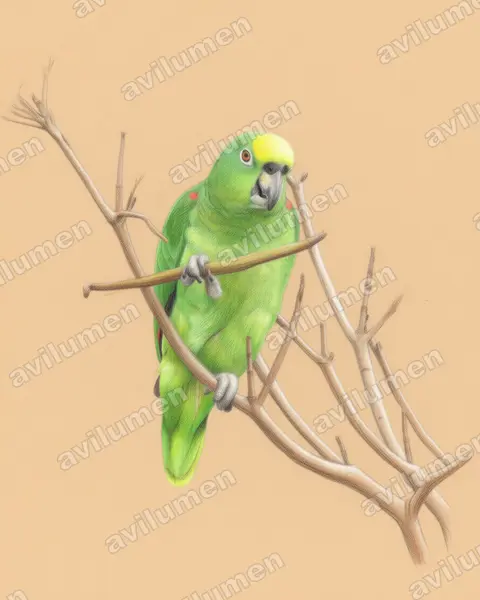
Colored pencil
Illustrations based on the photograph by Ymmer Vanegas (CC BY-SA 3.0), from Wikimedia Commons.
Digital editions
HD Digital Art Pack — Yellow-crowned Amazon
Digital download: 6 high-resolution illustrations of the Yellow-crowned Amazon (Amazona ochrocephala), print-ready. This is a digital file; no animal or physical item is included.
AI Avatar — Yellow-crowned Amazon
Generate an avatar fusing your face with the Yellow-crowned Amazon (Amazona ochrocephala). Delivered digitally in 8K, watermark-free. Digital product; no animals are sold or brokered.
Instant download. No live birds are sold.
Frequently asked questions
- Is Amazona ochrocephala (Yellow-crowned Amazon) endangered?
- The IUCN Red List places Amazona ochrocephala, commonly known as the Yellow-crowned Amazon, in the «Least concern» category. «Least concern» means it is not currently threatened.
- Where does Amazona ochrocephala (Yellow-crowned Amazon) live?
- Amazona ochrocephala (Yellow-crowned Amazon) is found in Brazil and South America.
- What family does Amazona ochrocephala (Yellow-crowned Amazon) belong to?
- Amazona ochrocephala (Yellow-crowned Amazon) belongs to the family Psittacidae, in the order Psittaciformes.
- What colour is Amazona ochrocephala (Yellow-crowned Amazon)?
- The plumage of Amazona ochrocephala (Yellow-crowned Amazon) combines these colours: Green and Yellow.
More from the same family
 Near threatened
Yellow-faced Parrot
Alipiopsitta xanthops
The yellow-faced parrot, formerly also known as the yellow-faced amazon, is the only species of the genus Alipiopsitta. It is a Neotropical parrot, and was classified in the genus Amazona for many years. It is a predominantly green and yellow-plumaged bird with a yellow head. It is a semi-nomadic species found in the cerrado region of Brazil and adjacent Bolivia.
from $1.99
 Least concern
Moluccan King Parrot
Alisterus amboinensis
The Moluccan king parrot is a parrot endemic to Peleng Island, Maluku, and West Papua in Indonesia. It is sometimes referred to as the Ambon king parrot or Amboina king parrot, but this is potentially misleading, as it is found on numerous other islands than Ambon. The male and female are similar in appearance, with a predominantly red head and underparts, green wings, and blue back and tail.
from $1.99
 Least concern
Papuan King Parrot
Alisterus chloropterus
The Papuan king parrot, also known as the green-winged king parrot, is a species of parrot in the family Psittaculidae found in New Guinea. Its natural habitats are subtropical or tropical moist lowland forest and subtropical or tropical moist montane forest.
from $1.99
 Least concern
Australian King Parrot
Alisterus scapularis
The Australian king parrot is a species of parrot endemic to eastern Australia ranging from Cooktown in Queensland to Port Campbell in Victoria. Found in humid and heavily forested upland regions of the eastern portion of the continent, including eucalyptus wooded areas in and directly adjacent to subtropical and temperate rainforest. They feed on fruits and seeds gathered from trees or on the ground.
from $1.99