Saint Lucia Amazon
Amazona versicolor
Avilumen editorial team ·

The Saint Lucia amazon, also known as the St. Lucia amazon and St. Lucia parrot, is a vulnerable species of bird in subfamily Arinae of the family Psittacidae, the African and New World parrots. It is endemic to Saint Lucia in the Lesser Antilles and is the country's national bird.
The Saint Lucia amazon (Amazona versicolor), also known as the St. Lucia amazon and St. Lucia parrot, is a vulnerable species of bird in subfamily Arinae of the family Psittacidae, the African and New World parrots. It is endemic to Saint Lucia in the Lesser Antilles and is the country's national bird.
Taxonomy and systematics
The Saint Lucia amazon is closely related to the red-necked amazon (A. arausiaca) of Dominica.
Description
The Saint Lucia amazon is 42 to 46 cm (17 to 18 in) long and weighs 505 to 1,000 g (18 to 35 oz). The sexes are alike. Their forehead is royal blue that is lighter on the crown and the rest of the face. Their hindcrown, nape, sides of the neck, and mantle are scaly green. The rest of their upperparts are plain green. Their upper breast is red, their lower breast and belly mottled green and maroon, and their vent area greenish yellow. Their wings are green with a red speculum and dark blue primaries. Their tail feathers are green with wide yellowish tips.
Distribution and habitat
The Saint Lucia amazon is found in the mountains of Saint Lucia's interior. It inhabits tropical moist montane forest at elevations between 500 and 900 m (1,600 and 3,000 ft).
Movement
The Saint Lucia amazon has no known pattern of movement.
Feeding
The Saint Lucia amazon feeds on seeds and fruit of a variety of palms and other plants.
Breeding
The Saint Lucia amazon's breeding season includes at least February and March and may continue beyond that. It nests in a tree cavity. The clutch size is two eggs. In captivity the incubation period is 28 days and fledging occurs about 81 days after hatch.
In captivity
Between 1975 and 2021, the Jersey Zoo maintained a breeding colony of Saint Lucia amazons. In 1982, they achieved the first captive breeding success of this species. The offspring of this breeding were returned to the wild. On 2 May 2021, the Jersey Zoo announced that their last amazon died, ending their tenure with this species. It is maintained in a few other collections in Europe.
Status
The IUCN originally assessed the Saint Lucia amazon in 1988 as Threatened and since 1994 as Vulnerable. Its estimated population of 1150 to 1500 mature individuals is believed to be increasing. The population was thought to total about 1000 in 1950 but declined to about 150 by the late 1970s as a result of habitat loss, hunting for food, the pet trade, and hurricanes. The species' plight at that time prompted conservation measures with "strong national and popular support"; the population had increased to about 300 by 1990 and has continued to increase.
Text adapted from Wikipedia · CC BY-SA 4.0
Taxonomy
- Order
- Psittaciformes
- Family
- Psittacidae
- Genus
- Amazona
- Conservation status
- Vulnerable
Listen to its call
No recording yet
Care guide
Amazon, African Grey and Eclectus Parrot Care Guide
How to care for Amazon parrots, African greys, eclectus and pionus: diet, cage setup, health, behavior and CITES requirements for medium and large parrots.
Read the guide →Illustration gallery
6 illustrations of Amazona versicolor (Saint Lucia Amazon) in different styles, true to its real plumage. Shown watermarked; the art pack includes the high-resolution originals, ready to print.
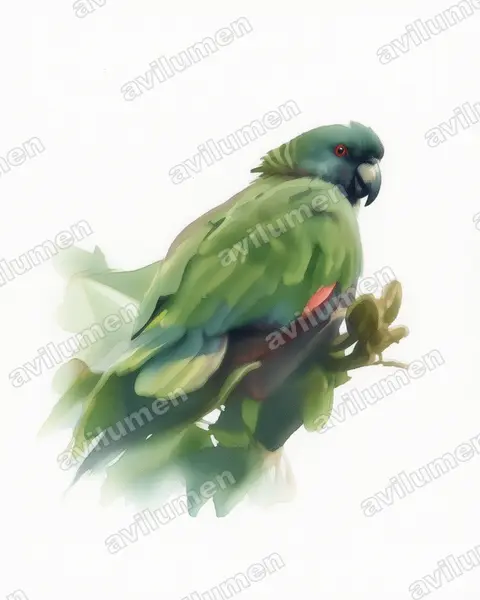
Watercolor 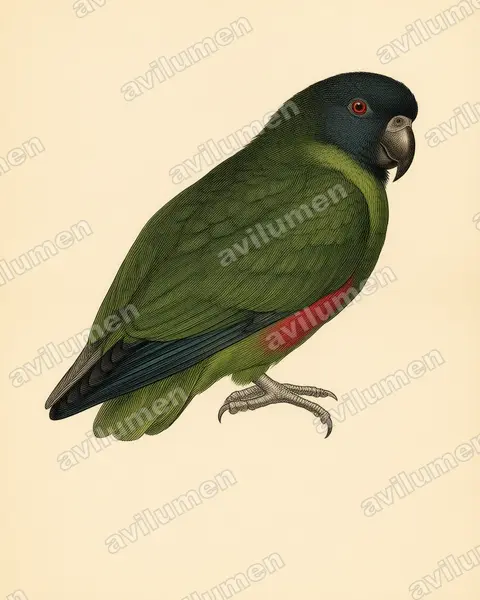
Vintage plate 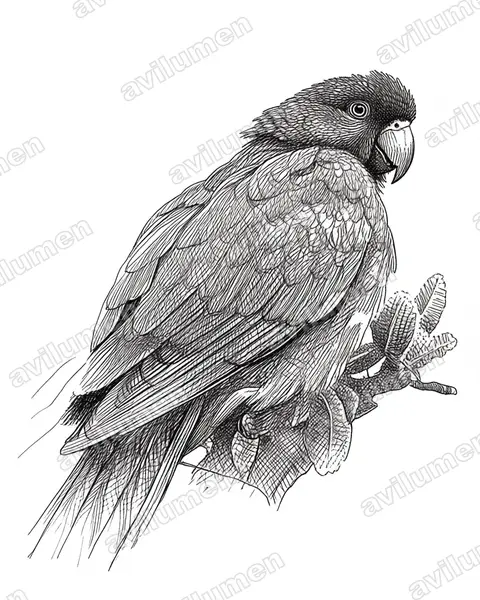
Ink 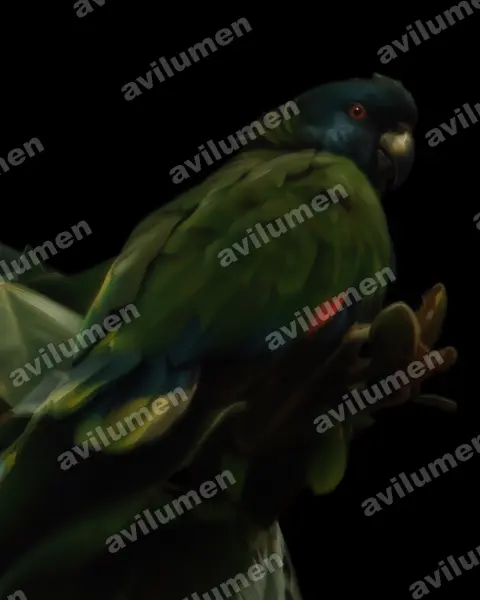
Oil 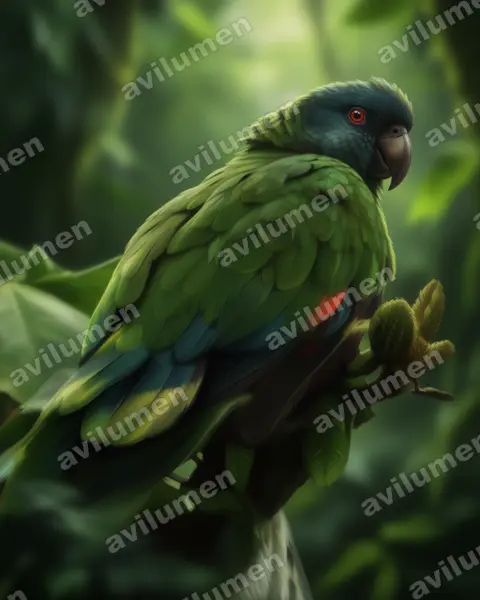
Realistic 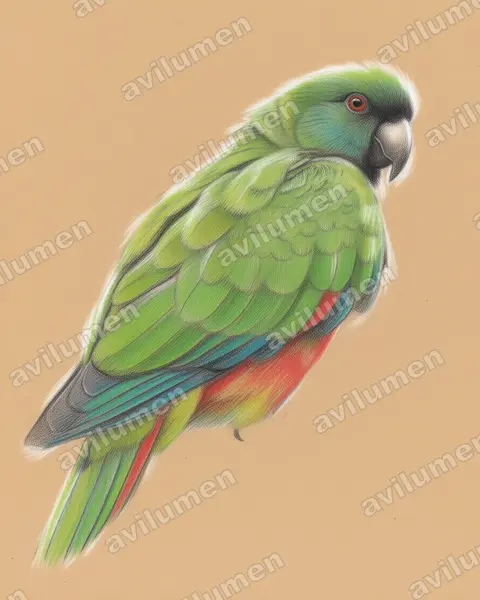
Colored pencil
Illustrations based on the photograph by Brennan Mulrooney (CC BY 2.0), from Wikimedia Commons.
Digital editions
HD Digital Art Pack — Saint Lucia Amazon
Digital download: 6 high-resolution illustrations of the Saint Lucia Amazon (Amazona versicolor), print-ready. This is a digital file; no animal or physical item is included.
AI Avatar — Saint Lucia Amazon
Generate an avatar fusing your face with the Saint Lucia Amazon (Amazona versicolor). Delivered digitally in 8K, watermark-free. Digital product; no animals are sold or brokered.
Instant download. No live birds are sold.
Frequently asked questions
- Is Amazona versicolor (Saint Lucia Amazon) endangered?
- The IUCN Red List places Amazona versicolor, commonly known as the Saint Lucia Amazon, in the «Vulnerable» category. «Vulnerable» means it faces a high risk of extinction in the medium term.
- What family does Amazona versicolor (Saint Lucia Amazon) belong to?
- Amazona versicolor (Saint Lucia Amazon) belongs to the family Psittacidae, in the order Psittaciformes.
- What colour is Amazona versicolor (Saint Lucia Amazon)?
- The plumage of Amazona versicolor (Saint Lucia Amazon) combines these colours: Green and Pink.
More from the same family
 Near threatened
Yellow-faced Parrot
Alipiopsitta xanthops
The yellow-faced parrot, formerly also known as the yellow-faced amazon, is the only species of the genus Alipiopsitta. It is a Neotropical parrot, and was classified in the genus Amazona for many years. It is a predominantly green and yellow-plumaged bird with a yellow head. It is a semi-nomadic species found in the cerrado region of Brazil and adjacent Bolivia.
from $1.99
 Least concern
Moluccan King Parrot
Alisterus amboinensis
The Moluccan king parrot is a parrot endemic to Peleng Island, Maluku, and West Papua in Indonesia. It is sometimes referred to as the Ambon king parrot or Amboina king parrot, but this is potentially misleading, as it is found on numerous other islands than Ambon. The male and female are similar in appearance, with a predominantly red head and underparts, green wings, and blue back and tail.
from $1.99
 Least concern
Papuan King Parrot
Alisterus chloropterus
The Papuan king parrot, also known as the green-winged king parrot, is a species of parrot in the family Psittaculidae found in New Guinea. Its natural habitats are subtropical or tropical moist lowland forest and subtropical or tropical moist montane forest.
from $1.99
 Least concern
Australian King Parrot
Alisterus scapularis
The Australian king parrot is a species of parrot endemic to eastern Australia ranging from Cooktown in Queensland to Port Campbell in Victoria. Found in humid and heavily forested upland regions of the eastern portion of the continent, including eucalyptus wooded areas in and directly adjacent to subtropical and temperate rainforest. They feed on fruits and seeds gathered from trees or on the ground.
from $1.99