Scarlet-fronted Parakeet
Aratinga wagleri
Avilumen editorial team ·

The scarlet-fronted parakeet, known in aviculture as the scarlet-fronted conure, red-fronted conure, or Wagler's conure, is a Near Threatened species of bird in subfamily Arinae of the family Psittacidae, the African and New World parrots. It is found in Colombia and Venezuela.
The scarlet-fronted parakeet (Psittacara wagleri), known in aviculture as the scarlet-fronted conure, red-fronted conure, or Wagler's conure, is a Near Threatened species of bird in subfamily Arinae of the family Psittacidae, the African and New World parrots. It is found in Colombia and Venezuela.
Taxonomy and systematics
The scarlet-fronted parakeet was for a time placed in the genus Aratinga but from about 2013 has been in its present genus Psittacara. Its taxonomy is otherwise unsettled. The International Ornithological Committee (IOC), BirdLife International's Handbook of the Birds of the World (HBW), and the Clements taxonomy assign it two subspecies, the nominate P. w. wagleri (G.R. Gray, 1845) and P. w. transilis (J.L. Peters, 1927). The American Ornithological Society assigns two others, P. w. frontatus (Cabanis, 1846) and P. w. minor (Carriker, 1933). The IOC, HBW, and Clements treat them as the two subspecies of the cordilleran parakeet (P. frontatus).
This article follows the two-subspecies model.
Description
The scarlet-fronted parakeet is 34 to 40 cm (13 to 16 in) long and weighs 162 to 217 g (5.7 to 7.7 oz). The sexes are alike. Adults are generally green that is yellower on the underparts; some have red speckles on their throat. Their English name comes from their red forehead and the front part of their crown. The undersides of their flight feathers and tail are olive-yellow. Their iris is pale gray surrounded by bare gray skin, their bill horn colored, and their legs and feet brownish. Subspecies P. w. transilis is overall somewhat smaller and darker than the nominate, and the red on its crown does not extend as far to the rear. Immature birds resemble adults but with less red on their head.
Distribution and habitat
The scarlet-fronted parakeet has a disjunct distribution. The nominate subspecies is found in the Colombian Andes, the isolated Sierra Nevada de Santa Marta in northern Colombia, in the Serranía del Perijá that straddles the Colombia/Venezuela border, and in western Venezuela. Subspecies P. w. transilis is found in extreme eastern Colombia and in northern Venezuela from Falcón east to Sucre and Monagas. The species inhabits a variety of landscapes including the edges of cloudforest, tropical deciduous forest, and gallery and secondary forest. It also occurs in fields, orchards, and parks in built-up areas. In elevation it ranges from 350 to 2,500 m (1,100 to 8,200 ft).
Movement
The scarlet-fronted parakeet makes seasonal movements in Venezuela; its movements, if any, in Colombia have not been defined. It travels in large flocks.
Feeding
The scarlet-fronted parakeet usually forages in the forest canopy. Its diet has not been fully described but is known to include fruits, nuts, and seeds. In some areas it may be a crop pest.
Breeding
The scarlet-fronted parakeet nests from April to June in Venezuela and December to June in northern Colombia. It breeds colonially, usually in fissures in cliff faces.
Vocalization
The scarlet-fronted parakeet is very vocal, especially in flight with "a continuous loud screeching chatter". It also makes "[s]queaky notes and screeches, kreee".
Status
The IUCN has assessed the scarlet-fronted parakeet as Near Threatened. It has a fragmented range; its population size is not known and is believed to be decreasing. The primary threats are "trapping pressure, persecution and habitat loss through land-use change."
Text adapted from Wikipedia · CC BY-SA 4.0
Distribution

Taxonomy
- Order
- Psittaciformes
- Family
- Psittacidae
- Genus
- Aratinga
- Conservation status
- Not evaluated
Listen to its call
No recording yet
Care guide
Budgie, Conure and Parakeet Care Guide
How to care for budgies, conures, parrotlets, ringnecks and other parakeets: diet, cage setup, health, behavior, breeding and legal status for owners.
Read the guide →Illustration gallery
6 illustrations of Aratinga wagleri (Scarlet-fronted Parakeet) in different styles, true to its real plumage. Shown watermarked; the art pack includes the high-resolution originals, ready to print.
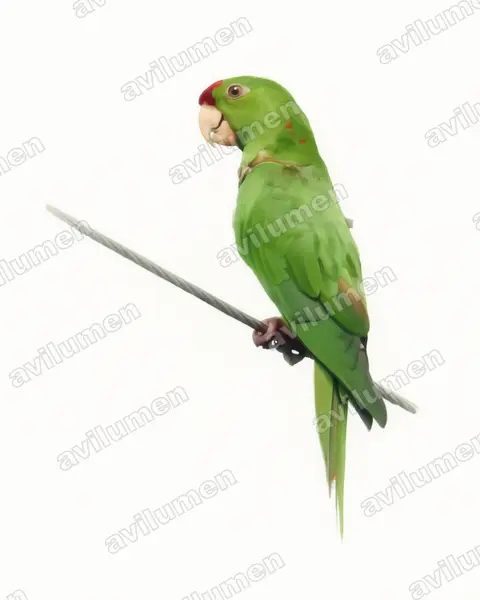
Watercolor 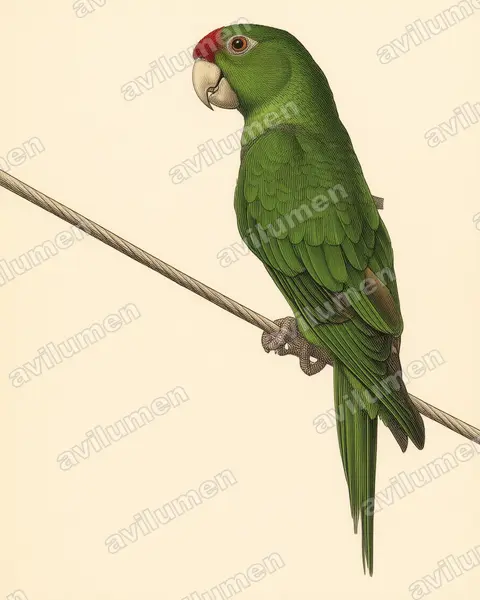
Vintage plate 
Ink 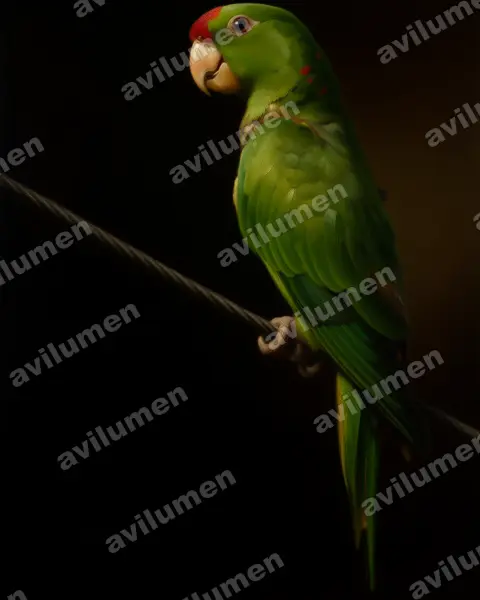
Oil 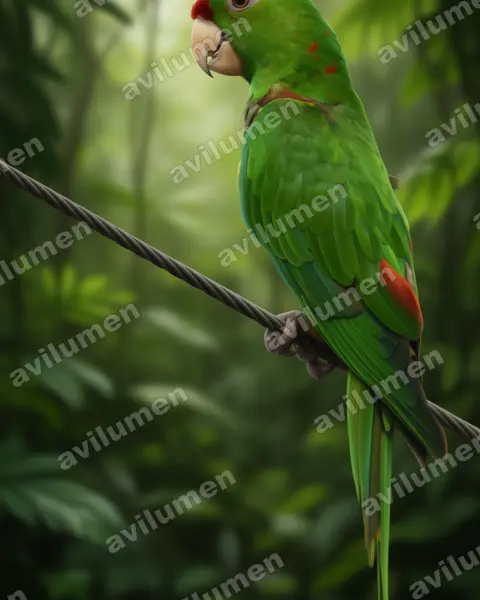
Realistic 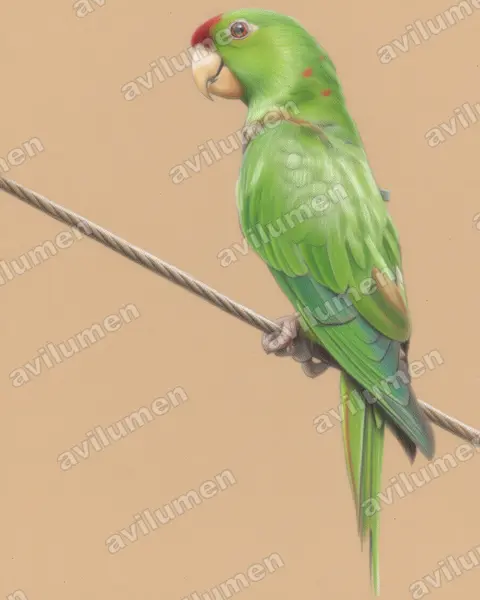
Colored pencil
Illustrations based on the photograph by Alejandro Bayer Tamayo from Armenia, Colombia (CC BY-SA 2.0), from Wikimedia Commons.
Digital editions
HD Digital Art Pack — Scarlet-fronted Parakeet
Digital download: 6 high-resolution illustrations of the Scarlet-fronted Parakeet (Aratinga wagleri), print-ready. This is a digital file; no animal or physical item is included.
AI Avatar — Scarlet-fronted Parakeet
Generate an avatar fusing your face with the Scarlet-fronted Parakeet (Aratinga wagleri). Delivered digitally in 8K, watermark-free. Digital product; no animals are sold or brokered.
Instant download. No live birds are sold.
Frequently asked questions
- Is Aratinga wagleri (Scarlet-fronted Parakeet) endangered?
- The IUCN Red List places Aratinga wagleri, commonly known as the Scarlet-fronted Parakeet, in the «Not evaluated» category. «Not evaluated» means the IUCN has not yet assessed this species.
- What family does Aratinga wagleri (Scarlet-fronted Parakeet) belong to?
- Aratinga wagleri (Scarlet-fronted Parakeet) belongs to the family Psittacidae, in the order Psittaciformes.
- What colour is Aratinga wagleri (Scarlet-fronted Parakeet)?
- The plumage of Aratinga wagleri (Scarlet-fronted Parakeet) combines these colours: Green and Red.
More from the same family
 Near threatened
Yellow-faced Parrot
Alipiopsitta xanthops
The yellow-faced parrot, formerly also known as the yellow-faced amazon, is the only species of the genus Alipiopsitta. It is a Neotropical parrot, and was classified in the genus Amazona for many years. It is a predominantly green and yellow-plumaged bird with a yellow head. It is a semi-nomadic species found in the cerrado region of Brazil and adjacent Bolivia.
from $1.99
 Least concern
Moluccan King Parrot
Alisterus amboinensis
The Moluccan king parrot is a parrot endemic to Peleng Island, Maluku, and West Papua in Indonesia. It is sometimes referred to as the Ambon king parrot or Amboina king parrot, but this is potentially misleading, as it is found on numerous other islands than Ambon. The male and female are similar in appearance, with a predominantly red head and underparts, green wings, and blue back and tail.
from $1.99
 Least concern
Papuan King Parrot
Alisterus chloropterus
The Papuan king parrot, also known as the green-winged king parrot, is a species of parrot in the family Psittaculidae found in New Guinea. Its natural habitats are subtropical or tropical moist lowland forest and subtropical or tropical moist montane forest.
from $1.99
 Least concern
Australian King Parrot
Alisterus scapularis
The Australian king parrot is a species of parrot endemic to eastern Australia ranging from Cooktown in Queensland to Port Campbell in Victoria. Found in humid and heavily forested upland regions of the eastern portion of the continent, including eucalyptus wooded areas in and directly adjacent to subtropical and temperate rainforest. They feed on fruits and seeds gathered from trees or on the ground.
from $1.99