Dusky-headed Parakeet
Aratinga weddellii
Avilumen editorial team ·

The dusky-headed parakeet, also known as Weddell's conure or dusky-headed conure in aviculture, is a small green Neotropical parrot with dusty grey head found in wooded habitats in the western Amazon basin of South America. Its range extends from southeastern Colombia south through eastern Ecuador, eastern Peru, and southwest Amazonian Brazil, to central Bolivia.
The dusky-headed parakeet (Aratinga weddellii), also known as Weddell's conure or dusky-headed conure in aviculture, is a small green Neotropical parrot with dusty grey head found in wooded habitats in the western Amazon basin of South America. Its range extends from southeastern Colombia south through eastern Ecuador, eastern Peru, and southwest Amazonian Brazil, to central Bolivia. It prefers semiopen habitats such as várzea, forest edge, and forest remnants, but can also be found in coffee plantations. It is generally common and its habitat preference makes it less vulnerable than many other Amazonian species. Consequently, it is considered to be of least concern by BirdLife International and IUCN.
This long-tailed species is generally green in color (both lutino and blue mutations are rare, but do exist in captivity) with a gray-brown head, a blue-tipped tail, and remiges that are dark gray from below, mainly blue from above. The bill is black, and it has a broad, bare, white (sometimes yellow-tinged) eye-ring. With a typical length of 25–28 cm (10–11 in) and a weight around 100 grams, it is slightly smaller than the sun conure. Many people call these conures mini-macaws because they have skin near their beaks and eyes, similar to the macaw.
It is social, and usually found in pairs or small groups. It may even flock with different species of conures. When food is plentiful, it may form flocks of up to 100 members. It eats fruit, seeds, and flowers, and searches decaying wood for insect larvae. It also ingests mineral-rich soil, e.g., from a clay lick, as a supplement. A pair raises their offspring together, nesting in woodpecker holes in trees or arboreal termite nests.
Consuming clay is believed to provide a mineral supplement and neutralise toxins in their diet. Their predators (along with many other neotropical parrots) include many birds of prey, monkeys, and in some cases, jaguars.
They do well in captivity. They are fairly easy to breed if provided with a durable nest box, and will lay up to three clutches per year. They are known to be quiet, compared to other conure species, but still very energetic and playful, like most conures. These conures' lifespans range from 25 to 50 years, though their typical lifespans are usually 35–40 years.
Recently, they have been sighted as a colony in the coastal districts of Lima, Perú. They probably came as pets, and have settled in this city.
Text adapted from Wikipedia · CC BY-SA 4.0
Where it lives
Distribution

Taxonomy
- Order
- Psittaciformes
- Family
- Psittacidae
- Genus
- Aratinga
- Conservation status
- Least concern
Listen to its call
No recording yet
Care guide
Budgie, Conure and Parakeet Care Guide
How to care for budgies, conures, parrotlets, ringnecks and other parakeets: diet, cage setup, health, behavior, breeding and legal status for owners.
Read the guide →Illustration gallery
6 illustrations of Aratinga weddellii (Dusky-headed Parakeet) in different styles, true to its real plumage. Shown watermarked; the art pack includes the high-resolution originals, ready to print.
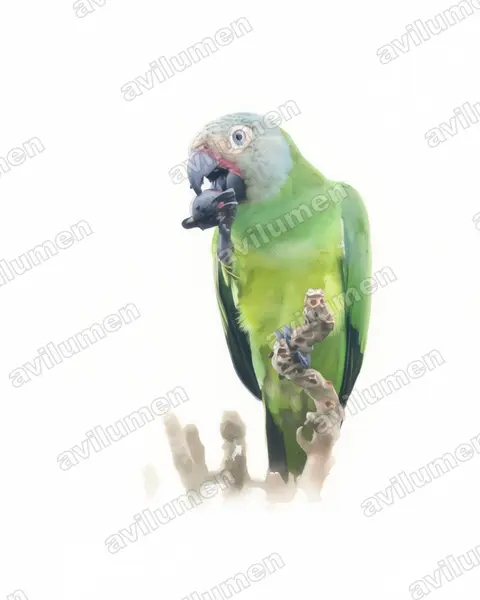
Watercolor 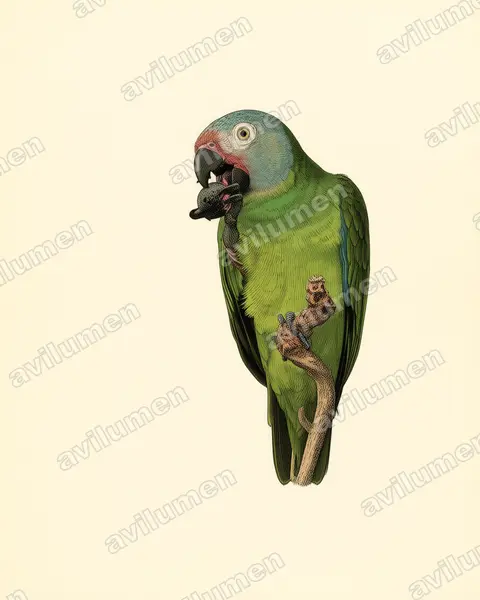
Vintage plate 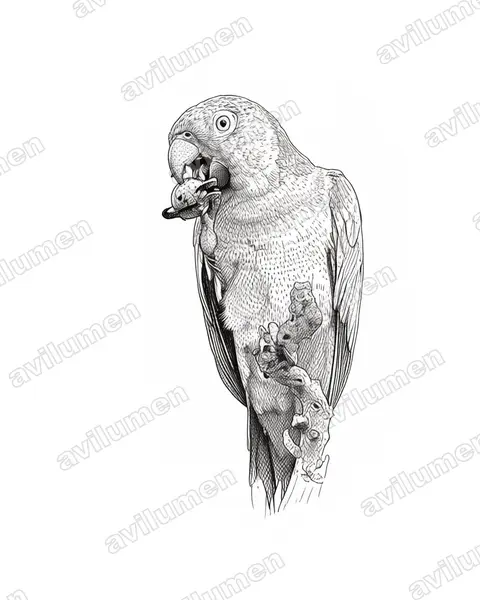
Ink 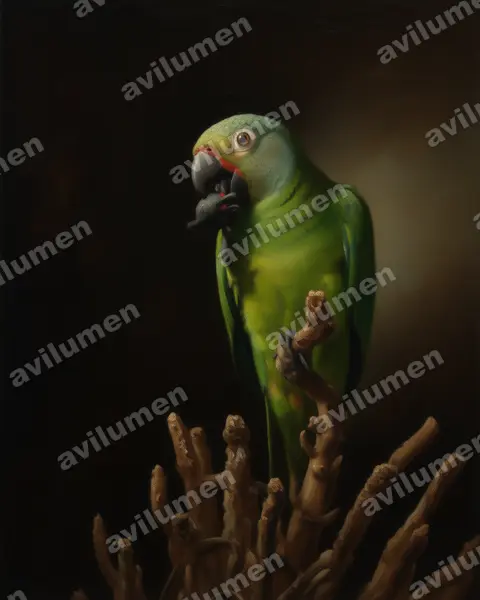
Oil 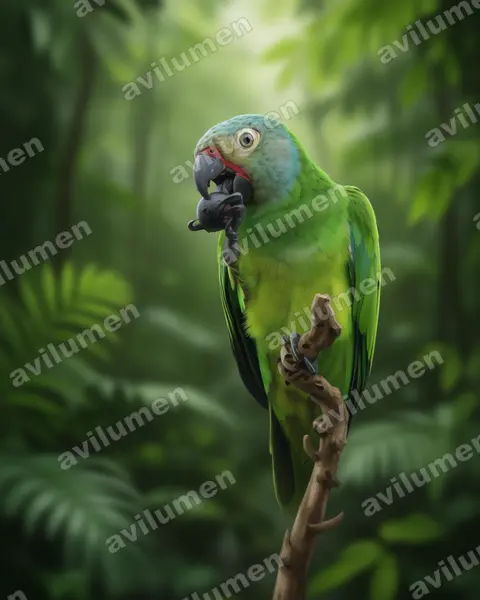
Realistic 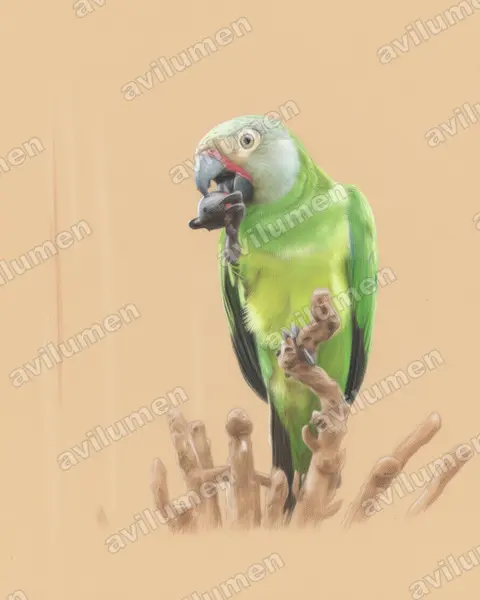
Colored pencil
Illustrations based on the photograph by Félix Uribe from Rionegro, Antioquia, Colombia (CC BY-SA 2.0), from Wikimedia Commons.
Digital editions
HD Digital Art Pack — Dusky-headed Parakeet
Digital download: 6 high-resolution illustrations of the Dusky-headed Parakeet (Aratinga weddellii), print-ready. This is a digital file; no animal or physical item is included.
AI Avatar — Dusky-headed Parakeet
Generate an avatar fusing your face with the Dusky-headed Parakeet (Aratinga weddellii). Delivered digitally in 8K, watermark-free. Digital product; no animals are sold or brokered.
Instant download. No live birds are sold.
Frequently asked questions
- Is Aratinga weddellii (Dusky-headed Parakeet) endangered?
- The IUCN Red List places Aratinga weddellii, commonly known as the Dusky-headed Parakeet, in the «Least concern» category. «Least concern» means it is not currently threatened.
- Where does Aratinga weddellii (Dusky-headed Parakeet) live?
- Aratinga weddellii (Dusky-headed Parakeet) is found in Brazil and South America.
- What family does Aratinga weddellii (Dusky-headed Parakeet) belong to?
- Aratinga weddellii (Dusky-headed Parakeet) belongs to the family Psittacidae, in the order Psittaciformes.
- What colour is Aratinga weddellii (Dusky-headed Parakeet)?
- The plumage of Aratinga weddellii (Dusky-headed Parakeet) combines these colours: Green and Grey.
More from the same family
 Near threatened
Yellow-faced Parrot
Alipiopsitta xanthops
The yellow-faced parrot, formerly also known as the yellow-faced amazon, is the only species of the genus Alipiopsitta. It is a Neotropical parrot, and was classified in the genus Amazona for many years. It is a predominantly green and yellow-plumaged bird with a yellow head. It is a semi-nomadic species found in the cerrado region of Brazil and adjacent Bolivia.
from $1.99
 Least concern
Moluccan King Parrot
Alisterus amboinensis
The Moluccan king parrot is a parrot endemic to Peleng Island, Maluku, and West Papua in Indonesia. It is sometimes referred to as the Ambon king parrot or Amboina king parrot, but this is potentially misleading, as it is found on numerous other islands than Ambon. The male and female are similar in appearance, with a predominantly red head and underparts, green wings, and blue back and tail.
from $1.99
 Least concern
Papuan King Parrot
Alisterus chloropterus
The Papuan king parrot, also known as the green-winged king parrot, is a species of parrot in the family Psittaculidae found in New Guinea. Its natural habitats are subtropical or tropical moist lowland forest and subtropical or tropical moist montane forest.
from $1.99
 Least concern
Australian King Parrot
Alisterus scapularis
The Australian king parrot is a species of parrot endemic to eastern Australia ranging from Cooktown in Queensland to Port Campbell in Victoria. Found in humid and heavily forested upland regions of the eastern portion of the continent, including eucalyptus wooded areas in and directly adjacent to subtropical and temperate rainforest. They feed on fruits and seeds gathered from trees or on the ground.
from $1.99