White-winged Parakeet
Brotogeris versicolurus
Avilumen editorial team ·

The white-winged parakeet, or canary-winged parakeet is a small parrot native to the Amazon River basin from southeast Colombia to the rivers mouth in Brazil. Caged birds have been released and the birds have established self-sustaining populations in Lima, Peru, Los Angeles, and Miami, Florida areas of the United States, and in Puerto Rico. They were also present in San Francisco, California until the mid-2000s.
The white-winged parakeet (Brotogeris versicolurus), or canary-winged parakeet is a small parrot native to the Amazon River basin from southeast Colombia to the rivers mouth in Brazil. Caged birds have been released and the birds have established self-sustaining populations in Lima, Peru, Los Angeles, and Miami, Florida areas of the United States, and in Puerto Rico. They were also present in San Francisco, California until the mid-2000s. Although feral birds are showing some recent declines as nesters in the United States, they seem to be doing well in their native habitat.
Description
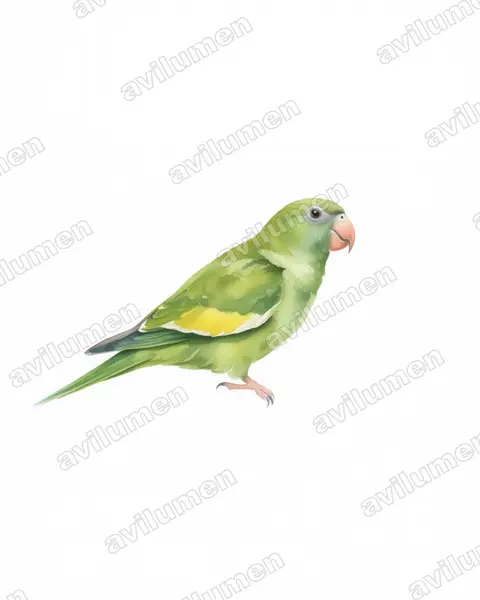
The white-winged parakeet typically is 22 cm in length, and is mostly green in color. It has a trailing yellow edge on its folded wings. Its most distinguished characteristic is the white wing patches most noticed when the bird is in flight. It is closely related to the yellow-chevroned parakeet, and the two have often been considered conspecific.
Behaviour
In captivity, these are charming birds that often have a close relationship with their human handlers. They enjoy spending time in physical contact with their owners, often riding around on shoulders or nesting in hair. They can have loud calls when not within sight of their "flock", but are generally quiet, otherwise. They are adept climbers and enjoy a myriad of challenges. They are a very adaptable species and are less picky than others about their available food options. They are not the strongest talkers, but are adept whistlers.
Food and feeding
The white-winged parakeet feeds mostly on fruit and seeds in its native habitat, and feral populations have adapted to take in blossoms and nectar. Feral birds also come to bird feeders. Wild birds primarily use disturbed forest and forest clearings around settlements. They rarely use deep tropical forest.
In captivity, a pelleted or seed diet is acceptable, supplemented with fresh fruits and vegetables and freshly sprouted seeds.
Breeding
The white-winged parakeet usually finds a hole in a tree in which to nest. It may also take over termite tunnels and excavate them for their own purposes.
Clutches usually consist of three to five white eggs, which hatch after about 26 days of incubation. Young fledge between six and seven weeks of age, and are fully weaned around nine weeks. After raising their young, all birds form rather large communal roosts until the next breeding season.
Text adapted from Wikipedia · CC BY-SA 4.0
Where it lives
Distribution

Taxonomy
- Order
- Psittaciformes
- Family
- Psittacidae
- Genus
- Brotogeris
- Conservation status
- Least concern
Listen to its call
No recording yet
Care guide
Budgie, Conure and Parakeet Care Guide
How to care for budgies, conures, parrotlets, ringnecks and other parakeets: diet, cage setup, health, behavior, breeding and legal status for owners.
Read the guide →Illustration gallery
6 illustrations of Brotogeris versicolurus (White-winged Parakeet) in different styles, true to its real plumage. Shown watermarked; the art pack includes the high-resolution originals, ready to print.
Watercolor 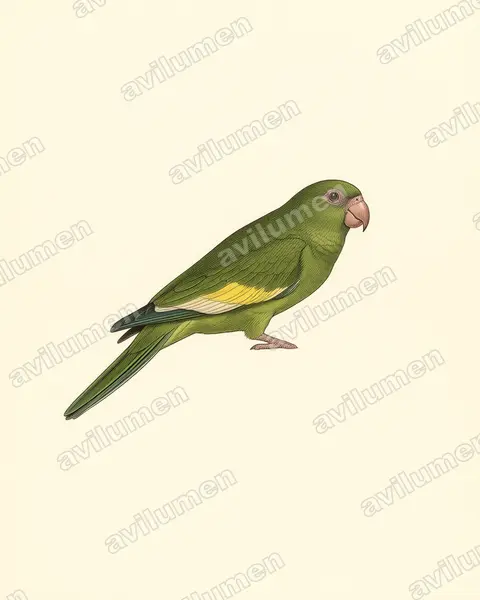
Vintage plate 
Ink 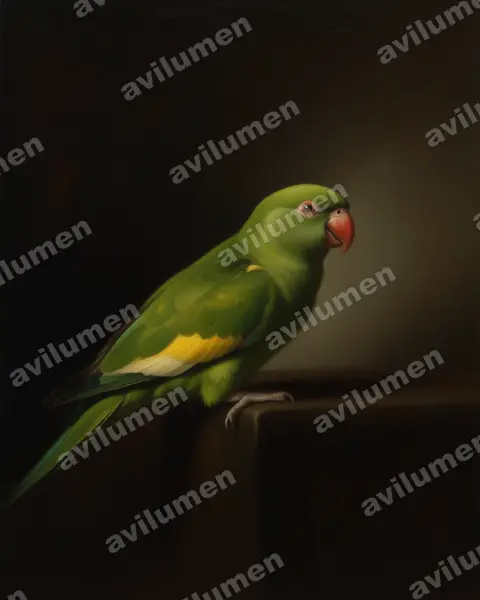
Oil 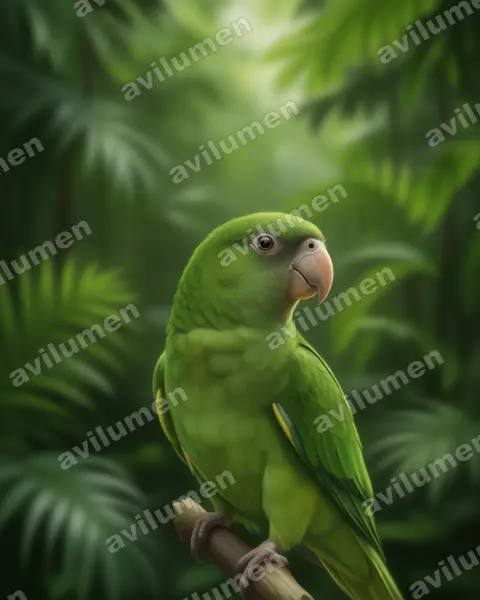
Realistic 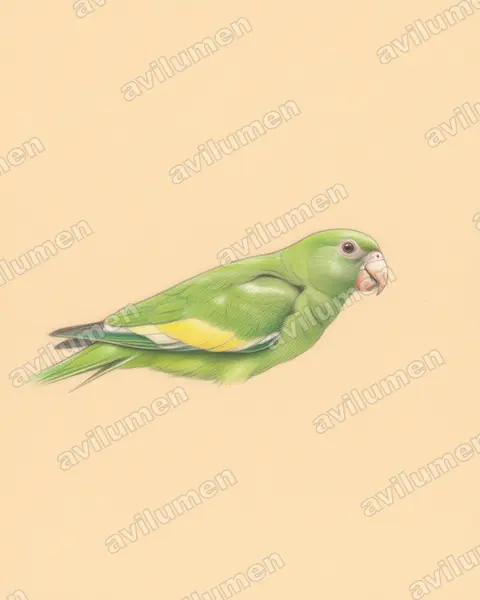
Colored pencil
Illustrations based on the photograph by Richard Crossley (CC BY-SA 3.0), from Wikimedia Commons.
Digital editions
HD Digital Art Pack — White-winged Parakeet
Digital download: 6 high-resolution illustrations of the White-winged Parakeet (Brotogeris versicolurus), print-ready. This is a digital file; no animal or physical item is included.
AI Avatar — White-winged Parakeet
Generate an avatar fusing your face with the White-winged Parakeet (Brotogeris versicolurus). Delivered digitally in 8K, watermark-free. Digital product; no animals are sold or brokered.
Instant download. No live birds are sold.
Frequently asked questions
- Is Brotogeris versicolurus (White-winged Parakeet) endangered?
- The IUCN Red List places Brotogeris versicolurus, commonly known as the White-winged Parakeet, in the «Least concern» category. «Least concern» means it is not currently threatened.
- Where does Brotogeris versicolurus (White-winged Parakeet) live?
- Brotogeris versicolurus (White-winged Parakeet) is found in Brazil and South America.
- What family does Brotogeris versicolurus (White-winged Parakeet) belong to?
- Brotogeris versicolurus (White-winged Parakeet) belongs to the family Psittacidae, in the order Psittaciformes.
- What colour is Brotogeris versicolurus (White-winged Parakeet)?
- The plumage of Brotogeris versicolurus (White-winged Parakeet) combines these colours: Green and Yellow.
More from the same family
 Near threatened
Yellow-faced Parrot
Alipiopsitta xanthops
The yellow-faced parrot, formerly also known as the yellow-faced amazon, is the only species of the genus Alipiopsitta. It is a Neotropical parrot, and was classified in the genus Amazona for many years. It is a predominantly green and yellow-plumaged bird with a yellow head. It is a semi-nomadic species found in the cerrado region of Brazil and adjacent Bolivia.
from $1.99
 Least concern
Moluccan King Parrot
Alisterus amboinensis
The Moluccan king parrot is a parrot endemic to Peleng Island, Maluku, and West Papua in Indonesia. It is sometimes referred to as the Ambon king parrot or Amboina king parrot, but this is potentially misleading, as it is found on numerous other islands than Ambon. The male and female are similar in appearance, with a predominantly red head and underparts, green wings, and blue back and tail.
from $1.99
 Least concern
Papuan King Parrot
Alisterus chloropterus
The Papuan king parrot, also known as the green-winged king parrot, is a species of parrot in the family Psittaculidae found in New Guinea. Its natural habitats are subtropical or tropical moist lowland forest and subtropical or tropical moist montane forest.
from $1.99
 Least concern
Australian King Parrot
Alisterus scapularis
The Australian king parrot is a species of parrot endemic to eastern Australia ranging from Cooktown in Queensland to Port Campbell in Victoria. Found in humid and heavily forested upland regions of the eastern portion of the continent, including eucalyptus wooded areas in and directly adjacent to subtropical and temperate rainforest. They feed on fruits and seeds gathered from trees or on the ground.
from $1.99