Fairy Lorikeet
Charmosynopsis pulchella
Avilumen editorial team ·

The fairy lorikeet is a species of parrot in the family Psittaculidae. Other common names include the little red lorikeet and the little red lory. Found in New Guinea, its natural habitats are subtropical or tropical moist lowland forests and subtropical or tropical moist montane forests. Its colouration is mainly red with some yellow on the throat and green on the wings. Two subspecies are recognised, C. p.
The fairy lorikeet (Charmosynopsis pulchella) is a species of parrot in the family Psittaculidae. Other common names include the little red lorikeet and the little red lory. Found in New Guinea, its natural habitats are subtropical or tropical moist lowland forests and subtropical or tropical moist montane forests. Its colouration is mainly red with some yellow on the throat and green on the wings. Two subspecies are recognised, C. p. pulchella and C. p. rothschildi.
Taxonomy
The fairy lorikeet was formally described in 1859 by the English zoologist George Robert Gray under the binomial name Charmosyna pulchella. It was moved from the original genus Charmosyna to the resurrected genus Charmosynopsis following the publication of a molecular phylogenetic study in 2020.
Description
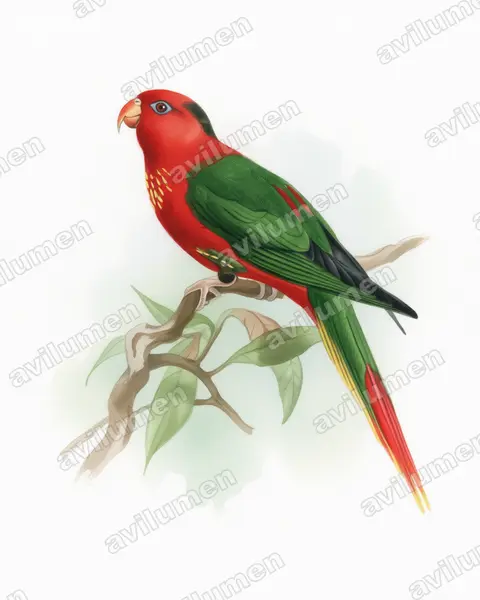
The fairy lorikeet grows to a length of about 18 cm (7 in) and weighs between 24 and 34 g (0.8 and 1.2 oz). The male of the nominate subspecies, C. p. pulchella, has the head, nape, breast and underparts red, the breast sometimes being streaked with yellow. The back of the crown has a purplish spot. The mantle, back and wings are dark green, as are the upper tail coverts. The upper side of the tail is green tipped with yellow and the central tail feathers are red towards their tips. The underside of the tail is yellow and the thighs are dark purple. The beak is orange and the eye yellowish-orange. The female is similar but the lower back is yellowish-green and the sides of the rump and flanks are yellow.
The male C. p. rothschildi differs in that the breast is green streaked with yellow, while the dark spot on the crown is larger and extends forward to the eye and fades backwards into the green mantle. The upper tail coverts are washed with yellow and the belly is dark purple. The female has a wide green breast band streaked with yellow and a greenish-yellow patch on the side of the rump.
Distribution
The fairy lorikeet is resident on the island of New Guinea. C. p. pulchella is present in mountainous regions from the Vogelkop Peninsula eastwards to the Huon Peninsula and the southeastern part of the island, as well as in the Fakfak Mountains in the Bomberai Peninsula. C. p. rothschildi is found in north and central New Guinea in the Cyclops Mountains and other nearby mountain ranges.
Behaviour
The fairy lorikeet is assumed to feed on pollen and nectar foraged from flowers high in the forest canopy and is often associated with Melicope trees. Breeding has been observed in December, January and April. A nesting site is often a hole at the base of an epiphytic plant where a clutch of one or two eggs is incubated for about twenty five days.
Conservation status
The fairy lorikeet has a wide range and is common in many places, though less so in other areas where it is collected for the pet trade. The population appears stable and the International Union for Conservation of Nature has assessed its conservation status as being of "least concern".
Text adapted from Wikipedia · CC BY-SA 4.0
Taxonomy
- Order
- Psittaciformes
- Family
- Psittacidae
- Genus
- Charmosynopsis
- Conservation status
- Least concern
Listen to its call
No recording yet
Illustration gallery
6 illustrations of Charmosynopsis pulchella (Fairy Lorikeet) in different styles, true to its real plumage. Shown watermarked; the art pack includes the high-resolution originals, ready to print.
Watercolor 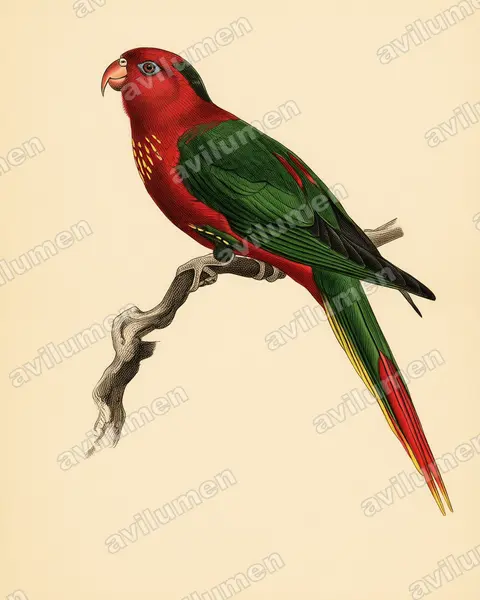
Vintage plate 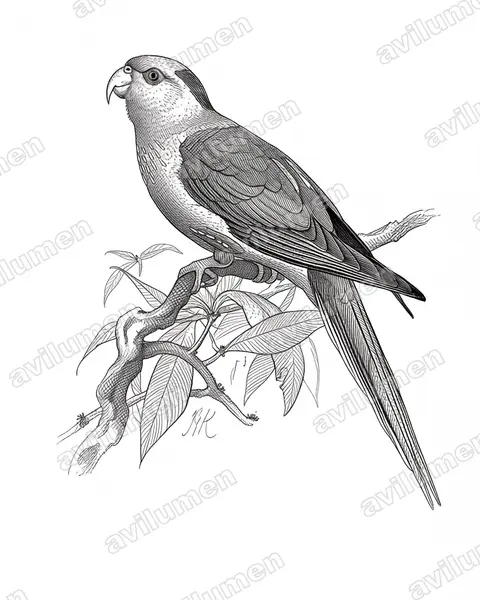
Ink 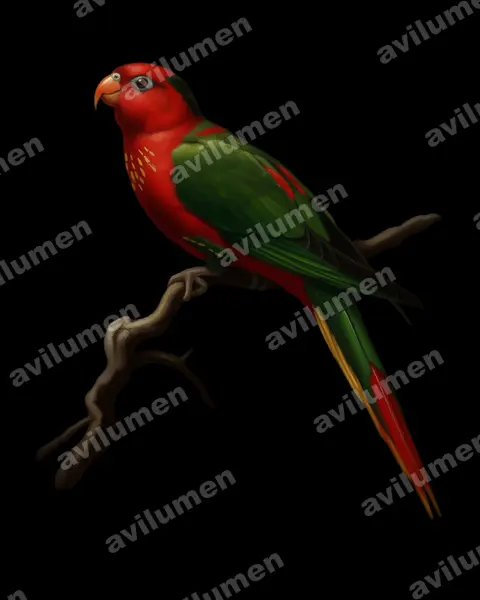
Oil 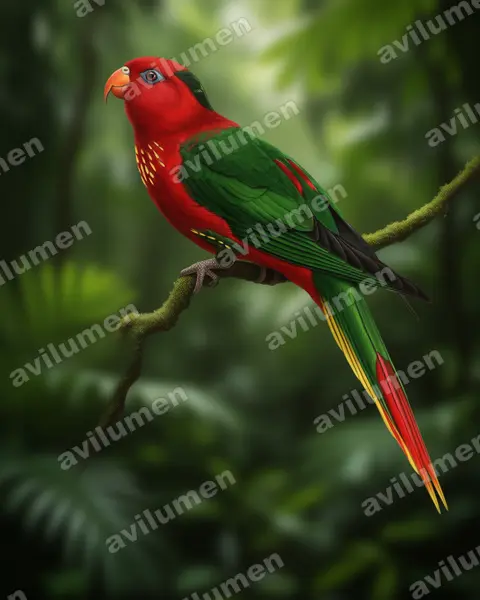
Realistic 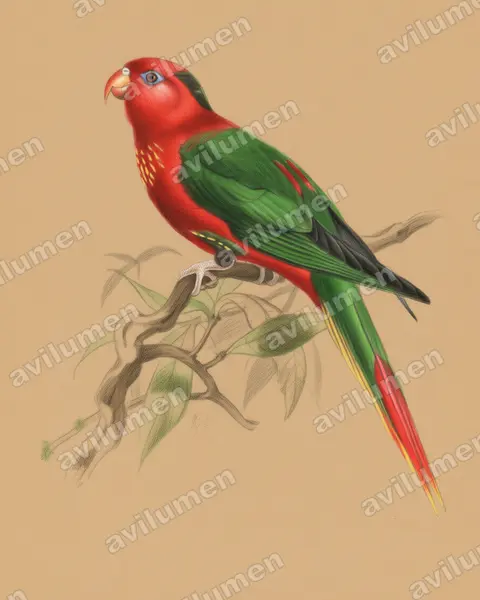
Colored pencil
Illustrations based on the photograph by John Gerrard Keulemans (Public domain), from Wikimedia Commons.
Digital editions
HD Digital Art Pack — Fairy Lorikeet
Digital download: 6 high-resolution illustrations of the Fairy Lorikeet (Charmosynopsis pulchella), print-ready. This is a digital file; no animal or physical item is included.
AI Avatar — Fairy Lorikeet
Generate an avatar fusing your face with the Fairy Lorikeet (Charmosynopsis pulchella). Delivered digitally in 8K, watermark-free. Digital product; no animals are sold or brokered.
Instant download. No live birds are sold.
Frequently asked questions
- Is Charmosynopsis pulchella (Fairy Lorikeet) endangered?
- The IUCN Red List places Charmosynopsis pulchella, commonly known as the Fairy Lorikeet, in the «Least concern» category. «Least concern» means it is not currently threatened.
- What family does Charmosynopsis pulchella (Fairy Lorikeet) belong to?
- Charmosynopsis pulchella (Fairy Lorikeet) belongs to the family Psittacidae, in the order Psittaciformes.
- What colour is Charmosynopsis pulchella (Fairy Lorikeet)?
- The plumage of Charmosynopsis pulchella (Fairy Lorikeet) combines these colours: Red, Yellow, and Green.
More from the same family
 Near threatened
Yellow-faced Parrot
Alipiopsitta xanthops
The yellow-faced parrot, formerly also known as the yellow-faced amazon, is the only species of the genus Alipiopsitta. It is a Neotropical parrot, and was classified in the genus Amazona for many years. It is a predominantly green and yellow-plumaged bird with a yellow head. It is a semi-nomadic species found in the cerrado region of Brazil and adjacent Bolivia.
from $1.99
 Least concern
Moluccan King Parrot
Alisterus amboinensis
The Moluccan king parrot is a parrot endemic to Peleng Island, Maluku, and West Papua in Indonesia. It is sometimes referred to as the Ambon king parrot or Amboina king parrot, but this is potentially misleading, as it is found on numerous other islands than Ambon. The male and female are similar in appearance, with a predominantly red head and underparts, green wings, and blue back and tail.
from $1.99
 Least concern
Papuan King Parrot
Alisterus chloropterus
The Papuan king parrot, also known as the green-winged king parrot, is a species of parrot in the family Psittaculidae found in New Guinea. Its natural habitats are subtropical or tropical moist lowland forest and subtropical or tropical moist montane forest.
from $1.99
 Least concern
Australian King Parrot
Alisterus scapularis
The Australian king parrot is a species of parrot endemic to eastern Australia ranging from Cooktown in Queensland to Port Campbell in Victoria. Found in humid and heavily forested upland regions of the eastern portion of the continent, including eucalyptus wooded areas in and directly adjacent to subtropical and temperate rainforest. They feed on fruits and seeds gathered from trees or on the ground.
from $1.99