Bare-faced Curassow
Crax fasciolata
Avilumen editorial team ·

The bare-faced curassow is a species of bird in the family Cracidae, the chachalacas, guans, curassows, etc. It is found in Brazil, Paraguay, and eastern Bolivia, and extreme northeast Argentina, in the cerrado, pantanal, and the southeastern region of the Amazon basin. Its natural habitats are subtropical or tropical dry forest and subtropical or tropical moist lowland forest.
The bare-faced curassow (Crax fasciolata) is a species of bird in the family Cracidae, the chachalacas, guans, curassows, etc. It is found in Brazil, Paraguay, and eastern Bolivia, and extreme northeast Argentina, in the cerrado, pantanal, and the southeastern region of the Amazon basin. Its natural habitats are subtropical or tropical dry forest and subtropical or tropical moist lowland forest.
Taxonomy
There are three currently recognized subspecies following the IOC,
C. f. fasciolata (Spix, 1825) – fasciated curassow – lowlands of Brazil to Paraguay and northeast Argentina
C. f. grayi (Ogilvie-Grant, 1893) – eastern Bolivia
C. f. pinima (Pelzeln, 1870) – northeastern Brazil
Description
The bare-faced curassow is a large bird reaching a length of 82 to 92 centimetres (32 to 36 in). The sexes differ in appearance. The male has black upper parts faintly glossed with greenish-olive, with an unfeathered face with yellowish bare skin, a small black crest, and white underparts. The female, on the other hand, has a black head, throat, neck and upper mantle, and a black and white barred crest. The remainder of the upper parts are greenish-black barred with white or ochre. The black tail is tipped with white or ochre and the underparts are black with ochre barring on the breast, paling to a yellowish or ochre belly. The facial skin on females is blackish.
Behaviour
The bare-faced curassow lives in moist, semi-deciduous and gallery forests, often near the fringes of the woodland. It mainly feeds on fruit, but seeds, flowers and small invertebrates are also eaten. Breeding takes place in the summer in the southern part of its range, with the nests being platforms of sticks in trees.
Status
The bare-faced curassow has a wide range and is fairly numerous in parts of its range; however, it is subject to hunting and to the destruction of its habitat and the total population is likely to be declining quite rapidly. The International Union for Conservation of Nature has assessed its conservation status as "vulnerable".
Text adapted from Wikipedia · CC BY-SA 4.0
Where it lives
Taxonomy
- Order
- Galliformes
- Family
- Cracidae
- Genus
- Crax
- Conservation status
- Vulnerable
Listen to its call
No recording yet
Illustration gallery
6 illustrations of Crax fasciolata (Bare-faced Curassow) in different styles, true to its real plumage. Shown watermarked; the art pack includes the high-resolution originals, ready to print.
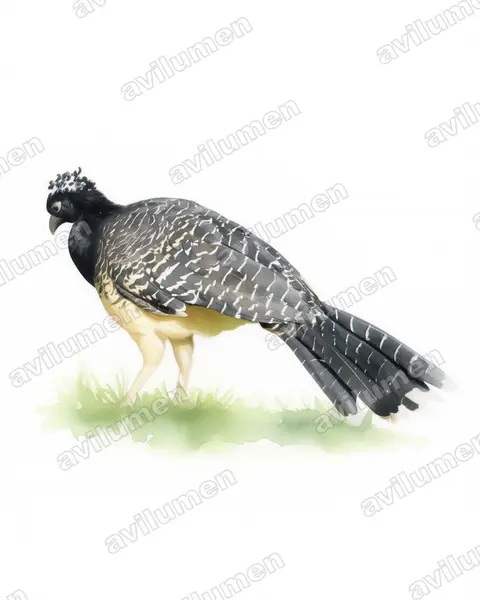
Watercolor 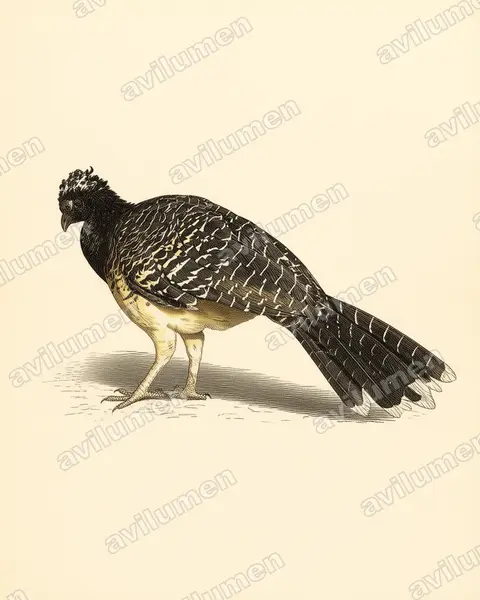
Vintage plate 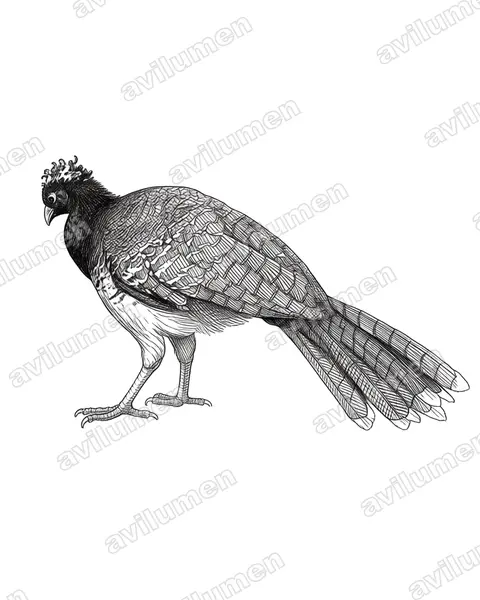
Ink 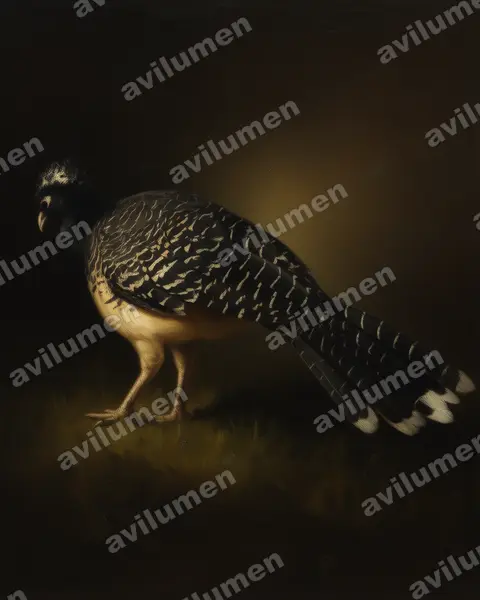
Oil 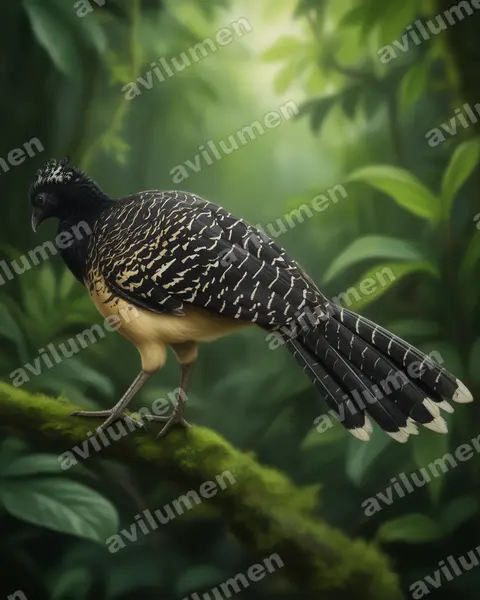
Realistic 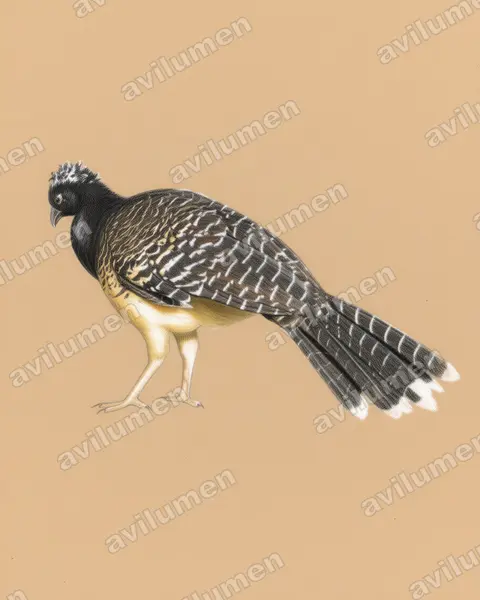
Colored pencil
Illustrations based on the photograph by Aconcagua (CC BY-SA 3.0), from Wikimedia Commons.
Digital editions
HD Digital Art Pack — Bare-faced Curassow
Digital download: 6 high-resolution illustrations of the Bare-faced Curassow (Crax fasciolata), print-ready. This is a digital file; no animal or physical item is included.
AI Avatar — Bare-faced Curassow
Generate an avatar fusing your face with the Bare-faced Curassow (Crax fasciolata). Delivered digitally in 8K, watermark-free. Digital product; no animals are sold or brokered.
Instant download. No live birds are sold.
Frequently asked questions
- Is Crax fasciolata (Bare-faced Curassow) endangered?
- The IUCN Red List places Crax fasciolata, commonly known as the Bare-faced Curassow, in the «Vulnerable» category. «Vulnerable» means it faces a high risk of extinction in the medium term.
- Where does Crax fasciolata (Bare-faced Curassow) live?
- Crax fasciolata (Bare-faced Curassow) is found in Brazil and South America.
- What family does Crax fasciolata (Bare-faced Curassow) belong to?
- Crax fasciolata (Bare-faced Curassow) belongs to the family Cracidae, in the order Galliformes.
- What colour is Crax fasciolata (Bare-faced Curassow)?
- The plumage of Crax fasciolata (Bare-faced Curassow) combines these colours: Black and Grey.
More from the same family
 Least concern
Wattled Guan
Aburria aburri
The wattled guan is a species of bird in the family Cracidae. It is a fairly large black cracid with blue-based, black-tipped beak and a long, red-and-yellow wattle.
from $1.99
 Least concern
Sickle-winged Guan
Chamaepetes goudotii
The sickle-winged guan is a species of bird in the chachalaca, guan, and curassow family Cracidae. It is found in Bolivia, Colombia, Ecuador, and Peru.
from $1.99
 Least concern
Black Guan
Chamaepetes unicolor
The black guan is a species of bird in the chachalaca, guan, and curassow family Cracidae. It is found in Costa Rica and Panama.
from $1.99
 Critically endangered
Blue-billed Curassow
Crax alberti
The blue-billed curassow is a species of bird in the family Cracidae, the chachalacas, guans, and curassows. It is endemic to Colombia.
from $1.99