Red-and-blue Lory
Eos histrio
Avilumen editorial team ·

The red-and-blue lory is a small, strikingly-colored parrot endemic to Indonesia. The species inhabits a single island, Karakelong, in the Indonesian archipelago, although it was formerly found on the Sangihe Islands and other parts of the Talaud Islands.
The red-and-blue lory (Trichoglossus histrio) is a small, strikingly-colored parrot endemic to Indonesia. The species inhabits a single island, Karakelong, in the Indonesian archipelago, although it was formerly found on the Sangihe Islands and other parts of the Talaud Islands.
Taxonomy
There are two subspecies recognized, one of which is extinct:
Challenger's red-and-blue lory, T. h. challengeri (Salvadori, 1891) - Talaud Islands, presently only found on Karakelong
†Sangir red-and-blue lory, T. h. histrio (P.L.S. Müller, 1776) - formerly found on Sangir, Siau, and Ruang, now extinct
The nominate subspecies, T. h. histrio, is thought to have become extinct due to deforestation. The subspecies T. h. challengeri, formerly thought to have existed on Miangas or Nenusa, was also previously thought to have become extinct, with the populations on the Talaud Islands belonging to the subspecies named the Talaud Islands red-and-blue lory, T. h. talautensis. However, the purported range of challengeri has never been established and is thus thought to be erroneous, so it was synonymized with T. h. talautensis by the International Ornithological Congress in 2022, thus "reviving" challengeri as a still-existing subspecies.
Description
The red-and-blue lory is roughly 12 inches (30 cm) in length, including the tail. The species is sexually monomorphic, i.e. sexes are visually alike.
The beak is short, sharply curved, and bright orange. The feathers nearest the cere (the area nearest the nostrils) are bright red. The crown of the head is intense purple. The back of the head is red, and the nape of the neck is intense violet. An indigo-violet stripe runs diagonally from the cere corner to the nape of the neck. The bird's plumage is mostly bright red. The rump and lower belly are a slightly deeper red. The breast has a broad band of deep blue. Extending the color from the nape, the bird's back is a deep violet purple. Wing and tail flight feathers - rectrices and remiges - are between red and red-violet. The wing covert feathers are black and red with black tips. The leg feathers are bluish-purple. The feet are medium gray, and the claws are black. The cere is very dark gray, and the irises of the eyes are dark brown.
The red-and-blue lory's voice consists of short, harsh chattering screeches. Their flight is said to be quick and straight.
Distribution and habitat
The red-and-blue lory is now confined to the Talaud Islands off northern Sulawesi, Indonesia, where almost all individuals appear to inhabit a single island (Karakelang). Further populations, some apparently introduced, disappeared during the 20th century from Sangihe, Siau and Tagulandang. The population is thought to be in rapid decline.
The birds inhabit forests from sea level to about 1,500 meters above sea level. The population is only sustainable or viable on Karakelang, and their population on that island is fragmented into approximately four locations. This restricted range makes them very vulnerable to potential extinction.
Ecology
These parrots are strictly arboreal, meaning they spend their lives in the trees. They do not forage on the ground. The species eats a primarily nectar- and pollen-based diet, like most lories and lorikeets. It supplements its diet with occasional insects and fruit. The red-and-blue lory is said to be raucous and noisy in the wild, but to be silent while feeding.
Mature trees are needed for nesting, and logging sometimes selectively removes these trees, which constitutes a threat to the specie's survival. Clutch size is 2 eggs, with a hatching time of 25–26 days. Outside of the breeding season, the species forms social flocks, which congregate in palm plantations. While the species is nonmigratory, they are said to fly between neighboring islands in search of food.
Most lories and lorikeets have a lifespan of 10–15 years in captivity, so although the lifespan of this species is not definitively known, it can be possibly inferred from the lifespans of similar species. Very rare in commercial aviculture, successful breeding has only been reported once in the scientific literature.
Conservation
The red-and-blue lory is currently classified as Endangered by the IUCN. The species is also listed as CITES Appendix I, meaning that all commercial international trade in wild-caught individuals is prohibited. Illegal trade continues, however, with 80% of the illegally taken or 'poached' specimens being shipped to the neighboring Philippines.
Threats to the population include illegal trapping for the pet trade, insecticide spraying on coconut plantations, logging or habitat degradation, and exotic Newcastle disease from escaped domestic poultry. Due to their striking appearance, these parrots have been valued as pets or cage birds in Indonesia and the Philippines since the 19th century. They have been trapped for commercial trade since that time. Only since the late 1990s did the trapping decrease. Loose enforcement of international and national laws has contributed to the decline of the species. These bird are fully protected by Indonesian law as well as CITES. Logging activities, even in their nature preserve home, also threaten the species. Population-wise, one of the two subspecies, the nominate or definitive subspecies, is presumed extinct, and the only other remaining of the two subspecies is on the decline. As of 2025, a best estimate of 2,400–8,400 red-and-blue lories remain in the wild.
Text adapted from Wikipedia · CC BY-SA 4.0
Taxonomy
- Order
- Psittaciformes
- Family
- Psittacidae
- Genus
- Eos
- Conservation status
- Endangered
Listen to its call
No recording yet
Care guide
Lory and Lorikeet Care Guide: Nectar Diet and Housing
How to care for lories and rainbow lorikeets: nectar and pollen diet, hygiene, cage setup, health, behavior and CITES legal status for lorikeet owners.
Read the guide →Illustration gallery
6 illustrations of Eos histrio (Red-and-blue Lory) in different styles, true to its real plumage. Shown watermarked; the art pack includes the high-resolution originals, ready to print.
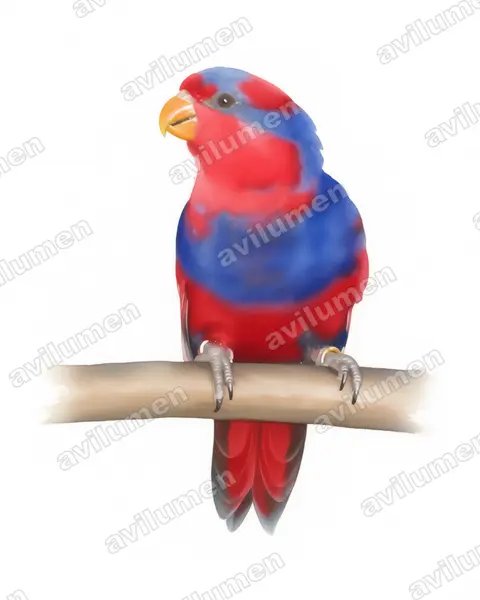
Watercolor 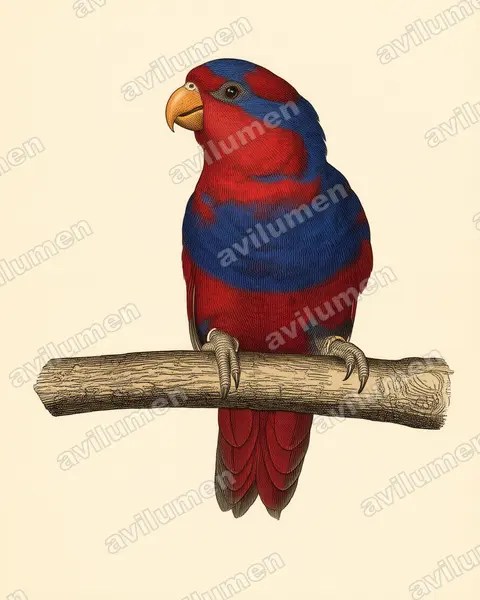
Vintage plate 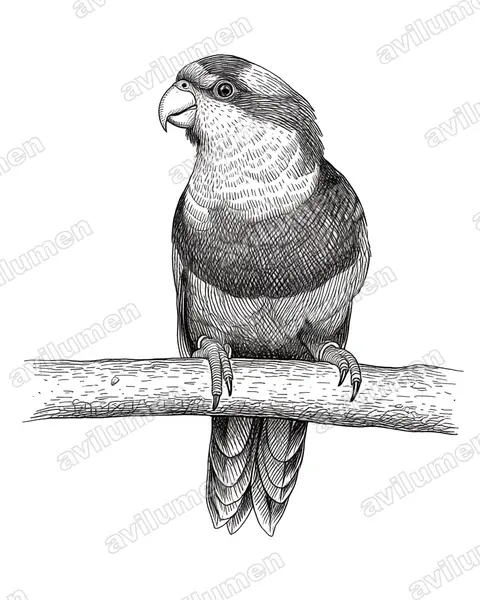
Ink 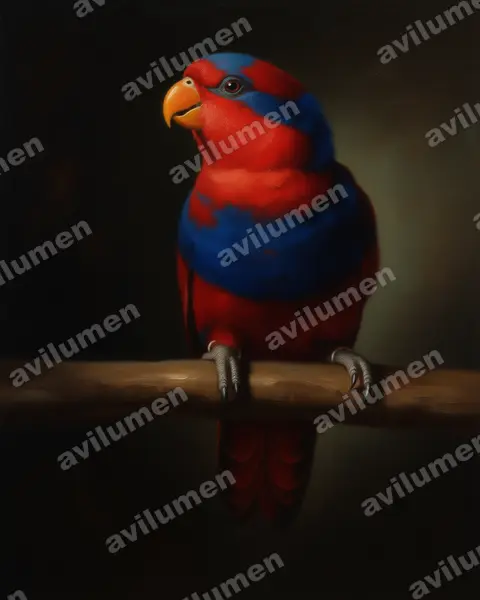
Oil 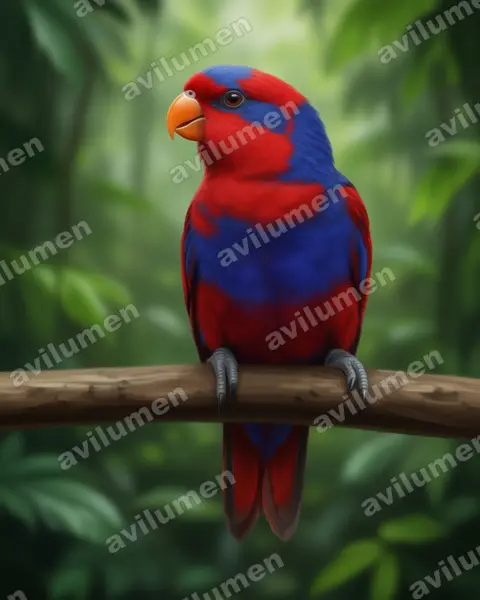
Realistic 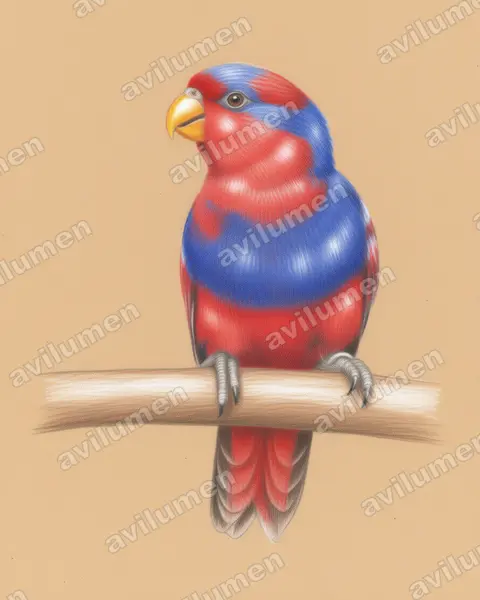
Colored pencil
Illustrations based on the photograph by Eos_histrio_talautensis.JPG: Drägüs derivative work: Snowmanradio (talk) (Public domain), from Wikimedia Commons.
Digital editions
HD Digital Art Pack — Red-and-blue Lory
Digital download: 6 high-resolution illustrations of the Red-and-blue Lory (Eos histrio), print-ready. This is a digital file; no animal or physical item is included.
AI Avatar — Red-and-blue Lory
Generate an avatar fusing your face with the Red-and-blue Lory (Eos histrio). Delivered digitally in 8K, watermark-free. Digital product; no animals are sold or brokered.
Instant download. No live birds are sold.
Frequently asked questions
- Is Eos histrio (Red-and-blue Lory) endangered?
- The IUCN Red List places Eos histrio, commonly known as the Red-and-blue Lory, in the «Endangered» category. «Endangered» means it faces a very high risk of disappearing in the wild.
- Where does Eos histrio (Red-and-blue Lory) live?
- Eos histrio (Red-and-blue Lory) is found in Indonesia.
- What family does Eos histrio (Red-and-blue Lory) belong to?
- Eos histrio (Red-and-blue Lory) belongs to the family Psittacidae, in the order Psittaciformes.
- What colour is Eos histrio (Red-and-blue Lory)?
- The plumage of Eos histrio (Red-and-blue Lory) combines these colours: Red and Blue.
More from the same family
 Near threatened
Yellow-faced Parrot
Alipiopsitta xanthops
The yellow-faced parrot, formerly also known as the yellow-faced amazon, is the only species of the genus Alipiopsitta. It is a Neotropical parrot, and was classified in the genus Amazona for many years. It is a predominantly green and yellow-plumaged bird with a yellow head. It is a semi-nomadic species found in the cerrado region of Brazil and adjacent Bolivia.
from $1.99
 Least concern
Moluccan King Parrot
Alisterus amboinensis
The Moluccan king parrot is a parrot endemic to Peleng Island, Maluku, and West Papua in Indonesia. It is sometimes referred to as the Ambon king parrot or Amboina king parrot, but this is potentially misleading, as it is found on numerous other islands than Ambon. The male and female are similar in appearance, with a predominantly red head and underparts, green wings, and blue back and tail.
from $1.99
 Least concern
Papuan King Parrot
Alisterus chloropterus
The Papuan king parrot, also known as the green-winged king parrot, is a species of parrot in the family Psittaculidae found in New Guinea. Its natural habitats are subtropical or tropical moist lowland forest and subtropical or tropical moist montane forest.
from $1.99
 Least concern
Australian King Parrot
Alisterus scapularis
The Australian king parrot is a species of parrot endemic to eastern Australia ranging from Cooktown in Queensland to Port Campbell in Victoria. Found in humid and heavily forested upland regions of the eastern portion of the continent, including eucalyptus wooded areas in and directly adjacent to subtropical and temperate rainforest. They feed on fruits and seeds gathered from trees or on the ground.
from $1.99