Horned Parakeet
Eunymphicus cornutus
Avilumen editorial team ·

The horned parakeet is a species of parrot in the genus Eunymphicus, in the family Psittaculidae. It is a medium-sized parrot endemic to New Caledonia. It is called "horned" because it has two black feathers that protrude from the head and have red tips.
The horned parakeet (Eunymphicus cornutus) is a species of parrot in the genus Eunymphicus, in the family Psittaculidae. It is a medium-sized parrot endemic to New Caledonia. It is called "horned" because it has two black feathers that protrude from the head and have red tips.
Taxonomy
The horned parakeet was formally described in 1788 by the German naturalist Johann Friedrich Gmelin in his revised and expanded edition of Carl Linnaeus's Systema Naturae. He placed it with all the other parrots in the genus Psittacus and coined the binomial name Psittacus cornutus. Gmelin based his description on the "horned parrot" that had been described and illustrated in 1781 by the English ornithologist John Latham in his A General Synopsis of Birds. Latham's specimen had been obtained from New Caledonia during Captain James Cook's first voyage to the south Pacific Ocean. The specimen formed part of the collection of Joseph Banks. The horned parakeet is now placed with the Ouvea parakeet in the genus Eunymphicus that was introduced in 1937 by the American ornithologist James L. Peters. The genus name combines the Ancient Greek eu meaning "true" and the genus name Nymphicus that had been introduce in 1832 by Johann Georg Wagler for the cockatiel. The specific epithet cornutus is Latin meaning "horned".
In 1998, it was found through DNA studies that Eunymphicus cornutus, the horned parakeet, and Eunymphicus uvaeensis, the Ouvea parakeet, were two separate species.
Description
Adult birds usually measure approximately 32 cm (or about 14 inches) in length, including the tail. Like many parrots, the horned parakeet is primarily green in color. This parrot has a yellowish nape with a black and red face and bluish wings and tail. Its most striking feature is a two-feather black crest, with the crest feathers tipped in red.
It makes a nasal "kho-khoot" contact call, and also makes a wide range of shrieks and chuckles.
Distribution and habitat
The horned parakeet is endemic to New Caledonia. It preferentially selects rainforest and laurel forest habitat, but will accept scrublands or savannah. It lives in humid pine forests on New Caledonia, especially when Agathis and Araucaria pines are present.
Behaviour and ecology
Small family groups, or pairs, will forage in the canopy for their diet of nuts and seeds.
Breeding
Horned parakeets will nest either on or near the ground, and also in hollowed-out logs, or nest hollows in dead trees. Uncommon among parrots, horned parakeets have been reported nest-sharing. The number of eggs laid is usually 2–4. Incubation lasts 21–22 days (in captivity) and the time from hatching to fledging is approximately 5 to 6 weeks (again, in captivity).
Status
This bird has declined since the 1880s, but it is still found in some range on New Caledonia and recent population estimates believe that there are over 5000 birds left. The main threats to the horned parakeet are the black rat, the wildcat, the introduced Rusa deer, logging, La Nina (wet) years, and Psittacine beak and feather disease, a severe virus which is known to affect ~42 species of parrots. Humans poaching the birds for local trade is rare, because the birds' nests are difficult to find, and more importantly, there are no ingrained local customs regarding keeping birds as pets.
The horned parakeet is listed by the IUCN as Vulnerable, due to their restricted range and small, declining population size. These parrots are listed as CITES I as of year 2000, meaning all international commerce regarding the species is prohibited. In 2014, the European Union listed the species as Annex A, which means all intra-EU trade is prohibited. The parrots are also fully protected under New Caledonian law.
Text adapted from Wikipedia · CC BY-SA 4.0
Taxonomy
- Order
- Psittaciformes
- Family
- Psittacidae
- Genus
- Eunymphicus
- Conservation status
- Vulnerable
Listen to its call
No recording yet
Illustration gallery
6 illustrations of Eunymphicus cornutus (Horned Parakeet) in different styles, true to its real plumage. Shown watermarked; the art pack includes the high-resolution originals, ready to print.
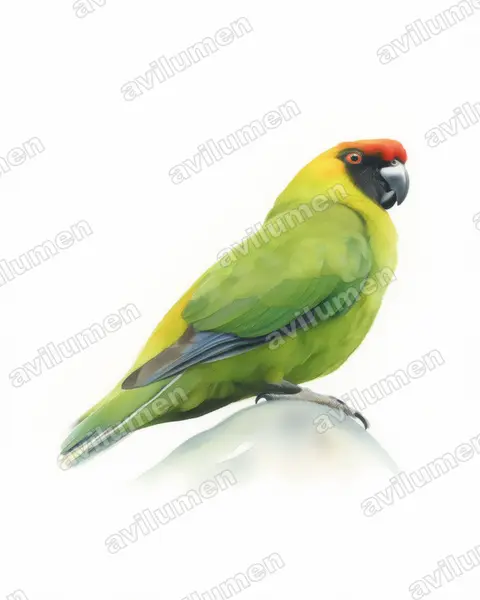
Watercolor 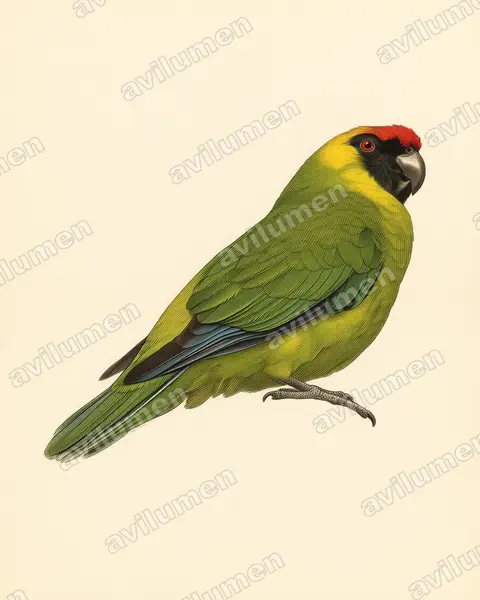
Vintage plate 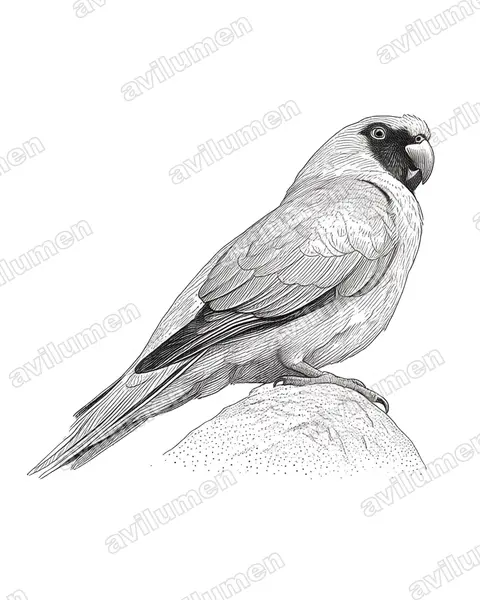
Ink 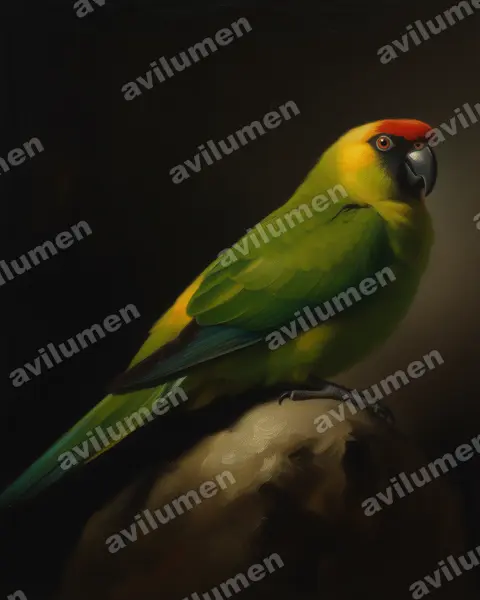
Oil 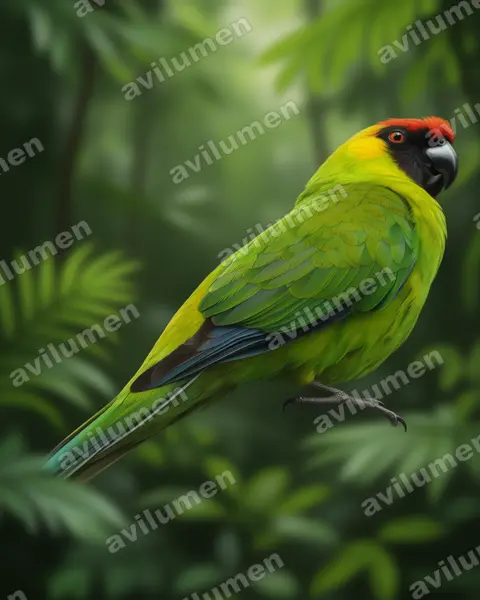
Realistic 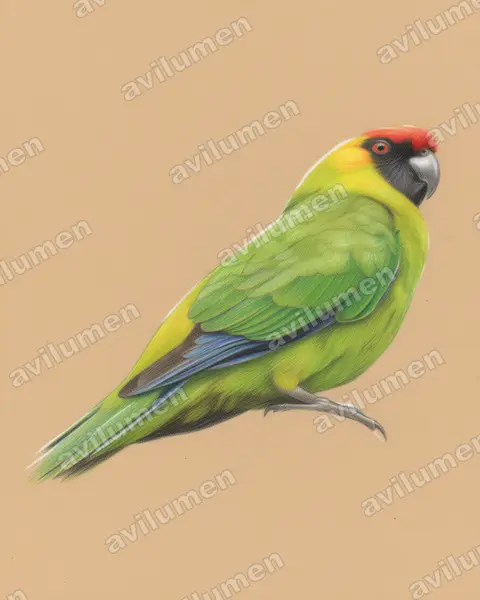
Colored pencil
Illustrations based on the photograph by Tunpin.ong (CC BY-SA 3.0), from Wikimedia Commons.
Digital editions
HD Digital Art Pack — Horned Parakeet
Digital download: 6 high-resolution illustrations of the Horned Parakeet (Eunymphicus cornutus), print-ready. This is a digital file; no animal or physical item is included.
AI Avatar — Horned Parakeet
Generate an avatar fusing your face with the Horned Parakeet (Eunymphicus cornutus). Delivered digitally in 8K, watermark-free. Digital product; no animals are sold or brokered.
Instant download. No live birds are sold.
Frequently asked questions
- Is Eunymphicus cornutus (Horned Parakeet) endangered?
- The IUCN Red List places Eunymphicus cornutus, commonly known as the Horned Parakeet, in the «Vulnerable» category. «Vulnerable» means it faces a high risk of extinction in the medium term.
- What family does Eunymphicus cornutus (Horned Parakeet) belong to?
- Eunymphicus cornutus (Horned Parakeet) belongs to the family Psittacidae, in the order Psittaciformes.
- What colour is Eunymphicus cornutus (Horned Parakeet)?
- The plumage of Eunymphicus cornutus (Horned Parakeet) combines these colours: Green and Red.
More from the same family
 Near threatened
Yellow-faced Parrot
Alipiopsitta xanthops
The yellow-faced parrot, formerly also known as the yellow-faced amazon, is the only species of the genus Alipiopsitta. It is a Neotropical parrot, and was classified in the genus Amazona for many years. It is a predominantly green and yellow-plumaged bird with a yellow head. It is a semi-nomadic species found in the cerrado region of Brazil and adjacent Bolivia.
from $1.99
 Least concern
Moluccan King Parrot
Alisterus amboinensis
The Moluccan king parrot is a parrot endemic to Peleng Island, Maluku, and West Papua in Indonesia. It is sometimes referred to as the Ambon king parrot or Amboina king parrot, but this is potentially misleading, as it is found on numerous other islands than Ambon. The male and female are similar in appearance, with a predominantly red head and underparts, green wings, and blue back and tail.
from $1.99
 Least concern
Papuan King Parrot
Alisterus chloropterus
The Papuan king parrot, also known as the green-winged king parrot, is a species of parrot in the family Psittaculidae found in New Guinea. Its natural habitats are subtropical or tropical moist lowland forest and subtropical or tropical moist montane forest.
from $1.99
 Least concern
Australian King Parrot
Alisterus scapularis
The Australian king parrot is a species of parrot endemic to eastern Australia ranging from Cooktown in Queensland to Port Campbell in Victoria. Found in humid and heavily forested upland regions of the eastern portion of the continent, including eucalyptus wooded areas in and directly adjacent to subtropical and temperate rainforest. They feed on fruits and seeds gathered from trees or on the ground.
from $1.99