Hooded Crane
Grus monacha
Avilumen editorial team ·

The hooded crane is a crane native to East Asia and a frequent migratory bird in Japan.
The hooded crane (Grus monacha) is a crane native to East Asia and a frequent migratory bird in Japan.
Description
It has a grey body. The top of the neck and head is white, except for a patch of bare red skin above the eye. It is one of the smallest cranes, but is still a fairly large bird, at 1 m (3.3 ft) long, a weight of 3.7 kg (8.2 lb) and a wingspan of 1.87 m (6.1 ft).
Distribution
The hooded crane breeds in south-central and south-eastern Siberia. Breeding is also suspected to occur in Mongolia. Over 80% of its population winters at Izumi, southern Japan. There are also wintering grounds in South Korea and China. There are about 100 hooded cranes wintering in Chongming Dongtan, Shanghai every year. Dongtan Nature Reserve is the largest natural wintering site in the world. In December 2011, a hooded crane was seen overwintering at the Hiwassee Refuge in southeastern Tennessee, well outside its normal range. In February 2012, one was seen at Goose Pond in southern Indiana, and is suspected to be the same bird, which may have migrated to North America by following sandhill cranes (Antigone canadensis). In March 2020, seven hooded cranes (Grus monacha) were seen in Siargao, Philippines where it was recorded as the first encounter of the species, since then, they are frequently migrating in the country, mainly on the wetlands in the southern regions.
Conservation
The estimated population of the species, as of 2025, is between 9,750 – 13,000 mature individuals. The major threats to its survival are wetland loss and degradation in its wintering grounds in China and South Korea as a result of reclamation for development and dam building. Conservation activities have been taken since 2008. Local universities, NGOs and communities are working together for a better and safer wintering location.
The hooded crane is evaluated as Vulnerable on the IUCN Red List of Threatened Species. It is listed on Appendix I and II of CITES. A society, Grus monacha International Aid (白头鹤的故事), has been formed to find ways to protect the species.
Text adapted from Wikipedia · CC BY-SA 4.0
Distribution

Taxonomy
- Order
- Gruiformes
- Family
- Gruidae
- Genus
- Grus
- Conservation status
- Vulnerable
Listen to its call
No recording yet
Illustration gallery
6 illustrations of Grus monacha (Hooded Crane) in different styles, true to its real plumage. Shown watermarked; the art pack includes the high-resolution originals, ready to print.
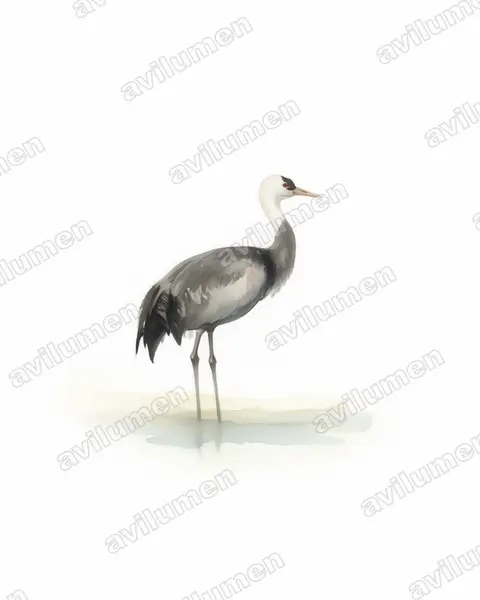
Watercolor 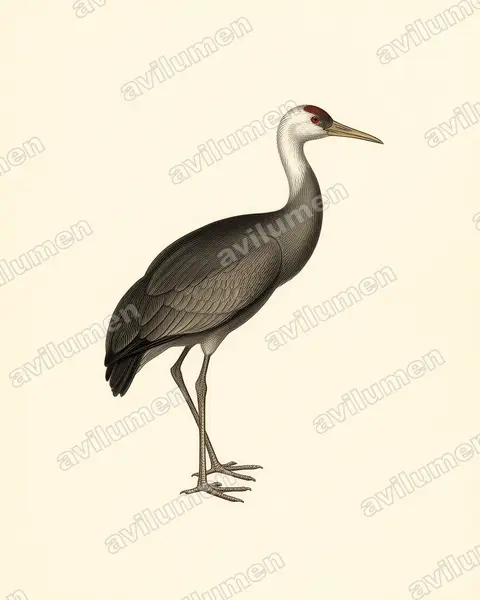
Vintage plate 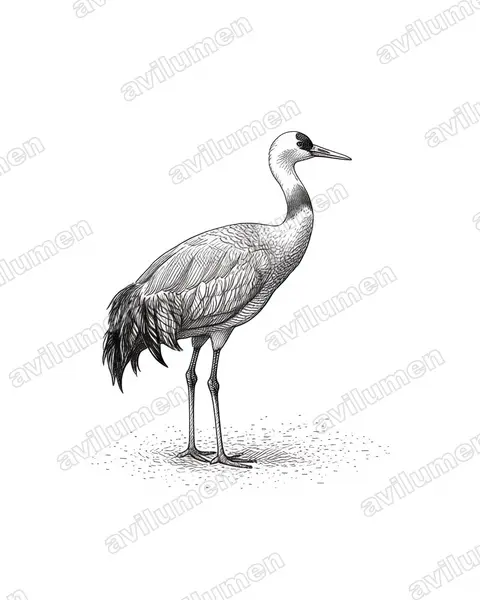
Ink 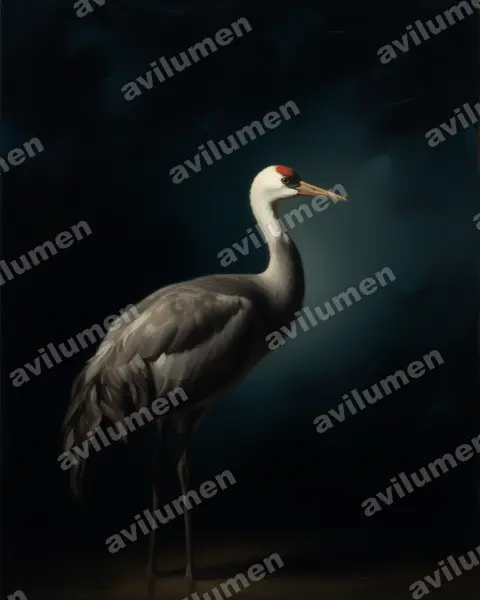
Oil 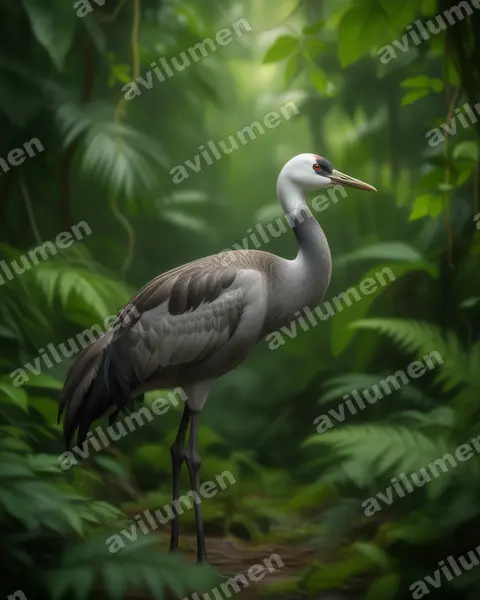
Realistic 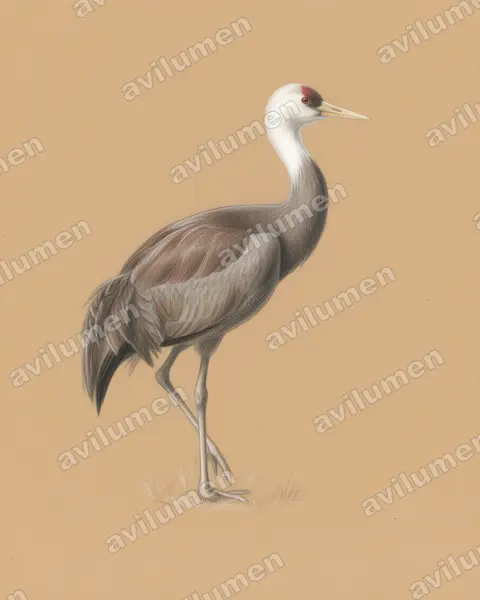
Colored pencil
Illustrations based on the photograph by Christoph Moning (christoph_moning) (CC BY 4.0), from Wikimedia Commons.
Digital editions
HD Digital Art Pack — Hooded Crane
Digital download: 6 high-resolution illustrations of the Hooded Crane (Grus monacha), print-ready. This is a digital file; no animal or physical item is included.
AI Avatar — Hooded Crane
Generate an avatar fusing your face with the Hooded Crane (Grus monacha). Delivered digitally in 8K, watermark-free. Digital product; no animals are sold or brokered.
Instant download. No live birds are sold.
Frequently asked questions
- Is Grus monacha (Hooded Crane) endangered?
- The IUCN Red List places Grus monacha, commonly known as the Hooded Crane, in the «Vulnerable» category. «Vulnerable» means it faces a high risk of extinction in the medium term.
- What family does Grus monacha (Hooded Crane) belong to?
- Grus monacha (Hooded Crane) belongs to the family Gruidae, in the order Gruiformes.
- What colour is Grus monacha (Hooded Crane)?
- The plumage of Grus monacha (Hooded Crane) combines these colours: Grey and White.
More from the same family
 Vulnerable
Blue crane
Anthropoides paradiseus
The blue crane, also known as the Stanley crane and the paradise crane, is the national bird of South Africa. The species is listed as Vulnerable by the IUCN.
from $1.99
 Least concern
Demoiselle crane
Anthropoides virgo
The demoiselle crane is a species of crane found in central Eurosiberia, ranging from the Black Sea to Mongolia and Northeast China. There is also a small breeding population in Turkey. These cranes are migratory birds. Birds from western Eurasia will spend the winter in Africa while the birds from Asia, Mongolia and China will spend the winter in the Indian subcontinent.
from $1.99
 Not evaluated
Sarus crane
Antigone antigone
The sarus crane is a large nonmigratory crane found in parts of the Indian subcontinent, Southeast Asia, and northern Australia. The tallest of the flying birds, standing at a height of up to 1.8 m, they are a conspicuous species of open wetlands in South Asia, seasonally flooded Dipterocarpus forests in Southeast Asia, and Eucalyptus-dominated woodlands and grasslands in Australia.
from $1.99
 Not evaluated
White-naped crane
Antigone vipio
The white-naped crane is a bird in the crane family, Gruidae. It breeds in shallow wetlands and wet meadows in northeastern Mongolia, northeastern China, and adjacent areas of southeastern Russia. It is a large bird measuring 112–125 cm (44–49 in) long, about 130 cm (4.3 ft) tall, and weighing about 5.6 kg (12 lb), with pinkish legs, a grey-and-white-striped neck, and a red face patch.
from $1.99