Landana firefinch
Lagonosticta landanae
Avilumen editorial team ·

The African firefinch, also called the blue-billed firefinch, is a common species of estrildid finch found in many parts of Africa. It has an estimated global extent of occurrence of 5,400,000 km2 (2,100,000 mi2).
The African firefinch (Lagonosticta rubricata), also called the blue-billed firefinch, is a common species of estrildid finch found in many parts of Africa. It has an estimated global extent of occurrence of 5,400,000 km2 (2,100,000 mi2).
Taxonomy
The African firefinch was formally described in 1823 by the German naturalist Hinrich Lichtenstein. He placed it with the finches in the genus Fringilla and coined the binomial name Fringilla rubricata. Lichtenstein gave the locality as "terra Caffrorum". This has been restricted to the town of Uitenhage in the Eastern Cape Province of South Africa. The specific epithet rubricata is from Latin rubricatus meaning "orange-red" or "ruddy". The African firefinch is now placed in the genus Lagonosticta that was introduced in 1851 by Jean Cabanis. An alternative common name for this species is the blue-billed firefinch.
Five subspecies are recognised.
L. r. polionota Shelley, 1873 – south Senegal to Nigeria
L. r. congica Sharpe, 1890 – Cameroon to south Sudan, west Uganda, south, east DR Congo and north Angola
L. r. haematocephala Neumann, 1907 – east Sudan, Ethiopia, central, south Uganda, west, central Kenya south to Zambia, Malawi, east Zimbabwe, east Tanzania and north, central Mozambique
L. r. landanae Sharpe, 1890 – Gabon to west DR Congo and northwest Angola
L. r. rubricata (Lichtenstein, MHC, 1823) – south Mozambique and north, east South Africa
The subspecies L. r. landanae has sometimes been treated as a separate species with the common name as either the Landana firefinch or the pale-billed firefinch. It differs from the other subspecies mainly in the bill colour but its plumage is very close to that of L. r. haematocephala.
Description
The African firefinch is a small red or red and brown species of estrildid finch. The male has a lead grey crown, nape and neck, merging on to an olive brown mantles with the scapulars, wing coverts and tertials also olive brown, sometimes with a grey tinge. The rump, uppertail coverts, outer tail feathers are deep carmine red, the rest of the tail is black. The underparts from the chin to the belly are deep scarlet, with small white spots on the upper breast and flanks, the scarlet of the flanks continues to the side of the rump. The centre of the belly is greyish becoming black on the vent and the undertail coverts. the short, pointed bill is blackish-grey with a pink base to the lower mandible. The female is similar to the male but is less intensely coloured; juveniles lack any red on the underparts. The African firefinch measures 10–11 cm (3.9–4.3 in) in length and weighs 8.6–11.7 g (0.30–0.41 oz).
Voice
The song, which is given by both sexes, is made up of various ringing notes which are randomly repeated and interspersed with squeaky whistle, trills and warbles. The alarm call is a harsh ticking which resembles the call of the Eurasian wren. More usual calls are rising trilling twitter " trrrrrrrr-t" and a loud clear "tui-tui-tui-tui", which is often followed by "wink-wink-wink".
Distribution and habitat
The African firefinch occurs in patches across sub-Saharan Africa, from Senegal east to Ethiopia then south to the southern Democratic Republic of Congo and Tanzania south through Mozambique to the Eastern Cape province of South Africa.
It generally prefers humid, thickly vegetated habitats such as bracken Pteridium aquilinum at forest edges, savanna with acacia woodland, rank grass within and belowscrub or thornbush, along streams and rivers with thick vegetation, often near quiet paths or roads. The African firefinch can also be seen in and around gardens and rural villages but not as commonly as some other firefinch species.
Food and feeding
The African firefinch mainly feeds on seeds which are supplemented with insects, it mostly forages on the ground, searching through the soil looking for food. It occurs in pairs or small family parties and may mix with other firefinches, staying close to cover and retreating quickly into the cover if alarmed.
Breeding
The male builds the nest, which is a round structure with a side entrance, the outer shell consists of long, dry grass blades and there is an inner shell of soft grass inflorescences, this is sometimes lined with feathers. The nest is typically hidden deep in long, thick grass, bracken-briar undergrowth or in grass growing among fallen branches or tree stumps. The 2-5 eggs are laid, in southern Africa, from November–June, with a peak from January–April, further north it breeds later in the year. Both sexes incubate the eggs, incubation lasting about 12 days, once hatched the chicks are fed both parents for 2–3 weeks up to fledging, after which they are fed for 10 more days at which point they become fully independent. The dusky indigobird is a brood parasite of the African firefinch.
Text adapted from Wikipedia · CC BY-SA 4.0
Taxonomy
- Order
- Passeriformes
- Family
- Estrildidae
- Genus
- Lagonosticta
- Conservation status
- Not evaluated
Listen to its call
No recording yet
Care guide
Canary and Finch Care Guide: Diet, Housing and Breeding
How to care for canaries, zebra finches, Gouldian finches and other finches: diet, flight cage setup, health, song and breeding. A guide for bird keepers.
Read the guide →Illustration gallery
6 illustrations of Lagonosticta landanae (Landana firefinch) in different styles, true to its real plumage. Shown watermarked; the art pack includes the high-resolution originals, ready to print.
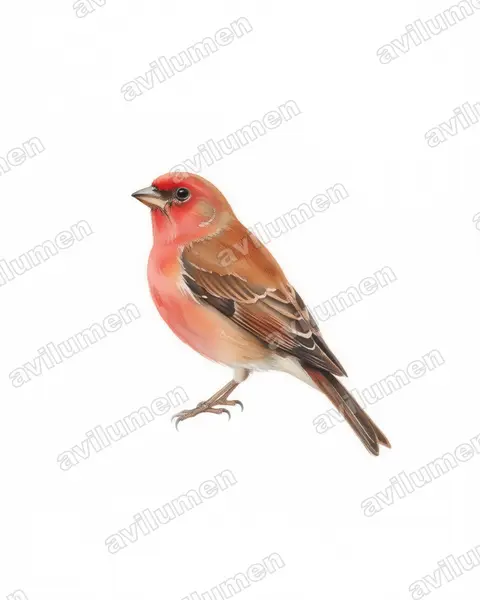
Watercolor 
Vintage plate 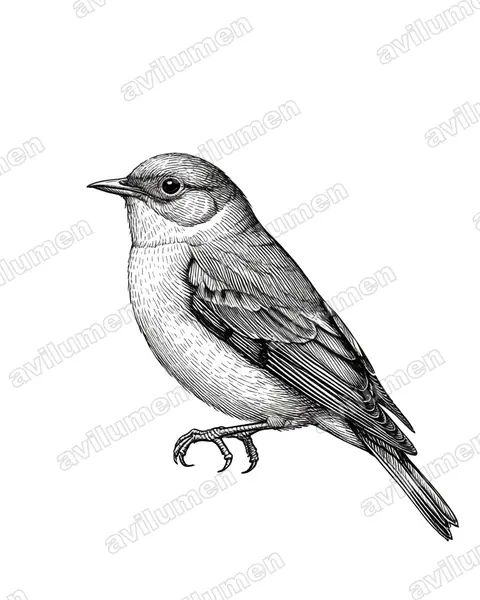
Ink 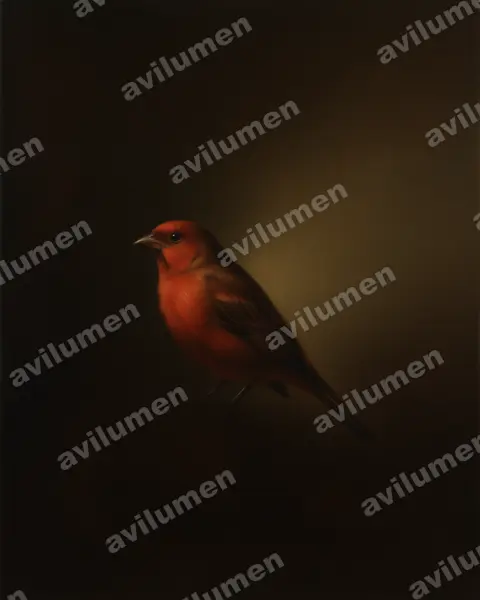
Oil 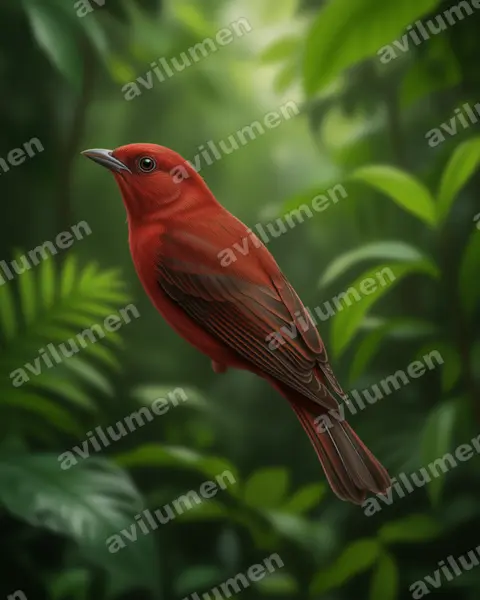
Realistic 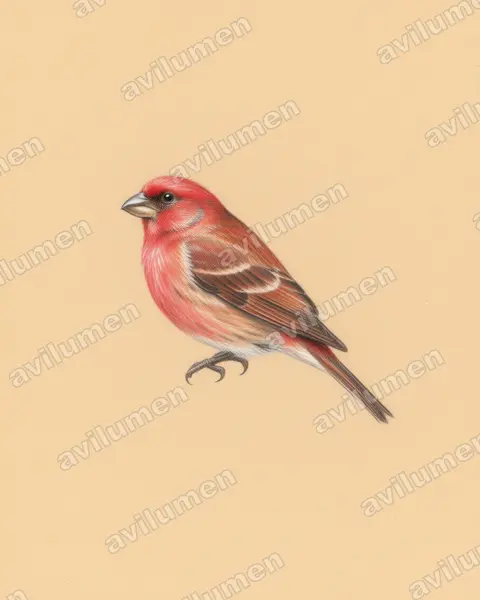
Colored pencil
Illustrations based on the photograph by Sharpe, 1890 (CC0), from Wikimedia Commons.
Digital editions
HD Digital Art Pack — Landana firefinch
Digital download: 6 high-resolution illustrations of the Landana firefinch (Lagonosticta landanae), print-ready. This is a digital file; no animal or physical item is included.
AI Avatar — Landana firefinch
Generate an avatar fusing your face with the Landana firefinch (Lagonosticta landanae). Delivered digitally in 8K, watermark-free. Digital product; no animals are sold or brokered.
Instant download. No live birds are sold.
Frequently asked questions
- Is Lagonosticta landanae (Landana firefinch) endangered?
- The IUCN Red List places Lagonosticta landanae, commonly known as the Landana firefinch, in the «Not evaluated» category. «Not evaluated» means the IUCN has not yet assessed this species.
- Where does Lagonosticta landanae (Landana firefinch) live?
- Lagonosticta landanae (Landana firefinch) is found in Africa.
- What family does Lagonosticta landanae (Landana firefinch) belong to?
- Lagonosticta landanae (Landana firefinch) belongs to the family Estrildidae, in the order Passeriformes.
- What colour is Lagonosticta landanae (Landana firefinch)?
- The plumage of Lagonosticta landanae (Landana firefinch) combines these colours: Brown and Black.
More from the same family
 Least concern
Red-headed finch
Amadina erythrocephala
The red-headed finch is a common species of estrildid finch found in Africa. It has an estimated global extent of occurrence of 1,600,000 km2 (620,000 sq mi). It is found in Angola, Botswana, Lesotho, Namibia, South Africa and Zimbabwe.
from $1.99
 Least concern
Cut-throat finch
Amadina fasciata
The cut-throat finch is a common species of estrildid finch found throughout Africa; it is also known as the bearded finch, the ribbon finch, the cut throat, and the weaver finch.
from $1.99
 Least concern
Red avadavat
Amandava amandava
The red avadavat, red munia or strawberry finch, is a sparrow-sized bird of the family Estrildidae. It is found in the open fields and grasslands of tropical Asia and is popular as a cage bird due to the colourful plumage of the males in their breeding season. It breeds in the Indian subcontinent in the monsoon season.
from $1.99
 Vulnerable
Green avadavat
Amandava formosa
The green avadavat or green munia is a species of Estrildid finch with green and yellow on the body, a bright red bill and black "zebra stripes" on the flanks. They are endemic to the Indian subcontinent and were formerly popular as cagebirds. The name "avadavat" is a corruption of the name the city of Ahmedabad in Gujarat, India, which was a centre of bird trade.
from $1.99