Chestnut munia
Lonchura atricapilla
Avilumen editorial team ·

The chestnut munia or black-headed munia is a small passerine. It was formerly considered conspecific with the closely related tricoloured munia, but is now widely accepted as a separate species. This estrildid finch is a resident breeding bird in Bangladesh, Brunei, Cambodia, China, India, Indonesia, Laos, Malaysia, Burma, Nepal, the Philippines, Singapore, Taiwan, Thailand, Vietnam and Hawaii.
The chestnut munia or black-headed munia (Lonchura atricapilla) is a small passerine. It was formerly considered conspecific with the closely related tricoloured munia, but is now widely accepted as a separate species. This estrildid finch is a resident breeding bird in Bangladesh, Brunei, Cambodia, China, India, Indonesia, Laos, Malaysia, Burma, Nepal, the Philippines, Singapore, Taiwan, Thailand, Vietnam and Hawaii. It also has been introduced to all the Greater Antilles and Martinique in the Caribbean.
Before 1995, it was the national bird of the Philippines, where it is known in Tagalog as mayang pula ("red maya") because of the brick red patch on the lower back which is visible only when it flies. This distinguishes it from other birds locally called maya, notably the predominantly brownish "mayang simbahan" ("church maya", which specifically refers to the Eurasian tree sparrow) which is more common in urban areas.
Subspecies
The chestnut munia has seven subspecies accepted:
Lonchura atricapilla rubronigra (Hodgson, 1836)
Lonchura atricapilla atricapilla (Vieillot, 1807)
Lonchura atricapilla deignani Parkes, 1958
Lonchura atricapilla sinensis (Blyth, 1852)
Lonchura atricapilla batakana (Chasen & Kloss, 1929)
Lonchura atricapilla formosana (Swinhoe, 1865)
Lonchura atricapilla jagori (Martens, 1866)
Description
Small, sexes alike, races differ slightly in intensity of colour. In L. a. jagori, the adult has the whole head, breast, centre of belly, and undertail coverts black; the back, wing, and sides of belly chestnut, brighter on underparts, duller on wings; uppertail coverts dark reddish brown, underpart buff; uppertail coverts and tail as adult. Bill silvery grey; eye chestnut; legs gray.
Habitat
The chestnut munia is a small gregarious bird which feeds mainly on grain and other seeds. It frequents open grassland and cultivation. The nest is a large domed grass structure in a bush or tall grass into which 4–7 white eggs are laid.
Characteristics
The chestnut munia is 11–12 cm in length. The adult has a stubby pale grey-blue bill, black head, and brown body, with a brick red patch on the lower back, visible only when it flies. Some races also have a black belly.
The sexes are similar, but immature birds have uniform pale brown upperparts, lack the dark head and have white to pale buff underparts.
National bird of the Philippines until 1995
The black-headed munia was the national bird of the Philippines until 1995, when that was transferred to the Philippine eagle. There, due to urbanisation and the resulting lack of awareness of local species, it is nowadays often confused for the Eurasian tree sparrow because that species, one of several also categorized as "maya" in the Philippines, is much more common in urban areas.
Text adapted from Wikipedia · CC BY-SA 4.0
Distribution

Taxonomy
- Order
- Passeriformes
- Family
- Estrildidae
- Genus
- Lonchura
- Conservation status
- Least concern
Listen to its call
No recording yet
Care guide
Canary and Finch Care Guide: Diet, Housing and Breeding
How to care for canaries, zebra finches, Gouldian finches and other finches: diet, flight cage setup, health, song and breeding. A guide for bird keepers.
Read the guide →Illustration gallery
6 illustrations of Lonchura atricapilla (Chestnut munia) in different styles, true to its real plumage. Shown watermarked; the art pack includes the high-resolution originals, ready to print.
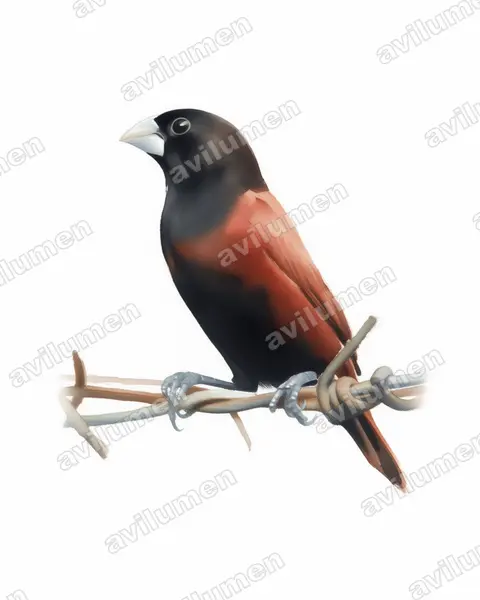
Watercolor 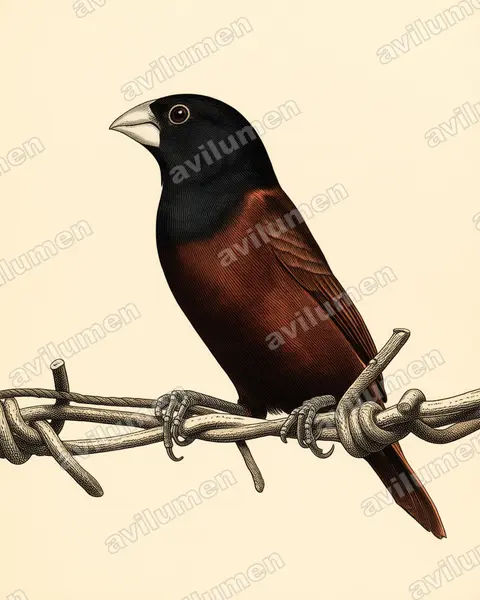
Vintage plate 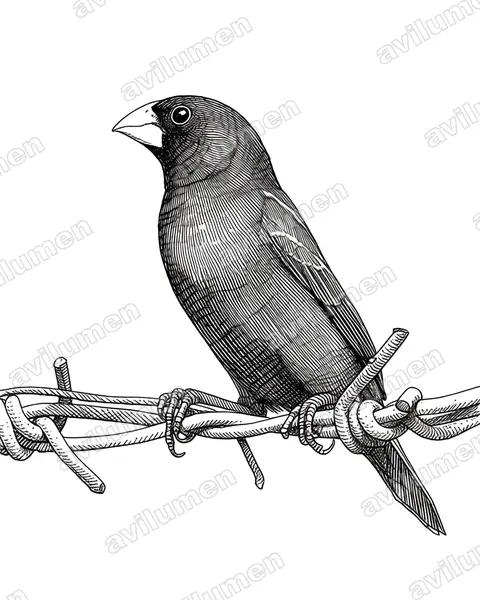
Ink 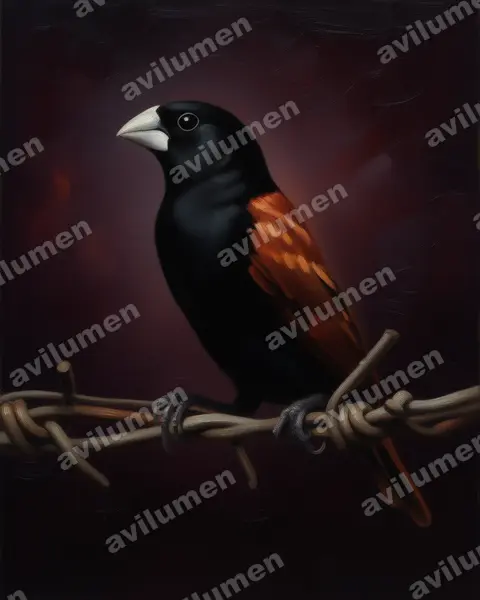
Oil 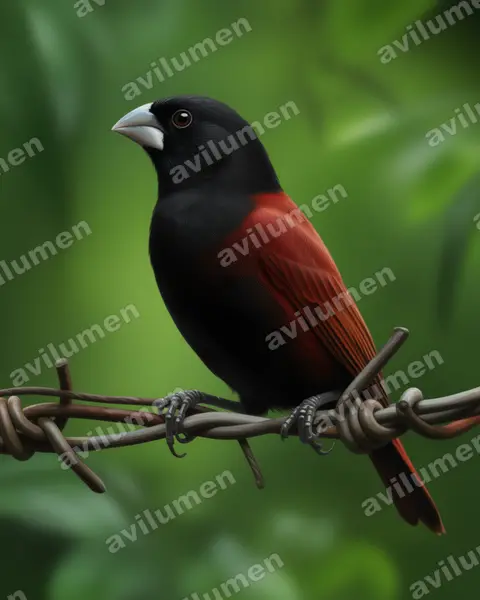
Realistic 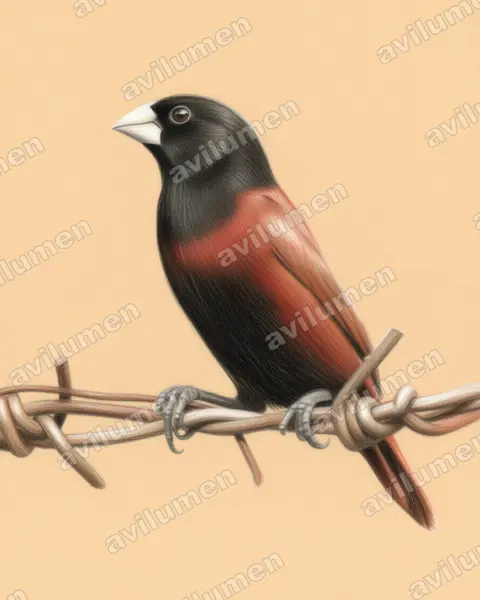
Colored pencil
Illustrations based on the photograph by Lonchura_atricapilla_jagori_-Camiguin_Sur-8.jpg: Heini Wang derivative work: Snowmanradio (talk) (CC BY 2.0), from Wikimedia Commons.
Digital editions
HD Digital Art Pack — Chestnut munia
Digital download: 6 high-resolution illustrations of the Chestnut munia (Lonchura atricapilla), print-ready. This is a digital file; no animal or physical item is included.
AI Avatar — Chestnut munia
Generate an avatar fusing your face with the Chestnut munia (Lonchura atricapilla). Delivered digitally in 8K, watermark-free. Digital product; no animals are sold or brokered.
Instant download. No live birds are sold.
Frequently asked questions
- Is Lonchura atricapilla (Chestnut munia) endangered?
- The IUCN Red List places Lonchura atricapilla, commonly known as the Chestnut munia, in the «Least concern» category. «Least concern» means it is not currently threatened.
- Where does Lonchura atricapilla (Chestnut munia) live?
- Lonchura atricapilla (Chestnut munia) is found in Indonesia, Laos, Malaysia, Myanmar, Palau, Philippines, Singapore, and United States.
- What family does Lonchura atricapilla (Chestnut munia) belong to?
- Lonchura atricapilla (Chestnut munia) belongs to the family Estrildidae, in the order Passeriformes.
- What colour is Lonchura atricapilla (Chestnut munia)?
- The plumage of Lonchura atricapilla (Chestnut munia) combines these colours: Brown and Black.
More from the same family
 Least concern
Red-headed finch
Amadina erythrocephala
The red-headed finch is a common species of estrildid finch found in Africa. It has an estimated global extent of occurrence of 1,600,000 km2 (620,000 sq mi). It is found in Angola, Botswana, Lesotho, Namibia, South Africa and Zimbabwe.
from $1.99
 Least concern
Cut-throat finch
Amadina fasciata
The cut-throat finch is a common species of estrildid finch found throughout Africa; it is also known as the bearded finch, the ribbon finch, the cut throat, and the weaver finch.
from $1.99
 Least concern
Red avadavat
Amandava amandava
The red avadavat, red munia or strawberry finch, is a sparrow-sized bird of the family Estrildidae. It is found in the open fields and grasslands of tropical Asia and is popular as a cage bird due to the colourful plumage of the males in their breeding season. It breeds in the Indian subcontinent in the monsoon season.
from $1.99
 Vulnerable
Green avadavat
Amandava formosa
The green avadavat or green munia is a species of Estrildid finch with green and yellow on the body, a bright red bill and black "zebra stripes" on the flanks. They are endemic to the Indian subcontinent and were formerly popular as cagebirds. The name "avadavat" is a corruption of the name the city of Ahmedabad in Gujarat, India, which was a centre of bird trade.
from $1.99