Eastern Ground Parrot
Pezoporus wallicus
Avilumen editorial team ·

The ground parrot is a parrot endemic to Australia. It is one of only four ground-dwelling parrots in the world, the others being the closely related night parrot, the Antipodes parakeet, and the flightless kākāpō from New Zealand.
The ground parrot (Pezoporus wallicus) is a parrot endemic to Australia. It is one of only four ground-dwelling parrots in the world, the others being the closely related night parrot (Pezoporus occidentalis), the Antipodes parakeet (Cyanoramphus unicolor), and the flightless kākāpō (Strigops habroptilus) from New Zealand.
The colouration of the two Pezoporus species and the kākāpō is similar – yellowish green with darker barring, somewhat reminiscent of the head and back of the wild-type budgerigar.
When disturbed, a ground parrot flies swiftly just above the ground before dropping back into the vegetation. The presence of the bird is often only revealed by its characteristic dusk and dawn call, a clear whistling sequence of notes which rise in pitch before fading. It is silent in flight.
The IOC World Bird List currently recognises three subspecies; the eastern ground parrot (subsp. wallicus), the western ground parrot or Kyloring (subsp. flaviventris) and the Tasmanian ground parrot. (subsp. leachi).
Description
The ground parrot is a medium-sized parrot, growing up to 30 cm long and weighing approximately 80 grams. It is distinctive, with grass green plumage, black streaking on the head and hindneck, prominent pale-yellow wing bars and black and yellow barring on the abdomen, thighs and under-tail coverts. The irises are pale yellow, the bill is dark grey and the feet and legs are flesh-pink. They have a distinguishing bright red band above the cere. Males and females appear alike.
Juveniles can be differentiated from adults in that they are slightly smaller, have duller yellow-olive plumage, absent red bands and thicker, bolder markings on the head and breast. When newly fledged, irises are dark grey-brown to brown in colour.
The eastern and Tasmanian subspecies (wallicus and leachi) differ from the western subspecies (flaviventris) in that they have thicker and more prominent black markings on the head, neck and belly.
Taxonomy and naming
This species belongs to genus Pezoporus, which also includes the night parrot (P. occidentalis). The genus name comes from the Ancient Greek word pezoporos, meaning "walking, going on foot."
Pezoporus belongs to the tribe Pezoporini (ground parrots and allies) which includes Neophema and Neopsephotus. It is part of parrot subfamily Platycercinae and family Psittaculidae, the Old World Parrots.
There are currently three recognised subspecies of P. wallicus
P. w. flaviventris (North, 1911) - the western ground parrot or Kyloring, as known by its indigenous Noongar name.
P. w. wallicus (Kerr, 1792) - the eastern ground parrot (nominate subspecies)
P. w. leachi (Matthews 1912) - the Tasmanian ground parrot
The western ground parrot (P. w. flaviventris) was once considered a separate species from the nominate subspecies based on a mitochondrial DNA study conducted in 2010. However, due to minimal morphological differences between the two and the split being based only on a single mitochondrial gene, the two are now considered to be conspecific and are only recognised as separate subspecies.
Distribution and habitat
This species is endemic to Australia. Each subspecies occurs within its own geographically separated distribution.
Subspecies wallicus, the eastern ground parrot, occurs in fragmented populations in coastal areas of south-eastern Queensland, New South Wales and Victoria. It is distributed as far north as near Fraser or K'gari Island, and as far south as Portland. It was formerly present in South Australia, but has since gone regionally extinct. The eastern ground parrot occurs mainly in dry or moist coastal heathland or sedgeland with a dense foliage cover and a high density of favoured food plants.
Subspecies flaviventris, the western ground parrot, only occurs in two disjunct populations in southern Western Australia, one in Fitzgerald River National Park, the other in Cape Arid National Park and Nuytsland Nature Reserve. It inhabits low, dry or swampy heathland near the coast, usually in areas that have been unburnt for long periods of time.
Subspecies leachi, the Tasmanian ground parrot, is endemic to Tasmania, which hosts the largest population of the species as a whole. The Tasmanian ground parrot population is suspected to consist of more than 100,000 birds.
Breeding
The breeding season of the ground parrot generally occurs from July to December, though eggs have also been recorded in March. Unlike most Australian parrots which nest in tree hollows, this species nests on the ground under a low, dense cover of vegetation including sedges, ferns and shrubs such as Banksia, Xanthorrhoea, Leptospermum and Empodisma. The nest is a shallow depression in dry, well-drained earth and is lined with leaves and stems.
The eggs are glossy, white and oval-shaped, measuring 25.4-26.9 mm. Clutch size is usually 3-4, but can range from as few as 2 to up to 7. Eggs are incubated by the female alone during the 21-24 day incubation period. If the clutch fails, a second may be laid. The male will bring food to the brooding female and nestlings. After approximately 20-28 days, the chicks will fledge and remain near the nest and their father for at least three weeks.
Conservation status
Although the species is listed as "Least Concern" on the IUCN Red List of Threatened Species due to the species' large distribution and population size as a whole, subspecies P. w. flaviventris has been listed as "Critically Endangered" on the EPBC Act List of Threatened Fauna. It is estimated that there are fewer than 150 birds remaining in the wild, making it one of the rarest parrots in Australia.
Subspecies P. w. wallicus has been listed as "Vulnerable" on both the Biodiversity Conservation Act 2016 in New South Wales and the Nature Conservation (Animals) Regulation 2020 in Queensland. In South Australia, it has been listed as "Endangered" on the list of the National Parks and Wildlife Act 1972, despite being locally extinct. Its last confirmed sighting in South Australia was in Port MacDonnell in January 1945
The species is listed in "Appendix I" by CITES.
Text adapted from Wikipedia · CC BY-SA 4.0
Taxonomy
- Order
- Psittaciformes
- Family
- Psittacidae
- Genus
- Pezoporus
- Conservation status
- Least concern
Listen to its call
No recording yet
Illustration gallery
6 illustrations of Pezoporus wallicus (Eastern Ground Parrot) in different styles, true to its real plumage. Shown watermarked; the art pack includes the high-resolution originals, ready to print.
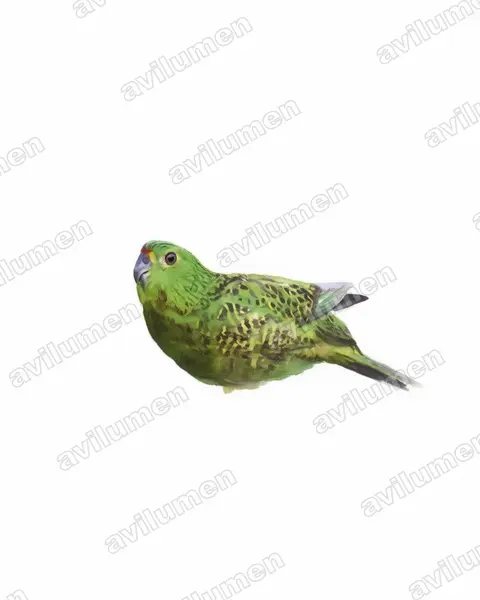
Watercolor 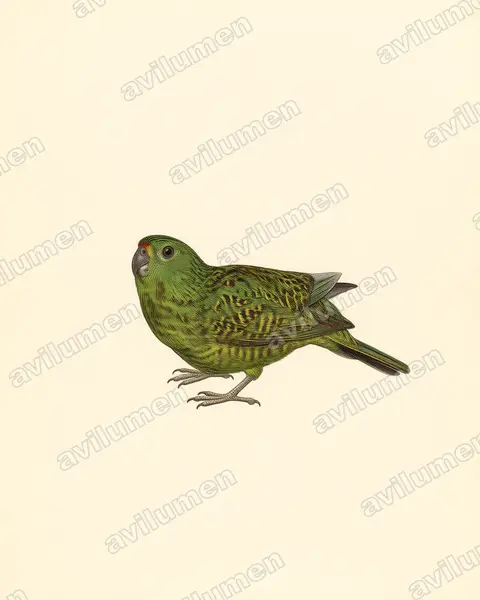
Vintage plate 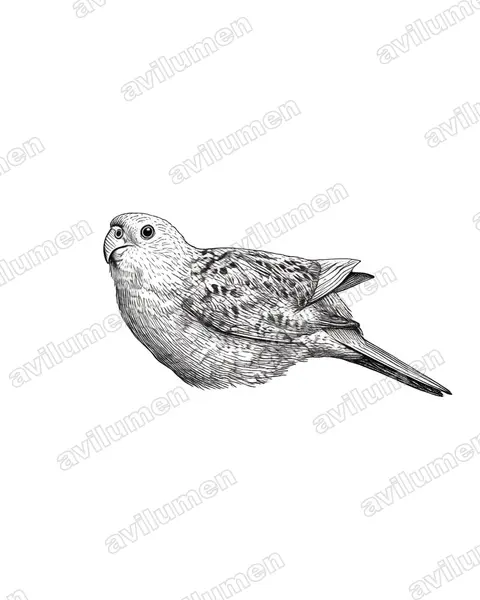
Ink 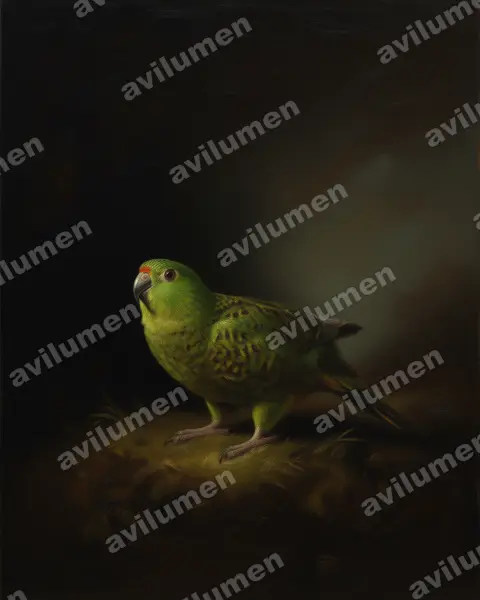
Oil 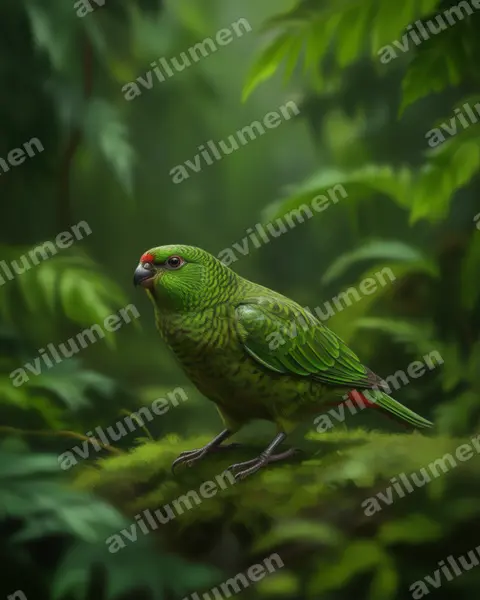
Realistic 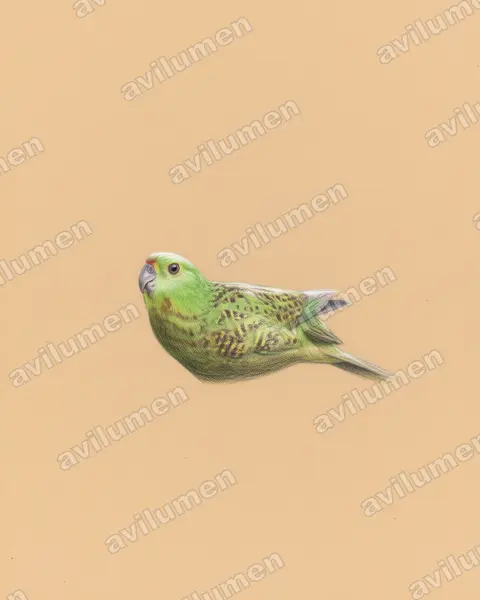
Colored pencil
Illustrations based on the photograph by PotMart186 (CC BY-SA 4.0), from Wikimedia Commons.
Digital editions
HD Digital Art Pack — Eastern Ground Parrot
Digital download: 6 high-resolution illustrations of the Eastern Ground Parrot (Pezoporus wallicus), print-ready. This is a digital file; no animal or physical item is included.
AI Avatar — Eastern Ground Parrot
Generate an avatar fusing your face with the Eastern Ground Parrot (Pezoporus wallicus). Delivered digitally in 8K, watermark-free. Digital product; no animals are sold or brokered.
Instant download. No live birds are sold.
Frequently asked questions
- Is Pezoporus wallicus (Eastern Ground Parrot) endangered?
- The IUCN Red List places Pezoporus wallicus, commonly known as the Eastern Ground Parrot, in the «Least concern» category. «Least concern» means it is not currently threatened.
- What family does Pezoporus wallicus (Eastern Ground Parrot) belong to?
- Pezoporus wallicus (Eastern Ground Parrot) belongs to the family Psittacidae, in the order Psittaciformes.
- What colour is Pezoporus wallicus (Eastern Ground Parrot)?
- The plumage of Pezoporus wallicus (Eastern Ground Parrot) combines these colours: Yellow, Green, and Brown.
More from the same family
 Near threatened
Yellow-faced Parrot
Alipiopsitta xanthops
The yellow-faced parrot, formerly also known as the yellow-faced amazon, is the only species of the genus Alipiopsitta. It is a Neotropical parrot, and was classified in the genus Amazona for many years. It is a predominantly green and yellow-plumaged bird with a yellow head. It is a semi-nomadic species found in the cerrado region of Brazil and adjacent Bolivia.
from $1.99
 Least concern
Moluccan King Parrot
Alisterus amboinensis
The Moluccan king parrot is a parrot endemic to Peleng Island, Maluku, and West Papua in Indonesia. It is sometimes referred to as the Ambon king parrot or Amboina king parrot, but this is potentially misleading, as it is found on numerous other islands than Ambon. The male and female are similar in appearance, with a predominantly red head and underparts, green wings, and blue back and tail.
from $1.99
 Least concern
Papuan King Parrot
Alisterus chloropterus
The Papuan king parrot, also known as the green-winged king parrot, is a species of parrot in the family Psittaculidae found in New Guinea. Its natural habitats are subtropical or tropical moist lowland forest and subtropical or tropical moist montane forest.
from $1.99
 Least concern
Australian King Parrot
Alisterus scapularis
The Australian king parrot is a species of parrot endemic to eastern Australia ranging from Cooktown in Queensland to Port Campbell in Victoria. Found in humid and heavily forested upland regions of the eastern portion of the continent, including eucalyptus wooded areas in and directly adjacent to subtropical and temperate rainforest. They feed on fruits and seeds gathered from trees or on the ground.
from $1.99