Red-billed Parrot
Pionus sordidus
Avilumen editorial team ·

The red-billed parrot, also known as coral-billed pionus or red-billed pionus, is a species of bird in subfamily Arinae of the family Psittacidae, the African and New World parrots. It is found in Bolivia, Colombia, Ecuador, Peru, and Venezuela.
The red-billed parrot (Pionus sordidus), also known as coral-billed pionus or red-billed pionus, is a species of bird in subfamily Arinae of the family Psittacidae, the African and New World parrots. It is found in Bolivia, Colombia, Ecuador, Peru, and Venezuela.
Taxonomy and systematics
In 1751 the English naturalist George Edwards included an illustration and a description of the red-billed parrot in the fourth volume of his A Natural History of Uncommon Birds. He used the English name "The dusky parrot". Edwards based his hand-colored etching on a live bird in London that was owned by the botanist and Fellow of the Royal Society Peter Collinson. Collinson believed his parrot had come from New Spain. When in 1758 the Swedish naturalist Carl Linnaeus updated his Systema Naturae for the tenth edition, he placed the red-billed parrot with the other parrots in the genus Psittacus. Linnaeus included a brief description, coined the binomial name Psittacus sordidus, and cited Edwards' work. The red-billed parrot is now one of eight species of parrot placed in the genus Pionus that was introduced in 1832 by the German naturalist Johann Georg Wagler. The genus name is from Ancient Greek piōn, pionos meaning "fat". The specific epithet sordidus is Latin meaning "shabby" or "dirty".
The red-billed parrot has these six subspecies:
P. s. saturatus Todd, 1915
P. s. ponsi Aveledo & Ginés, 1950
P. s. sordidus (Linnaeus, 1758)
P. s. antelius Todd, 1947
P. s. corallinus Bonaparte, 1854
P. s. mindoensis Chapman, 1925
In the early 20th century some authors treated subspecies P. s. corallinus as a separate species. More recently some authors have questioned the validity of P. s. mindoensis as separate from corallinus. The red-billed parrot and the scaly-headed parrot (P. maximiliani) are sister species.
Description
The red-billed parrot is 27 to 29 cm (11 to 11 in) long and weighs about 272 g (9.6 oz). All of the subspecies have the eponymous red bill. Adults of the nominate subspecies P. s. sordidus have a dull green head whose feathers have dull blue edges; their eye is surrounded by bare grayish skin. Their back, wings, and inner tail feathers are olive green; their outer tail feathers are blue. Their upper breast is dull blue that becomes buff-olive with a pink tinge on the belly. Their undertail coverts are red. Immature birds have a green head and breast and yellowish green undertail coverts.
Subspecies P. s. antelius is paler than the nominate and has very little blue on the breast. P. s. saturatus is darker than the nominate and P. s. ponsi is darker than saturatus. Subspecies P. s. corallinus is larger and greener than the nominate, and its mantle and back have gray and blue tinges. P. s. mindoensis is similar to corallinus but somewhat yellower.
Distribution and habitat
The subspecies of the red-billed parrot have a disjunct distribution. They are found thus:
P. s. saturatus, Colombia's Sierra Nevada de Santa Marta
P. s. ponsi, from the foothills of Sierra Nevada de Santa Marta east into Serranía del Perijá that straddles the Colombia-Venezuela border
P. s. sordidus, northern Venezuela from Falcón and Lara east to Miranda
P. s. antelius, the northeastern Venezuelan states of Anzoátegui, Sucre, and Monagas
P. s. corallinus, discontinuously from the Eastern Andes of Colombia south through eastern Ecuador to central Peru and separately in central Bolivia
P. s. mindoensis, western Ecuador
The red-billed parrot inhabits a variety of wooded landscapes including the interior, clearings, and edges of humid to wet lowland and submontane evergreen and semi-deciduous forests; cloud-, secondary, and gallery forests; and coffee plantations. In elevation it is mostly found between 500 and 1,500 m (1,600 and 4,900 ft) but ranges as low as 100 m (300 ft) and as high as 2,400 m (7,900 ft).
Movement
The red-billed parrot makes some local seasonal movements in northern Venezuela but its movements, if any, in the rest of its range are not known.
Feeding
Little is known about the red-billed parrot's foraging behavior or diet, though the latter is known to include fruits and blossoms.
Breeding
The red-billed parrot's breeding season varies geographically. It spans February to April in Colombia and January to May in Ecuador; in Venezuela it includes April and in Bolivia includes October. It nests in holes in trees. The clutch size appears to usually be three eggs. The incubation period is about 27 days and fledging occurs about 12 weeks after hatch.
Vocalization
The red-billed parrot's flight calls appear to be different among the subspecies. P. s. sordidus and P. s. antelius make "a strident "kee!-yak" ". P. s. corallinus and P. s. mindoensis make "an upslurred "crree!" and a more mellow "crrah" ".
Status
The IUCN has assessed the red-billed parrot as being of Least Concern. It has a very large range but its population size is not known and is believed to be decreasing. No immediate threats have been identified. It is considered fairly common in most of its range. Deforestation in Colombia and Venezuela has caused local declines. In general "however, the species persists in moderately disturbed habitat."
Text adapted from Wikipedia · CC BY-SA 4.0
Where it lives
Distribution

Taxonomy
- Order
- Psittaciformes
- Family
- Psittacidae
- Genus
- Pionus
- Conservation status
- Least concern
Listen to its call
No recording yet
Care guide
Amazon, African Grey and Eclectus Parrot Care Guide
How to care for Amazon parrots, African greys, eclectus and pionus: diet, cage setup, health, behavior and CITES requirements for medium and large parrots.
Read the guide →Illustration gallery
6 illustrations of Pionus sordidus (Red-billed Parrot) in different styles, true to its real plumage. Shown watermarked; the art pack includes the high-resolution originals, ready to print.
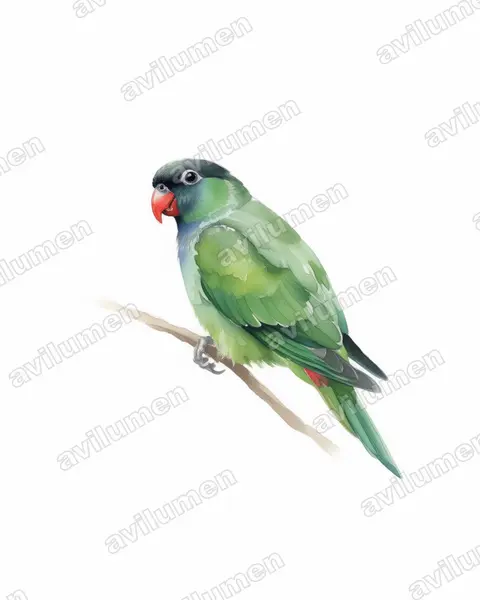
Watercolor 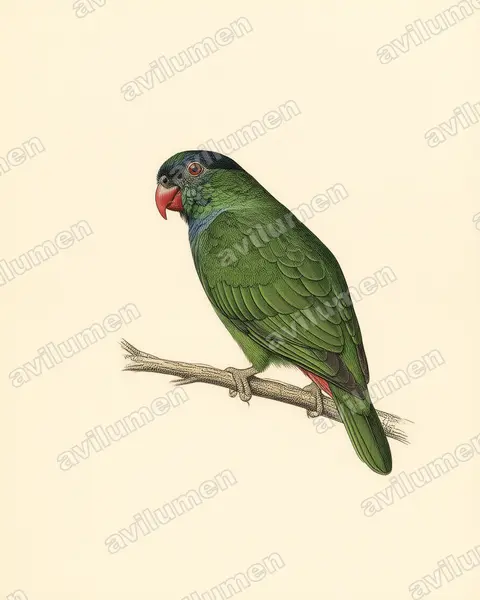
Vintage plate 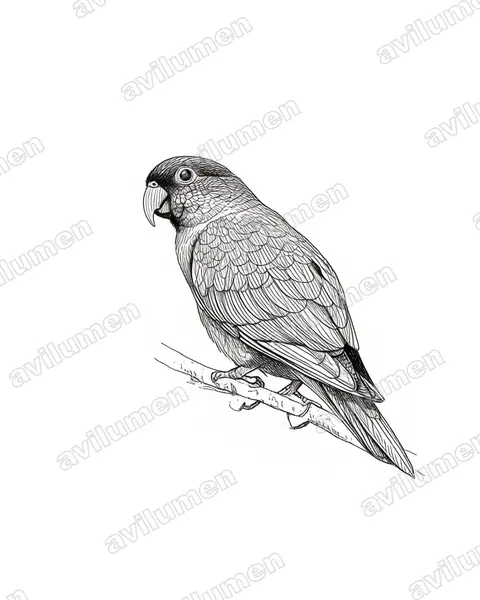
Ink 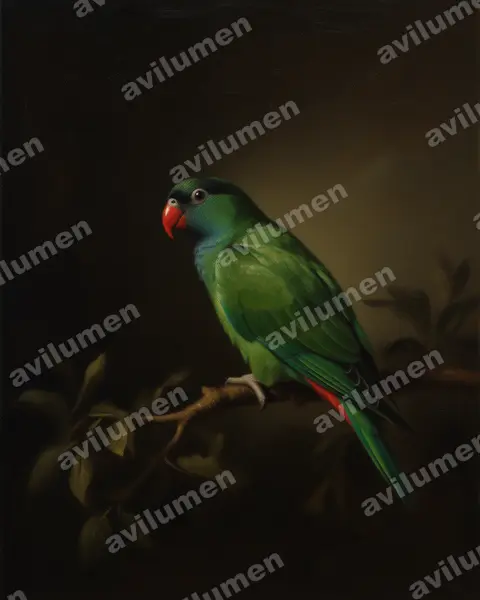
Oil 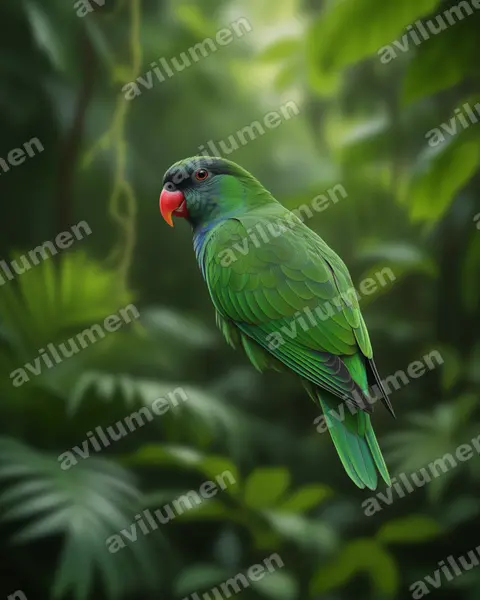
Realistic 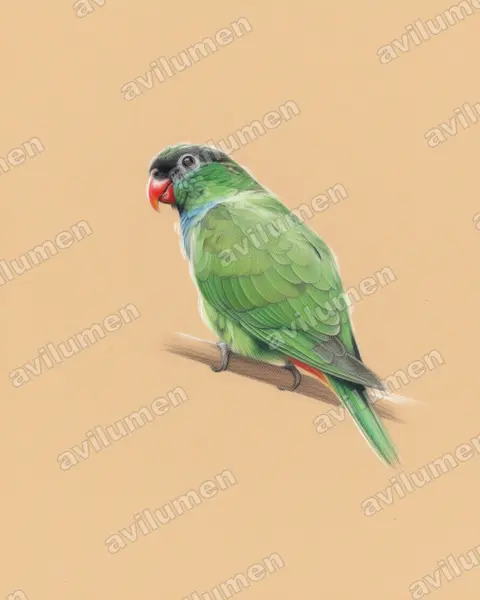
Colored pencil
Illustrations based on the photograph by Nomdeploom (CC BY-SA 4.0), from Wikimedia Commons.
Digital editions
HD Digital Art Pack — Red-billed Parrot
Digital download: 6 high-resolution illustrations of the Red-billed Parrot (Pionus sordidus), print-ready. This is a digital file; no animal or physical item is included.
AI Avatar — Red-billed Parrot
Generate an avatar fusing your face with the Red-billed Parrot (Pionus sordidus). Delivered digitally in 8K, watermark-free. Digital product; no animals are sold or brokered.
Instant download. No live birds are sold.
Frequently asked questions
- Is Pionus sordidus (Red-billed Parrot) endangered?
- The IUCN Red List places Pionus sordidus, commonly known as the Red-billed Parrot, in the «Least concern» category. «Least concern» means it is not currently threatened.
- Where does Pionus sordidus (Red-billed Parrot) live?
- Pionus sordidus (Red-billed Parrot) is found in South America.
- What family does Pionus sordidus (Red-billed Parrot) belong to?
- Pionus sordidus (Red-billed Parrot) belongs to the family Psittacidae, in the order Psittaciformes.
- What colour is Pionus sordidus (Red-billed Parrot)?
- The plumage of Pionus sordidus (Red-billed Parrot) combines these colours: Red and Brown.
More from the same family
 Near threatened
Yellow-faced Parrot
Alipiopsitta xanthops
The yellow-faced parrot, formerly also known as the yellow-faced amazon, is the only species of the genus Alipiopsitta. It is a Neotropical parrot, and was classified in the genus Amazona for many years. It is a predominantly green and yellow-plumaged bird with a yellow head. It is a semi-nomadic species found in the cerrado region of Brazil and adjacent Bolivia.
from $1.99
 Least concern
Moluccan King Parrot
Alisterus amboinensis
The Moluccan king parrot is a parrot endemic to Peleng Island, Maluku, and West Papua in Indonesia. It is sometimes referred to as the Ambon king parrot or Amboina king parrot, but this is potentially misleading, as it is found on numerous other islands than Ambon. The male and female are similar in appearance, with a predominantly red head and underparts, green wings, and blue back and tail.
from $1.99
 Least concern
Papuan King Parrot
Alisterus chloropterus
The Papuan king parrot, also known as the green-winged king parrot, is a species of parrot in the family Psittaculidae found in New Guinea. Its natural habitats are subtropical or tropical moist lowland forest and subtropical or tropical moist montane forest.
from $1.99
 Least concern
Australian King Parrot
Alisterus scapularis
The Australian king parrot is a species of parrot endemic to eastern Australia ranging from Cooktown in Queensland to Port Campbell in Victoria. Found in humid and heavily forested upland regions of the eastern portion of the continent, including eucalyptus wooded areas in and directly adjacent to subtropical and temperate rainforest. They feed on fruits and seeds gathered from trees or on the ground.
from $1.99