Pale-headed Rosella
Platycercus adscitus
Avilumen editorial team ·

The pale-headed rosella, is a broad-tailed parrot of the genus Platycercus native to northeastern Australia. It is a moderate-size parrot with a pale yellow head, predominantly white cheeks, scalloped black and gold back and pale blue underparts. Two subspecies are recognised, although some authorities consider it to be conspecific with the eastern rosella of southeastern Australia.
The pale-headed rosella (Platycercus adscitus), is a broad-tailed parrot of the genus Platycercus native to northeastern Australia. It is a moderate-size parrot with a pale yellow head, predominantly white cheeks, scalloped black and gold back and pale blue underparts. Two subspecies are recognised, although some authorities consider it to be conspecific with the eastern rosella of southeastern Australia.
Found in open woodland, it feeds on seeds and fruit. As with other rosellas, the pale-headed rosella nests in hollows of large trees. It readily adapts to aviculture and is sold as a cagebird.
Taxonomy
The pale-headed rosella was formally described in 1790 by the English ornithologist John Latham and given the binomial name Psittacus adscitus. The specific epithet is from Latin asciscere meaning "to approve". Latham did not specify a locality but in 1912 Gregory Mathews designated the locality as Cooktown, Queensland in northeast Australia. The pale-headed rosella is now placed in the genus Platycercus that was introduced in 1925 by Nicholas Aylward Vigors.
There are two subspecies, the nominate adscitus (Cape York Peninsula) and the better known palliceps (eastern Queensland), known as the blue-cheeked rosella, that was depicted in 1832 by the English artist Edward Lear in his Illustrations of the Family of Psittacidae, or Parrots. Its closest relative was thought to be the eastern rosella, which replaces it in southeastern Australia. Hybrids of the two taxa have been recorded where their ranges meet in northeastern New South Wales and southeastern Queensland. However, a 2017 mitochondrial study found that the closest relative was in fact the northern rosella, and that the eastern rosella was an earlier offshoot.
Other common names occasionally seen include mealy rosella, Moreton Bay rosella, blue rosella, and blue-cheeked rosella for the northern subspecies. The term white-cheeked rosella has been used for a species or superspecies combining the pale-headed and eastern forms.
Description
The pale-headed rosella is 33 cm (13 in) long, which includes the 15 cm length of its tail. Its underparts are pale blue, and upper breast and head are pale cream-yellow, the tail which is blue-black and green and the vent which is blood red. The feathers of the nape, scapulars and back are black edged with bright yellow, giving rise to a scalloped appearance. In these margins of the northern race, the yellow is paler with a pale blue tinge. The cheeks are wholly white in the southern subspecies, and partly flushed with blue in the lowerparts in the northern subspecies. The bill is pale blue-white and the legs dark grey. The eyes are yellow-brown. The sexes are similar in appearance, although the female is slightly smaller and duller.
Distribution and habitat
The nominate subspecies adscitus is found from the Cape York Peninsula south through to Cardwell in central-northern Queensland. There is a broad range of intermediate forms, while the southern subspecies palliceps extends from Townsville and points inland south into northeastern New South Wales to the vicinity of the Clarence River. It is common throughout its range. Its preferred habitat is open forest, but has adapted well to human modification of the rural landscape and may even become a pest to orchards and cereal crops. Watering troughs help the species in the dryer western limits of its range.
It was also introduced to Hawaii in 1877, but had died out there by the late 1920s.
Feeding
It eats grass and tree seeds and fruits, including river red-gum (Eucalyptus camaldulensis), river she-oak (Casuarina cunninghamiana), snow-in-summer (Melaleuca linariifolia) and other melaleucas, and rough cockleburr (Xanthium strumarium). Birds are partial to the introduced Scotch thistle (Onopordum acanthium).
Breeding
The breeding season varies according to region, with southern birds nesting from September to December and northern ones later from February to June. One brood is laid. The nesting site is usually a hollow over 1 m (3 ft) deep in a tree trunk anywhere up to 30 m (100 ft) above the ground. Although even found to nest in a tree trunk hollow under ground. A clutch of five or six (although up to nine have been recorded) round, white and slightly shiny eggs, measuring 26 x 22 mm, is laid.
Aviculture
The species is relatively hardy and easy to keep in cultivation. It can be aggressive and so is recommended to be segregated from other birds in captivity.
Text adapted from Wikipedia · CC BY-SA 4.0
Taxonomy
- Order
- Psittaciformes
- Family
- Psittacidae
- Genus
- Platycercus
- Conservation status
- Least concern
Listen to its call
No recording yet
Care guide
Budgie, Conure and Parakeet Care Guide
How to care for budgies, conures, parrotlets, ringnecks and other parakeets: diet, cage setup, health, behavior, breeding and legal status for owners.
Read the guide →Illustration gallery
6 illustrations of Platycercus adscitus (Pale-headed Rosella) in different styles, true to its real plumage. Shown watermarked; the art pack includes the high-resolution originals, ready to print.
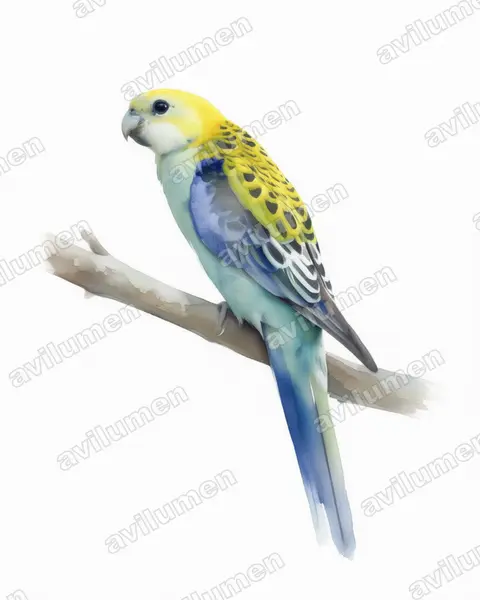
Watercolor 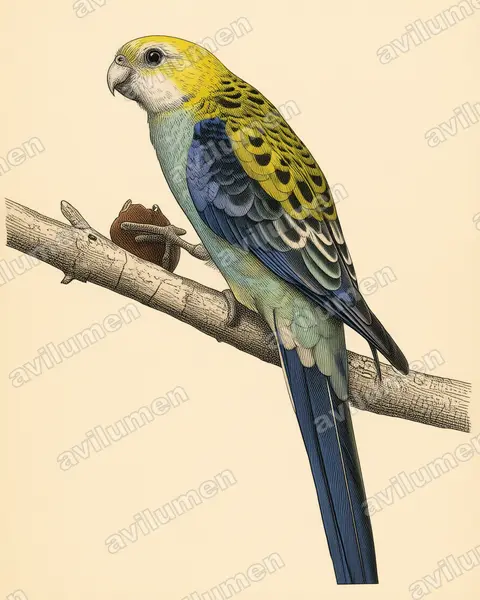
Vintage plate 
Ink 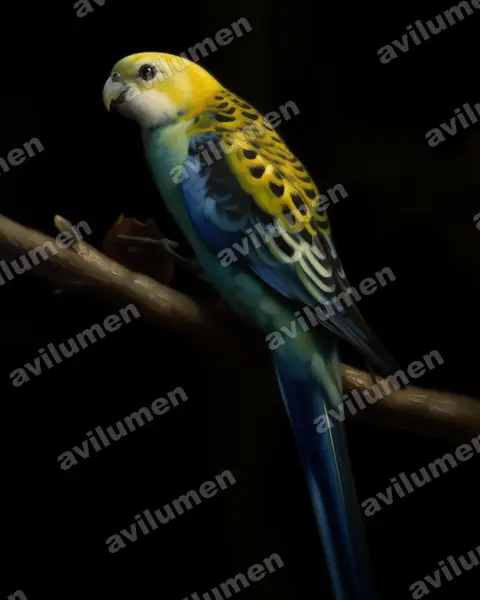
Oil 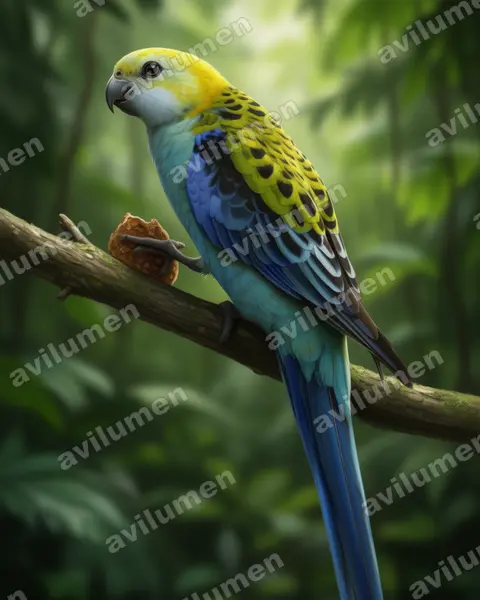
Realistic 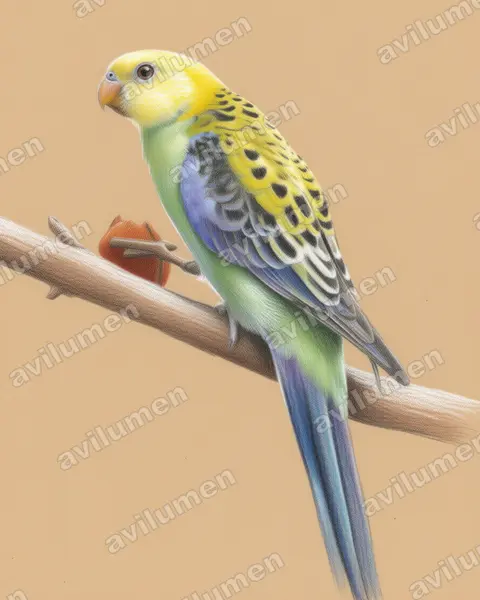
Colored pencil
Illustrations based on the photograph by Glen Fergus (CC BY-SA 2.5), from Wikimedia Commons.
Digital editions
HD Digital Art Pack — Pale-headed Rosella
Digital download: 6 high-resolution illustrations of the Pale-headed Rosella (Platycercus adscitus), print-ready. This is a digital file; no animal or physical item is included.
AI Avatar — Pale-headed Rosella
Generate an avatar fusing your face with the Pale-headed Rosella (Platycercus adscitus). Delivered digitally in 8K, watermark-free. Digital product; no animals are sold or brokered.
Instant download. No live birds are sold.
Frequently asked questions
- Is Platycercus adscitus (Pale-headed Rosella) endangered?
- The IUCN Red List places Platycercus adscitus, commonly known as the Pale-headed Rosella, in the «Least concern» category. «Least concern» means it is not currently threatened.
- Where does Platycercus adscitus (Pale-headed Rosella) live?
- Platycercus adscitus (Pale-headed Rosella) is found in Australia.
- What family does Platycercus adscitus (Pale-headed Rosella) belong to?
- Platycercus adscitus (Pale-headed Rosella) belongs to the family Psittacidae, in the order Psittaciformes.
- What colour is Platycercus adscitus (Pale-headed Rosella)?
- The plumage of Platycercus adscitus (Pale-headed Rosella) combines these colours: Yellow, Blue, and White.
More from the same family
 Near threatened
Yellow-faced Parrot
Alipiopsitta xanthops
The yellow-faced parrot, formerly also known as the yellow-faced amazon, is the only species of the genus Alipiopsitta. It is a Neotropical parrot, and was classified in the genus Amazona for many years. It is a predominantly green and yellow-plumaged bird with a yellow head. It is a semi-nomadic species found in the cerrado region of Brazil and adjacent Bolivia.
from $1.99
 Least concern
Moluccan King Parrot
Alisterus amboinensis
The Moluccan king parrot is a parrot endemic to Peleng Island, Maluku, and West Papua in Indonesia. It is sometimes referred to as the Ambon king parrot or Amboina king parrot, but this is potentially misleading, as it is found on numerous other islands than Ambon. The male and female are similar in appearance, with a predominantly red head and underparts, green wings, and blue back and tail.
from $1.99
 Least concern
Papuan King Parrot
Alisterus chloropterus
The Papuan king parrot, also known as the green-winged king parrot, is a species of parrot in the family Psittaculidae found in New Guinea. Its natural habitats are subtropical or tropical moist lowland forest and subtropical or tropical moist montane forest.
from $1.99
 Least concern
Australian King Parrot
Alisterus scapularis
The Australian king parrot is a species of parrot endemic to eastern Australia ranging from Cooktown in Queensland to Port Campbell in Victoria. Found in humid and heavily forested upland regions of the eastern portion of the continent, including eucalyptus wooded areas in and directly adjacent to subtropical and temperate rainforest. They feed on fruits and seeds gathered from trees or on the ground.
from $1.99