Blue-winged Macaw
Primolius maracana
Avilumen editorial team ·

The blue-winged macaw, in aviculture more commonly known as Illiger's macaw, is a species of small macaw found in central and eastern South America. The second name is in honor of the German ornithologist Johann Karl Wilhelm Illiger. It was previously placed in the genera Ara or Propyrrhura. Blue-winged macaws have been known to reach an age of 50–60 years.
The blue-winged macaw (Primolius maracana), in aviculture more commonly known as Illiger's macaw, is a species of small macaw (sometimes called a mini-macaw) found in central and eastern South America. The second name is in honor of the German ornithologist Johann Karl Wilhelm Illiger. It was previously placed in the genera Ara or Propyrrhura. Blue-winged macaws have been known to reach an age of 50–60 years.
Description
It has a total length of approximately 36–43 cm (14–17 in). It has a moderately sized black bill, a long tail and a mainly green plumage. The upperside of the remiges and primary coverts are blue, as indicated by its common name. The underside of the wings is yellowish, the tail-tip, crown and cheeks are bluish, and the tail-base and small belly-patch are red. The iris is amber. It and the red-bellied macaw are the only macaws where the bare facial-skin is yellowish, but this often fades to white in captivity. Unlike the red-bellied macaw, the blue-winged has a red lower abdomen and a red lower back. In the wild, its flight pattern is said to be a distinctive 'jerky, rearing motion.'
Habitat and food
The blue-winged macaw occurs in eastern and southern Brazil (with a remnant population north-east), eastern Paraguay and, at least formerly, in far north-eastern Argentina and east of Bolivia. It occurs in evergreen and deciduous forests, with a preference for gallery forest. They mainly feed on seeds of Cnidoscolus phyllacanthus, Jatropha, Guazuma ulmifolia, and the non-native Melia azedarach. However, the birds also feed on fruits and nuts.
Breeding
The blue-winged macaw attain sexual maturity between 2 and 4 years after they are born. Adult females usually produce two eggs which take approximately 29 days to hatch. Young blue-winged macaws learn to fly about 11 weeks after they have hatched. They stay with their parents for about a year after learning to fly. Relatively little information exists on its reproduction in the wild, but the breeding season in north-eastern Brazil is apparently from December to February. However, in 1990, a female blue-winged macaw was discovered with a male Spix's macaw in a site.
Threats
These birds are affected mostly by deforestation. They were also captured for the cagebird trade - from 1977 to 1979, 183 birds arrived at the United States from Paraguay. It has declined in the southern part of its range, and there are no recent records from Misiones Province in Argentina where many were killed by farmers who considered them pests. Therefore, it was previously considered vulnerable. Information from Brazil suggests it remains widespread and has even re-colonised areas in its historical range in southern Rio de Janeiro. This has led to it being downlisted to near threatened.
Aviculture
The blue-winged macaw is sometimes kept by humans as an aviary bird or companion parrot. An intensely social bird and a strong flier, this macaw does best when housed with other birds (whether other blue-winged macaws or member of a different parrot species) and given plenty of space in which to fly. It is also an avid chewer and may damage its keeper's property unless provided with wooden destructible objects to occupy its time. Captive breeding of this species is encouraged, due to conservation concerns. If kept as a pet, the blue-winged macaw can bond strongly with humans and some individuals may even begin to mirror their owner's emotional state.
Text adapted from Wikipedia · CC BY-SA 4.0
Where it lives
Distribution

Taxonomy
- Order
- Psittaciformes
- Family
- Psittacidae
- Genus
- Primolius
- Conservation status
- Near threatened
Listen to its call
No recording yet
Care guide
Macaw Care Guide: Diet, Housing and Breeding
How to care for a macaw: diet, cage and aviary size, health, breeding, noise and CITES legal requirements. A practical guide for current and future owners.
Read the guide →Illustration gallery
6 illustrations of Primolius maracana (Blue-winged Macaw) in different styles, true to its real plumage. Shown watermarked; the art pack includes the high-resolution originals, ready to print.
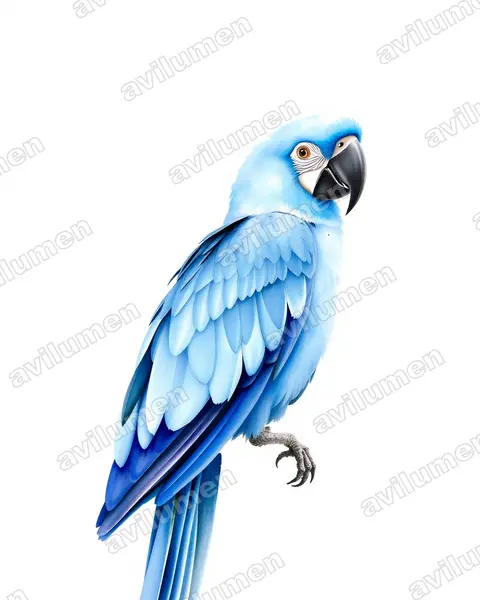
Watercolor 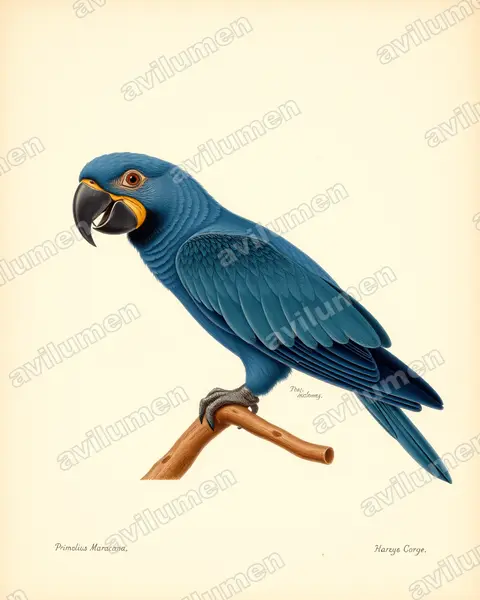
Vintage plate 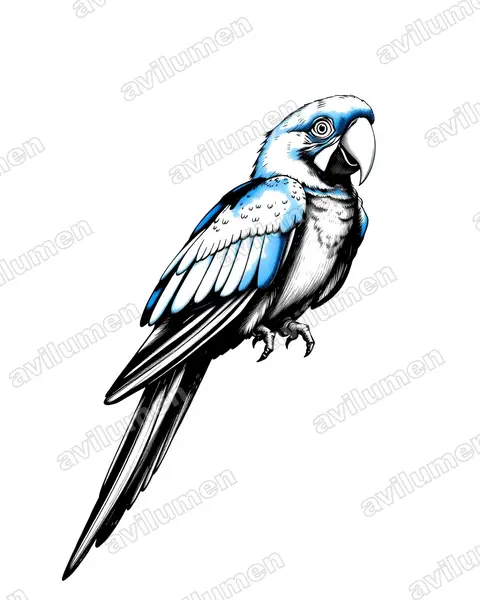
Ink 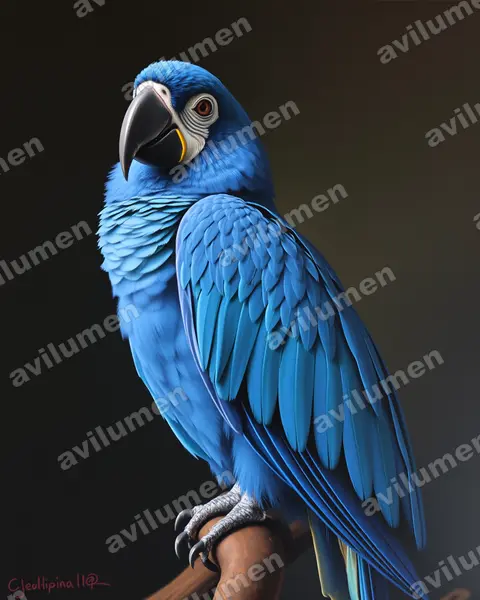
Oil 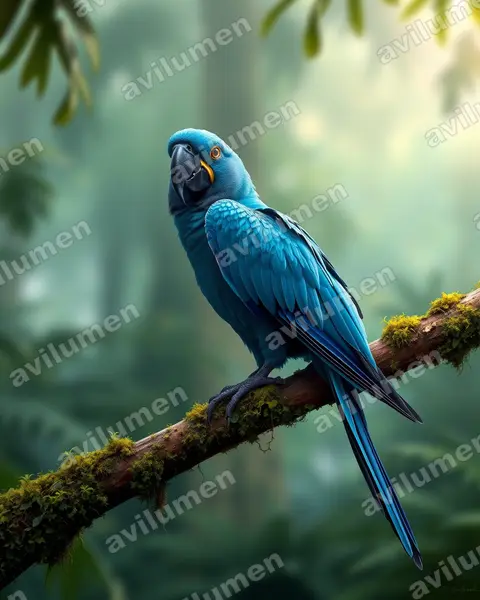
Realistic 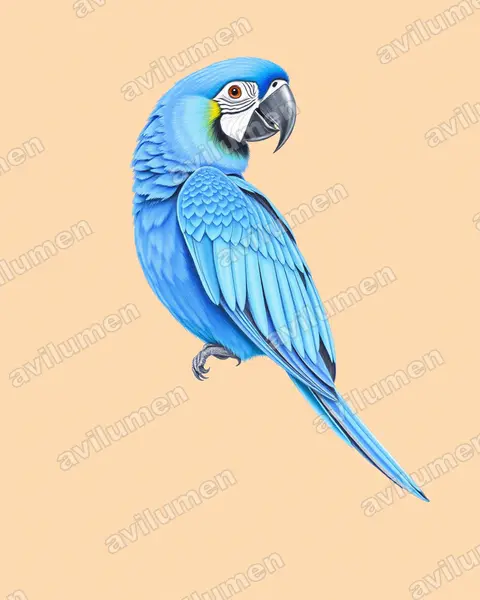
Colored pencil
Digital editions
HD Digital Art Pack — Blue-winged Macaw
Digital download: 6 high-resolution illustrations of the Blue-winged Macaw (Primolius maracana), print-ready. This is a digital file; no animal or physical item is included.
AI Avatar — Blue-winged Macaw
Generate an avatar fusing your face with the Blue-winged Macaw (Primolius maracana). Delivered digitally in 8K, watermark-free. Digital product; no animals are sold or brokered.
Instant download. No live birds are sold.
Frequently asked questions
- Is Primolius maracana (Blue-winged Macaw) endangered?
- The IUCN Red List places Primolius maracana, commonly known as the Blue-winged Macaw, in the «Near threatened» category. «Near threatened» means it is not threatened yet, but is close to becoming so.
- Where does Primolius maracana (Blue-winged Macaw) live?
- Primolius maracana (Blue-winged Macaw) is found in Brazil and South America.
- What family does Primolius maracana (Blue-winged Macaw) belong to?
- Primolius maracana (Blue-winged Macaw) belongs to the family Psittacidae, in the order Psittaciformes.
- What colour is Primolius maracana (Blue-winged Macaw)?
- The plumage of Primolius maracana (Blue-winged Macaw) combines these colours: Blue and Green.
More from the same family
 Near threatened
Yellow-faced Parrot
Alipiopsitta xanthops
The yellow-faced parrot, formerly also known as the yellow-faced amazon, is the only species of the genus Alipiopsitta. It is a Neotropical parrot, and was classified in the genus Amazona for many years. It is a predominantly green and yellow-plumaged bird with a yellow head. It is a semi-nomadic species found in the cerrado region of Brazil and adjacent Bolivia.
from $1.99
 Least concern
Moluccan King Parrot
Alisterus amboinensis
The Moluccan king parrot is a parrot endemic to Peleng Island, Maluku, and West Papua in Indonesia. It is sometimes referred to as the Ambon king parrot or Amboina king parrot, but this is potentially misleading, as it is found on numerous other islands than Ambon. The male and female are similar in appearance, with a predominantly red head and underparts, green wings, and blue back and tail.
from $1.99
 Least concern
Papuan King Parrot
Alisterus chloropterus
The Papuan king parrot, also known as the green-winged king parrot, is a species of parrot in the family Psittaculidae found in New Guinea. Its natural habitats are subtropical or tropical moist lowland forest and subtropical or tropical moist montane forest.
from $1.99
 Least concern
Australian King Parrot
Alisterus scapularis
The Australian king parrot is a species of parrot endemic to eastern Australia ranging from Cooktown in Queensland to Port Campbell in Victoria. Found in humid and heavily forested upland regions of the eastern portion of the continent, including eucalyptus wooded areas in and directly adjacent to subtropical and temperate rainforest. They feed on fruits and seeds gathered from trees or on the ground.
from $1.99