Cuban parakeet
Psittacara euops
Avilumen editorial team ·

The Cuban parakeet is a Vulnerable species of bird in subfamily Arinae of the family Psittacidae, the African and New World parrots. It is endemic to the island of Cuba.
The Cuban parakeet (Psittacara euops) is a Vulnerable species of bird in subfamily Arinae of the family Psittacidae, the African and New World parrots. It is endemic to the island of Cuba.
Taxonomy and systematics
The Cuban parakeet was for a time placed in the genus Aratinga but from about 2013 has been in its present genus Psittacara. It is monotypic.
Description
The Cuban parakeet is 22 to 29 cm (8.7 to 11 in) long and weighs 78 to 96 g (2.8 to 3.4 oz). The sexes are alike. Adults are mostly yellow-green that is paler on their underparts. They have red spots scattered on their head, neck, and breast; females have fewer than males. The edge of their wing and their underwing coverts are bright red. The undersides of their flight feathers and tail are pale green to olive. Their eye is light yellow surrounded by bare light pink to reddish white skin, their bill is light pink, and their feet are pink to ivory. Juveniles resemble adults, but have little or no red on the head and breast.
Distribution and habitat
The Cuban parakeet formerly was found throughout the main island of Cuba and on Isla de la Juventud (Isle of Pines). It was extirpated from Isla de la Juventud by about 1900. In the 21st century it has a disjunct distribution in the Zapata Swamp; in parts of Villa Clara, Ciego de Ávila, Sancti Spíritus, Camagüey, and Guantanamo provinces; in the western Escambray Mountains; and in the Cauto River watershed.
The Cuban parakeet inhabits two quite different landscapes. One is savannas with many palms and isolated trees. The other is evergreen and semi-deciduous montane forest. Royal palm is present in both landscapes and is the species' preferred nest substrate.
Behavior
The Cuban parakeet is very social and is usually seen in flocks that may number up to about 50 individuals.
Movement
The Cuban parakeet is not migratory.
Feeding
The Cuban parakeet's diet includes seeds, fruits (both green and ripe), and flower buds, pollen, and nectar. More than 50 species of plants have been documented as sources.
Breeding
The Cuban parakeet nests between February and September. Almost all nests are in holes excavated by woodpeckers though cavities in limestone cliffs are also used. No material is added to the substrate though in trees and palms the adults may loosen chips from the inner walls to line the bottom of the cavity. The clutch size is two to five eggs with an average of four. The incubation period is about 24 days and fledging occurs 55 to 60 days after hatch. The male brings food to the nest for the female which in turn feeds the nestlings.
Vocalization
The Cuban parakeet has a variety of vocalizations. Its "warning calls" in response to a predator are "more metallic than scraping; they can be described as erh, erh, erh, erh." Its "contact call" is used while feeding and is described as "kkkkeeeeerrrrrrrrrrrrrr". It also makes a "flight contact" call, usually when taking off and landing; it is similar to the warning call. "Courtship calls" are "smooth and short...and sound like keirp-keirp-keirp."
Status
The IUCN originally assessed the Cuban parakeet as Threatened but since 1994 has rated it as Vulnerable. It has a small and fragmented range and its estimated population of 1500 to 7000 mature individuals is believed to be decreasing. Continuing habitat loss and illegal trapping for the domestic and export cage bird trade are the principal threats. The increasing frequency and intensity of hurricanes attributed to climate change is a potential additional threat. Cuban authorities have recommended that the IUCN rating be changed to Endangered. Most of the remaining populations are in somewhat protected areas.
Text adapted from Wikipedia · CC BY-SA 4.0
Distribution

Taxonomy
- Order
- Psittaciformes
- Family
- Psittacidae
- Genus
- Psittacara
- Conservation status
- Vulnerable
Listen to its call
No recording yet
Care guide
Budgie, Conure and Parakeet Care Guide
How to care for budgies, conures, parrotlets, ringnecks and other parakeets: diet, cage setup, health, behavior, breeding and legal status for owners.
Read the guide →Illustration gallery
6 illustrations of Psittacara euops (Cuban parakeet) in different styles, true to its real plumage. Shown watermarked; the art pack includes the high-resolution originals, ready to print.
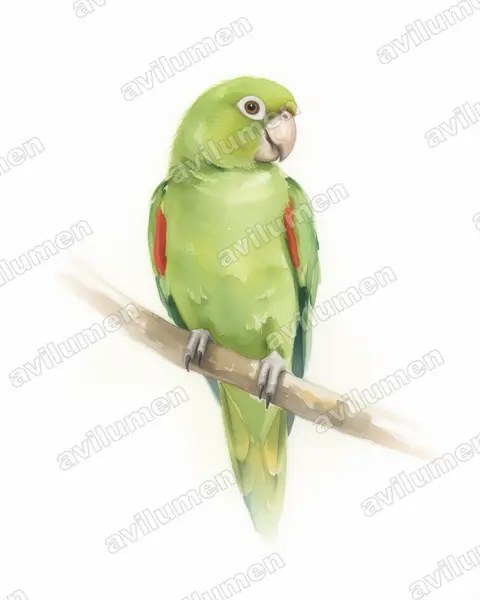
Watercolor 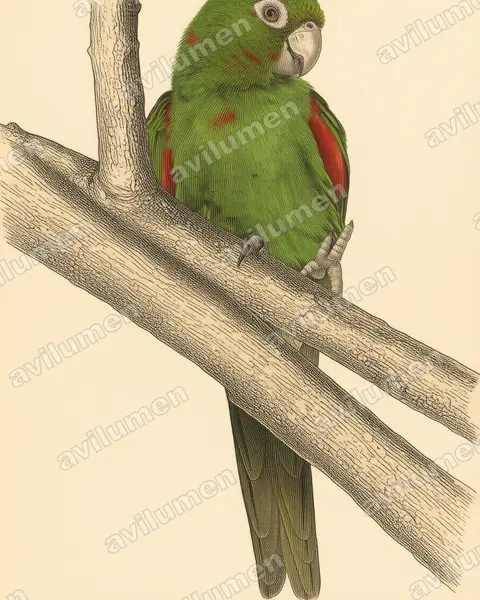
Vintage plate 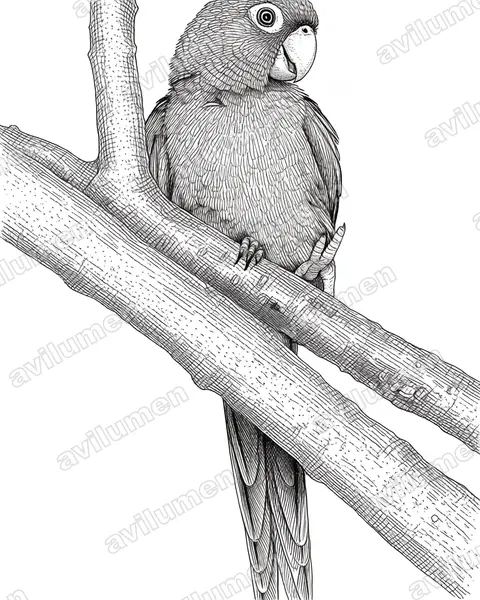
Ink 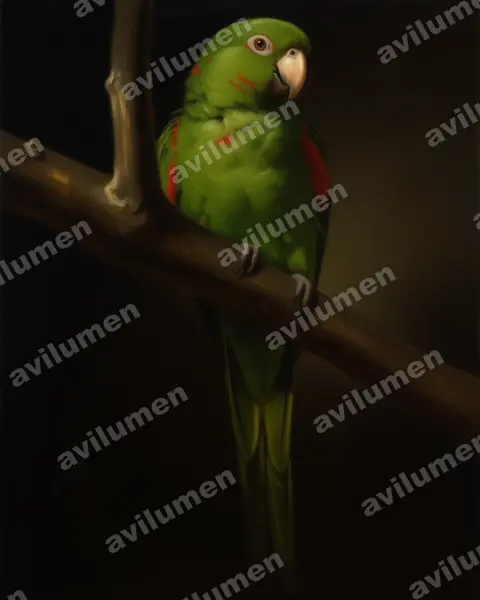
Oil 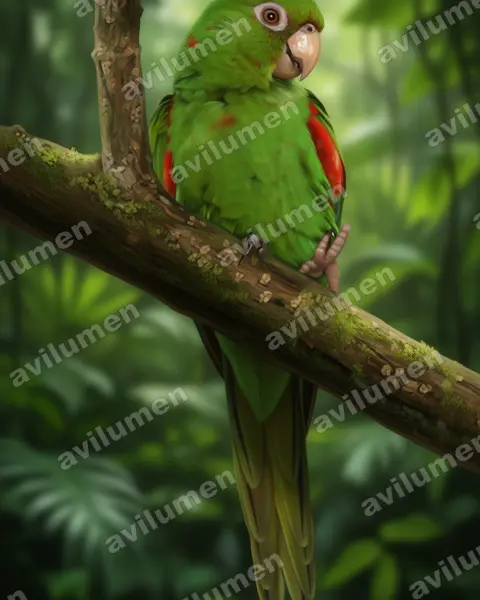
Realistic 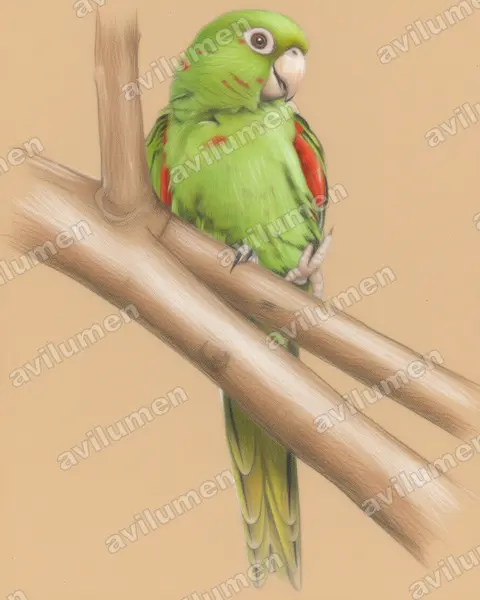
Colored pencil
Illustrations based on the photograph by dominic sherony (CC BY-SA 2.0), from Wikimedia Commons.
Digital editions
HD Digital Art Pack — Cuban parakeet
Digital download: 6 high-resolution illustrations of the Cuban parakeet (Psittacara euops), print-ready. This is a digital file; no animal or physical item is included.
AI Avatar — Cuban parakeet
Generate an avatar fusing your face with the Cuban parakeet (Psittacara euops). Delivered digitally in 8K, watermark-free. Digital product; no animals are sold or brokered.
Instant download. No live birds are sold.
Frequently asked questions
- Is Psittacara euops (Cuban parakeet) endangered?
- The IUCN Red List places Psittacara euops, commonly known as the Cuban parakeet, in the «Vulnerable» category. «Vulnerable» means it faces a high risk of extinction in the medium term.
- What family does Psittacara euops (Cuban parakeet) belong to?
- Psittacara euops (Cuban parakeet) belongs to the family Psittacidae, in the order Psittaciformes.
- What colour is Psittacara euops (Cuban parakeet)?
- The plumage of Psittacara euops (Cuban parakeet) combines these colours: Green and Yellow.
More from the same family
 Near threatened
Yellow-faced Parrot
Alipiopsitta xanthops
The yellow-faced parrot, formerly also known as the yellow-faced amazon, is the only species of the genus Alipiopsitta. It is a Neotropical parrot, and was classified in the genus Amazona for many years. It is a predominantly green and yellow-plumaged bird with a yellow head. It is a semi-nomadic species found in the cerrado region of Brazil and adjacent Bolivia.
from $1.99
 Least concern
Moluccan King Parrot
Alisterus amboinensis
The Moluccan king parrot is a parrot endemic to Peleng Island, Maluku, and West Papua in Indonesia. It is sometimes referred to as the Ambon king parrot or Amboina king parrot, but this is potentially misleading, as it is found on numerous other islands than Ambon. The male and female are similar in appearance, with a predominantly red head and underparts, green wings, and blue back and tail.
from $1.99
 Least concern
Papuan King Parrot
Alisterus chloropterus
The Papuan king parrot, also known as the green-winged king parrot, is a species of parrot in the family Psittaculidae found in New Guinea. Its natural habitats are subtropical or tropical moist lowland forest and subtropical or tropical moist montane forest.
from $1.99
 Least concern
Australian King Parrot
Alisterus scapularis
The Australian king parrot is a species of parrot endemic to eastern Australia ranging from Cooktown in Queensland to Port Campbell in Victoria. Found in humid and heavily forested upland regions of the eastern portion of the continent, including eucalyptus wooded areas in and directly adjacent to subtropical and temperate rainforest. They feed on fruits and seeds gathered from trees or on the ground.
from $1.99