Mitred parakeet
Psittacara mitratus
Avilumen editorial team ·

The mitred parakeet, also known as the mitred conure in aviculture, is a species of bird in subfamily Arinae of the family Psittacidae, the African and New World parrots. It is native to Argentina, Bolivia, and Peru. It has been introduced to Uruguay and is established there. There are also substantial populations in the US states of California and Florida and smaller numbers in Hawaii.
The mitred parakeet (Psittacara mitratus), also known as the mitred conure in aviculture, is a species of bird in subfamily Arinae of the family Psittacidae, the African and New World parrots. It is native to Argentina, Bolivia, and Peru. It has been introduced to Uruguay and is established there. There are also substantial populations in the US states of California and Florida and smaller numbers in Hawaii.
Taxonomy and systematics
The mitred parakeet was for a time placed in the genus Aratinga but from about 2013 has been in its present genus Psittacara. Its taxonomy is otherwise unsettled. The International Ornithological Committee (IOC) recognizes these three subspecies:
P. m. chlorogenys (Arndt, 2006)
P. m. mitratus (Tschudi, 1844)
P. m. tucumanus (Arndt, 2006)
The American Ornithological Society (AOS) and the Clements taxonomy recognize a fourth subspecies, P. m. alticola ("Chapman's parakeet"), that Arndt (2006) had suggested as a separate species. Agnolin (2009) called into question the validity of P. m. tucumanus, and BirdLife International's Handbook of the Birds of the World (HBW) does not recognize it or P. m. alticola, assigning only P. m. chlorogenys and P. m. mitratus to the mitred parakeet.
Arndt (2006) also suggested that another full species, P. hockingi ("Hocking's parakeet"), exists within the mitred parakeet. The IOC, AOS, Clements, and HBW have not accepted this taxon as either a species or subspecies.
This article follows the three-subspecies model.
Description
The mitred parakeet is 31 to 38 cm (12 to 15 in) long and weighs 219 to 275 g (7.7 to 9.7 oz). The sexes are alike. Adults of all subspecies are mostly green with a purplish forehead and a variable amount and pattern of red on the face. All subspecies have a red forecrown and red in front of their eye. The red usually extends past the eye and down the cheeks, and is often just flecks on the ear coverts. Subspecies P. m. chlorogenys has less red around and below the eye than the others, often a blue tinge on the crown, and some red on the thighs. Some individuals of all subspecies have a small amount of red at the bend of the wing. Their eye is surrounded by bare white skin and their bill is horn colored. Juveniles have little or no red.
The differences in plumage coloration noted in the field and in specimens are possibly due to erroneous age assignments, and might also be clinal.
Distribution and habitat
The nominate subspecies P. m. mitratus of the mitred parakeet is found from the departments of Ayacucho and Cuzco in Peru south through Bolivia into northwestern Argentina as far as Córdoba Province. Subspecies P. m. chlorogenys is found on the eastern slope of the Peruvian Andes between Amazonas and Junín departments. P. m. tucumanus is found in the Argentinian provinces of Córdoba and Tucumán.
The mitred parakeet has been introduced to Uruguay and is established there. Populations in California, Florida, and Hawaii are apparently derived from escaped or released cage birds. California's official list does not include the species but the other two states' lists do.
In their native range mitred parakeets inhabit a variety of landscapes, most of them forested. These include both evergreen and deciduous montane forest, cloudforest, secondary forest, and semi-humid to humid scrub areas in otherwise arid zones. Subspecies P. m. chlorogenys ranges from 1,200 to 2,900 m (3,900 to 9,500 ft) in elevation. The other two subspecies occur in the wider elevational range of 1,000 to 3,400 m (3,300 to 11,200 ft) with one reported sighting at 4,000 m (13,000 ft) in Peru. The introduced populations in California and Florida mostly occur in suburban and urban areas while those in Hawaii occur in both populated and unpopulated areas.
Movement
The mitred parakeet makes some movements in response to food availability and also apparently roams outside the breeding season. Flocks of up to 2000 have been reported though those of about 100 individuals are more common.
Feeding
The mitred parakeet's diet in its native range has not been fully described but is known to include berries and other fruits, seeds, nuts, and maize. In California the species has been observed feeding on fruits and flowers. In south Florida it has been documented feeding on 34 species of plants, both native and introduced.
Breeding
In its native range the mitred parakeet nests in tree cavities and on cliffs. Its clutch size in the wild is two to three eggs. In Florida it nests almost exclusively on human structures and in Hawaii has nested on sea cliffs.
Vocalization
The mitred parakeet is very vocal, especially in flight with "a continuous loud screeching chatter". It also makes nasal "[s]queaky notes and screeches".
Status
The IUCN has assessed the mitred parakeet as being of Least Concern in its native range. It has a large range and though its population size is not known it is believed to be stable. Though it was formerly heavily captured for the cage bird trade, as of 2018 no immediate threats have been identified. It is considered generally common and locally abundant and occurs in several protected areas.
The population of mitred parakeet in California was estimated at 1000 individuals in 2002. That in south Florida has been increasing since at least 2004 and by 2019 had reached at least 400. The population in Hawaii had reached about 200 by 2003; lethal control measures reduced the population to about 30 in 2012. Occasional sightings at widespread sites have continued into the 2020s.
Aviculture
The subspecies seen in American aviculture is Psittacara m. mitrata (though this is labelled with some uncertainty considering the recent developments in the taxonomy). Popular as pets, the mitred parakeets are considered outgoing and playful. They are even used as "watch birds", given their loud, piercing alarm call. Like most parrots, they tend to be devoted to their human owners. They have been known to grow attached to groups rather than individuals. They make great pets for people who will devote their time and money and will understand the birds natural behaviors; screaming, biting, splashing, etc.
Text adapted from Wikipedia · CC BY-SA 4.0
Where it lives
Distribution

Taxonomy
- Order
- Psittaciformes
- Family
- Psittacidae
- Genus
- Psittacara
- Conservation status
- Least concern
Listen to its call
No recording yet
Care guide
Budgie, Conure and Parakeet Care Guide
How to care for budgies, conures, parrotlets, ringnecks and other parakeets: diet, cage setup, health, behavior, breeding and legal status for owners.
Read the guide →Illustration gallery
6 illustrations of Psittacara mitratus (Mitred parakeet) in different styles, true to its real plumage. Shown watermarked; the art pack includes the high-resolution originals, ready to print.
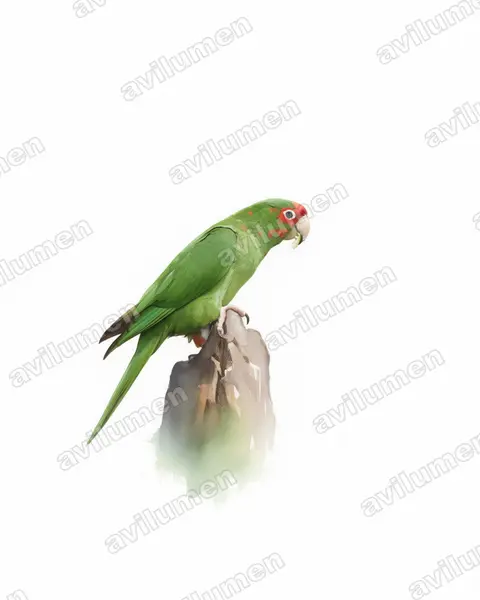
Watercolor 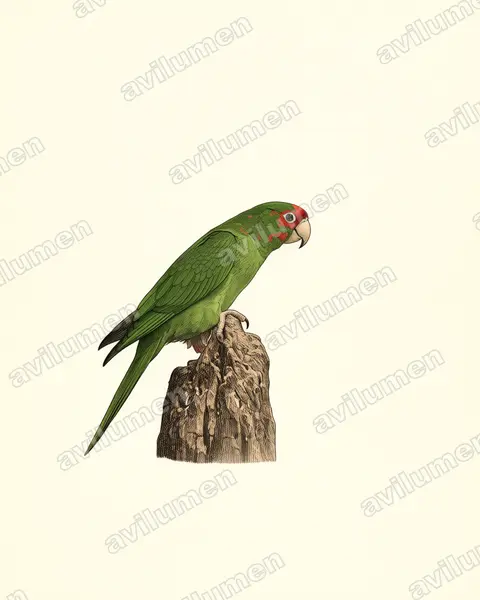
Vintage plate 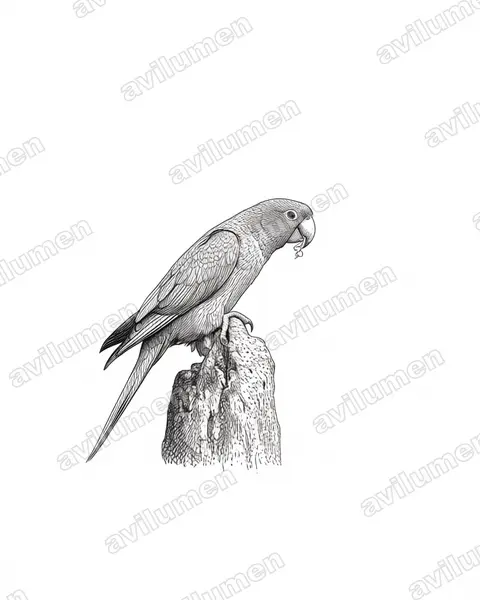
Ink 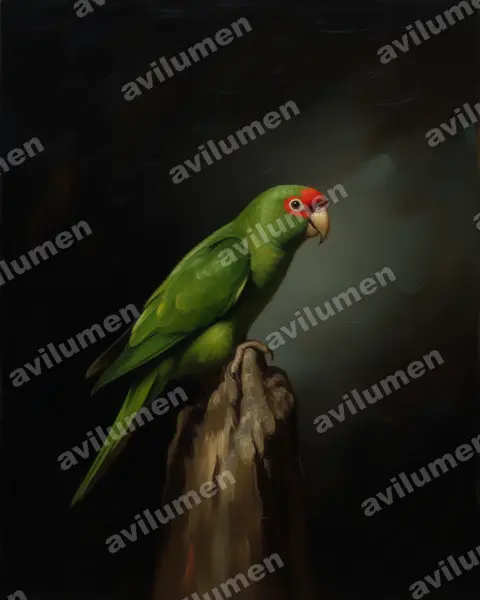
Oil 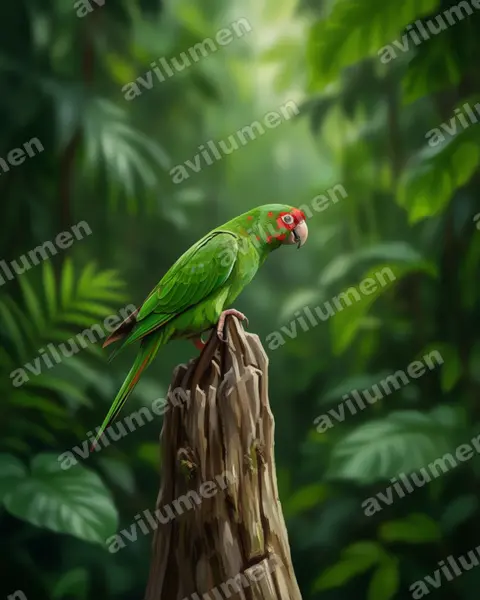
Realistic 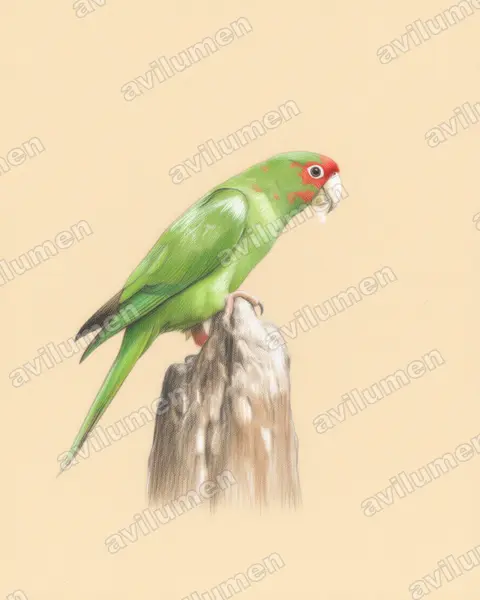
Colored pencil
Illustrations based on the photograph by Melvin Toul (CC BY-SA 4.0), from Wikimedia Commons.
Digital editions
HD Digital Art Pack — Mitred parakeet
Digital download: 6 high-resolution illustrations of the Mitred parakeet (Psittacara mitratus), print-ready. This is a digital file; no animal or physical item is included.
AI Avatar — Mitred parakeet
Generate an avatar fusing your face with the Mitred parakeet (Psittacara mitratus). Delivered digitally in 8K, watermark-free. Digital product; no animals are sold or brokered.
Instant download. No live birds are sold.
Frequently asked questions
- Is Psittacara mitratus (Mitred parakeet) endangered?
- The IUCN Red List places Psittacara mitratus, commonly known as the Mitred parakeet, in the «Least concern» category. «Least concern» means it is not currently threatened.
- Where does Psittacara mitratus (Mitred parakeet) live?
- Psittacara mitratus (Mitred parakeet) is found in South America.
- What family does Psittacara mitratus (Mitred parakeet) belong to?
- Psittacara mitratus (Mitred parakeet) belongs to the family Psittacidae, in the order Psittaciformes.
- What colour is Psittacara mitratus (Mitred parakeet)?
- The plumage of Psittacara mitratus (Mitred parakeet) combines these colours: Green and Red.
More from the same family
 Near threatened
Yellow-faced Parrot
Alipiopsitta xanthops
The yellow-faced parrot, formerly also known as the yellow-faced amazon, is the only species of the genus Alipiopsitta. It is a Neotropical parrot, and was classified in the genus Amazona for many years. It is a predominantly green and yellow-plumaged bird with a yellow head. It is a semi-nomadic species found in the cerrado region of Brazil and adjacent Bolivia.
from $1.99
 Least concern
Moluccan King Parrot
Alisterus amboinensis
The Moluccan king parrot is a parrot endemic to Peleng Island, Maluku, and West Papua in Indonesia. It is sometimes referred to as the Ambon king parrot or Amboina king parrot, but this is potentially misleading, as it is found on numerous other islands than Ambon. The male and female are similar in appearance, with a predominantly red head and underparts, green wings, and blue back and tail.
from $1.99
 Least concern
Papuan King Parrot
Alisterus chloropterus
The Papuan king parrot, also known as the green-winged king parrot, is a species of parrot in the family Psittaculidae found in New Guinea. Its natural habitats are subtropical or tropical moist lowland forest and subtropical or tropical moist montane forest.
from $1.99
 Least concern
Australian King Parrot
Alisterus scapularis
The Australian king parrot is a species of parrot endemic to eastern Australia ranging from Cooktown in Queensland to Port Campbell in Victoria. Found in humid and heavily forested upland regions of the eastern portion of the continent, including eucalyptus wooded areas in and directly adjacent to subtropical and temperate rainforest. They feed on fruits and seeds gathered from trees or on the ground.
from $1.99