Timneh parrot
Psittacus timneh
Avilumen editorial team ·

The Timneh parrot, also known as the Timneh grey parrot or Timneh African grey parrot, is a West African parrot. Formerly classified as a subspecies of the grey parrot Psittacus erithacus timneh, it is now considered a full species Psittacus timneh. In aviculture, it is often referred to by the initials TAG and is commonly kept as a companion parrot.
The Timneh parrot (Psittacus timneh), also known as the Timneh grey parrot or Timneh African grey parrot, is a West African parrot. Formerly classified as a subspecies of the grey parrot Psittacus erithacus timneh, it is now considered a full species Psittacus timneh. In aviculture, it is often referred to by the initials TAG and is commonly kept as a companion parrot.
Taxonomy
The Timneh parrot was formally described in 1844 by the British zoologist and collector Louis Fraser. He coined the binomial name Psittacus timneh and specified the type locality as "Timneh country, Sierra Leone". The Temne are an ethnic group that are predominantly found in the Northern Province of Sierra Leone. The Timneh parrot was formerly classified as a subspecies of the grey parrot but is now treated as a separate species based on the results of a genetic and morphological study published in 2007.
Two subspecies are recognised:
P. t. timneh Fraser, 1844 – south Guinea to Sierra Leone, Liberia, Mali and west Ivory Coast
Príncipe grey parrot (P. t. princeps) Alexander, 1909 – Príncipe, an island off the west coast of Africa
The Clements Checklist classifies the Príncipe grey parrot as a subspecies of the grey parrot instead.
Description
Growing to 28–33 centimetres (11–13 in) in length and weighing 275–375 grams (9.7–13.2 oz), the Timneh is a medium-sized parrot. Its plumage is mainly a mottled grey, with a white face mask and pale yellow eyes. Compared with the only other recognised Psittacus species, the grey parrot (P. erithacus), the Timneh is smaller and darker, with a dull, dark maroon (rather than crimson) tail and a horn-coloured patch on the upper mandible. Like the grey parrot, the Timneh parrot is one of the most intelligent bird species. The Timneh parrot may be more outgoing around human beings, and can learn to talk at a younger age than the grey parrot.
Distribution and habitat
The Timneh parrot is endemic to the western parts of the moist Upper Guinean forests and bordering savannas of West Africa from Guinea-Bissau, Sierra Leone and southern Mali eastwards to at least 70 km east of the Bandama River in Ivory Coast. There is no natural range overlap with the grey parrot although, as both taxa are common in aviculture, escapes can occur and hybridization between greys and Timnehs has been observed in captivity. The birds typically inhabit dense forest, but are also seen at forest edges and in clearings, in gallery forest along waterways, savanna woodland and mangroves. Though they are sometimes found in cultivated areas and gardens, it is not clear whether these habitats contain self-sustaining populations; the birds may make seasonal movements out of the driest parts of their range in the dry season.
Status, threats and conservation
Of a total estimated population of 120,000–259,000 individual birds, the largest populations are in Ivory Coast (54,000–130,000) and Liberia (50,000–100,000). In the other range countries, estimated numbers are Sierra Leone (11,000–18,000), Guinea (5,000–10,000) and Guinea-Bissau (100–1,000), with insignificant numbers in southern Mali. Surveys indicate that the species has disappeared from the forests around Mount Nimba and in Nimba County, Liberia.
The Timneh parrot has been undergoing population decline both through the loss of its forest habitat and trapping for the international wild bird trade. The fragmentation and loss of forests, as well as climatic changes, has become a major factor in the food availability for parrots. The species ability to track food (such as plants and plant parts including fruits, seeds, flowers, leaf buds, and sap) and switch diets determines the species ability to cope with environmental changes; it is a contributory factor to the population decline of the Timneh parrot. Along with the closely related Congo grey parrot, it is one of the most popular pet birds in the United States, Europe and the Middle East due to its longevity and ability to mimic human speech.
In January 2007, the CITES' Animals Committee imposed a two-year ban on exports of Timneh parrots from Sierra Leone, Liberia, Ivory Coast and Guinea, while the importation of wild-caught birds into the EU was banned in the same year. Despite this, in 2009, Guinea exported 720 birds. The legal trade, which is monitored by CITES, may constitute only a small proportion of the total numbers trapped in the wild.
In 2012, BirdLife International gave the Timneh parrot full species status on the basis of genetic, morphological, plumage and vocal differences and classified it as Endangered in 2016.
Text adapted from Wikipedia · CC BY-SA 4.0
Distribution

Taxonomy
- Order
- Psittaciformes
- Family
- Psittacidae
- Genus
- Psittacus
- Conservation status
- Endangered
Listen to its call
No recording yet
Care guide
Amazon, African Grey and Eclectus Parrot Care Guide
How to care for Amazon parrots, African greys, eclectus and pionus: diet, cage setup, health, behavior and CITES requirements for medium and large parrots.
Read the guide →Illustration gallery
6 illustrations of Psittacus timneh (Timneh parrot) in different styles, true to its real plumage. Shown watermarked; the art pack includes the high-resolution originals, ready to print.
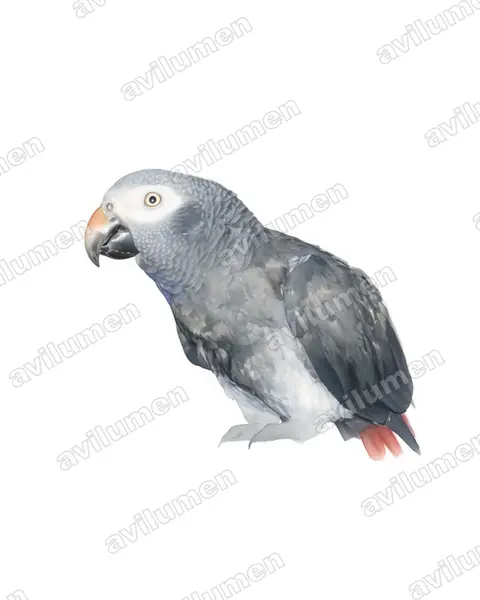
Watercolor 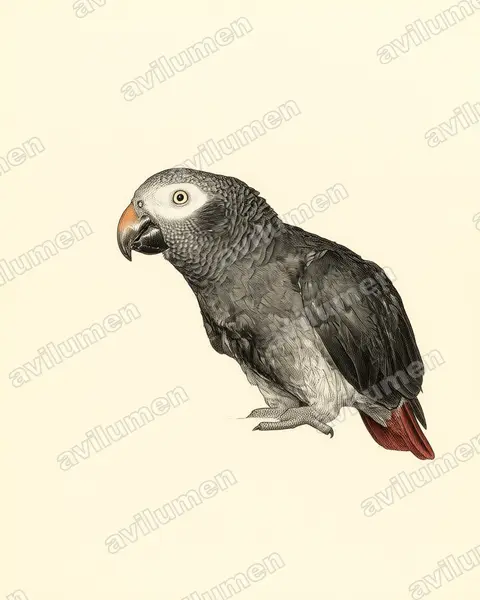
Vintage plate 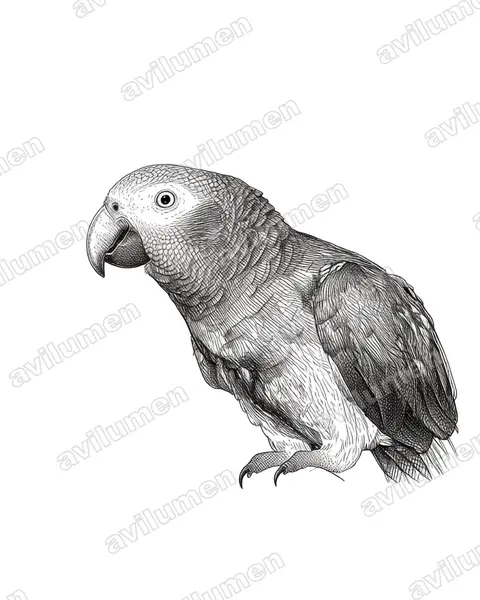
Ink 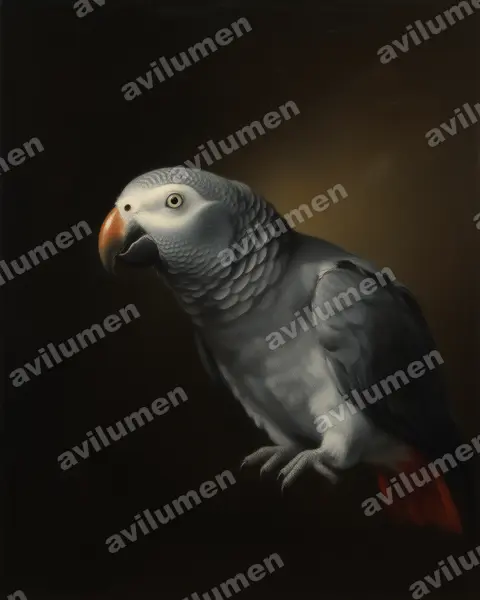
Oil 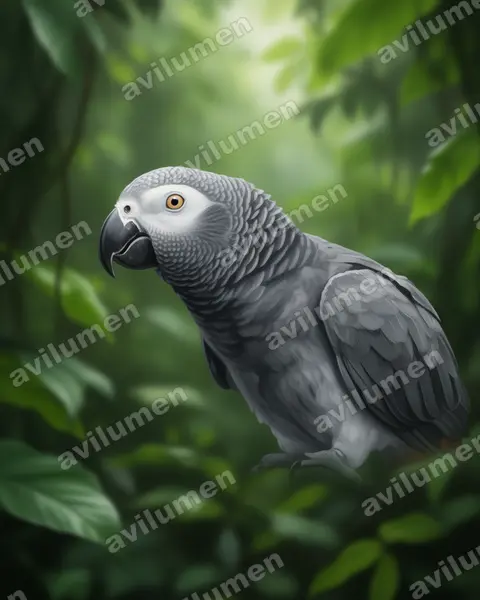
Realistic 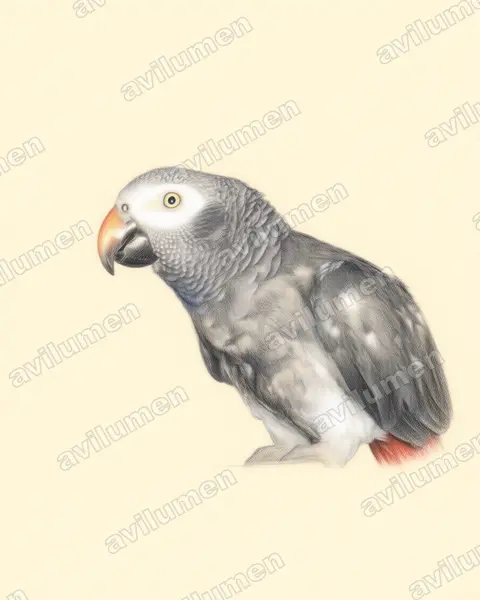
Colored pencil
Illustrations based on the photograph by Diana (CC BY 2.0), from Wikimedia Commons.
Digital editions
HD Digital Art Pack — Timneh parrot
Digital download: 6 high-resolution illustrations of the Timneh parrot (Psittacus timneh), print-ready. This is a digital file; no animal or physical item is included.
AI Avatar — Timneh parrot
Generate an avatar fusing your face with the Timneh parrot (Psittacus timneh). Delivered digitally in 8K, watermark-free. Digital product; no animals are sold or brokered.
Instant download. No live birds are sold.
Frequently asked questions
- Is Psittacus timneh (Timneh parrot) endangered?
- The IUCN Red List places Psittacus timneh, commonly known as the Timneh parrot, in the «Endangered» category. «Endangered» means it faces a very high risk of disappearing in the wild.
- Where does Psittacus timneh (Timneh parrot) live?
- Psittacus timneh (Timneh parrot) is found in Africa.
- What family does Psittacus timneh (Timneh parrot) belong to?
- Psittacus timneh (Timneh parrot) belongs to the family Psittacidae, in the order Psittaciformes.
- What colour is Psittacus timneh (Timneh parrot)?
- The plumage of Psittacus timneh (Timneh parrot) combines these colours: Grey.
More from the same family
 Near threatened
Yellow-faced Parrot
Alipiopsitta xanthops
The yellow-faced parrot, formerly also known as the yellow-faced amazon, is the only species of the genus Alipiopsitta. It is a Neotropical parrot, and was classified in the genus Amazona for many years. It is a predominantly green and yellow-plumaged bird with a yellow head. It is a semi-nomadic species found in the cerrado region of Brazil and adjacent Bolivia.
from $1.99
 Least concern
Moluccan King Parrot
Alisterus amboinensis
The Moluccan king parrot is a parrot endemic to Peleng Island, Maluku, and West Papua in Indonesia. It is sometimes referred to as the Ambon king parrot or Amboina king parrot, but this is potentially misleading, as it is found on numerous other islands than Ambon. The male and female are similar in appearance, with a predominantly red head and underparts, green wings, and blue back and tail.
from $1.99
 Least concern
Papuan King Parrot
Alisterus chloropterus
The Papuan king parrot, also known as the green-winged king parrot, is a species of parrot in the family Psittaculidae found in New Guinea. Its natural habitats are subtropical or tropical moist lowland forest and subtropical or tropical moist montane forest.
from $1.99
 Least concern
Australian King Parrot
Alisterus scapularis
The Australian king parrot is a species of parrot endemic to eastern Australia ranging from Cooktown in Queensland to Port Campbell in Victoria. Found in humid and heavily forested upland regions of the eastern portion of the continent, including eucalyptus wooded areas in and directly adjacent to subtropical and temperate rainforest. They feed on fruits and seeds gathered from trees or on the ground.
from $1.99