Crimson seedcracker
Pyrenestes sanguineus
Avilumen editorial team ·

The crimson seedcracker is a common species of estrildid finch found in Africa. It has an estimated global extent of occurrence of 834,000 km2 (322,000 mi2). It is found in Burkina Faso, Côte d'Ivoire, Gambia, Guinea, Guinea-Bissau, Liberia, Mali, Senegal and Sierra Leone. The International Union for Conservation of Nature has classified the species as being of least concern.
The crimson seedcracker (Pyrenestes sanguineus) is a common species of estrildid finch found in Africa. It has an estimated global extent of occurrence of 834,000 km2 (322,000 mi2). It is found in Burkina Faso, Côte d'Ivoire, Gambia, Guinea, Guinea-Bissau, Liberia, Mali, Senegal and Sierra Leone. The International Union for Conservation of Nature has classified the species as being of least concern.
Description
The crimson seedcracker grows to a length of about 14 cm (5.5 in). It is a plump bird with a domed head and a broad, sharply-pointed bill. The plumage on the upper parts is dark brown or brownish-black while the head, sides of neck, face, chin, throat, breast and flanks are glossy crimson-red. The outer tail feathers are brown, and the rump and the central pair of tail feathers are crimson. The underparts are dark brown, the bill is steel blue, the eye is brown, the eyelids white and the legs are brown or olive-brown. The sexes are similar except that the upper parts of the female are a paler shade of brown.
Distribution and habitat
The crimson seedcracker is native to tropical West Africa, where its range extends from Senegal and Gambia to southern Mali and Ivory Coast. It occurs in dense undergrowth in freshwater swamps, marshes, besides tidal creeks and rice paddies, and in bushy habitats near rivers and streams.
Behaviour
The crimson seedcracker has a broad, strong bill and feeds on grass, sedge and rice seeds, especially seeds that are hard to break open. It forages through the undergrowth, but can sometimes be observed feeding on the ground in the open in the vicinity of scrub, in pairs or in the company of bluebills or other small birds. When it takes to the wing, it rises with a series of twists, before setting off with an undulating flight, similar to that of a sparrow. Breeding takes place in September. The crimson seedcracker exhibits polymorphism, there being two morphs, large-billed individuals and small-billed ones. These morphs are unrelated to sex, body size, age or geographical origin, but are associated with differences in diet, with the larger-billed morphs able to tackle larger and harder seeds such as those of the nutrushes; it is hypothesized that a mutation in a single gene had a large effect on the morphology of individuals.
Status
The crimson seedcracker is a non-migratory species and has a wide range in West Africa. It is a shy and unobtrusive bird so may easily be overlooked, but the population seems stable and the International Union for Conservation of Nature has assessed its conservation status as being of "least concern".
Text adapted from Wikipedia · CC BY-SA 4.0
Where it lives
Taxonomy
- Order
- Passeriformes
- Family
- Estrildidae
- Genus
- Pyrenestes
- Conservation status
- Least concern
Listen to its call
No recording yet
Care guide
Canary and Finch Care Guide: Diet, Housing and Breeding
How to care for canaries, zebra finches, Gouldian finches and other finches: diet, flight cage setup, health, song and breeding. A guide for bird keepers.
Read the guide →Illustration gallery
6 illustrations of Pyrenestes sanguineus (Crimson seedcracker) in different styles, true to its real plumage. Shown watermarked; the art pack includes the high-resolution originals, ready to print.
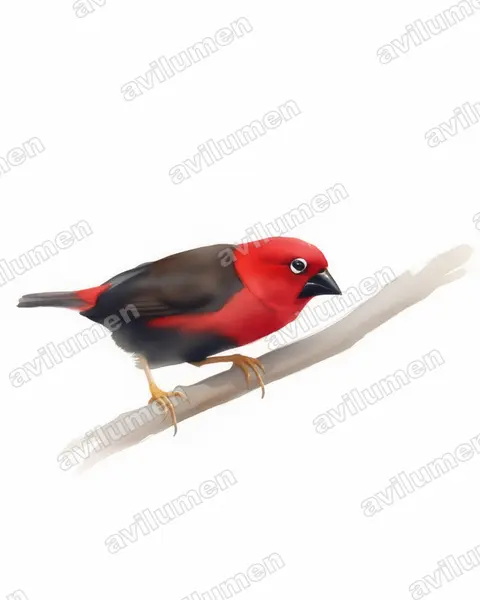
Watercolor 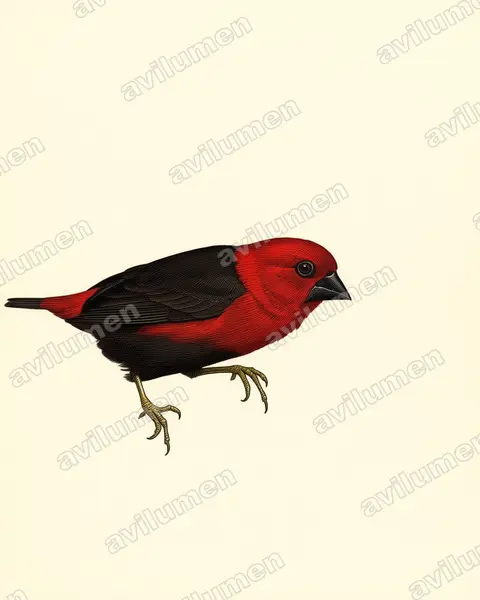
Vintage plate 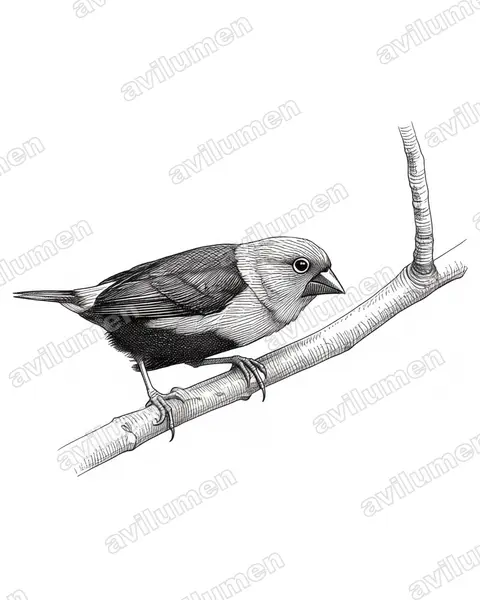
Ink 
Oil 
Realistic 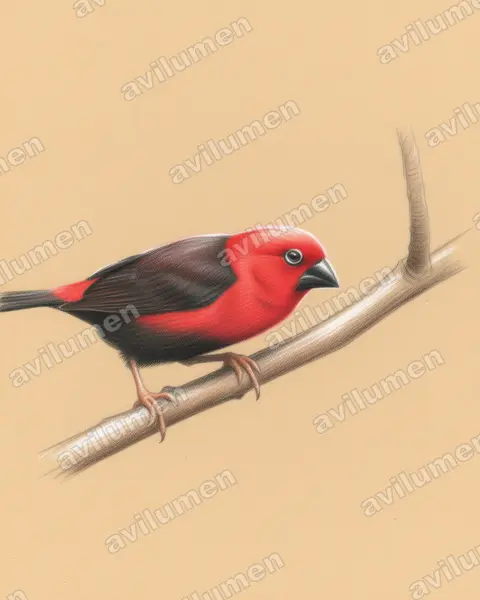
Colored pencil
Illustrations based on the photograph by Oiseaux orca&cie (CC BY-SA 4.0), from Wikimedia Commons.
Digital editions
HD Digital Art Pack — Crimson seedcracker
Digital download: 6 high-resolution illustrations of the Crimson seedcracker (Pyrenestes sanguineus), print-ready. This is a digital file; no animal or physical item is included.
AI Avatar — Crimson seedcracker
Generate an avatar fusing your face with the Crimson seedcracker (Pyrenestes sanguineus). Delivered digitally in 8K, watermark-free. Digital product; no animals are sold or brokered.
Instant download. No live birds are sold.
Frequently asked questions
- Is Pyrenestes sanguineus (Crimson seedcracker) endangered?
- The IUCN Red List places Pyrenestes sanguineus, commonly known as the Crimson seedcracker, in the «Least concern» category. «Least concern» means it is not currently threatened.
- Where does Pyrenestes sanguineus (Crimson seedcracker) live?
- Pyrenestes sanguineus (Crimson seedcracker) is found in Africa and Burkina Faso.
- What family does Pyrenestes sanguineus (Crimson seedcracker) belong to?
- Pyrenestes sanguineus (Crimson seedcracker) belongs to the family Estrildidae, in the order Passeriformes.
- What colour is Pyrenestes sanguineus (Crimson seedcracker)?
- The plumage of Pyrenestes sanguineus (Crimson seedcracker) combines these colours: Red and Black.
More from the same family
 Least concern
Red-headed finch
Amadina erythrocephala
The red-headed finch is a common species of estrildid finch found in Africa. It has an estimated global extent of occurrence of 1,600,000 km2 (620,000 sq mi). It is found in Angola, Botswana, Lesotho, Namibia, South Africa and Zimbabwe.
from $1.99
 Least concern
Cut-throat finch
Amadina fasciata
The cut-throat finch is a common species of estrildid finch found throughout Africa; it is also known as the bearded finch, the ribbon finch, the cut throat, and the weaver finch.
from $1.99
 Least concern
Red avadavat
Amandava amandava
The red avadavat, red munia or strawberry finch, is a sparrow-sized bird of the family Estrildidae. It is found in the open fields and grasslands of tropical Asia and is popular as a cage bird due to the colourful plumage of the males in their breeding season. It breeds in the Indian subcontinent in the monsoon season.
from $1.99
 Vulnerable
Green avadavat
Amandava formosa
The green avadavat or green munia is a species of Estrildid finch with green and yellow on the body, a bright red bill and black "zebra stripes" on the flanks. They are endemic to the Indian subcontinent and were formerly popular as cagebirds. The name "avadavat" is a corruption of the name the city of Ahmedabad in Gujarat, India, which was a centre of bird trade.
from $1.99