Green-cheeked Parakeet
Pyrrhura molinae
Avilumen editorial team ·

The green-cheeked parakeet, also sometimes known as the green-cheeked conure in aviculture, is a species of bird in subfamily Arinae of the family Psittacidae, aka the parrots. It is found in Argentina, Bolivia, Brazil, and Paraguay. It is also a popular pet bird.
The green-cheeked parakeet (Pyrrhura molinae), also sometimes known as the green-cheeked conure in aviculture, is a species of bird in subfamily Arinae of the family Psittacidae, aka the parrots. It is found in Argentina, Bolivia, Brazil, and Paraguay. It is also a popular pet bird.
Taxonomy and systematics
The green-cheeked parakeet has six subspecies:
P. m. flavoptera Maijer, Herzog, Kessler, Friggens & Fjeldsa, 1998
P. m. molinae (Massena & Souance, 1854)
P. m. phoenicura (Schlegel, 1864)
P. m. hypoxantha (Salvadori 1899)
P. m. restricta Todd, 1947
P. m. australis Todd, 1915
Subspecies P. m. hypoxantha was previously known as P. m. sordida and was sometimes treated as a separate species. However, by the principle of priority the older name hypoxantha replaced sordida. The green-cheeked parakeet has also been treated as conspecific with the maroon-bellied parakeet (P. frontalis).
The green-cheeked parakeet is most closely related to the maroon-bellied, pearly (P. lepida), and crimson-bellied (P. perlata) parakeets.
Description
The green-cheeked parakeet is 25 to 26 cm (9.8 to 10 in) long and weighs 62 to 81 g (2.2 to 2.9 oz). The sexes are the same sizes. Adults of the nominate subspecies P. m. molinae are dull brown from forehead to nape and have green cheeks, ashy brown ear coverts, and a creamy white ring of bare skin around the eye. Their upperparts are green. Their chin, throat, and the sides of their neck are a scaly brown and whitish. Their belly is dull reddish and their lower flanks and vent area are green. Their wing is mostly green, with bluish flight feathers. Their tail is dull reddish. Immatures are similar to adults but without the red belly.
Subspecies P. m. phoenicura is green on the upper surface of its tail's base. P. m. restricta has a blue collar, a blue tinge on its cheeks, and a smaller red belly patch than the nominate. P. m. hypoxantha has a paler crown and less distinct scaling on the breast than the nominate. P. m. australis is paler than the nominate and has a larger red belly patch. P. m. flavoptera is orange to red at the bend of the wing and on the carpal edge and is otherwise like the nominate.
A small number of individuals of P. m. hypoxantha have mostly yellow underparts.
Distribution and habitat
The subspecies of the green-cheeked parakeet are found thus:
P. m. flavoptera, west-central Bolivia in southeastern La Paz and northwestern Cochabamba departments
P. m. molinae, Bolivia between La Paz and Chuquisaca departments
P. m. phoenicura, northeastern Santa Cruz Department in northeastern Bolivia and southwestern Mato Grosso in Brazil
P. m. hypoxantha, eastern Santa Cruz Department in extreme eastern Bolivia, western Mato Grosso do Sul in southwestern Brazil, and northern Paraguay
P. m. restricta, central Santa Cruz Department in east-central Bolivia
P. m. australis, from southern Bolivia's Tarija Department into northwestern Argentina as far as Tucumán Province
The green-cheeked parakeet inhabits lowland woodlands and forest (chiefly deciduous), secondary forest, and gallery forest in the lower elevations of the Pantanal and humid subtropical forest as high as 2,000 m (6,600 ft).
Movement
The populations of green-cheeked parakeet breeding in higher elevations move to lower ones in winter.
Feeding
The green-cheeked parakeet has a varied diet that, in the wild, consists of fruits, seeds, flowers and, to a lesser extent, nectar and leaves.
Breeding
The green-cheeked parakeet's breeding season in Argentina includes February, but its season elsewhere has not been defined. It nests in tree cavities. In captivity the clutch size is four to six eggs, the incubation period is 22 to 25 days, both sexes incubate the clutch, and fledging occurs about seven weeks after hatch.
Vocalization
The green-cheeked parakeet's flight calls "comprise rather high-pitched notes with a grating quality and usually given in fast series, e.g. "krree krree krree", but also single "kuree" notes." From a perch it "utters high-pitched, more melodious notes, such as a bisyllabic "rrekeet" or "keew"." However, perched birds are often silent. Flocks in flight "call frequently and simultaneously, producing a noisy, harsh and piercing chattering."
Status
The IUCN has assessed the green-cheeked parakeet as being of Least Concern. It has a fairly large range but its population size is not known and is believed to be decreasing. No immediate threats have been identified. It is considered common in much of its range.
In aviculture
Green-cheeked parakeets are common in aviculture and are popular companion parrots. They are playful, affectionate and intelligent, known as having a "big personality in a small body". They can learn to talk, albeit with a limited vocabulary and a gravelly voice. They like to be held (although some like it more than others) and can learn tricks such as lying on their backs, "kissing", shaking, hanging upside down, minor tool use, and even can be potty trained. Green-cheeked parrots are not very loud at most times, so even an apartment dweller can enjoy their companionship. They are the quietest of the conures and can learn tricks and have a limited vocabulary, with extensive training. They can be prone to biting, particularly when young, but an owner can cure this behavior with patience and time.
When cared for properly, captive green-cheeked parakeets can live 25–30 years. However, their average lifespan in captivity is closer to 10 years, due to frequent neglect and/or an incorrect diet.
Color variations
In addition to the natural color forms, color varieties have been selectively bred in aviculture:
Cinnamon are lime green and have a lighter, paler coloring. The head is tan and the tail feathers are a lighter maroon compared to normal green-cheeked parakeets.
Yellow-sided have bright-colored breasts that graduate from red to yellow and dark gray heads. Rarely, they also possess a bright yellow feather on each side of the upper wing. This is a rare recessive character of which only one hatchling in approximately 10 clutches can be found to have. This feature often increases their value.
Pineapple are a combination of the cinnamon and yellow-sided variations. They have a breast of bright colors, a tan head and lime green feathers on the back like a cinnamon green-cheeked parrot. The tail feathers are the same as a yellow-sided, providing a halo effect.
Turquoise have a body with some blue-green and green feathers. The end of the wing feathers have a highly iridescent quality if left unclipped. The breast feathers are grayish and the tail feathers are gray.
Green/red/blue apple varieties are less common, but have been seen.
Text adapted from Wikipedia · CC BY-SA 4.0
Where it lives
Distribution

Taxonomy
- Order
- Psittaciformes
- Family
- Psittacidae
- Genus
- Pyrrhura
- Conservation status
- Least concern
Listen to its call
No recording yet
Care guide
Budgie, Conure and Parakeet Care Guide
How to care for budgies, conures, parrotlets, ringnecks and other parakeets: diet, cage setup, health, behavior, breeding and legal status for owners.
Read the guide →Illustration gallery
6 illustrations of Pyrrhura molinae (Green-cheeked Parakeet) in different styles, true to its real plumage. Shown watermarked; the art pack includes the high-resolution originals, ready to print.
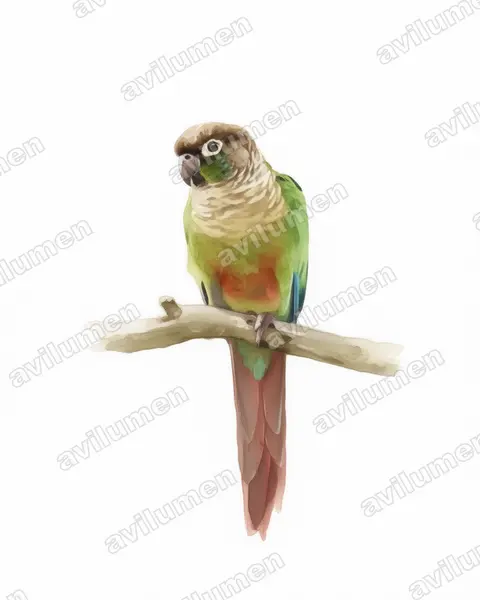
Watercolor 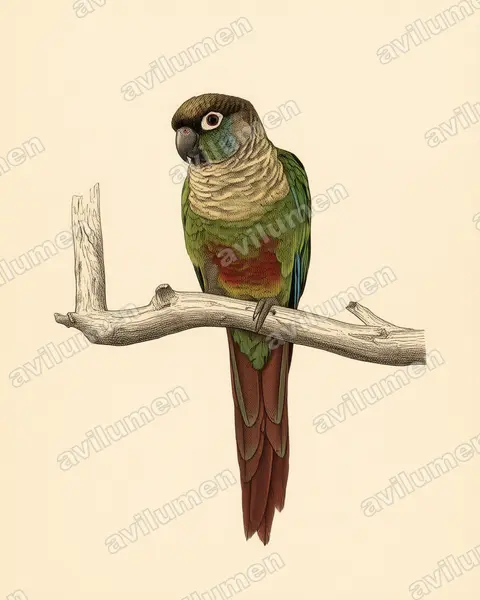
Vintage plate 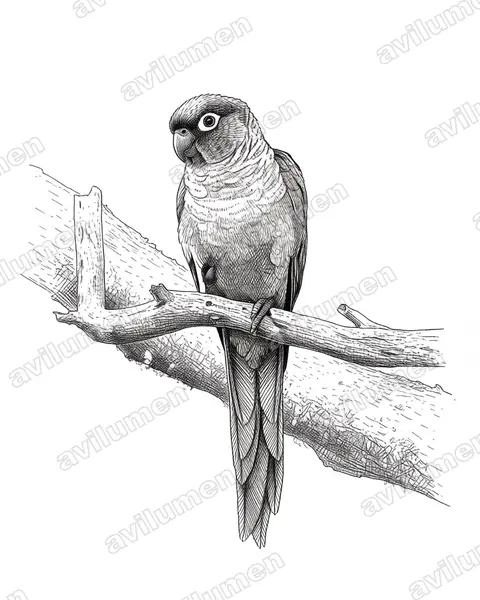
Ink 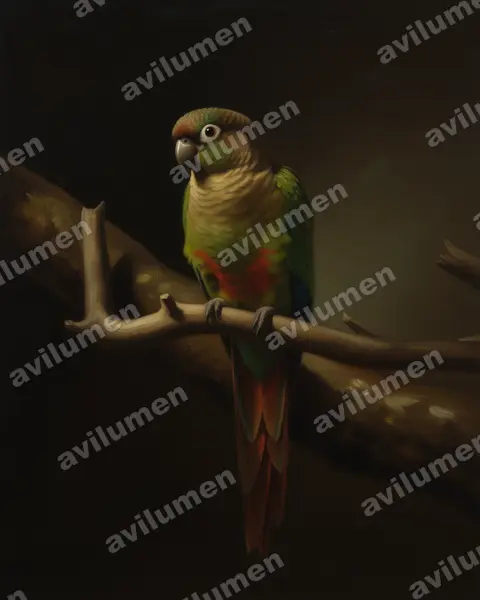
Oil 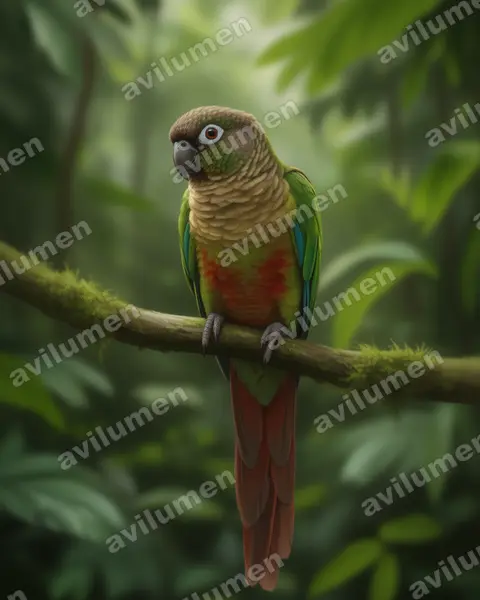
Realistic 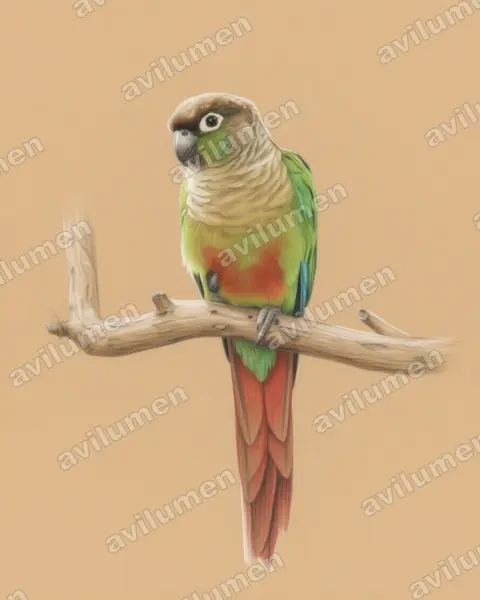
Colored pencil
Illustrations based on the photograph by jeanpaulboerekamps (CC0), from Wikimedia Commons.
Digital editions
HD Digital Art Pack — Green-cheeked Parakeet
Digital download: 6 high-resolution illustrations of the Green-cheeked Parakeet (Pyrrhura molinae), print-ready. This is a digital file; no animal or physical item is included.
AI Avatar — Green-cheeked Parakeet
Generate an avatar fusing your face with the Green-cheeked Parakeet (Pyrrhura molinae). Delivered digitally in 8K, watermark-free. Digital product; no animals are sold or brokered.
Instant download. No live birds are sold.
Frequently asked questions
- Is Pyrrhura molinae (Green-cheeked Parakeet) endangered?
- The IUCN Red List places Pyrrhura molinae, commonly known as the Green-cheeked Parakeet, in the «Least concern» category. «Least concern» means it is not currently threatened.
- Where does Pyrrhura molinae (Green-cheeked Parakeet) live?
- Pyrrhura molinae (Green-cheeked Parakeet) is found in Brazil and South America.
- What family does Pyrrhura molinae (Green-cheeked Parakeet) belong to?
- Pyrrhura molinae (Green-cheeked Parakeet) belongs to the family Psittacidae, in the order Psittaciformes.
- What colour is Pyrrhura molinae (Green-cheeked Parakeet)?
- The plumage of Pyrrhura molinae (Green-cheeked Parakeet) combines these colours: Green and Red.
More from the same family
 Near threatened
Yellow-faced Parrot
Alipiopsitta xanthops
The yellow-faced parrot, formerly also known as the yellow-faced amazon, is the only species of the genus Alipiopsitta. It is a Neotropical parrot, and was classified in the genus Amazona for many years. It is a predominantly green and yellow-plumaged bird with a yellow head. It is a semi-nomadic species found in the cerrado region of Brazil and adjacent Bolivia.
from $1.99
 Least concern
Moluccan King Parrot
Alisterus amboinensis
The Moluccan king parrot is a parrot endemic to Peleng Island, Maluku, and West Papua in Indonesia. It is sometimes referred to as the Ambon king parrot or Amboina king parrot, but this is potentially misleading, as it is found on numerous other islands than Ambon. The male and female are similar in appearance, with a predominantly red head and underparts, green wings, and blue back and tail.
from $1.99
 Least concern
Papuan King Parrot
Alisterus chloropterus
The Papuan king parrot, also known as the green-winged king parrot, is a species of parrot in the family Psittaculidae found in New Guinea. Its natural habitats are subtropical or tropical moist lowland forest and subtropical or tropical moist montane forest.
from $1.99
 Least concern
Australian King Parrot
Alisterus scapularis
The Australian king parrot is a species of parrot endemic to eastern Australia ranging from Cooktown in Queensland to Port Campbell in Victoria. Found in humid and heavily forested upland regions of the eastern portion of the continent, including eucalyptus wooded areas in and directly adjacent to subtropical and temperate rainforest. They feed on fruits and seeds gathered from trees or on the ground.
from $1.99