Crimson-bellied Parakeet
Pyrrhura perlata
Avilumen editorial team ·

The crimson-bellied parakeet, known as the crimson-bellied conure in aviculture, is a species of bird in subfamily Arinae of the family Psittacidae, the African and New World parrots. It is found in Bolivia and Brazil.
The crimson-bellied parakeet (Pyrrhura perlata), known as the crimson-bellied conure in aviculture, is a species of bird in subfamily Arinae of the family Psittacidae, the African and New World parrots. It is found in Bolivia and Brazil.
Taxonomy and systematics
The crimson-bellied parakeet's taxonomic history is potentially confusing. It has been assigned to several genera since its original description. Since the mid-1800s it was known as Pyrrhura rhodogaster, but following a 1983 review it was discovered that the type specimen for P. perlata, long believed to belong to the closely related pearly parakeet, actually was a juvenile crimson-bellied parakeet. Consequently, P. perlata was transferred to this species, while P. rhodogaster became a junior synonym under the principle of priority.
The crimson-bellied parakeet is monotypic.
Description
The crimson-bellied parakeet is 24 to 25 cm (9.4 to 9.8 in) long and weighs 76 to 91 g (2.7 to 3.2 oz). The sexes are the same. Adults have a dark grayish brown head flecked with pale grayish buff, dark brownish gray ear coverts, a goldish green upper cheeks, and turquoise-blue lower cheeks. Their nape has a narrow blue band. Their upperparts are green with a bluish tinge. Their throat, upper breast, and the sides of their neck are gray to blue with a scaly appearance, and sometimes with pinkish tips to the feathers. The belly and upper flanks are bright red and their lower flanks and vent area are greeish blue. Their wing is mostly green, with black and cobalt blue primaries and red underwing coverts. Their tail's top surface is reddish brown and the lower surface is blackish brown. Their iris is dark brown, their bill blackish, and their legs blackish gray. Immatures are similar to adults but have a mostly green belly.
Distribution and habitat
The crimson-bellied parakeet is found in the Amazon Basin from the Mamoré River in northeastern Bolivia east into Brazil south of the Amazon River in the states of Mato Grosso, Rondônia, Amazonas, and Pará. It mostly inhabits the canopy and edges of humid terra firme forest and secondary forest, and also occurs in drier lowland forest. In elevation it ranges as high as 600 m (2,000 ft).
Movement
The crimson-bellied parakeet is non-migratory.
Feeding
The crimson-bellied parakeet feeds mainly on fruit but also includes flowers in its diet.
Breeding
The crimson-bellied parakeet breeds between August and November, and possibly from April to June. It is assumed to nest in tree cavities like other Pyrrhura parakeets. Their clutch size is four to six eggs. The incubation period is 25 days and fledging occurs seven to eight weeks after hatch.
Vocalization
The crimson-bellied parakeet's call is a "high, rapid "wrr'wur-wir-wir-wir"." It also makes "a strange, slightly toy-trumpet-like "peeéh"."
Status
The IUCN originally assessed the crimson-bellied parakeet as being of Least Concern, then in 2012 as Vulnerable, and since 2021 again as of Least Concern. It has a large range but its population size is not known and is believed to be decreasing. "The primary threat to this species is accelerating deforestation in the Amazon basin as land is cleared for cattle ranching and soy production". It is also affected by hunting. It does occur in about 75,000 km2 (29,000 sq mi) of protected lands within its range of about 1,430,000 km2 (552,000 sq mi).
Text adapted from Wikipedia · CC BY-SA 4.0
Where it lives
Distribution

Taxonomy
- Order
- Psittaciformes
- Family
- Psittacidae
- Genus
- Pyrrhura
- Conservation status
- Least concern
Listen to its call
No recording yet
Care guide
Budgie, Conure and Parakeet Care Guide
How to care for budgies, conures, parrotlets, ringnecks and other parakeets: diet, cage setup, health, behavior, breeding and legal status for owners.
Read the guide →Illustration gallery
6 illustrations of Pyrrhura perlata (Crimson-bellied Parakeet) in different styles, true to its real plumage. Shown watermarked; the art pack includes the high-resolution originals, ready to print.
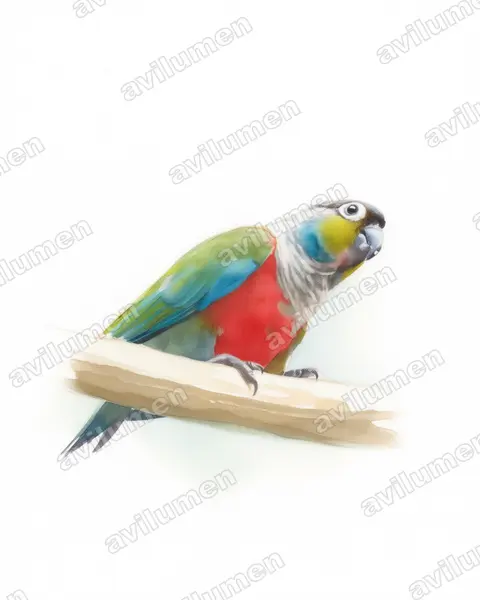
Watercolor 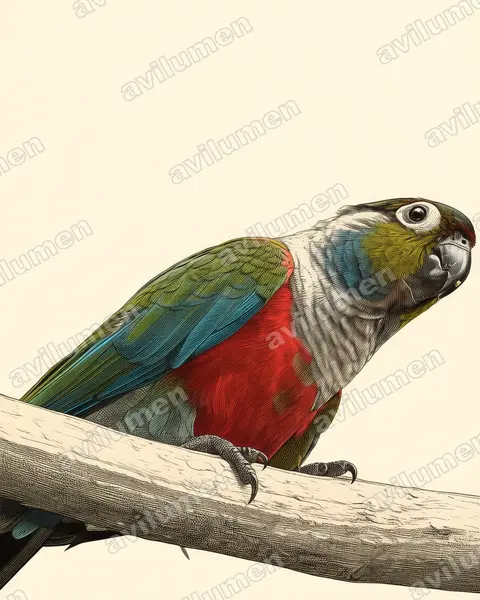
Vintage plate 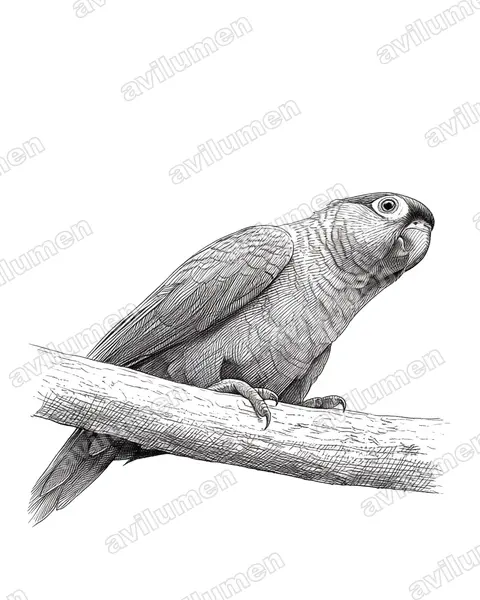
Ink 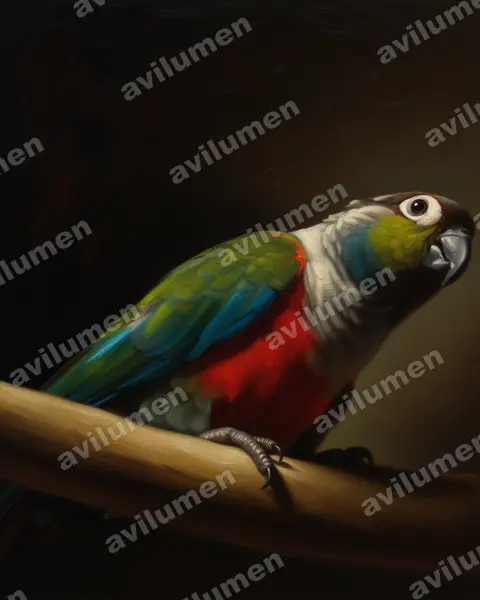
Oil 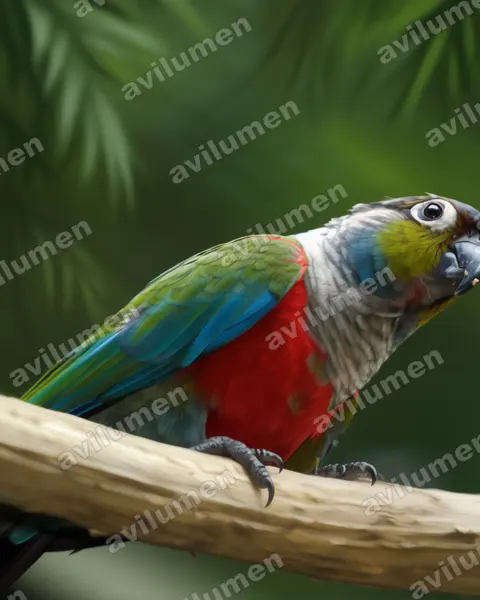
Realistic 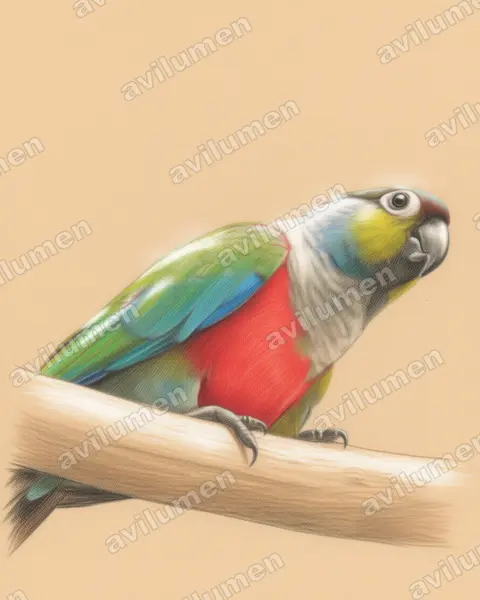
Colored pencil
Illustrations based on the photograph by Pyrrhura_perlata_-captive-8a.jpg: Nori Almeida derivative work: Snowmanradio (talk) (CC BY 2.0), from Wikimedia Commons.
Digital editions
HD Digital Art Pack — Crimson-bellied Parakeet
Digital download: 6 high-resolution illustrations of the Crimson-bellied Parakeet (Pyrrhura perlata), print-ready. This is a digital file; no animal or physical item is included.
AI Avatar — Crimson-bellied Parakeet
Generate an avatar fusing your face with the Crimson-bellied Parakeet (Pyrrhura perlata). Delivered digitally in 8K, watermark-free. Digital product; no animals are sold or brokered.
Instant download. No live birds are sold.
Frequently asked questions
- Is Pyrrhura perlata (Crimson-bellied Parakeet) endangered?
- The IUCN Red List places Pyrrhura perlata, commonly known as the Crimson-bellied Parakeet, in the «Least concern» category. «Least concern» means it is not currently threatened.
- Where does Pyrrhura perlata (Crimson-bellied Parakeet) live?
- Pyrrhura perlata (Crimson-bellied Parakeet) is found in Brazil and South America.
- What family does Pyrrhura perlata (Crimson-bellied Parakeet) belong to?
- Pyrrhura perlata (Crimson-bellied Parakeet) belongs to the family Psittacidae, in the order Psittaciformes.
- What colour is Pyrrhura perlata (Crimson-bellied Parakeet)?
- The plumage of Pyrrhura perlata (Crimson-bellied Parakeet) combines these colours: Green and Red.
More from the same family
 Near threatened
Yellow-faced Parrot
Alipiopsitta xanthops
The yellow-faced parrot, formerly also known as the yellow-faced amazon, is the only species of the genus Alipiopsitta. It is a Neotropical parrot, and was classified in the genus Amazona for many years. It is a predominantly green and yellow-plumaged bird with a yellow head. It is a semi-nomadic species found in the cerrado region of Brazil and adjacent Bolivia.
from $1.99
 Least concern
Moluccan King Parrot
Alisterus amboinensis
The Moluccan king parrot is a parrot endemic to Peleng Island, Maluku, and West Papua in Indonesia. It is sometimes referred to as the Ambon king parrot or Amboina king parrot, but this is potentially misleading, as it is found on numerous other islands than Ambon. The male and female are similar in appearance, with a predominantly red head and underparts, green wings, and blue back and tail.
from $1.99
 Least concern
Papuan King Parrot
Alisterus chloropterus
The Papuan king parrot, also known as the green-winged king parrot, is a species of parrot in the family Psittaculidae found in New Guinea. Its natural habitats are subtropical or tropical moist lowland forest and subtropical or tropical moist montane forest.
from $1.99
 Least concern
Australian King Parrot
Alisterus scapularis
The Australian king parrot is a species of parrot endemic to eastern Australia ranging from Cooktown in Queensland to Port Campbell in Victoria. Found in humid and heavily forested upland regions of the eastern portion of the continent, including eucalyptus wooded areas in and directly adjacent to subtropical and temperate rainforest. They feed on fruits and seeds gathered from trees or on the ground.
from $1.99