Sunda zebra finch
Taeniopygia guttata
Avilumen editorial team ·

The Sunda zebra finch is a species of bird in the family Estrildidae. It is found in the Lesser Sundas. For almost two centuries, its closest relative from Australia was generally included in T.guttata as a subspecies; since the 2020s it is generally considered a separate species Taeniopygia castanotis.
The Sunda zebra finch (Taeniopygia guttata) is a species of bird in the family Estrildidae. It is found in the Lesser Sundas. For almost two centuries, its closest relative from Australia was generally included in T.guttata as a subspecies; since the 2020s it is generally considered a separate species Taeniopygia castanotis.
Most pre-2020 literature referencing "T.guttata" actually refers to the birds now known as T.castanotis – in particular physiological, neurological and behavioral studies generally used "T.guttata" for the Australian species, because T.guttata sensu stricto was never kept in captivity in significant numbers, and thus was unavailable for such research.
Species identification
Differences between the two zebrafinches are slight. Purebred adult males, however, can immediately distinguished by the grey throat of T.guttata, while that region is barred black-and-white in T.castanotis. These namesake "zebra" markings are limited to a barely visible patch on the sides of the lower neck in T.guttata. In direct comparison, the Sunda species has a slight brownish hue on the top of the head and the underside.
More importantly, during their courtship rituals, the Sunda species' males adopt a more upright pose than the Australian ones, and while the latter fluff up the feathers at the back of the head, the Sunda males fluff the forehead feathers instead. These slight differences seem to be sufficient to ensure assortative mating even in mixed flocks in captivity: individuals of the two zebrafinch species will only mate with each other if no conspecific partners are available.
Parasites
T. guttata sometimes serves as a model organism. Study of the immune response of T. guttata to parasites is informative for avians as a class. Its transcriptome responses to infection have been studied by Watson et al., 2017 and Scalf et al., 2019. T. guttata is not known to have ever been infected with any Plasmodium. Valkiūnas et al., 2018 find T. guttata seems totally resistant to the malaria parasite that is most common among avians, Plasmodium relictum.
Vocalization
Only male zebra finches sing. Each finch has an individual song. Between the ages of 25 and 90 days old, young zebra finches learn to sing by copying the songs of adults, and sometimes by copying the songs of other juveniles.
Text adapted from Wikipedia · CC BY-SA 4.0
Taxonomy
- Order
- Passeriformes
- Family
- Estrildidae
- Genus
- Taeniopygia
- Conservation status
- Least concern
Listen to its call
No recording yet
Care guide
Canary and Finch Care Guide: Diet, Housing and Breeding
How to care for canaries, zebra finches, Gouldian finches and other finches: diet, flight cage setup, health, song and breeding. A guide for bird keepers.
Read the guide →Illustration gallery
6 illustrations of Taeniopygia guttata (Sunda zebra finch) in different styles, true to its real plumage. Shown watermarked; the art pack includes the high-resolution originals, ready to print.
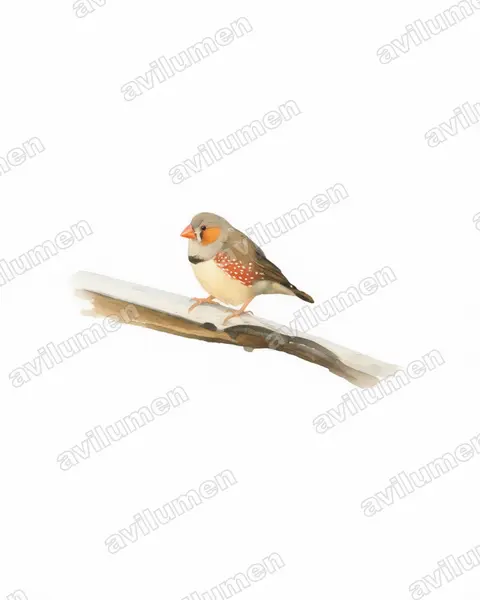
Watercolor 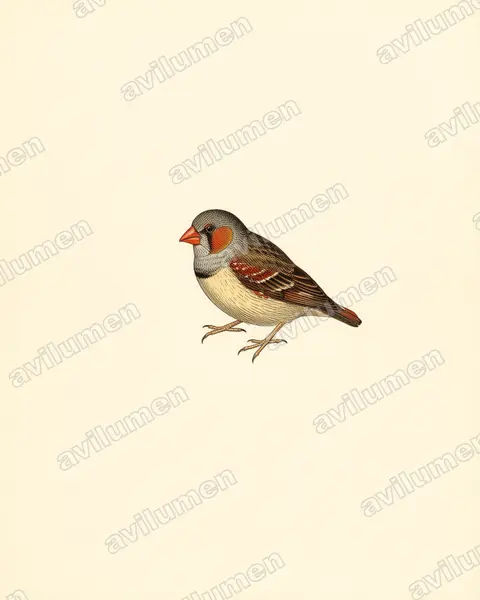
Vintage plate 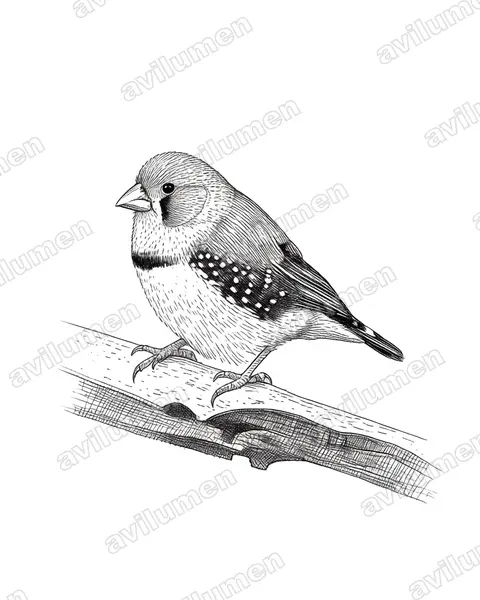
Ink 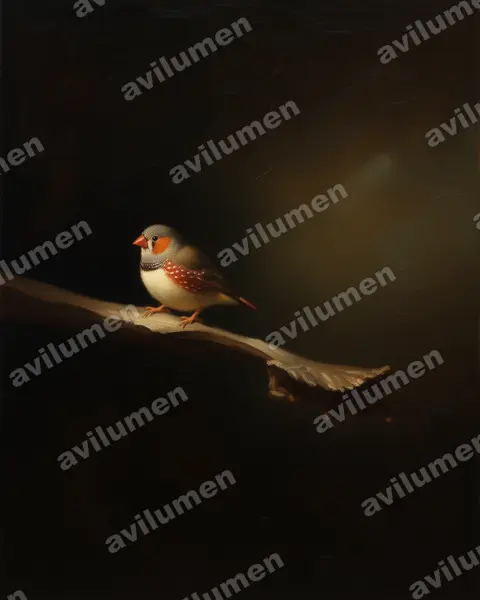
Oil 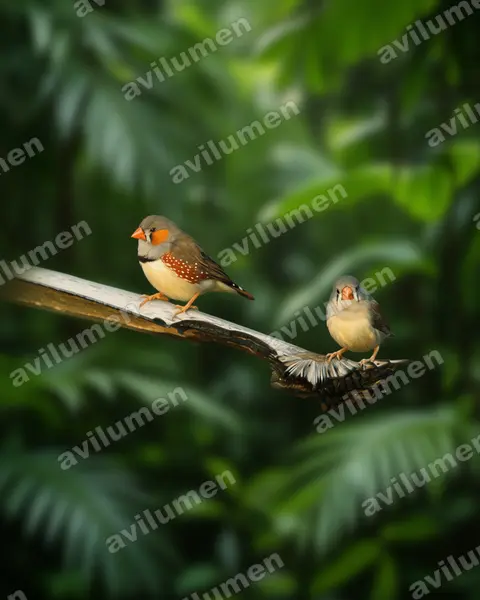
Realistic 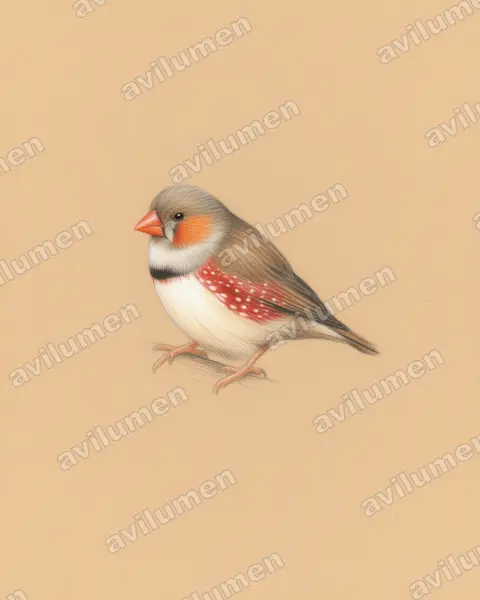
Colored pencil
Illustrations based on the photograph by christoph_moning (CC BY 4.0), from Wikimedia Commons.
Digital editions
HD Digital Art Pack — Sunda zebra finch
Digital download: 6 high-resolution illustrations of the Sunda zebra finch (Taeniopygia guttata), print-ready. This is a digital file; no animal or physical item is included.
AI Avatar — Sunda zebra finch
Generate an avatar fusing your face with the Sunda zebra finch (Taeniopygia guttata). Delivered digitally in 8K, watermark-free. Digital product; no animals are sold or brokered.
Instant download. No live birds are sold.
Frequently asked questions
- Is Taeniopygia guttata (Sunda zebra finch) endangered?
- The IUCN Red List places Taeniopygia guttata, commonly known as the Sunda zebra finch, in the «Least concern» category. «Least concern» means it is not currently threatened.
- Where does Taeniopygia guttata (Sunda zebra finch) live?
- Taeniopygia guttata (Sunda zebra finch) is found in Africa and Indonesia.
- What family does Taeniopygia guttata (Sunda zebra finch) belong to?
- Taeniopygia guttata (Sunda zebra finch) belongs to the family Estrildidae, in the order Passeriformes.
- What colour is Taeniopygia guttata (Sunda zebra finch)?
- The plumage of Taeniopygia guttata (Sunda zebra finch) combines these colours: Grey and Brown.
More from the same family
 Least concern
Red-headed finch
Amadina erythrocephala
The red-headed finch is a common species of estrildid finch found in Africa. It has an estimated global extent of occurrence of 1,600,000 km2 (620,000 sq mi). It is found in Angola, Botswana, Lesotho, Namibia, South Africa and Zimbabwe.
from $1.99
 Least concern
Cut-throat finch
Amadina fasciata
The cut-throat finch is a common species of estrildid finch found throughout Africa; it is also known as the bearded finch, the ribbon finch, the cut throat, and the weaver finch.
from $1.99
 Least concern
Red avadavat
Amandava amandava
The red avadavat, red munia or strawberry finch, is a sparrow-sized bird of the family Estrildidae. It is found in the open fields and grasslands of tropical Asia and is popular as a cage bird due to the colourful plumage of the males in their breeding season. It breeds in the Indian subcontinent in the monsoon season.
from $1.99
 Vulnerable
Green avadavat
Amandava formosa
The green avadavat or green munia is a species of Estrildid finch with green and yellow on the body, a bright red bill and black "zebra stripes" on the flanks. They are endemic to the Indian subcontinent and were formerly popular as cagebirds. The name "avadavat" is a corruption of the name the city of Ahmedabad in Gujarat, India, which was a centre of bird trade.
from $1.99