Blue-crowned Parakeet
Thectocercus acuticaudatus
Avilumen editorial team ·

The blue-crowned parakeet, blue-crowned conure, or sharp-tailed conure is a small green Neotropical parrot with a blue head and pale beak native to large parts of South America, from eastern Colombia to Curacao in the southern Caribbean, and to the northern region of Argentina. They inhabit savanna-like habitats, woodland and forest margins, but avoid dense humid forest such as the Amazon.
The blue-crowned parakeet, blue-crowned conure, or sharp-tailed conure (Thectocercus acuticaudatus) is a small green Neotropical parrot with a blue head and pale beak native to large parts of South America, from eastern Colombia to Curacao in the southern Caribbean, and to the northern region of Argentina. They inhabit savanna-like habitats, woodland and forest margins, but avoid dense humid forest such as the Amazon.
This species is officially called a parakeet by the AOU and by birders, though usually called conures in aviculture.
Taxonomy
While T. acuticaudatus is the only species in the monotypic genus Thectocercus, this species has five subspecies:
Thectocercus acuticaudatus (Vieillot 1818)
Thectocercus acuticaudatus acuticaudatus (Vieillot 1818)
Thectocercus acuticaudatus haemorrhous (Spix 1824)
Thectocercus acuticaudatus koenigi (Arndt 1995)
Thectocercus acuticaudatus neoxenus (Cory 1909)
Thectocercus acuticaudatus neumanni (Blake and Traylor 1947)
Previously, this species was part of the genus Aratinga, but that genus was split in four distinct genera once various phylogenetic studies showed that the genus, as traditionally defined, was polyphyletic.
Description
The blue-crowned parakeet is a medium-sized bird measuring approximately 37 cm (14.5 in) in length and weighing between 140 and 190 g (4.9 and 6.7 oz).
Blue-crowns are born with red coloring around the head, but blue-crowns are predominantly green, with dull blue coloring on the forehead, crown, cheeks, and ears in the nominate, but less blue in other subspecies. It has a ring of white featherless skin around each eye, though this is bright orange-yellow in wild T. acuticaudata neumanni. The breast feathers may also be tinged with blue, though they are more commonly green to yellow-green. Closed wing coloring matches that of the body while extended wings show blue-brown, becoming chestnut on the outer flight feathers. The tail feathers are green on top, maroon to red-brown on the underside, iridescing to bright orange and scarlet under full-spectrum light. Legs are pink-brown with grey-brown claws. The upper mandible is horn-colored, tapering to a needle-sharp, grey-black tip. In the southern and western nominate and subspecies neumanni, the lower mandible is horn-colored in juveniles, fading to grey-black by the bird's second year. The remaining eastern, central and northern subspecies retain the horn-colored lower mandible throughout adulthood.
Breeding
The blue-crowned parakeet's nest is a hole in a tree. The eggs are white and there are usually three to four in a clutch. The female incubates the eggs for 26 days, and the chicks fledge from the nest about 52 days after hatching.
Aviculture
Blue-crowned parakeets are generally called blue-crowned conures in aviculture. They are social birds and are relatively good talkers compared to other conures. They have become quite popular as pets, with a reputation as one of the "easier" parrots to care for . However, they are also intelligent, high-energy birds that require a lot of attention and a cage with ample room and toys. They can also be quite loud at times. Consequently, they are more appropriate companions for serious bird enthusiasts rather than the casual birdkeeper.
In fiction
A talking blue-crowned conure was the titular star of the family movie Paulie. In the film, Paulie, the main character was played by 14 different birds.
Text adapted from Wikipedia · CC BY-SA 4.0
Where it lives
Distribution

Taxonomy
- Order
- Psittaciformes
- Family
- Psittacidae
- Genus
- Thectocercus
- Conservation status
- Not evaluated
Listen to its call
No recording yet
Care guide
Budgie, Conure and Parakeet Care Guide
How to care for budgies, conures, parrotlets, ringnecks and other parakeets: diet, cage setup, health, behavior, breeding and legal status for owners.
Read the guide →Illustration gallery
6 illustrations of Thectocercus acuticaudatus (Blue-crowned Parakeet) in different styles, true to its real plumage. Shown watermarked; the art pack includes the high-resolution originals, ready to print.
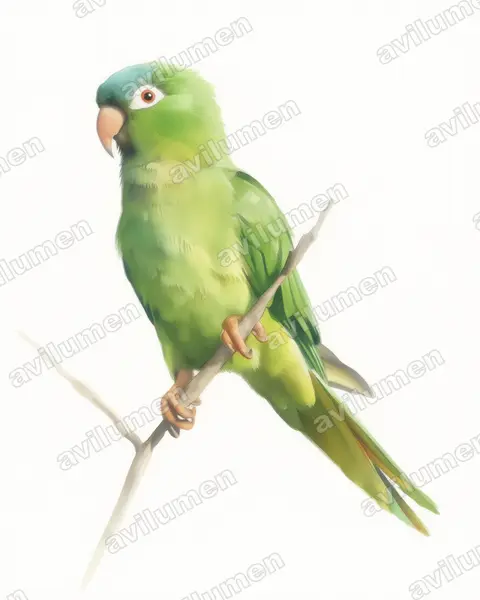
Watercolor 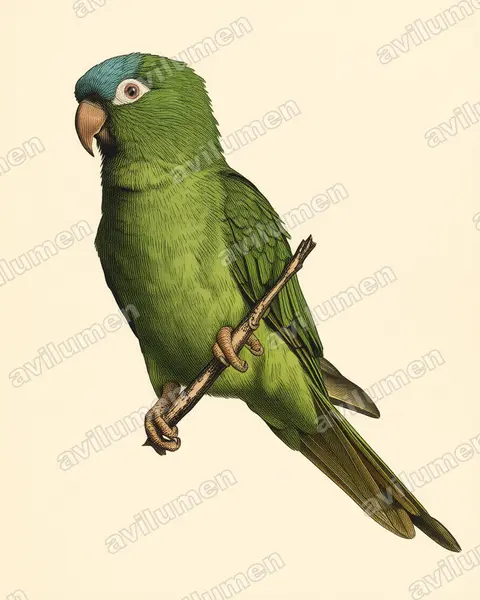
Vintage plate 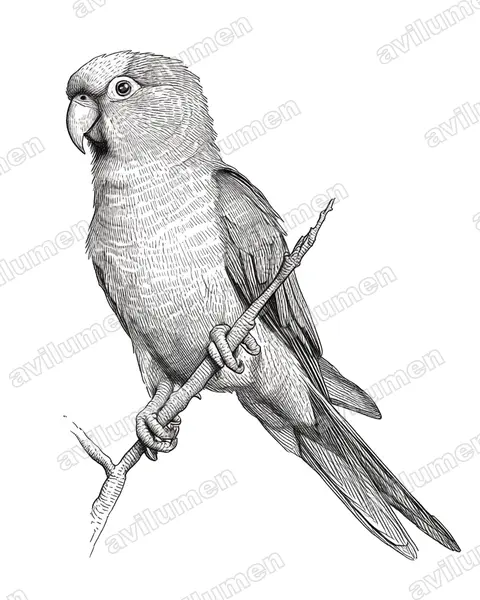
Ink 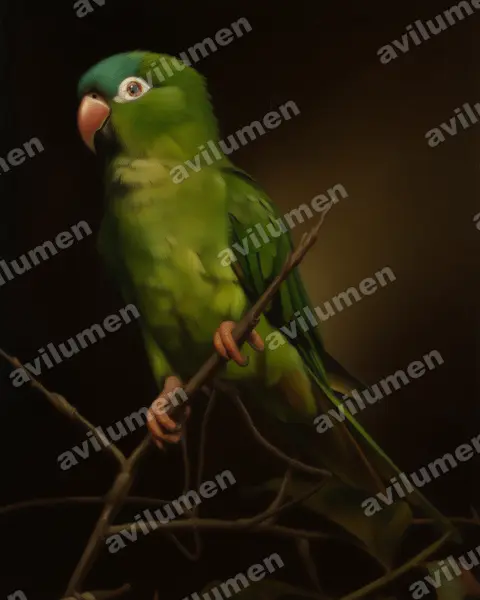
Oil 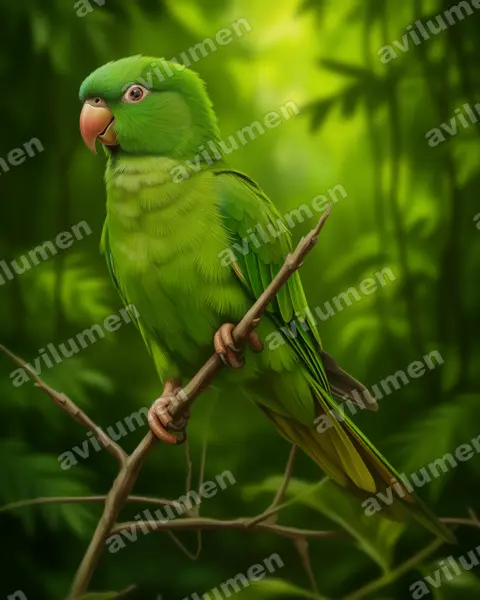
Realistic 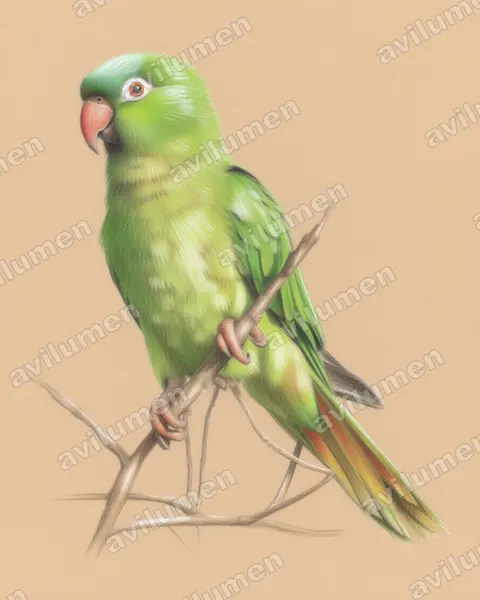
Colored pencil
Illustrations based on the photograph by Bernard DUPONT from FRANCE (CC BY-SA 2.0), from Wikimedia Commons.
Digital editions
HD Digital Art Pack — Blue-crowned Parakeet
Digital download: 6 high-resolution illustrations of the Blue-crowned Parakeet (Thectocercus acuticaudatus), print-ready. This is a digital file; no animal or physical item is included.
AI Avatar — Blue-crowned Parakeet
Generate an avatar fusing your face with the Blue-crowned Parakeet (Thectocercus acuticaudatus). Delivered digitally in 8K, watermark-free. Digital product; no animals are sold or brokered.
Instant download. No live birds are sold.
Frequently asked questions
- Is Thectocercus acuticaudatus (Blue-crowned Parakeet) endangered?
- The IUCN Red List places Thectocercus acuticaudatus, commonly known as the Blue-crowned Parakeet, in the «Not evaluated» category. «Not evaluated» means the IUCN has not yet assessed this species.
- Where does Thectocercus acuticaudatus (Blue-crowned Parakeet) live?
- Thectocercus acuticaudatus (Blue-crowned Parakeet) is found in Brazil and South America.
- What family does Thectocercus acuticaudatus (Blue-crowned Parakeet) belong to?
- Thectocercus acuticaudatus (Blue-crowned Parakeet) belongs to the family Psittacidae, in the order Psittaciformes.
- What colour is Thectocercus acuticaudatus (Blue-crowned Parakeet)?
- The plumage of Thectocercus acuticaudatus (Blue-crowned Parakeet) combines these colours: Green and Blue.
More from the same family
 Near threatened
Yellow-faced Parrot
Alipiopsitta xanthops
The yellow-faced parrot, formerly also known as the yellow-faced amazon, is the only species of the genus Alipiopsitta. It is a Neotropical parrot, and was classified in the genus Amazona for many years. It is a predominantly green and yellow-plumaged bird with a yellow head. It is a semi-nomadic species found in the cerrado region of Brazil and adjacent Bolivia.
from $1.99
 Least concern
Moluccan King Parrot
Alisterus amboinensis
The Moluccan king parrot is a parrot endemic to Peleng Island, Maluku, and West Papua in Indonesia. It is sometimes referred to as the Ambon king parrot or Amboina king parrot, but this is potentially misleading, as it is found on numerous other islands than Ambon. The male and female are similar in appearance, with a predominantly red head and underparts, green wings, and blue back and tail.
from $1.99
 Least concern
Papuan King Parrot
Alisterus chloropterus
The Papuan king parrot, also known as the green-winged king parrot, is a species of parrot in the family Psittaculidae found in New Guinea. Its natural habitats are subtropical or tropical moist lowland forest and subtropical or tropical moist montane forest.
from $1.99
 Least concern
Australian King Parrot
Alisterus scapularis
The Australian king parrot is a species of parrot endemic to eastern Australia ranging from Cooktown in Queensland to Port Campbell in Victoria. Found in humid and heavily forested upland regions of the eastern portion of the continent, including eucalyptus wooded areas in and directly adjacent to subtropical and temperate rainforest. They feed on fruits and seeds gathered from trees or on the ground.
from $1.99