Orange-winged amazon
Amazona amazonica
Avilumen editorial team ·

The orange-winged amazon, also known as orange-winged parrot and loro guaro, is a large amazon parrot. It is a resident breeding bird in tropical South America, from Colombia, Trinidad and Tobago south to Peru, Bolivia and central Brazil. Its habitat is forest and semi-open country. Although common, it is persecuted as an agricultural pest and by capture for the pet trade. It is also hunted as a food source.
The orange-winged amazon (Amazona amazonica), also known as orange-winged parrot and loro guaro, is a large amazon parrot. It is a resident breeding bird in tropical South America, from Colombia, Trinidad and Tobago south to Peru, Bolivia and central Brazil. Its habitat is forest and semi-open country. Although common, it is persecuted as an agricultural pest and by capture for the pet trade (over 66,000 captured from 1981 to 1985). It is also hunted as a food source. Introduced breeding populations have been reported in Puerto Rico and Tenerife in the Canary Islands.
Taxonomy
The orange-winged amazon was formally described in 1766 by the Swedish naturalist Carl Linnaeus in the twelfth edition of his Systema Naturae He placed it with all the other parrots in the genus Psittacus and coined the binomial name Psittacus amazonicus. Linnaeus cited the 1760 description by the French zoologist Mathurin Jacques Brisson. Brisson used the French name "Le Perroquet Amazone" and the Latin name later used by Linnaeus, Psittacus amazonicus. Although Brisson coined Latin names, these do not conform to the binomial system and are not recognised by the International Commission on Zoological Nomenclature. The orange-winged amazon is now one of around 30 species placed in the genus Amazona that was introduced by the French naturalist René Lesson in 1830. The species is considered to be monotypic: no subspecies are recognised.
Description
The orange-winged amazon is a mainly green parrot about 33 cm (13 in) long and weighing about 340 g. It has blue and yellow feathers on its head which varies in extent between individuals. The upper mandible is partly horn colored (gray) and partly dark-gray. It has orange feathers in the wings and tail, which can be seen when in flight. The male and female are identical in external appearance.
Diet and feeding
The orange-winged amazons are noisy birds and makes loud, high-pitched screams. It eats fruit, seeds, nuts, blossoms, leaf buds, and berries, including the fruit of palm trees and sometimes cocoa, mangoes, and oranges. It roosts communally in palm and other trees, and large numbers can be seen at the roost sites at dawn and dusk. It is becoming common as a feral bird in the Miami, Florida area, and there are colonies in London, England.
Breeding
The orange-winged amazon nests in tree cavities. The eggs are white and there are usually three or four in a clutch. The female incubates the eggs for about 26 days and the chicks leave the nest about 60 days after hatching.
The orange-winged amazon has been introduced to Tenerife in the Canary Islands, where it has been observed successfully hybridizing with a feral scaly-headed parrot (Pionus maximiliani) and also attempting to breed with feral monk parakeet (Myiopsitta monachus) and rose-ringed parakeet (Psittacula krameri), even involving itself in the former species' unusual nest-building behaviour.
Text adapted from Wikipedia · CC BY-SA 4.0
Where it lives
Distribution

Taxonomy
- Order
- Psittaciformes
- Family
- Psittacidae
- Genus
- Amazona
- Conservation status
- Least concern
Listen to its call
No recording yet
Care guide
Amazon, African Grey and Eclectus Parrot Care Guide
How to care for Amazon parrots, African greys, eclectus and pionus: diet, cage setup, health, behavior and CITES requirements for medium and large parrots.
Read the guide →Illustration gallery
6 illustrations of Amazona amazonica (Orange-winged amazon) in different styles, true to its real plumage. Shown watermarked; the art pack includes the high-resolution originals, ready to print.
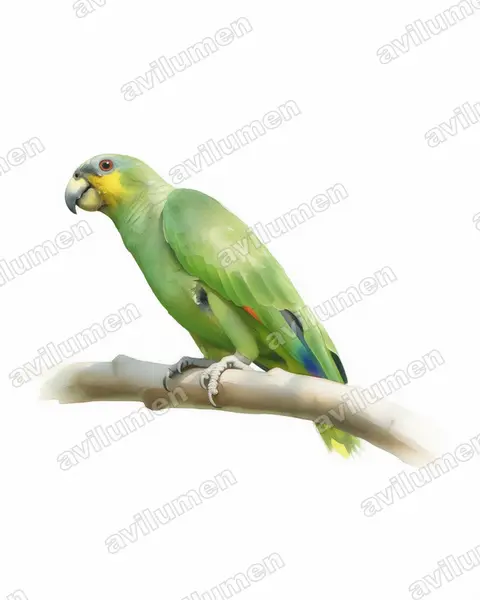
Watercolor 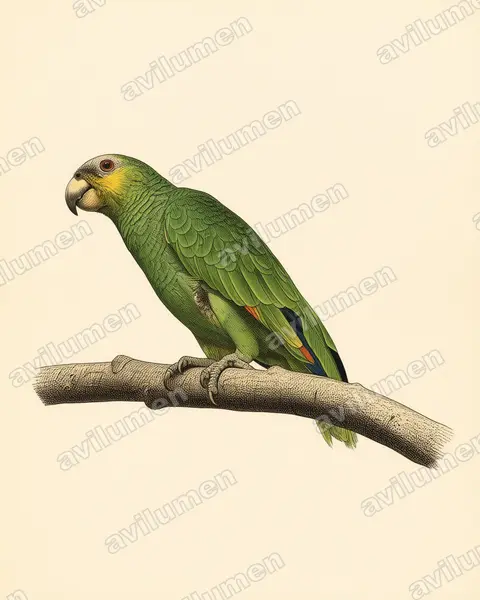
Vintage plate 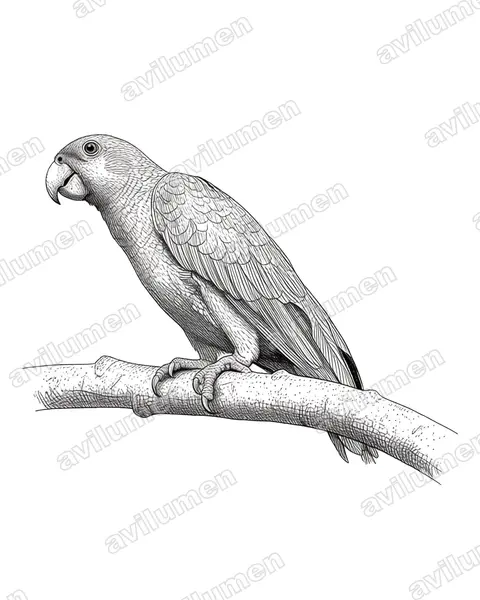
Ink 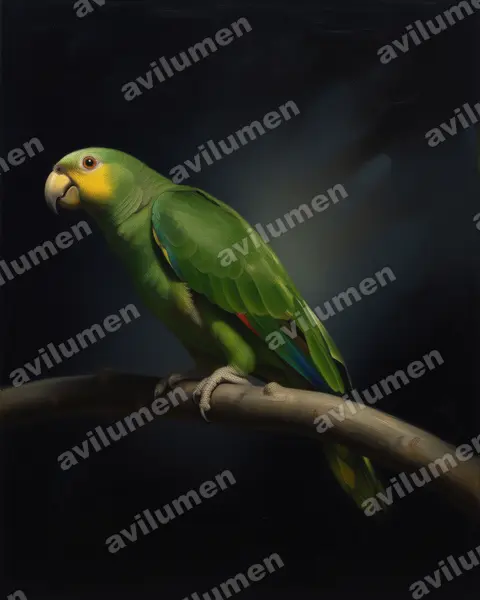
Oil 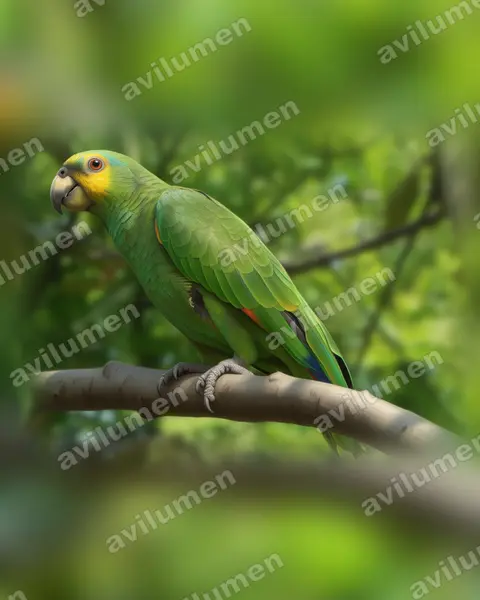
Realistic 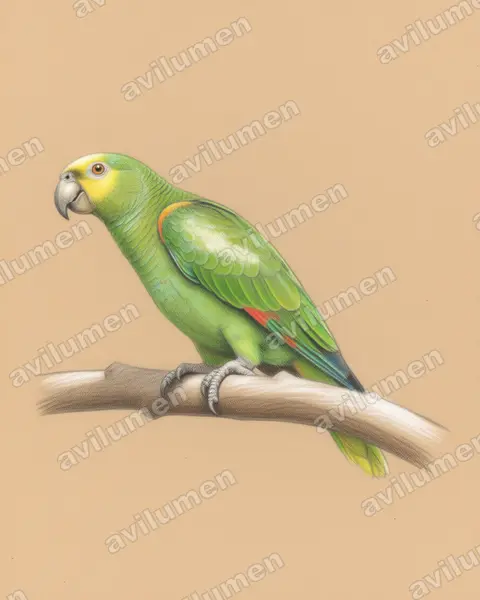
Colored pencil
Illustrations based on the photograph by Philipp Weigell (CC BY 3.0), from Wikimedia Commons.
Digital editions
HD Digital Art Pack — Orange-winged amazon
Digital download: 6 high-resolution illustrations of the Orange-winged amazon (Amazona amazonica), print-ready. This is a digital file; no animal or physical item is included.
AI Avatar — Orange-winged amazon
Generate an avatar fusing your face with the Orange-winged amazon (Amazona amazonica). Delivered digitally in 8K, watermark-free. Digital product; no animals are sold or brokered.
Instant download. No live birds are sold.
Frequently asked questions
- Is Amazona amazonica (Orange-winged amazon) endangered?
- The IUCN Red List places Amazona amazonica, commonly known as the Orange-winged amazon, in the «Least concern» category. «Least concern» means it is not currently threatened.
- Where does Amazona amazonica (Orange-winged amazon) live?
- Amazona amazonica (Orange-winged amazon) is found in Africa, Brazil, and South America.
- What family does Amazona amazonica (Orange-winged amazon) belong to?
- Amazona amazonica (Orange-winged amazon) belongs to the family Psittacidae, in the order Psittaciformes.
- What colour is Amazona amazonica (Orange-winged amazon)?
- The plumage of Amazona amazonica (Orange-winged amazon) combines these colours: Green and Orange.
More from the same family
 Near threatened
Yellow-faced Parrot
Alipiopsitta xanthops
The yellow-faced parrot, formerly also known as the yellow-faced amazon, is the only species of the genus Alipiopsitta. It is a Neotropical parrot, and was classified in the genus Amazona for many years. It is a predominantly green and yellow-plumaged bird with a yellow head. It is a semi-nomadic species found in the cerrado region of Brazil and adjacent Bolivia.
from $1.99
 Least concern
Moluccan King Parrot
Alisterus amboinensis
The Moluccan king parrot is a parrot endemic to Peleng Island, Maluku, and West Papua in Indonesia. It is sometimes referred to as the Ambon king parrot or Amboina king parrot, but this is potentially misleading, as it is found on numerous other islands than Ambon. The male and female are similar in appearance, with a predominantly red head and underparts, green wings, and blue back and tail.
from $1.99
 Least concern
Papuan King Parrot
Alisterus chloropterus
The Papuan king parrot, also known as the green-winged king parrot, is a species of parrot in the family Psittaculidae found in New Guinea. Its natural habitats are subtropical or tropical moist lowland forest and subtropical or tropical moist montane forest.
from $1.99
 Least concern
Australian King Parrot
Alisterus scapularis
The Australian king parrot is a species of parrot endemic to eastern Australia ranging from Cooktown in Queensland to Port Campbell in Victoria. Found in humid and heavily forested upland regions of the eastern portion of the continent, including eucalyptus wooded areas in and directly adjacent to subtropical and temperate rainforest. They feed on fruits and seeds gathered from trees or on the ground.
from $1.99