Puerto Rican Amazon
Amazona vittata
Avilumen editorial team ·

The Puerto Rican amazon, also known as the Puerto Rican parrot or iguaca (Taíno), is the only extant parrot endemic to Puerto Rico. Measuring 28–30 cm (11.0–11.8 in), the bird is a predominantly green parrot with a red forehead and white rings around the eyes. Belonging to the Neotropical genus Amazona, its closest relatives are believed to be the Cuban amazon and the Hispaniolan amazon.
The Puerto Rican amazon (Amazona vittata), also known as the Puerto Rican parrot (Spanish: cotorra puertorriqueña) or iguaca (Taíno), is the only extant parrot endemic to Puerto Rico. Measuring 28–30 cm (11.0–11.8 in), the bird is a predominantly green parrot with a red forehead and white rings around the eyes. Belonging to the Neotropical genus Amazona, its closest relatives are believed to be the Cuban amazon (Amazona leucocephala) and the Hispaniolan amazon (Amazona ventralis).
The Puerto Rican amazon reaches sexual maturity at between three and four years of age. It reproduces once a year and is a cavity nester. Once the female lays eggs she will remain in the nest and continuously incubate them until hatching. The chicks are fed by both parents and will fledge 60 to 65 days after hatching. This parrot's diet is varied and consists of flowers, fruits, leaves, bark and nectar obtained from the forest canopy.
The species is the only remaining native parrot to Puerto Rico and has been listed as critically endangered by the World Conservation Union since 1994. Once widespread and abundant, the population declined drastically in the 19th and early 20th centuries with the removal of most of its native habitat; the species has completely vanished from Vieques and Mona Island. Conservation efforts commenced in 1968 to save the bird from extinction.
Taxonomy and evolution
The Puerto Rican amazon was described by the French polymath Georges-Louis Leclerc, Comte de Buffon in 1780 in his Histoire Naturelle des Oiseaux. The bird was also illustrated in a hand-coloured plate engraved by François-Nicolas Martinet in the Planches Enluminées D'Histoire Naturelle which was produced under the supervision of Edme-Louis Daubenton to accompany Buffon's text. Neither the plate caption nor Buffon's description included a scientific name but in 1783 the Dutch naturalist Pieter Boddaert coined the binomial name Psittacus vittatus in his catalogue of the Planches Enluminées. Buffon mistakenly believed that his specimen had been collected in the French colony of Saint-Domingue (modern Haiti), rather than in Puerto Rico. The Puerto Rican amazon is now placed in the large Neotropical genus Amazona that was introduced by the French naturalist René Lesson in 1830. The specific epithet vittatus is Latin for "banded".
Birds in the genus Amazona are commonly known as amazons. They have also been given the generic epithet of "parrot" by the American Ornithologists' Union, and hence "Puerto Rican parrot" is an alternative common name in North America. The indigenous Taíno people called it the iguaca, an onomatopoeic name that resembled the parrots' flight call.
There are two recognized subspecies:
A. v. vittata is the nominate and only extant subspecies, inhabiting Puerto Rico and formerly nearby Vieques Island and Mona Island.
A. v. gracilipes inhabited Culebra Island and is now extinct. It is unclear whether it was substantially different from the nominate subspecies.
Evolutionary history
The various native parrot species in the West Indies are assumed to be descended from a singular group that immigrated to the Caribbean at some point. Some small species would have encountered problems traversing large bodies of water, but parrots have flight strength and various behavioral characteristics that would facilitate "over-water" dispersion. Most Caribbean bird species originate from Central, North and South America. The Amazona species found in the Caribbean are divided in two groups: five mid-sized species found in the Greater Antilles and seven large species in the Lesser Antilles. All the Greater Antillean amazons display characteristics leading to suppositions of relatedness, including predominantly green-toned color patterns and white rings around the eyes. Russello and Amato conclude that all Greater Antillean Amazona descend from Amazona albifrons with Amazona vittata, Amazona leucocephala, and Amazona ventralis constituting a complex, a cluster of species so closely related that they intergrade.
British ornithologist David Lack considered that the Puerto Rican amazon had evolved from the Hispaniolan amazon (A. ventralis) found in Hispaniola, but it has since been argued that he omitted some elements in his analysis, including the similarities found between the black-billed amazon (A. agilis) of Jamaica and the Puerto Rican amazon. Subsequent studies showed that size and color patterns were not sufficient to assess evolutionary relationships, and that patterns changed with relative ease even within members of the same species. The research concluded that the Puerto Rican amazon may share a common ancestor with the Jamaican A. agilis. However, recent phylogenetic studies show that the Puerto Rican amazon is more closely related to the Hispaniolan amazon and the Cuban amazon than to the black-billed amazon.
Description
The Puerto Rican amazon measures 28–30 cm (11.0–11.8 in) and weighs 250–300 g (8.8–10.6 oz), or 275 g (9.7 oz) on average. Although small compared to amazons in general, it is similar in size to other Greater Antilles Amazona species. Sexual dimorphism is not present. Both males and females have predominantly green plumage, though their feathers have blue edges. The primary flight feathers of the wings and the main covert feathers are dark blue. The color of the feathers on the underside varies depending on the body part: the feathers on the underside of the wings, which can be seen during flight, are bright blue; those in the tail have yellow-green tone. Their underparts are paler and yellow-tinged, their foreheads are red, and they have white ovals around the eyes. The iris is brown, the bill a horn color, and the legs yellow-tan. Aside from DNA tests, males and females can only be distinguished by behavioral differences during the breeding season. Immature birds have plumage similar to adults.
Population and distribution
The precise distribution of the Puerto Rican amazon before the arrival of Spanish colonialists is uncertain, because of a lack of contemporary records and then the extermination of the indigenous Taíno people, but the species was apparently widespread and abundant. There is also evidence the species may have inhabited other nearby islands, such as Antigua, Barbuda and the Virgin Islands. Estimates of the parrot's early numbers vary greatly. Some authorities claim that there were once more than a million individuals, while others suggest a more modest population of 100,000. During the first 150 years of Spanish rule the human population was small, and in 1650, when the population of the island was 880 people, the species was still abundant throughout the archipelago. After 1650, human habitation increased exponentially, and by the 18th century the Puerto Rican amazon population started to be affected. Heinrich Moritz Gaede, a German naturalist, declared that by 1836 the parrot population had noticeably declined. Even so, as late as 1864, British ornithologist Edward Cavendish Taylor noted that the parrots were still common near the island's capital, San Juan.
At first, human activity had not posed a significant threat to the Puerto Rican amazon. The Taíno hunted the parrot but without much effect on its population. In the past 200 years, however, many factors have led to a drastic decrease in the birds' numbers: agricultural development, the construction of roads, hydroelectric development, and the adoption of young chicks as pets. Especially during the latter half of the 19th century, most of Puerto Rico's virgin forests, a historical habitat of the species, were cleared for agricultural development, primarily for the production of sugar, cotton, corn and rice. The amazon quickly came to rely on these crops as its main food source and so became seen as a pest; local farmers repelled or hunted the bird if possible. As agriculture expanded, the amazon's habitat disappeared further and its population declined.
The species was historically found in mature or old-growth forests in Puerto Rico at all elevations, and in holes, cliffs, and other diverse habitats at lower elevations. The species could be found at medium elevations in the Guajataca State Forest (until 1910) and the Rio Abajo State Forest (until the 1920s), and at high elevations in the Carite State Forest (until the 1930s). Accounts from the early 1900s describe the parrots traveling away from the Luquillo forest and the Sierra de Cayey towards the main island's coast to find food. The species was extirpated from Culebra by the early 20th century. The karst region in the northwestern part of Puerto Rico was identified as a haven for the species. In particular, a region named Valle de las Cotorras (Valley of the Parrots), located in the region between San Sebastián and Morovis, was home to a sizable population. Eventually their natural habitat was reduced to the Cordillera Central. By 1960 they were only to be found in primary forest at the Luquillo Mountains in El Yunque National Forest. The species is currently found at elevations between 396 and 823 m (1,299 and 2,700 ft). Since the species requires mature forests with open-cavity trees for reproduction, it does not occur in dwarf and secondary forests.
By the 1950s, there were only 200 parrots in the wild, and in 1975 the population reached an absolute low of 13 individuals. Numbers then recovered, and in August 1989 there were an estimated minimum of 47 individuals. But on September 18, 1989, Hurricane Hugo struck the northeast coast of Puerto Rico inflicting heavy casualties on the remaining birds. In the aftermath of the hurricane the population was estimated at 23 individuals. In 2004, the wild population was 30–35 individuals, and the long-term trend appears to be stable albeit with some fluctuations. The current range of the species is 16 km2 (6.2 sq mi), 0.2% of what it once was. In the aftermath of Hurricane María it was estimated only 3 of the 50 parrots survived in the wild, representing a loss of 90%. Recovery programs continue and as of 2021 the total population is around 500 including those in captivity and in the wild.
Behavior
The Puerto Rican amazon is diurnal, typically beginning its day half an hour after sunrise. It is generally secretive when inside its nest, using its green plumage as camouflage. In contrast, it may be vocal and noisy when outside the nest. Upon taking flight, its color pattern provides some contrast to the forest. The flight mechanism of this species is similar to the one found in other amazons, and involves strokes below the body axis, unlike most birds whose wings flow above their bodies in flight. Amazons can fly moderately fast, reaching a top speed of approximately 30 km/h (19 mph), and are fairly agile when evading predators in mid-air. When in search of food, the parrots group in pairs. Couples and their fledged young display a tendency to stay together. The amazon makes two flight calls, a take-off squawk which consist of a pattern of long squawks, and a loud "bugle", commonly used in flight and which may have several meanings depending on the circumstances when it is used.
Diet
Like almost all amazons, the Puerto Rican amazon is a herbivore. Its diet consists of flowers, fruits, leaves, bark and nectar obtained from the forest's canopy. The species has been recorded to consume more than 60 different materials, although its diet was historically more varied due to its larger range. Among the items it consumes are the pericarp of the seeds of sierran palm (Prestoea montana), tabonuco (Dacryodes excelsa), and negra lora (Matayba domingensis); the fruits of bejuco de rana (Marcgravia sintenisii), camasey (Miconia sintenisii), cupey de altura (Clusia gundlachii), and palo de cruz (Rheedia portoricensis); the flowers of bejuco de rana, achiotillo (Alchornea latifolia), and Piptocarpha tetrantha; the leaves and twigs of cupeillo (Clusia grisebachiana), laurel magnolia (Magnolia splendens), caimitillo verde (Micropholis garciniaefolia), and Piptocarpha tetrantha; the bark of bejuco de rana, cupeillo, and common cachimbo (Psychotria berteriana); and the buds of cuaba (Inga vera). It normally selects the fruits positioned directly in front of its eyes, picking them one at a time with some rare exceptions. When feeding, it uses a foot to pick up the food. The amazon feeds in a slow, paused manner taking 8–60 seconds to consume separate items.
Breeding
The Puerto Rican amazon usually mates for life, with pairs only changing mates if one bird perishes or abandons the nest. A male may abandon the female if the latter is injured, re-mating with a more "physically perfect" subject. The pairing process is unknown; however, new pairs tend to participate in mutual mating dances characterized by coordinated bows, partial extension of the wings and full tail expansion.
The Puerto Rican amazon is a secondary cavity nester, nesting in tree trunk cavities, both naturally occurring and excavated by other species. It prefers to nest in Palo colorado trees (Cyrilla racemiflora), but uses other trees, including the laurel sabino (Magnolia splendens) and tabonuco (Dacryodes excelsa), to a lesser extent. These trees are mature cavity-forming trees which provide protection against predators and the entry of water. Recently, the species has also nested in artificial wooden boxes designed as part of the recovery plan for the species. Nest height varies from 7–15 m (23–49 ft) above ground. The male usually leads the search for nest sites, although the final decision seems to be taken by the female. Once a site is selected, the pair will spend some time inspecting and cleaning it. No lining material is added to the nest.
Text adapted from Wikipedia · CC BY-SA 4.0
Distribution

Taxonomy
- Order
- Psittaciformes
- Family
- Psittacidae
- Genus
- Amazona
- Conservation status
- Critically endangered
Listen to its call
No recording yet
Care guide
Amazon, African Grey and Eclectus Parrot Care Guide
How to care for Amazon parrots, African greys, eclectus and pionus: diet, cage setup, health, behavior and CITES requirements for medium and large parrots.
Read the guide →Illustration gallery
6 illustrations of Amazona vittata (Puerto Rican Amazon) in different styles, true to its real plumage. Shown watermarked; the art pack includes the high-resolution originals, ready to print.
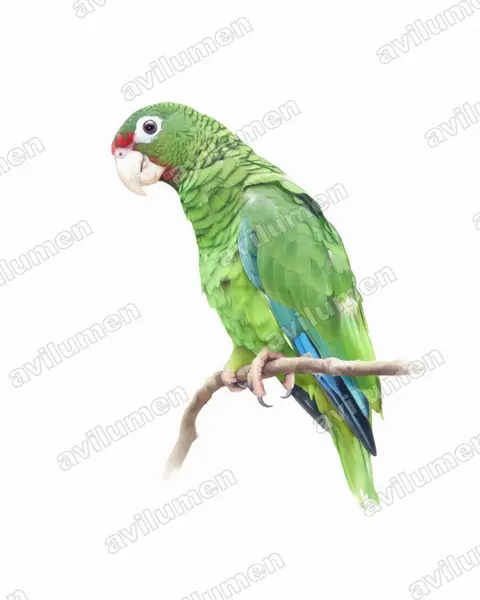
Watercolor 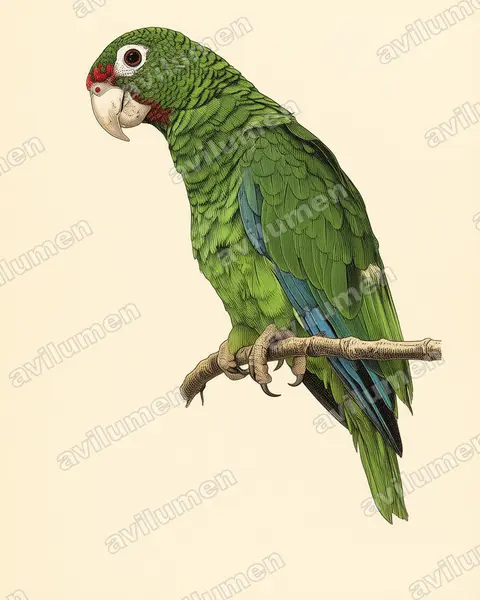
Vintage plate 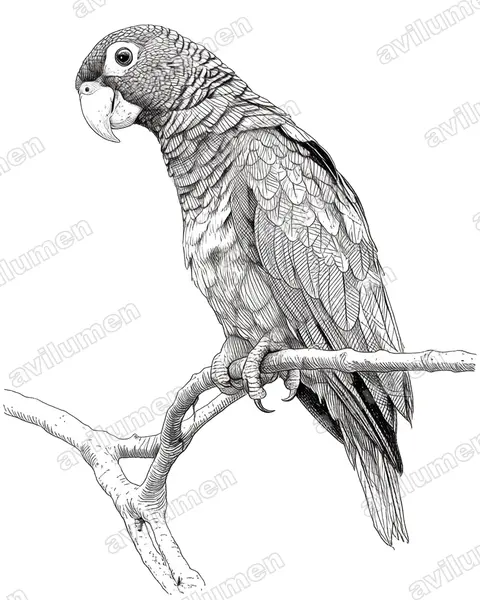
Ink 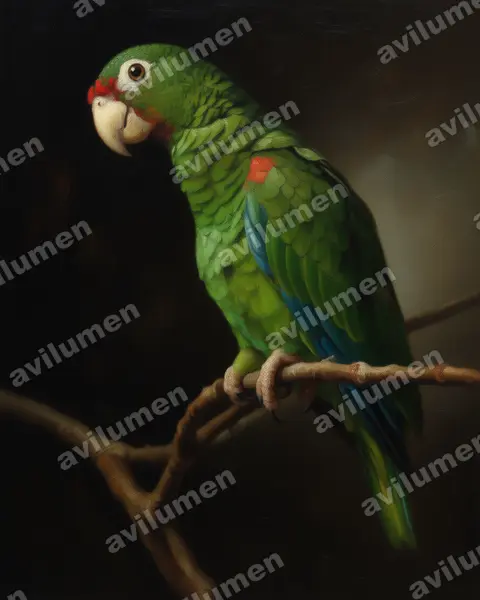
Oil 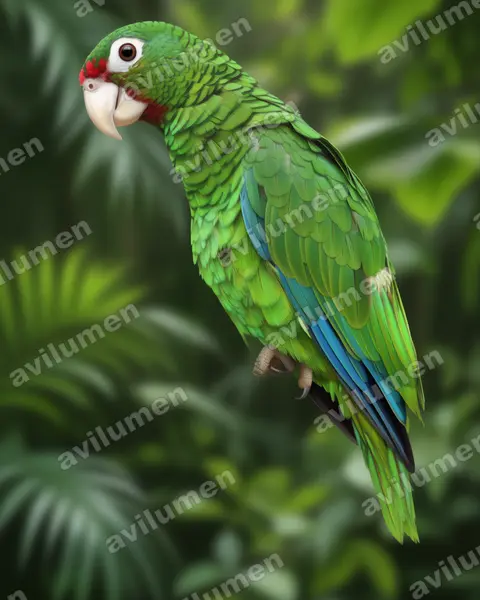
Realistic 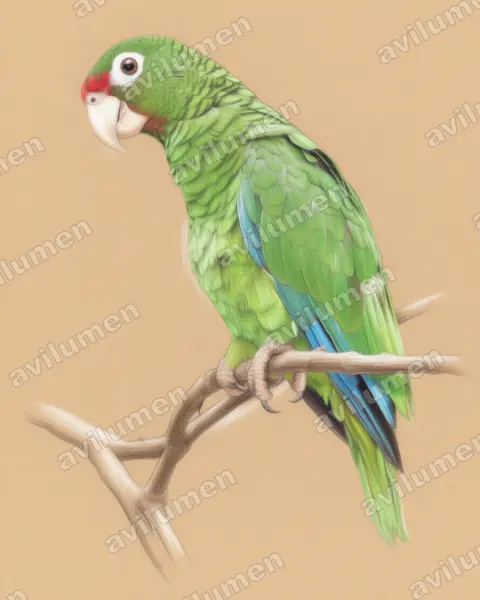
Colored pencil
Illustrations based on the photograph by Tom MacKenzie (Public domain), from Wikimedia Commons.
Digital editions
HD Digital Art Pack — Puerto Rican Amazon
Digital download: 6 high-resolution illustrations of the Puerto Rican Amazon (Amazona vittata), print-ready. This is a digital file; no animal or physical item is included.
AI Avatar — Puerto Rican Amazon
Generate an avatar fusing your face with the Puerto Rican Amazon (Amazona vittata). Delivered digitally in 8K, watermark-free. Digital product; no animals are sold or brokered.
Instant download. No live birds are sold.
Frequently asked questions
- Is Amazona vittata (Puerto Rican Amazon) endangered?
- The IUCN Red List places Amazona vittata, commonly known as the Puerto Rican Amazon, in the «Critically endangered» category. «Critically endangered» is the highest threat level before extinction.
- What family does Amazona vittata (Puerto Rican Amazon) belong to?
- Amazona vittata (Puerto Rican Amazon) belongs to the family Psittacidae, in the order Psittaciformes.
- What colour is Amazona vittata (Puerto Rican Amazon)?
- The plumage of Amazona vittata (Puerto Rican Amazon) combines these colours: Green, Red, and White.
More from the same family
 Near threatened
Yellow-faced Parrot
Alipiopsitta xanthops
The yellow-faced parrot, formerly also known as the yellow-faced amazon, is the only species of the genus Alipiopsitta. It is a Neotropical parrot, and was classified in the genus Amazona for many years. It is a predominantly green and yellow-plumaged bird with a yellow head. It is a semi-nomadic species found in the cerrado region of Brazil and adjacent Bolivia.
from $1.99
 Least concern
Moluccan King Parrot
Alisterus amboinensis
The Moluccan king parrot is a parrot endemic to Peleng Island, Maluku, and West Papua in Indonesia. It is sometimes referred to as the Ambon king parrot or Amboina king parrot, but this is potentially misleading, as it is found on numerous other islands than Ambon. The male and female are similar in appearance, with a predominantly red head and underparts, green wings, and blue back and tail.
from $1.99
 Least concern
Papuan King Parrot
Alisterus chloropterus
The Papuan king parrot, also known as the green-winged king parrot, is a species of parrot in the family Psittaculidae found in New Guinea. Its natural habitats are subtropical or tropical moist lowland forest and subtropical or tropical moist montane forest.
from $1.99
 Least concern
Australian King Parrot
Alisterus scapularis
The Australian king parrot is a species of parrot endemic to eastern Australia ranging from Cooktown in Queensland to Port Campbell in Victoria. Found in humid and heavily forested upland regions of the eastern portion of the continent, including eucalyptus wooded areas in and directly adjacent to subtropical and temperate rainforest. They feed on fruits and seeds gathered from trees or on the ground.
from $1.99